Table of Contents
This analysis is brought to you by Inkwood Research, a leading market intelligence firm specializing in battery testing equipment technologies, electric vehicle power systems, and energy storage validation methodologies. Based on our proprietary research analyzing global battery manufacturers, automotive electrification programs, and testing laboratory partnerships across North America, Europe, and Asia-Pacific, we deliver actionable insights that empower strategic decision-making for enterprises navigating the battery testing equipment market expansion and technological evolution.
TLDR
State of Charge (SOC) measures remaining battery energy as a percentage, while State of Health (SOH) evaluates long-term battery condition compared to original capacity. Understanding these critical metrics is essential for optimizing battery testing equipment market applications across electric vehicles, renewable energy storage, and consumer electronics. Accurate SOC prevents unexpected power failures, whereas SOH monitoring predicts replacement timing. Together, these measurements drive innovation in the global battery testing equipment market, supporting manufacturers in delivering safer, more reliable battery systems worldwide.
Battery engineers, automotive OEM decision-makers, energy storage system designers, testing laboratory managers, and quality assurance professionals will benefit from this comprehensive analysis. Additionally, product strategists evaluating battery management systems, research scientists developing next-generation chemistries, and investment analysts tracking the North America battery testing equipment market and the Europe battery testing equipment market will gain actionable insights into critical battery performance metrics.
Understanding Critical Battery Performance Metrics
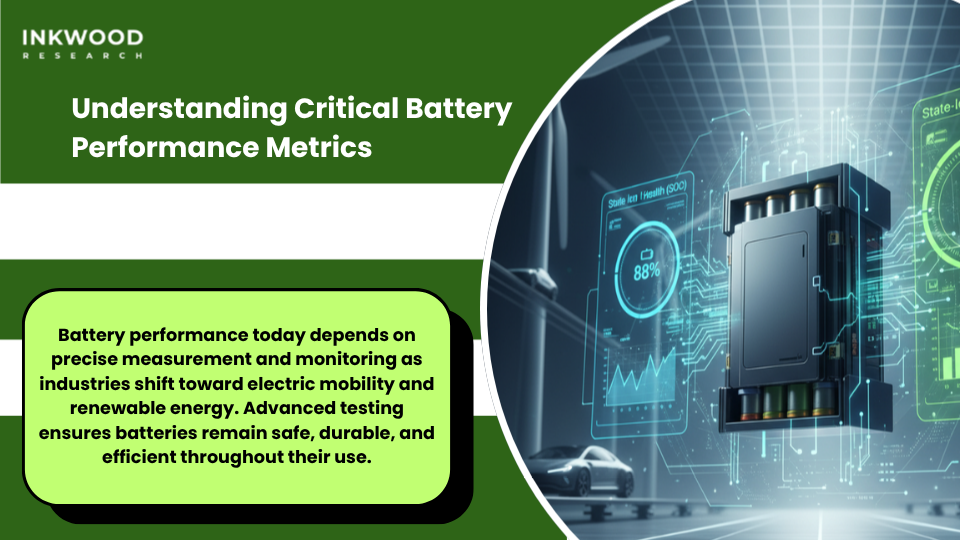
Battery performance measurement has become increasingly sophisticated as electrification transforms global industries. Two fundamental metrics dominate quality assurance protocols: State of Charge and State of Health. These parameters drive validation workflows throughout the battery testing equipment market, enabling manufacturers to ensure safety, reliability, and longevity across diverse applications.
Why Do These Metrics Matter Today?
Electric vehicles now represent over 35% of new car purchases worldwide, according to industry forecasts. This surge creates unprecedented demand for accurate battery diagnostics. Meanwhile, renewable energy installations require grid-scale storage systems that maintain performance across thousands of charge-discharge cycles. Consequently, testing equipment must deliver precision measurements that inform critical operational decisions.
The Testing Equipment Revolution
According to our analysis, the global battery testing equipment market reached $633.05 million in 2025 and projects growth to $897.32 million by 2032. This expansion reflects stricter regulatory requirements and technological complexity. Moreover, advanced testing platforms now integrate artificial intelligence algorithms that analyze vast datasets, predicting battery lifespan with remarkable accuracy.
State of Charge: Real-Time Energy Monitoring
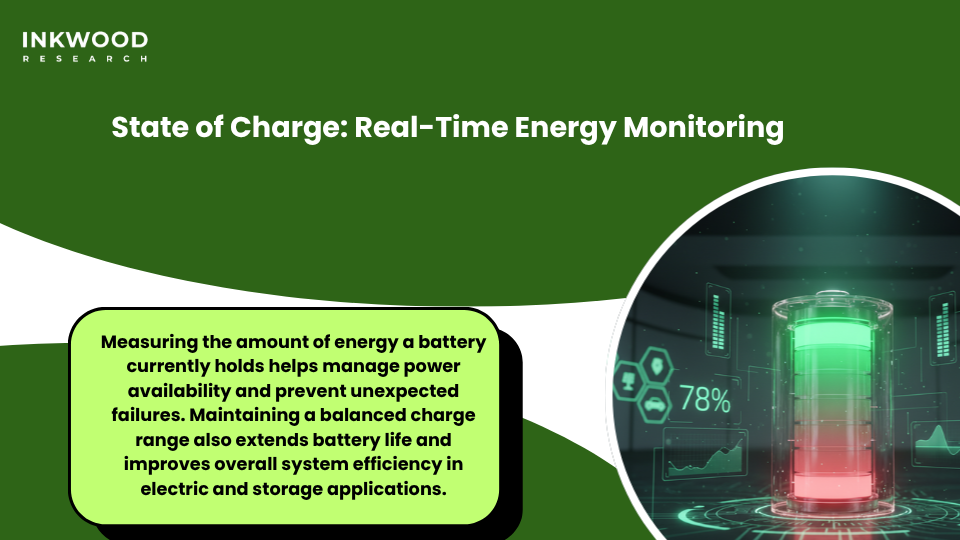
State of Charge represents the percentage of energy remaining in a battery relative to maximum capacity. Think of it as a sophisticated fuel gauge for electrochemical systems. When a battery displays 100% SOC, it holds maximum available energy. Conversely, 0% indicates complete depletion.
How Does SOC Measurement Work?
Testing equipment employs multiple methodologies to determine SOC accurately. Voltage measurement provides the simplest approach, correlating open-circuit voltage with charge state. However, this technique requires rest periods and varies across battery chemistries. Coulomb counting offers superior precision by integrating current flow over time. Advanced algorithms compensate for temperature effects and aging factors that influence measurement accuracy.
Optimal Operating Windows
Maintaining SOC between 20-80% significantly extends battery lifespan across lithium-ion chemistries. Deep discharges stress electrochemical interfaces, accelerating degradation mechanisms. Similarly, prolonged high-voltage exposure damages cathode materials. Equipment within the North America battery testing equipment market increasingly incorporates automated protocols that enforce these operating boundaries during validation cycles.
Industrial Applications
Electric vehicle manufacturers rely on real-time SOC data for range estimation and driver communication. Energy storage systems utilize SOC information to optimize charge-discharge scheduling, maximizing revenue from electricity arbitrage. Further, consumer electronics implement SOC algorithms that balance performance with longevity, automatically adjusting charging behavior based on usage patterns.
State of Health: Long-Term Battery Condition Assessment
State of Health quantifies battery degradation by comparing current maximum capacity against original specifications. A fresh battery exhibits 100% SOH, while aged cells demonstrate progressively lower values. Further, industry standards typically mandate replacement when SOH drops below 70-80%, depending on application criticality.
Degradation Mechanisms and Detection
Batteries age through multiple pathways that testing equipment must identify. Capacity fade results from active material loss and electrolyte decomposition. Impedance growth reflects lithium plating and solid-electrolyte interphase thickening. According to our research, the Europe battery testing equipment market emphasizes SOH validation to comply with the EU Battery Regulation, which mandates digital battery passports containing verified performance data.
Measurement Approaches
Capacity testing provides direct SOH assessment by fully charging and discharging batteries while measuring energy throughput. Internal resistance analysis offers faster evaluation, correlating impedance increases with aging. Furthermore, electrochemical impedance spectroscopy enables detailed diagnosis, identifying specific degradation mechanisms through frequency-domain analysis. Modern testing platforms integrate these techniques, providing comprehensive SOH characterization within hours rather than days.
Predictive Maintenance Benefits
Accurate SOH monitoring enables proactive replacement strategies that prevent unexpected failures. Fleet operators schedule maintenance based on actual battery condition rather than arbitrary timelines. Additionally, grid storage operators optimize asset utilization by retiring batteries to less-demanding second-life applications before complete failure. This data-driven approach reduces operational costs while improving system reliability.
Key Differences Between SOC and SOH
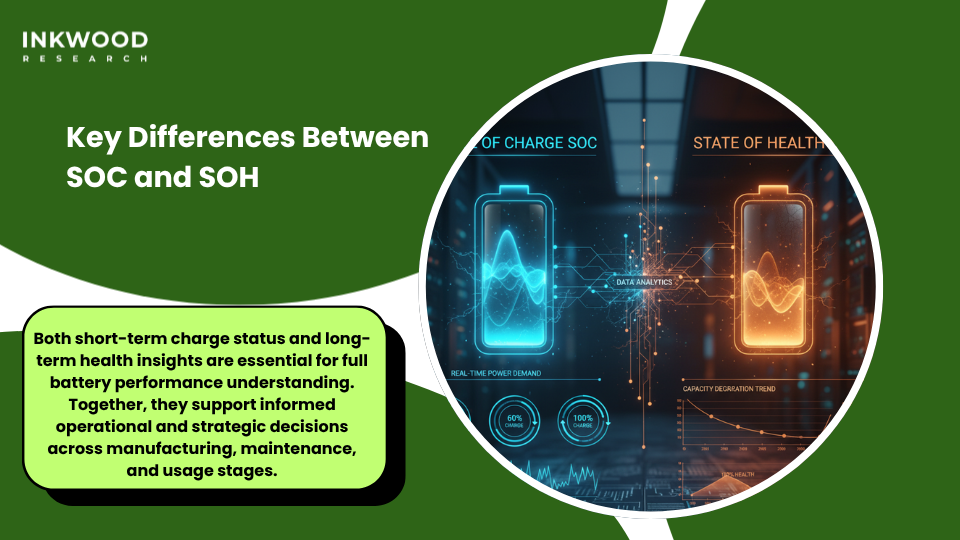
While both metrics evaluate battery condition, they serve distinct purposes within quality assurance workflows. Understanding these differences enables effective testing strategy development.
Temporal Characteristics
SOC fluctuates continuously during normal operation, responding immediately to charging and discharging activities. Conversely, SOH changes gradually over months and years as degradation accumulates. Equipment in the battery testing equipment market must therefore provide real-time SOC tracking alongside periodic SOH assessments that capture long-term trends.
Measurement Complexity
SOC determination relies on straightforward voltage and current monitoring. However, SOH evaluation requires sophisticated test protocols spanning multiple charge-discharge cycles. Temperature chambers, precision power supplies, and high-resolution data acquisition systems constitute the infrastructure supporting comprehensive SOH characterization.
Decision-Making Applications
Operators use SOC information for immediate tactical decisions. Should the battery charge now? Can the system complete its current task? Meanwhile, SOH data informs strategic planning. When should procurement initiate replacement orders? Plus, which batteries deserve refurbishment investment? These complementary perspectives enable optimized asset management throughout battery lifecycles.

Modern battery validation demands sophisticated instrumentation capable of sub-millisecond data acquisition and sub-milliohm resistance measurement. The global battery testing equipment market has responded with increasingly capable platforms.
- Multi-Channel Cyclers
High-throughput testing requires simultaneous evaluation of dozens or hundreds of cells. Multi-channel cyclers from industry leaders provide independent control of each test channel while sharing centralized power infrastructure. Additionally, regenerative designs recover discharge energy, reducing facility electricity consumption by 40-60%. These systems enable gigafactory quality control where production volumes demand rapid cell qualification.
- Environmental Simulation
Temperature profoundly influences battery behavior, necessitating climate-controlled testing environments. Chambers maintaining -40°C to +85°C validate performance across automotive operating ranges. In addition, thermal cycling protocols simulate years of seasonal variation within weeks, accelerating SOH degradation studies. Moreover, according to our market analysis, Canadian facilities particularly emphasize cold-weather testing capabilities given their harsh winter conditions.
- Impedance Spectroscopy Integration
Electrochemical impedance spectroscopy has migrated from specialized laboratory equipment into mainstream test platforms. Real-time impedance tracking identifies subtle degradation signatures invisible to conventional voltage-current monitoring. Lithium plating detection prevents catastrophic failures before they occur. Consequently, these capabilities position impedance-enabled systems as premium offerings within the battery testing equipment market.
- Cloud-Based Analytics Platforms
Data management challenges grow exponentially with test channel proliferation. Cloud connectivity enables centralized monitoring of globally distributed testing facilities. Further, machine learning algorithms detect anomalous patterns correlating with manufacturing process variations. Predictive models forecast SOH trajectories, optimizing test schedules to balance accuracy with throughput.
Market Implications for Battery Testing Equipment

Regulatory mandates and technological advancement drive sustained investment in battery testing infrastructure. Understanding market dynamics helps stakeholders position their technology strategies effectively.
North American Market Dynamics
The North America battery testing equipment market reached $156.77 million in 2025, progressing toward $215.54 million by 2032. Federal regulations, including FMVSS No. 305a, effective February 2025, establish comprehensive electric vehicle battery safety requirements. Moreover, these standards mandate rigorous SOC and SOH validation throughout product lifecycles. Consequently, automotive manufacturers invest heavily in testing capabilities supporting regulatory compliance.
European Market Evolution
The Europe battery testing equipment market demonstrated $137.17 million valuation in 2025, projecting $187.45 million by 2032. The EU Battery Regulation, enforced in February 2024, requires digital battery passports containing verified SOC and SOH data. Accordingly, carbon footprint declarations necessitate site-specific testing documentation. These unprecedented compliance burdens create sustained equipment demand across European manufacturing facilities.
Asia-Pacific Leadership
China dominates the global battery testing equipment market through massive production capacity and aggressive electrification policies. Manufacturers, including CATL and BYD, require extensive quality assurance infrastructure supporting gigafactory operations. Furthermore, government mandates stipulate comprehensive safety certification before market entry. Consequently, this regulatory framework ensures robust testing equipment adoption throughout Asia-Pacific battery supply chains.
Competitive Landscape and Industry Leaders

The battery testing equipment market features established instrumentation specialists alongside emerging technology providers. Understanding competitive positioning helps procurement teams evaluate supplier capabilities.
Arbin Instruments
Headquartered in College Station, Texas, Arbin Instruments operates a 65,000-square-foot manufacturing facility producing high-precision test equipment. The company’s Laboratory Battery Tester (LBT) series delivers measurement resolution down to 100 parts per million, addressing rigorous accuracy requirements for SOH characterization. Meanwhile, Regenerative Battery Tester (RBT) configurations provide solutions for electric vehicle pack testing with voltage capabilities reaching 1,500 volts.
Chroma Systems Solutions
Chroma Systems Solutions specializes in modular testing platforms serving applications from cell-level validation through complete pack evaluation. Their systems integrate seamlessly with environmental chambers and battery management system emulators. Further, automated test sequence programming accelerates validation workflows while ensuring consistent SOC cycling protocols across product generations.
Chauvin Arnoux
French manufacturer Chauvin Arnoux brings over a century of electrical measurement expertise to battery testing markets. The company operates three production facilities in Normandy, handling complete manufacturing processes from mechanical component production through final calibration. Aligning with this, portable testing instruments enable field SOC assessments for telecommunications infrastructure and industrial backup power systems.
Megger Group Limited
Megger Group Limited focuses on electrical test equipment serving the utility, industrial, and automotive sectors. Additionally, battery testing solutions emphasize rugged portable designs suitable for field deployment. Conductance testing technology provides rapid SOH screening without full discharge cycles. This, in turn, enables maintenance teams to assess large battery banks efficiently.
Midtronics Inc
Midtronics pioneered conductance-based battery testing, translating laboratory impedance spectroscopy into handheld diagnostic tools. Further, their instruments dominate automotive service centers, enabling technicians to evaluate starting battery SOH within seconds. Plus, cloud connectivity uploads test results automatically, creating fleet-wide battery health databases supporting predictive maintenance programs.
Latest Product Developments and Innovations

Technology providers continuously enhance testing capabilities, responding to emerging battery chemistries and stringent performance requirements. Accordingly, recent developments demonstrate industry innovation velocity.
UL Solutions European Expansion
In May 2025, UL Solutions opened its Europe Advanced Battery Testing Laboratory in Aachen, Germany, significantly expanding testing capacity for electric vehicle batteries and large-scale energy storage systems. Moreover, the facility replaces a smaller leased operation, providing comprehensive safety and functional evaluation services. This investment reflects growing European demand for third-party SOC and SOH certification supporting regulatory compliance.
GÖPEL Electronic Modular Platform
GÖPEL electronic introduced a modular high-voltage battery test bench in June 2025, specifically designed for comprehensive electric vehicle battery pack evaluation. In all, the system addresses surging demand for specialized testing solutions capable of validating pack-level SOH while maintaining cell-level SOC monitoring. Modular architecture enables capacity expansion matching production growth.
Arbin Regenerative Technology
Arbin Instruments continues to develop its Regenerative Battery Test (RBT) Series for high-current cell testing applications. Also, energy recovery features reduce operational costs while enabling extended SOC cycling protocols essential for accelerated lifetime studies. These systems appeal to research institutions and automotive manufacturers conducting next-generation chemistry development programs.
BioLogic BCS-900 Launch
BioLogic’s 2024 introduction of the BCS-900 added 10A/6V modules optimized for research benches conducting fundamental electrochemistry studies. Moreover, the scalable backplane architecture accommodates expansion to high-volume pack testing lines, illustrating multi-segment product strategies. Real-time electrochemical impedance spectroscopy capabilities enable continuous SOH monitoring throughout charge-discharge cycles.
ReJoule Machine Learning Integration
California-based ReJoule embedded machine learning models inside portable graders that predict SOH within three minutes, dramatically reducing screening costs for second-life battery applications. Consequently, this innovation addresses growing circular economy initiatives where retired electric vehicle batteries find new service in stationary energy storage systems. Moreover, rapid SOH assessment enables the economic viability of battery repurposing programs.
Key Takeaways
- SOC measures remaining energy percentage, while SOH evaluates long-term battery condition relative to original specifications
- Maintaining SOC between 20-80% significantly extends battery lifespan across lithium-ion applications
- The global battery testing equipment market projects growth from $633.05 million (2025) to $897.32 million (2032)
- Regulatory mandates, including FMVSS No. 305a and the EU Battery Regulation, drive testing equipment adoption
- Multi-channel regenerative cyclers and integrated impedance spectroscopy represent current technology frontiers
- Major manufacturers, including Arbin Instruments, Chroma Systems, and BioLogic, continuously enhance testing capabilities
- Cloud-based analytics and machine learning optimize SOC/SOH prediction accuracy and testing efficiency
- Regional markets demonstrate distinct growth drivers: automotive safety in North America, sustainability mandates in Europe, and production scale in Asia-Pacific
Conclusion
State of Charge and State of Health represent foundational metrics enabling safe, reliable battery system deployment across transportation, energy, and consumer electronics sectors. As the battery testing equipment market advances, measurement precision improves while testing throughput accelerates. Regulatory frameworks worldwide increasingly mandate comprehensive SOC and SOH validation, ensuring sustained equipment demand.
Organizations navigating battery electrification initiatives must invest in testing infrastructure that matches their application requirements. Whether validating gigafactory production quality or assessing second-life battery viability, accurate SOC and SOH measurement remains non-negotiable. Additionally, technology providers continue innovating, delivering platforms that balance laboratory precision with industrial throughput demands.
Inkwood Research provides comprehensive market intelligence supporting strategic decision-making throughout the battery testing equipment ecosystem. Our analysis helps manufacturers, testing laboratories, and end-users understand technology trends, competitive dynamics, and regulatory evolution.
Contact our team right away to discuss how customized research deliverables can inform your battery testing strategy and equipment procurement decisions.
Frequently Asked Questions (FAQs)
SOC measures how much energy remains available right now (like a fuel gauge), while SOH evaluates overall battery condition compared to when it was new (like a health checkup). SOC changes constantly during use, whereas SOH degrades gradually over months and years.
For lithium-ion batteries in electric vehicles, quarterly SOH assessments provide adequate monitoring. High-usage applications like fleet vehicles benefit from monthly checks. Energy storage systems typically require semi-annual SOH validation to detect degradation trends before capacity significantly declines.
Physical degradation is irreversible, but mildly degraded batteries may recover up to 5% capacity through calibration cycles and proper storage at 50% SOC. However, genuine SOH improvement requires replacing degraded cells. Proper operational practices slow future degradation but cannot reverse existing damage.