
Table of Contents
TLDR
The battery market surges toward $472.59 billion by 2032, driven by explosive EV battery market expansion and renewable energy demands. The lithium-ion battery market size dominates with a notable share, while solid state battery market developments promise revolutionary performance. Battery market growth accelerates at 16.35% CAGR through 2032. Moreover, EV battery market share expansion, battery market 2024 innovations, and lead acid battery market resilience create unprecedented opportunities across automotive, grid storage, and consumer electronics applications.
C-suite executives planning electrification strategies, investment analysts evaluating energy storage opportunities, automotive industry decision-makers implementing EV roadmaps, renewable energy developers designing grid-scale storage projects, battery technology researchers exploring next-generation chemistries, supply chain managers navigating critical mineral sourcing, and product strategists positioning sustainable transportation solutions will discover actionable intelligence for capturing market opportunities.
Global Battery Market Landscape: Unprecedented Growth Trajectory
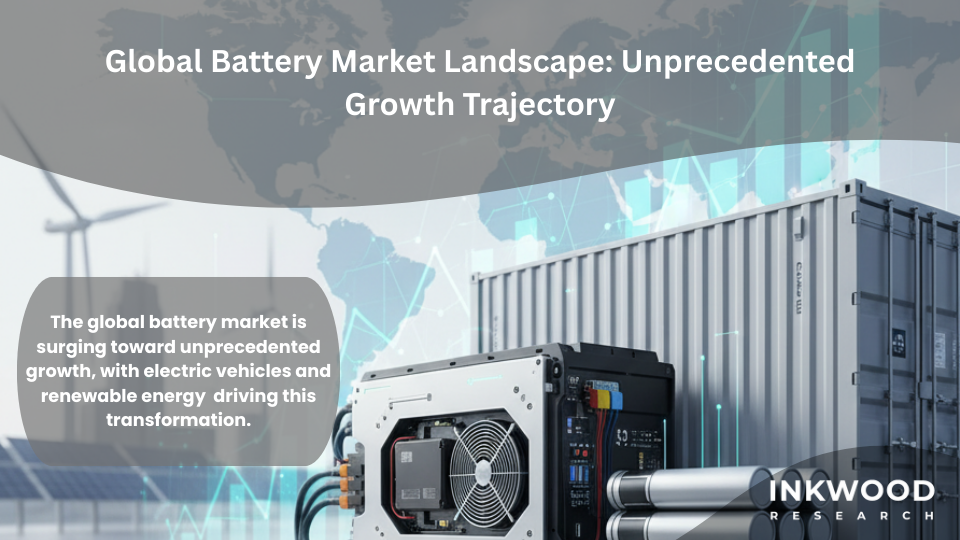
Picture this: every three seconds, another electric vehicle rolls off production lines worldwide, each demanding cutting-edge battery technology. According to Inkwood Research, the battery market size reached $163.73 billion in 2025. Meanwhile, projections reveal staggering expansion toward $472.59 billion by 2032. Battery market growth accelerates at a 16.35% CAGR during the forecast period. Furthermore, this explosive trajectory reflects converging forces: automotive electrification, renewable energy integration, and consumer electronics proliferation.
Understanding the Battery Market Value Proposition
Battery market value extends beyond mere numbers. These electrochemical powerhouses convert chemical energy into electrical power through sophisticated redox reactions. Modern battery technologies encompass diverse chemistries serving critical functions. Automotive propulsion systems demand high energy density. Consumer electronics require compact, lightweight solutions. Grid-scale storage infrastructure enables renewable energy management. Industrial applications prioritize durability and reliability.
Consequently, the battery market 2024 dynamics reveal unprecedented technological advancement. Today’s landscape features sophisticated lithium ion battery market variants delivering exceptional energy density. Established lead acid battery market solutions provide cost-effective reliability. Emerging technologies like sodium ion battery market offerings and solid state battery market chemistries promise transformative improvements. The U.S. Energy Information Administration confirms utility-scale battery storage capacity exceeded 26 gigawatts in 2024.
Primary Growth Catalysts Reshaping the Battery Market Outlook
Electric vehicle adoption catalyzes unprecedented battery market growth worldwide. Governments mandate aggressive electrification timelines through legislative frameworks. Consumers increasingly embrace zero-emission transportation alternatives. Renewable energy integration requires massive grid-scale storage capacity. Solar and wind power generation create intermittent supply patterns. Therefore, sophisticated energy storage systems become essential infrastructure components.
Consumer electronics proliferation drives relentless portable battery demand. Smartphones, laptops, wearables, and expanding IoT device ecosystems require reliable power sources. Additionally, government policies supporting the clean energy transition accelerate market expansion. Tax credit programs incentivize domestic battery manufacturing investments. Carbon emission regulations tighten globally, forcing comprehensive electrification solutions. Consequently, battery manufacturers benefit from unprecedented policy support across developed and emerging markets
Battery Technology Evolution: From Lithium-Ion to Solid-State Batteries
What happens when decades of incremental innovation suddenly accelerate toward revolutionary breakthroughs? Lithium ion battery market technology dominates today’s energy storage landscape. However, next-generation chemistries promise quantum leaps in performance, safety, and sustainability.
Lithium-Ion Battery Market Size and Dominance
The lithium ion battery market size represents 44% of the total battery market share. These rechargeable powerhouses deliver energy densities ranging from 150-300 watt-hours per kilogram. Traditional lead acid battery market solutions offer only 30-50 Wh/kg by comparison. This performance gap explains lithium-ion’s dominance across automotive, consumer electronics, and grid storage applications.
Nevertheless, the lithium battery market evolution continues rapidly. LFP (lithium iron phosphate) chemistry captured the majority of the EV battery market share in 2024. Tesla integrates LFP batteries into standard-range Model 3 and Model Y variants. Ford invests $3.5 billion in Michigan LFP manufacturing using licensed CATL technology. European automakers, including Volkswagen and Stellantis, adopt LFP for entry-level models. Compelling cost competitiveness drives this transformation. Elimination of scarce cobalt dependency reduces supply chain vulnerabilities.
Solid State Battery Market: The Holy Grail Technology
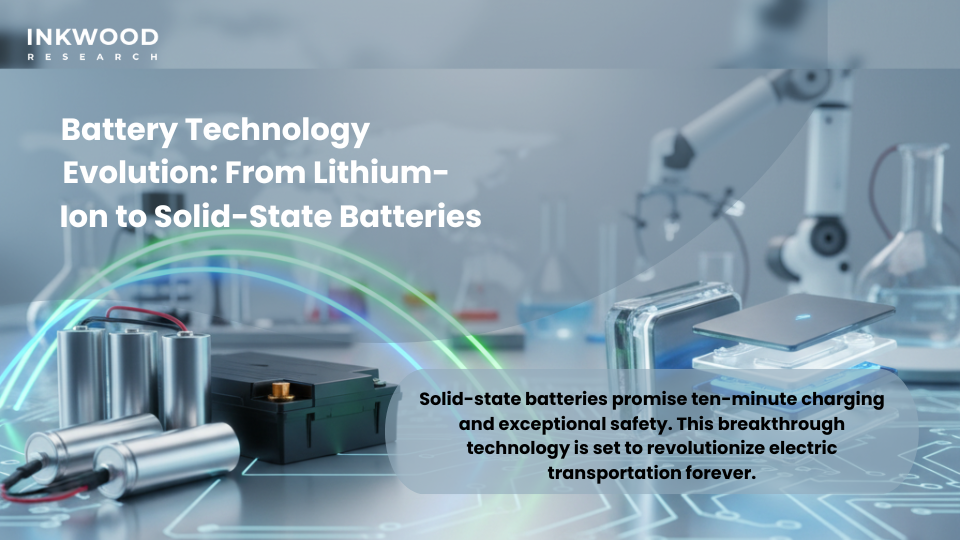
Imagine batteries charging in 10 minutes while delivering 620-mile driving ranges. Solid state battery market development accelerates dramatically toward commercial production. Major automakers target near-term launches despite persistent technical challenges. Toyota announced partnerships achieving mass production capacity by 2027-2028. These revolutionary batteries promise over 620 miles of range with 10-minute fast charging.
Similarly, Nissan targets fiscal year 2028 commercialization using sulfur-based solid electrolytes. Honda unveiled demonstration production lines in November 2024. Manufacturing solid electrolytes at an industrial scale remains technically challenging. Interface stability between solid electrolytes and electrode materials presents engineering obstacles. Capital requirements substantially exceed conventional battery production investments. However, performance advantages justify aggressive development timelines.
Mercedes-Benz began testing production EVs powered by solid-state batteries in February 2025. Toyota aims to launch the world’s first all-solid-state battery EV by 2027. Sumitomo Metal Mining plans cathode material supply beginning in 2028. Nevertheless, cost competitiveness with established technologies remains uncertain. Initial applications will likely focus on premium vehicle segments.
EV Battery Market Dominance: Automotive Transformation Accelerates
Traditional automakers face an existential question: adapt or perish? EV battery market expansion fundamentally reshapes automotive manufacturing and energy consumption patterns. Electric vehicle adoption surges globally, creating insatiable demand for advanced battery systems.
EV Battery Market Share 2024 Dynamics
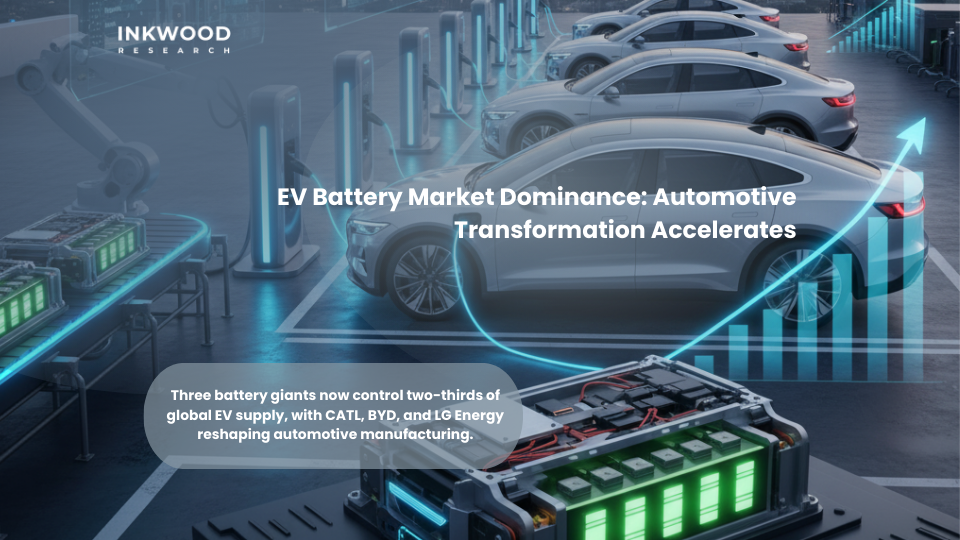
EV battery market share 2024 reveals fierce competition among global suppliers. CATL maintained commanding leadership with a 37.9% market position. BYD captured a 17.2% share with aggressive expansion strategies. LG Energy Solution secured third position with 10.8% market presence. These three giants collectively control approximately 66% of global supply.
Furthermore, the EV battery market size reached 894.4 GWh in 2024, reflecting 27.2% year-over-year growth. Tesla, BMW, Mercedes-Benz, and Volkswagen rely heavily on CATL batteries. BYD not only produces batteries but also manufactures its own EVs. The company rapidly secures market share beyond the Chinese domestic markets. Asian and European expansion accelerates through aggressive pricing strategies.
Automotive Applications Driving Battery Market 2030 Projections
Global EV sales exceeded 13.5 million units in 2023, representing 34% year-over-year growth, reaching 40 million total electric cars. U.S. battery capacity increased 66% in 2024, according to government data. Generators added 10.4 GW of new storage capacity, second only to solar installations.
Consequently, battery market 2030 projections indicate sustained momentum. Government incentives accelerate adoption through purchase subsidies and tax credits. European Union regulations mandate ambitious zero-emission vehicle quotas by 2035. China’s aggressive New Energy Vehicle subsidies created the world’s largest demand center. Infrastructure investments expand charging networks supporting longer-distance travel. Range anxiety diminishes as battery technology advances and delivers practical driving ranges.
Competitive Landscape: Industry Giants Battle for Market Share
Behind every electric vehicle revolution stands a fierce battle for technological supremacy. Battery market report analysis reveals strategic maneuvering among global powerhouses competing for dominance.
CATL: The Undisputed Battery Market Leader
Contemporary Amperex Technology Co., Limited commands over one-third of the global market presence. The company evolved from a domestic Chinese supplier to an international powerhouse. Strategic partnerships with Tesla, Toyota, Ford, BMW, and Mercedes-Benz cement market leadership. CATL batteries power approximately one in every three electric vehicles worldwide.
In May 2025, CATL raised $4.6 billion through the Hong Kong Stock Exchange IPO. Proceeds fund new battery plant construction in Hungary, serving European clients. The company invests over $7.6 billion in European facilities, including 100 GWh of Hungary capacity. Production targets Stellantis, BMW, and Daimler by 2025. Moreover, aggressive R&D spending maintains a technological cutting edge across diverse chemistries.
BYD: Vertical Integration Drives Competitive Advantage
BYD Company commands 17.2% battery market share through an integrated manufacturing approach. The company produces both batteries and electric vehicles simultaneously. This vertical integration delivers cost-efficient, customized solutions. Breakthrough Blade Battery technology enhances safety while maintaining energy density. Furthermore, BYD sold 4.14 million EVs in 2024 using proprietary battery systems.
Next-generation Blade Battery launches in 2025, featuring significant improvements. Range and performance boost while maintaining LFP chemistry’s inherent safety advantages. Additionally, international expansion accelerates beyond the traditional Chinese stronghold. South Korean and European markets receive growing attention. Price competitiveness enables rapid market share gains against established players.
LG Energy Solution: Strategic Partnerships Fuel Growth
LG Energy Solution captured a 10.8% market position through strategic automotive partnerships. The company supplies Tesla, Volkswagen, Chevrolet, and Ford with high-performance batteries. In October 2024, LG signed a supply agreement providing Ford with 109 GWh of batteries. Production commences in 2026 from the Poland facility supporting European commercial vans.
GM’s Ultium Cells partnership positions LG for North American market leadership. New electric vehicles, including the Chevy Equinox EV, Blazer EV, and Silverado EV, integrate Ultium batteries. Federal Communications Commission requirements ensure telecommunication backup power capabilities. LG’s diversified applications span automotive, grid storage, and telecommunications infrastructure. Deep-rooted partnerships with General Motors, Hyundai, and Volkswagen ensure sustained growth.
Panasonic Corporation: Tesla Partnership Drives Volume
Panasonic ranked sixth globally with 35.1 GWh battery usage in 2024. The company primarily supplies Tesla Model 3 and Model Y production. However, the 18% year-over-year decline reflected Tesla’s sales challenges and Model 3 facelift transformation. Nevertheless, recovery expectations remain strong through advanced cell introductions.
Panasonic’s $4 billion Kansas facility progresses toward 30 GWh annual capacity by 2026. Advanced 2170 and 4680 cell formats promise improved performance characteristics. Tesla partnership extends decades, creating deep technological integration. North American manufacturing capacity supports Inflation Reduction Act compliance. Consequently, Panasonic positions itself for market share recovery through technological innovation.
Samsung SDI: Premium Automotive Focus Strategy
Samsung SDI experienced a 10.6% volume decline in 2024, reaching 29.6 GWh. Decreased demand from European and North American automakers pressured results. Battery packs primarily power BMW models, including i4, i5, i7, and iX. Rivian’s R1S and R1T maintain steady sales volumes. Joint venture with Stellantis in the U.S. expands production capabilities.
Despite challenges, Samsung introduced next-generation solid-state battery technologies. New batteries target UPS and energy storage system applications. Premium positioning focuses on high-performance automotive segments. Strategic partnerships maintain market presence despite volume pressures. Innovation investments position Samsung for long-term competitiveness.
Innovation cycles accelerate as manufacturers race toward next-generation solutions. Recent product launches demonstrate remarkable technological advancement across multiple chemistry platforms.
BYD’s Next-Generation Blade Battery (2025)
BYD announced the enhanced Blade Battery launching in 2025 with significant performance improvements. Energy density increases boost range while maintaining LFP chemistry’s safety advantages. The blade-style cell-to-pack design eliminates traditional module architecture. This innovation reduces weight while maximizing volumetric efficiency. Consequently, cost competitiveness is strengthened against conventional battery pack designs.
Thermal stability characteristics exceed NMC chemistry performance under stress conditions. Nail penetration tests demonstrate superior safety margins, preventing thermal runaway. Moreover, a cobalt-free composition eliminates supply chain vulnerabilities. Long cycle life exceeds 3,000 charge-discharge cycles, maintaining 80% capacity. Electric bus fleets operating globally validate durability under demanding conditions.
Mercedes-Benz Solid-State Battery Vehicles (February 2025)
Mercedes-Benz achieved a milestone by putting the “first car powered by a lithium-metal solid-state battery on the road.” Modified EQS vehicles equipped with Factorial Energy’s solid-state technology demonstrated 750-mile range capability. This represents approximately 20% improvement over conventional lithium-ion configurations. Fast-charging performance enables 10-80% recharging in under 15 minutes.
Factorial’s proprietary FEST (Factorial Electrolyte System Technology) delivers 390 Wh/kg energy density. Breakthrough “Solstice” battery extends driving range by 80% compared to current technologies. Consequently, WLTP range projections exceed 620 miles for production vehicles. Mercedes targets series production by decade’s end. Initial applications will focus on the flagship S-Class and EQS segments.
Honda All-Solid-State Battery Production Line (November 2024)
Honda unveiled a demonstration production line for all-solid-state batteries, advancing the commercialization timeline. The facility in Sakura City, Tochigi Prefecture, spans 27,400 square meters. Equipment installation completed, enabling January 2025 production startup. Roll-pressing technique adapted from liquid lithium-ion manufacturing processes demonstrates scalability potential.
Battery cells potentially achieve 50% size reduction, 35% weight decrease, and 25% cost savings. These improvements fundamentally alter EV economics, making electrification financially viable. Production capacity targets second-half decade commercial launches. Strategic partnership opportunities with Nissan explore joint materials procurement. External sales possibilities exist if mutually beneficial arrangements emerge.
Exide Technologies Lithium Iron Phosphate Launch (October 2024)
Exide Technology introduced a next-generation lithium iron phosphate battery for material handling fleets. Industrial applications benefit from LFP chemistry’s longevity and safety characteristics. Forklift operations in warehouses and distribution centers represent the primary target markets. Fast-charging capabilities minimize downtime during shift changes. Temperature tolerance enables operation across diverse climate conditions.
Total cost of ownership calculations favor LFP over traditional lead-acid solutions. Longer cycle life reduces replacement frequency, lowering long-term expenses. Maintenance-free operation eliminates watering requirements and corrosion management. Furthermore, consistent power delivery throughout the discharge cycle improves operational efficiency. Fleet operators increasingly adopt lithium solutions, replacing legacy technologies.
Mercedes-Benz Battery Recycling Facility (October 2024)
Mercedes-Benz inaugurated Europe’s first in-house battery recycling facility, establishing a circular economy model. Integrated mechanical-hydrometallurgical processes achieve 96% recovery rates for critical minerals. Lithium, nickel, and cobalt extraction reduces primary raw material dependence. Annual processing capacity targets thousands of battery packs supporting sustainability objectives.
Closed-loop recycling infrastructure reduces environmental impact while securing material supplies. End-of-life battery collection networks span European operations. Second-life applications extend battery usefulness before recycling. Stationary energy storage systems utilize degraded automotive batteries. Consequently, comprehensive lifecycle management maximizes resource efficiency.
Regional Market Dynamics: Geographic Powerhouses
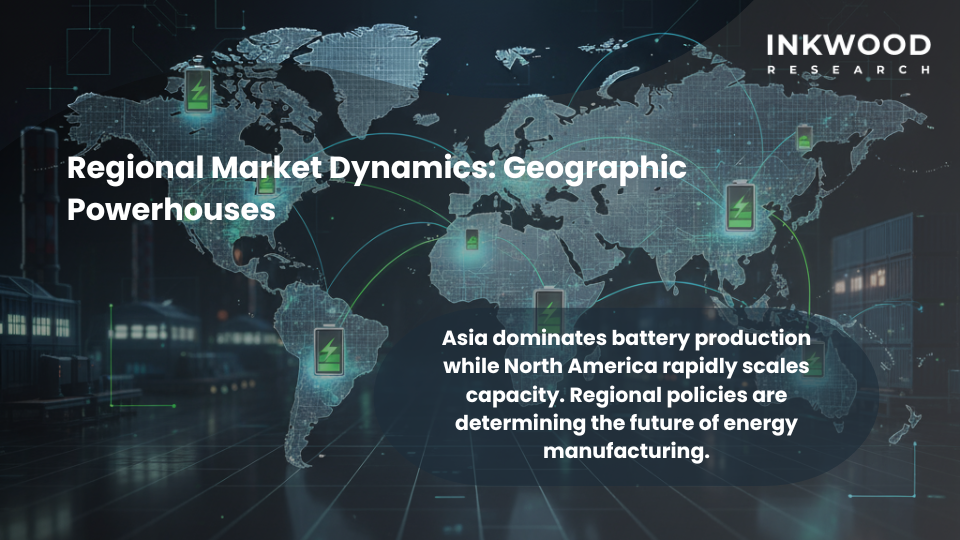
Geography shapes competitive dynamics as nations compete for technological leadership. Regional battery market report analysis reveals distinct characteristics driving localized growth patterns.
Asia-Pacific: Manufacturing Epicenter Commands Major Market Share
Asia-Pacific dominates the global battery market size, with China’s aggressive industrial policies creating the world’s largest battery production ecosystem. CATL, BYD, and other Chinese manufacturers command global supply chains. Government subsidies accelerate domestic EV adoption, creating massive captive demand. New Energy Vehicle incentives transformed the transportation landscape fundamentally.
Japan maintains technological leadership through Toyota, Nissan, and Honda innovations. Solid state battery market development receives substantial government support. South Korea’s LG Energy Solution, Samsung SDI, and SK On compete globally. India emerges as a production destination through Production-Linked Incentive schemes. Targeting 50 GWh domestic capacity by 2025 reflects ambitious industrialization goals.
North America: Inflation Reduction Act Reshapes Manufacturing
U.S. Department of Energy reports over $73 billion in battery manufacturing investments announced since August 2022. The Inflation Reduction Act provides substantial tax credits, incentivizing domestic production. Automakers, including GM, Ford, and Tesla rapidly scaling their manufacturing capabilities.
California leads state-level initiatives through stringent zero-emission vehicle mandates. Consumer adoption increases steadily despite moderating growth rates. EV sales reached 1.4 million units in 2024, representing 40% year-over-year growth. Grid-scale installations expand dramatically, supporting renewable energy penetration. Canada leverages abundant critical mineral resources, attracting international investments.
Europe: Regulatory Frameworks Drive Electrification
European battery market outlook reflects aggressive decarbonization policies. EU regulations mandate ambitious zero-emission vehicle quotas by 2035. Automakers accelerate electrification roadmaps, meeting regulatory requirements. Germany, France, and the United Kingdom lead manufacturing investments. CATL’s Hungary facility represents the largest foreign investment in European capacity.
Local content requirements encourage domestic manufacturing establishments. Volkswagen, Stellantis, and BMW establish joint ventures with battery suppliers. Northvolt emerges as European champion, building gigafactories across the continent. Recycling infrastructure develops to support circular economy principles. Critical raw material sourcing from ethical suppliers receives regulatory emphasis.
Conclusion
The global battery market stands at a transformative inflection point. Technological breakthroughs converge with supportive policies and surging demand across multiple sectors. Battery market growth accelerates toward unprecedented scale as electrification reshapes transportation and energy infrastructure. Companies investing in advanced chemistries, sustainable manufacturing, and strategic partnerships will capture disproportionate value.
Nevertheless, challenges persist around critical mineral supply chains, manufacturing cost structures, and technology commercialization timelines. Solid state battery market development faces technical hurdles despite promising performance advantages. Regional competition intensifies as nations compete for technological leadership and economic benefits. Success requires balancing innovation velocity with practical commercialization considerations.
Forward-thinking organizations must navigate this complex landscape strategically. Inkwood Research provides comprehensive market intelligence supporting informed decision-making. Our analysis covers technology trends, competitive dynamics, regulatory developments, and regional opportunities. Connect with our expert team for customized research addressing your specific strategic requirements.
Ready to capitalize on battery market opportunities?
Contact Inkwood Research today for tailored market analysis, competitive intelligence, and strategic consulting services. Our experienced analysts deliver actionable insights supporting successful market entry, investment decisions, and technology positioning strategies.
Frequently Asked Questions (FAQs)
Inkwood Research forecasts the market reaching $472.59 billion by 2032, growing at a 16.35% CAGR. Key drivers include electric vehicle adoption, renewable energy storage deployment, and consumer electronics demand. Government policies supporting clean energy transition provide additional momentum through tax incentives and emission regulations.
Lithium-ion batteries dominate the EV battery market share with LFP chemistry capturing nearly 50% of the global market in 2024. EV battery market share 2024 data shows CATL commanding a 37.9% position, BYD securing 17.2%, and LG Energy Solution holding 10.8%. LFP batteries offer cost advantages and improved safety, while NMC variants provide superior energy density for premium applications. Tesla, Ford, and European automakers increasingly adopt LFP for mass-market models.
Major automakers, including Toyota, Nissan, and Honda, target the solid state battery market commercialization between 2027-2028. Toyota aims to launch the world’s first all-solid-state battery EV by 2027 with a 620-mile range and 10-minute charging. Mercedes-Benz targets series production by decade’s end. However, mass-market adoption depends on achieving cost parity with conventional lithium ion battery market technologies. Initial applications will focus on premium vehicle segments.