Table of Contents
This analysis is brought to you by Inkwood Research, a leading market intelligence firm specializing in Asia-Pacific robotics ecosystems, human-AI collaboration frameworks, and smart city automation technologies. Our research team brings deep expertise in Japanese industrial robotics, South Korean urban AI deployment, and autonomous RPA automation adoption patterns across advanced Asian economies. Through strategic partnerships with robotics consortia, municipal technology agencies, and enterprise automation providers, we deliver actionable intelligence that supports strategic decision-making for businesses navigating the global autonomous robotic process automation bots market.
TLDR
Japan and South Korea are redefining what it means for humans and machines to work together. Japan is deploying autonomous RPA bots across manufacturing, elder care, and logistics, while Seoul is building one of the world’s most integrated AI-driven urban management systems. Both nations treat automation as a collaborative tool rather than a replacement for human judgment. The global autonomous robotic process automation (RPA) bots market is projected to grow from US$2.24 billion in 2026 to US$24.06 billion by 2034 at a CAGR of 34.57%, and both countries are central to that story.
This blog is essential reading for enterprise technology strategists, robotics investors, and urban planners evaluating human-AI collaboration frameworks across Asia-Pacific. Additionally, policy analysts tracking smart city development, automation vendors entering the Japanese and South Korean markets, and executives assessing intelligent RPA bots deployments in advanced service and manufacturing economies will find targeted, evidence-grounded intelligence here.
Japan – Robots as Colleagues? A Look at Japan’s Journey into Human-Agent Collaboration
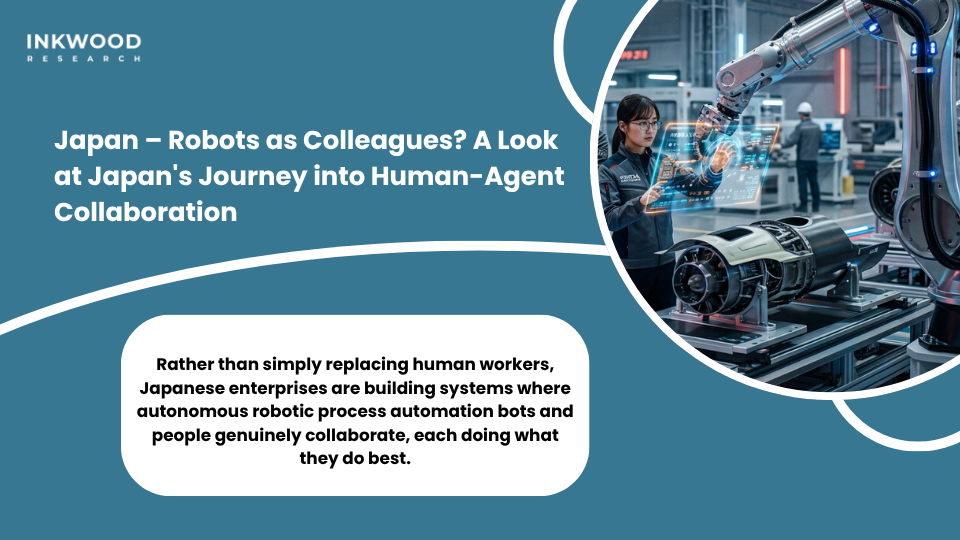
Japan has long been a benchmark for industrial automation, but something more nuanced is happening now. Rather than simply replacing human workers, Japanese enterprises are building systems where autonomous robotic process automation bots and people genuinely collaborate, each doing what they do best. The Japan autonomous robotic process automation (RPA) bots market size is valued at $92.34 million as of 2026 and is expected to reach $1,130.34 million by 2034, progressing with a CAGR of 36.77% during the forecast years, 2026–2034.
Moreover, this shift is partly cultural: Japan’s concept of ‘monozukuri’ (the art of making things) has always valued craftsmanship alongside efficiency, and modern automation reflects that same philosophy.
The urgency behind this evolution is structural. Japan’s Ministry of Internal Affairs and Communications consistently documents one of the world’s most acute labor shortages, with the working-age population declining year over year. Consequently, intelligent RPA bots are filling critical gaps in manufacturing, elder care, and logistics sectors where human shortages are already measurable.
What Are Autonomous RPA Bots and How Do They Differ from Traditional RPA?
Traditional RPA bots follow fixed, rule-based scripts. They are effective for repetitive, structured tasks but break down when conditions change unexpectedly. Autonomous RPA bots, by contrast, incorporate AI decision-making, natural language processing, and machine learning to handle variability and unstructured inputs. The result is a digital worker that can adapt, reading context, making inferences, and escalating to human colleagues only when genuinely necessary.
This distinction matters because it changes the nature of the human-automation relationship. Autonomous RPA automation is not just faster automation; it is collaborative automation. Workers interact with these bots as they would with a knowledgeable colleague, providing guidance and receiving processed outputs rather than simply supervising repetitive sequences.
How Is Japan Deploying AI-Powered RPA Bots Across Key Sectors?
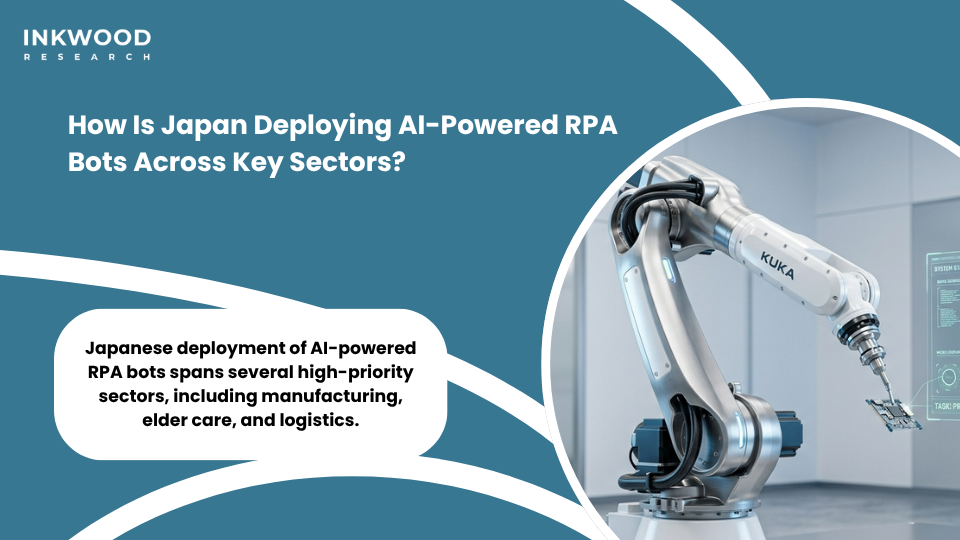
Japanese deployment of AI-powered RPA bots spans several high-priority sectors, including manufacturing, elder care, and logistics.
- In manufacturing, automotive and electronics firms use intelligent process automation bots to manage quality control workflows, supply chain exception handling, and real-time production scheduling. These bots monitor multiple data streams simultaneously, flagging anomalies and suggesting corrective actions faster than any human team could manage at scale.
- In elder care, where demand is growing rapidly due to Japan’s aging demographics, autonomous digital workforce automation supports care workers by managing patient scheduling, medication tracking, and documentation. This application is particularly significant because it preserves the human element of care while removing administrative burden.
- Furthermore, logistics operators, facing mounting e-commerce volumes, are deploying next-generation RPA automation to manage warehouse operations, route optimization, and customs documentation with minimal manual oversight.
Which Companies Are Leading Japan's Human-AI Collaboration Push?
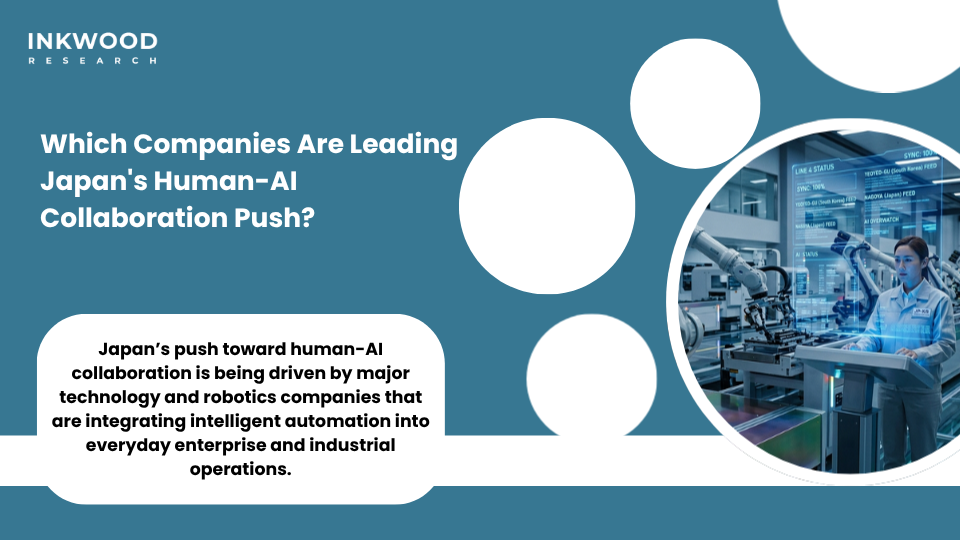
Japan’s push toward human-AI collaboration is being driven by major technology and robotics companies that are integrating intelligent automation into everyday enterprise and industrial operations. Firms such as Fanuc, NTT Data, Fujitsu, and SoftBank Robotics are developing collaborative robots, AI-powered RPA platforms, and machine learning–driven service robots.
They enable humans and autonomous systems to work together more efficiently across sectors like manufacturing, finance, healthcare, retail, and facility management. Moreover, these innovations are positioning Japan as a global leader in the evolution of human-agent collaboration and intelligent automation ecosystems.
- Fanuc continues advancing its collaborative robot (cobot) platforms, integrating autonomous RPA automation layers that allow factory bots to communicate with enterprise software systems directly.
- NTT Data has expanded its intelligent automation bots portfolio, offering enterprise clients modular AI-powered RPA bots that connect legacy systems with modern cloud workflows.
- Fujitsu has launched AI-driven robotic process automation tools designed for financial services and healthcare sectors, enabling autonomous decision-making within compliance-governed environments.
- SoftBank Robotics, through its Pepper and Whiz platforms, is integrating advanced robotic process automation tools into retail and facility management, embedding machine learning into routine service interactions.
Seoul – A City on Autopilot? Seoul’s Vision for AI-Driven Urban Management
Seoul is building something ambitious: a city where autonomous systems manage traffic, public services, infrastructure monitoring, and emergency response in a coordinated, real-time loop. The South Korean capital has consistently ranked among the world’s most digitally advanced cities, and its latest smart city initiatives are taking that reputation to a new level.
The Seoul Metropolitan Government has published detailed digital transformation roadmaps describing how AI-driven urban management will reduce response times, cut operational costs, and improve quality of life for its 9.7 million residents. The South Korea autonomous robotic process automation (RPA) bots market size is valued at $42.16 million as of 2026 and is expected to reach $582.10 million by 2034, progressing with a CAGR of 38.84% during the forecast years, 2026–2034.
Accordingly, autonomous RPA bots are central to this architecture, handling data processing, citizen service workflows, and cross-agency coordination tasks that previously required large administrative teams.
How Does Autonomous RPA Automation Power Seoul's Smart City Infrastructure?
Seoul’s smart city framework relies on enterprise automation bots that process data from thousands of sensors, cameras, and connected devices across the city. These intelligent RPA bots handle tasks ranging from real-time traffic signal optimization to automated public safety reporting. Moreover, they connect municipal departments that previously operated in silos, enabling faster coordination during emergencies and routine operations alike.
A particularly visible application is Seoul’s AI-powered traffic management system, which uses autonomous digital workforce automation to analyze live data and adjust signal timing dynamically. Additionally, citizen services, including permit applications, complaint routing, and social welfare processing, are increasingly managed by AI-powered RPA bots, reducing wait times and administrative backlogs substantially.
What Are the Latest Developments in Korean Autonomous Automation?
South Korea is rapidly advancing its autonomous automation ecosystem, with major technology firms integrating AI-powered RPA solutions across enterprise and industrial environments. Accordingly, companies such as Samsung SDS, LG CNS, KT Corporation, and Kakao Enterprise are deploying intelligent automation platforms that support smart manufacturing.
They do this via telecom network management, financial services workflows, and enterprise operations through self-learning bots and cognitive automation tools. Further, this momentum is strengthened by government initiatives from the Ministry of Science and ICT, which is actively funding AI and automation pilot programs to accelerate digital transformation across public administration and healthcare sectors.
- Samsung SDS has expanded its Brity Automation platform, introducing self-learning automation bots that handle financial reconciliation, HR workflows, and supply chain coordination for enterprise clients.
- LG CNS has launched next-generation RPA automation solutions for smart manufacturing, integrating cognitive robotic process automation with IoT sensor networks across Korean industrial facilities.
- KT Corporation is deploying AI-powered process automation across its telecommunications infrastructure, using autonomous RPA solutions to manage network fault detection and resolution with minimal human intervention.
- Kakao Enterprise has introduced intelligent automation bots for the financial services sector, enabling automated KYC workflows, fraud detection, and customer query resolution at scale.
South Korea’s broader enterprise automation momentum is supported by government policy. The Korean Ministry of Science and ICT has prioritized AI and automation as pillars of the national digital transformation agenda, funding pilot programs that test autonomous RPA automation in public administration and healthcare settings.
Key Takeaways
- The Japan autonomous robotic process automation (RPA) bots market size is valued at $92.34 million as of 2026 and is expected to reach $1,130.34 million by 2034, progressing with a CAGR of 36.77% during the forecast years, 2026–2034.
- Japan’s deployment of autonomous RPA bots is driven by acute labor shortages, with intelligent process automation bots filling critical gaps in manufacturing, elder care, and logistics.
- The South Korea autonomous robotic process automation (RPA) bots market size is valued at $42.16 million as of 2026 and is expected to reach $582.10 million by 2034, progressing with a CAGR of 38.84% during the forecast years, 2026–2034.
- Seoul’s smart city framework uses enterprise automation bots for real-time traffic management, citizen services, and cross-agency coordination, backed by strong government policy.
- Key players, including Fanuc, NTT Data, Samsung SDS, and LG CNS, are developing next-generation RPA automation platforms that embed AI decision-making into enterprise workflows.
- Both Japan and South Korea treat autonomous digital workforce automation as a partner to human workers; the collaborative orientation sets them apart from purely cost-driven automation markets.
Conclusion:
Japan and South Korea have each built something worth studying closely. Japan is using autonomous RPA bots to close a labor gap that demographics have made unavoidable, and doing so in a way that keeps human workers central to the process. South Korea, through Seoul’s smart city programs, is demonstrating what city-scale intelligent automation actually looks like when it is coordinated rather than fragmented.
What connects both markets is the underlying philosophy. Automation here is treated as infrastructure for human capability, not a workaround for it. Companies like Fanuc, NTT Data, Samsung SDS, and LG CNS are building platforms that reflect that thinking, and the results are visible across manufacturing floors, care facilities, and city dashboards alike.
The Japan autonomous RPA bots market is projected to grow from US$92.34 million in 2026 to US$1,130.34 million by 2034, and South Korea is on a similar trajectory. For businesses evaluating where to invest in next-generation RPA automation across Asia-Pacific, these two markets offer more than just growth numbers. They offer a framework for what human-AI collaboration can look like at scale.
Inkwood Research provides the market intelligence and regional expertise to help organizations navigate this space with confidence.
Connect with our team to explore how our analysis can support your strategy in the Asia-Pacific autonomous automation market.
Frequently Asked Questions
What are autonomous RPA bots?
Autonomous RPA bots are AI-powered digital workers that handle complex, variable tasks using machine learning and NLP, going beyond fixed rule-based scripts to adapt in real time.
How are autonomous RPA bots different from traditional RPA?
Traditional RPA breaks when processes change. Autonomous RPA bots adapt to changing inputs, make contextual decisions, and escalate only genuinely complex cases to human workers.
What industries use autonomous robotic process automation in Japan and South Korea?
Manufacturing, elder care, logistics, financial services, and smart city management are the primary sectors, with government-backed pilots expanding into public administration and healthcare.
Are autonomous RPA bots powered by AI?
Yes. AI-powered RPA bots use machine learning, NLP, and computer vision to process unstructured data and make decisions, capabilities that standard rule-based RPA systems do not possess.
What is the future of autonomous automation in Asia?
Autonomous automation will deepen human-AI collaboration, with self-learning bots handling higher-complexity tasks while human workers focus on judgment-intensive and relationship-driven roles.
How do South Korea's smart city deployments use autonomous RPA?
Seoul uses autonomous RPA automation for traffic optimization, public service processing, and emergency coordination, integrating bots across municipal departments for real-time city management.