
Table of Contents
This analysis is brought to you by Inkwood Research, a leading market intelligence firm specializing in Asia-Pacific cloud infrastructure, China digital economy policy, and AI-driven cloud migration services ecosystems. Our research team combines extensive experience analyzing China’s data localization regulations, AI cloud migration solutions, and domestic hyperscaler competitive dynamics across enterprise, government, and manufacturing sectors. Through strategic partnerships with Chinese technology enterprises and global cloud migration advisors, we deliver actionable intelligence for enterprises navigating the China AI-driven cloud migration services market.
TLDR
The China AI-driven cloud migration services market is projected to grow from US$220.37 million in 2026 to US$2,190.97 million by 2034 at a 33.26% CAGR, one of the highest growth rates in the global AI cloud migration landscape. China’s combination of stringent data localization laws, a government-backed digital economy strategy, and domestically developed AI cloud migration solutions gives local providers, particularly Alibaba Cloud, Huawei Cloud, and Tencent Cloud, structural advantages that global hyperscalers cannot easily replicate within China’s borders.
Enterprise technology leaders, multinational CIOs operating in China, and cloud architects evaluating AI cloud migration solutions across Asia-Pacific will find this analysis directly relevant. Additionally, investors tracking the China AI-driven cloud migration services market, AI cloud migration consulting services providers entering the Chinese market, and policy strategists monitoring China’s digital economy frameworks will gain targeted intelligence on the competitive dynamics, regulatory environment, and technology trends shaping this high-growth market.
What Makes the China AI-Driven Cloud Migration Services Market Structurally Unique?
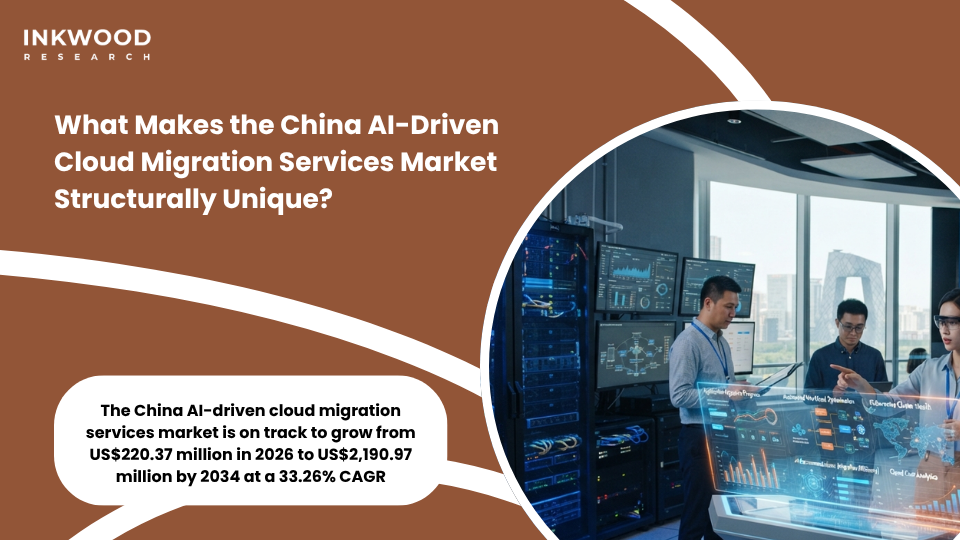
Most major cloud markets follow a recognizable pattern: global hyperscalers compete on technical capability, and enterprises select based on price, performance, and compliance fit. The China AI-driven cloud migration services market fundamentally breaks this pattern. Regulatory architecture, government industrial policy, and the technical maturity of domestic AI cloud migration solutions have together created a market where local providers hold structural advantages that global players cannot simply out-spend or out-feature.
The China AI-driven cloud migration services market is on track to grow from US$220.37 million in 2026 to US$2,190.97 million by 2034 at a 33.26% CAGR, making it one of the fastest-growing national AI cloud migration markets in the world. This growth reflects the sheer scale of China’s enterprise cloud transformation, but it also reflects the specific characteristics of a market where AI cloud migration strategy must be designed around domestic regulatory realities from the outset.
Furthermore, China’s position as a global manufacturing powerhouse, a technology innovator, and a government-directed digital economy means that the China AI-driven cloud migration services market is shaped by forces that are simply absent in most other markets. Understanding those forces is essential for any enterprise, domestic or multinational, seeking to build a viable AI-powered cloud transformation strategy in China.
How Do China’s Data Laws Shape Enterprise AI Cloud Migration Strategy?
China has built one of the world’s most comprehensive data governance frameworks in a relatively short time, and that framework is the single most important factor shaping how enterprises design AI-driven cloud migration services within China’s borders. Three legislative pillars define the compliance environment that every AI cloud migration solution must address:
- The Cybersecurity Law of the People’s Republic of China requires that data generated within China be stored domestically, and establishes security review requirements for cross-border data transfers that apply directly to cloud migration architectures
- The Personal Information Protection Law (PIPL) establishes consent and data minimization requirements that shape how AI-based workload assessment tools must classify and handle personal data during cloud migrations
- The Data Security Law establishes classification requirements for important data, requiring enterprises to implement security measures that are directly relevant to cloud migration automation frameworks AI
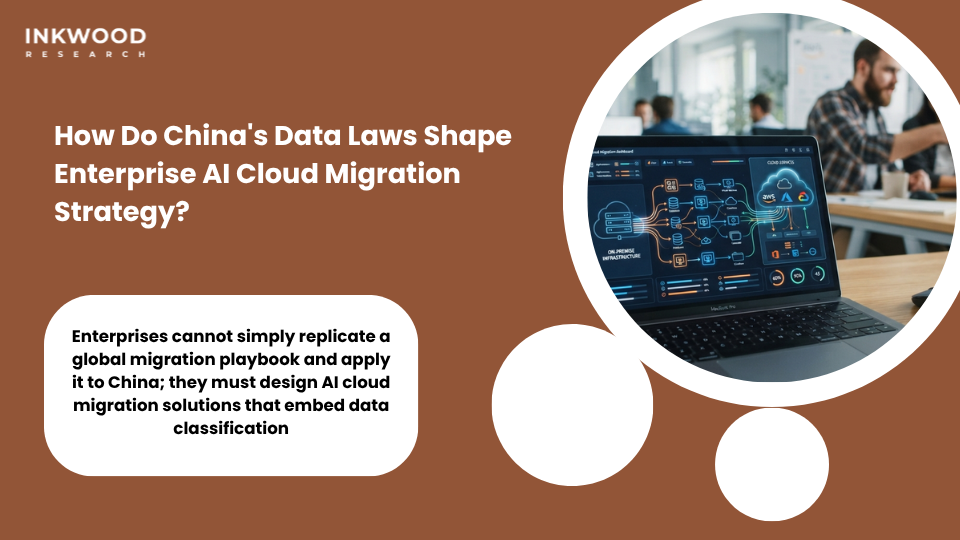
Together, these laws make automated cloud migration using AI a compliance necessity rather than a technical preference. Enterprises cannot simply replicate a global migration playbook and apply it to China; they must design AI cloud migration solutions that embed data classification, cross-border transfer controls, and security review processes into the migration workflow itself. Consequently, this compliance complexity creates a natural advantage for domestic providers whose intelligent cloud migration services were built from the ground up within this regulatory environment.
How Does Alibaba Cloud Compare to Global Hyperscalers in AI Migration Capabilities?
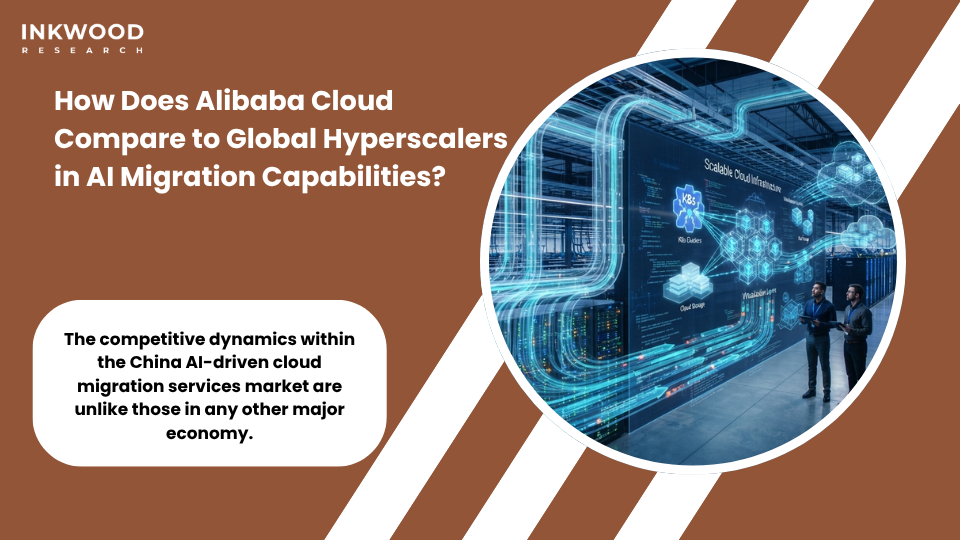
The competitive dynamics within the China AI-driven cloud migration services market are unlike those in any other major economy. Global hyperscalers, AWS, Microsoft Azure, and Google Cloud, operate in China only through local joint venture structures with licensed domestic partners, fundamentally limiting their ability to offer the full suite of AI cloud migration solutions that they deploy in other markets. Alibaba Cloud, Huawei Cloud, and Tencent Cloud face no such structural constraints, and they have used that freedom to build migration capabilities deeply integrated with China’s regulatory and technical environment.
Alibaba Cloud leads the China AI-driven cloud migration services market through its Apsara platform, which provides AI-driven application dependency mapping, predictive analytics for cloud migration, and cloud migration automation frameworks AI that are natively compliant with China’s data governance laws. Alibaba’s enterprise AI cloud migration solutions have been deployed across retail, financial services, logistics, and manufacturing sectors, and the company’s deep knowledge of Chinese enterprise IT architecture gives it a practical migration advantage that no global provider can easily replicate.
Huawei Cloud has carved out a dominant position in government and state-owned enterprise cloud migration, leveraging its trusted supplier relationships and its purpose-built cloud migration managed services with AI designed for China’s public sector compliance requirements.
Meanwhile, Tencent Cloud is strongest in media, gaming, and internet-native enterprises, where its AI-enabled DevOps and cloud migration capabilities enable rapid, high-volume workload transitions. Global hyperscalers, by contrast, tend to serve multinational enterprises operating in China, where their role is to support the international portion of hybrid cloud architectures rather than drive domestic migration at scale.
A US technology company expanding its China operations engaged Inkwood Research to evaluate enterprise AI cloud migration solutions providers within the China AI-driven cloud migration services market. Our analysis benchmarked Alibaba Cloud, Huawei Cloud, Tencent Cloud, and available global hyperscaler joint venture offerings across compliance depth, AI workload optimization capabilities, and migration support quality. The resulting vendor assessment helped the client select an architecture that balanced domestic regulatory compliance with its global IT integration requirements.
What Technologies Are Driving China's Intelligent Cloud Migration Services?
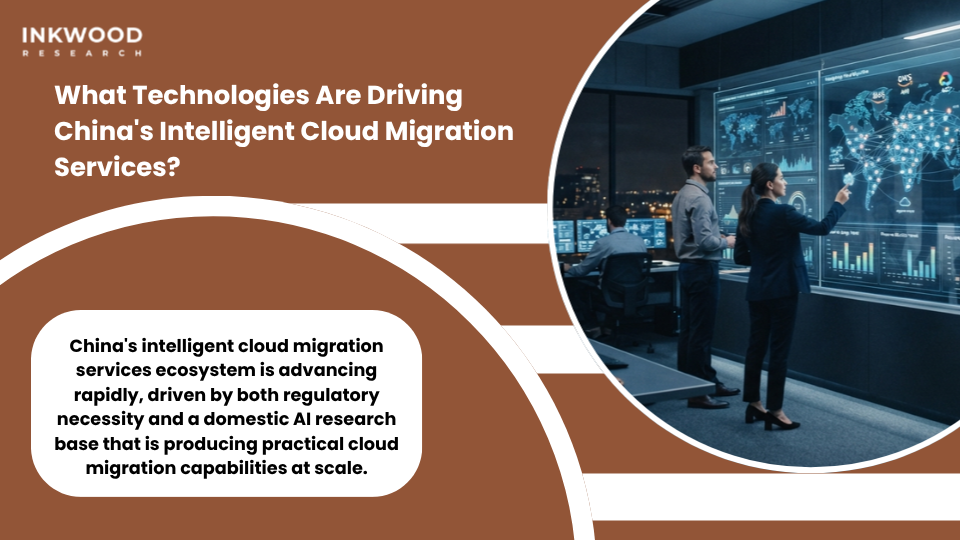
China’s intelligent cloud migration services ecosystem is advancing rapidly, driven by both regulatory necessity and a domestic AI research base that is producing practical cloud migration capabilities at scale. Several technology trends are particularly consequential for enterprises planning AI cloud migration in China:
- Generative AI in cloud transformation: Chinese domestic AI models, including those developed by Alibaba’s DAMO Academy and Baidu’s AI Research division, are being integrated into cloud migration automation frameworks AI, enabling intelligent workload classification and compliance documentation generation at enterprise scale
- Machine learning in cloud migration: Domestic providers have trained migration optimization models on China-specific enterprise IT patterns, achieving higher accuracy in migration risk prediction than general-purpose global models that lack this regional training data
- Autonomous cloud migration platforms: Alibaba Cloud and Huawei Cloud are both investing in autonomous migration capabilities that reduce human intervention requirements, an important advantage in a market where qualified cloud migration specialists are in high demand
- AI workload optimization cloud migration: Platforms that dynamically reallocate workloads based on real-time performance and compliance signals are enabling enterprises in China to achieve cloud migration cost optimization using AI while maintaining regulatory compliance
- AI-driven digital transformation services: Domestic cloud providers are increasingly bundling intelligent cloud migration services with broader enterprise digital transformation programs, making cloud migration a component of a wider AI modernization agenda rather than a standalone IT project
Additionally, multi-cloud migration AI solutions are gaining traction in China’s enterprise sector, as organizations seek to distribute workloads across Alibaba Cloud, Huawei Cloud, and private cloud infrastructure to manage both regulatory concentration risk and business continuity requirements. This trend is creating new demand for intelligent cloud onboarding solutions that can manage complex, multi-provider migration architectures within China’s compliance framework.
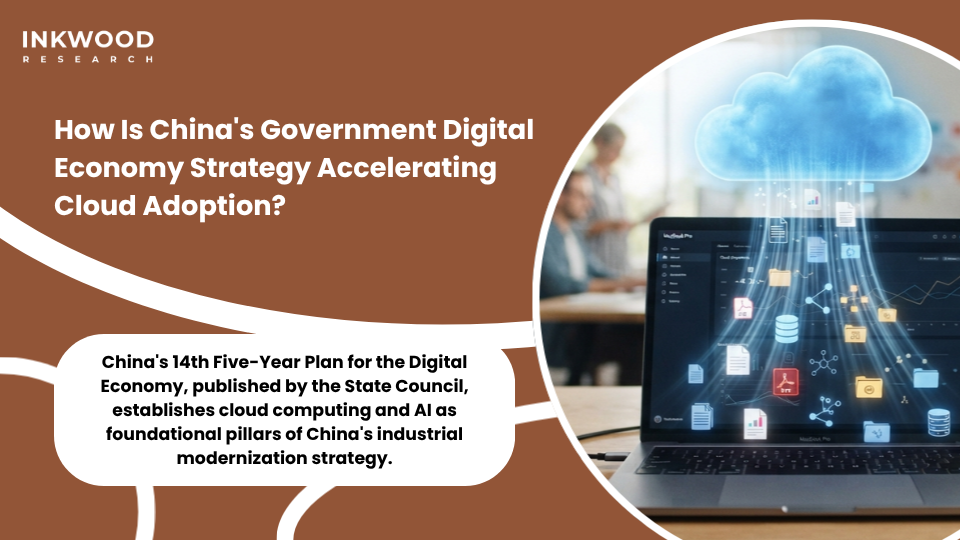
China’s 14th Five-Year Plan for the Digital Economy, published by the State Council, establishes cloud computing and AI as foundational pillars of China’s industrial modernization strategy. It sets explicit targets for cloud adoption across manufacturing, public services, and strategic industries, targets that are directly translating into enterprise demand for AI-driven cloud migration services across the China AI-driven cloud migration services market.
The government’s push for cloud adoption is not passive; it is active and directive. State-owned enterprises and government agencies are expected to migrate workloads to compliant cloud environments on accelerated timelines, creating a captive demand base for Huawei Cloud and Alibaba Cloud’s enterprise AI cloud migration solutions. Meanwhile, the Manufacturing Cloud initiative is driving AI cloud migration for manufacturing industry applications at a scale that is simply unprecedented in any other market.
Moreover, China’s national AI development programs are feeding directly into cloud migration technology capabilities. Investments in AI research, chip development, and large language model training are producing domestic AI tools that are being integrated into intelligent cloud migration services, reducing dependence on global technology providers and strengthening the competitive position of domestic players within the China AI-driven cloud migration services market.
Key Takeaways
- The China AI-driven cloud migration services market grows from US$220.37 million (2026) to US$2,190.97 million (2034) at a 33.26% CAGR, among the fastest growth rates in the global AI cloud migration landscape
- China’s Cybersecurity Law, PIPL, and Data Security Law create a compliance architecture that gives domestically built AI cloud migration solutions a structural advantage over global providers
- Alibaba Cloud, Huawei Cloud, and Tencent Cloud lead the China AI-driven cloud migration services market with natively compliant, AI-powered cloud transformation capabilities
- Global hyperscalers operate in China only through joint venture structures, limiting their migration capabilities relative to domestic providers who built their platforms within China’s regulatory environment
- China’s 14th Five-Year Digital Economy Plan and manufacturing cloud initiatives are creating directed, government-backed demand that is accelerating the China AI-driven cloud migration services market beyond commercial-only drivers
Conclusion:
The China AI-driven cloud migration services market is not following the same playbook as other major cloud economies, and that distinction matters enormously for every enterprise seeking to operate, invest, or compete within it. Domestic providers hold regulatory, technical, and policy advantages that global hyperscalers are structurally constrained from matching. Meanwhile, China’s government-directed digital economy strategy is creating demand at a scale and speed that few other markets can replicate.
For enterprises navigating this environment, the strategic imperative is clear: AI cloud migration solutions designed for China must be built around China’s specific regulatory and competitive realities from day one.
Inkwood Research provides the market intelligence and advisory depth needed to make those decisions with confidence.
Connect with our team to explore how our insights can advance your AI cloud migration strategy in the China AI-driven cloud migration services market.
Frequently Asked Questions
What is the China AI-driven cloud migration services market size?
It grows from US$220.37 million in 2026 to US$2,190.97 million by 2034 at a 33.26% CAGR, driven by data localization laws and the government digital economy strategy.
Why do domestic providers have an advantage in China's AI cloud migration market?
China’s data laws require domestic data storage and compliance controls that domestic AI cloud migration solutions were built to address natively, while global hyperscalers operate under joint venture constraints.
How do China's data laws affect automated cloud migration using AI?
They require data classification, cross-border transfer controls, and security reviews embedded within cloud migration automation frameworks AI, making compliance a core migration design requirement.
Which companies lead the China AI-driven cloud migration services market?
Alibaba Cloud, Huawei Cloud, and Tencent Cloud lead domestically. AWS, Microsoft Azure, and Google Cloud serve multinationals through licensed joint venture structures with limited migration capabilities.
What role does China's 14th Five-Year Plan play in AI cloud migration adoption?
It sets explicit cloud adoption targets for state-owned enterprises and strategic industries, creating government-directed demand that accelerates the China AI-driven cloud migration services market beyond commercial drivers.
How does generative AI in cloud transformation apply to China's migration market?
Domestic AI models from Alibaba and Baidu are integrated into migration automation frameworks, enabling intelligent workload classification and compliance documentation generation at enterprise scale.