Table of Contents
This analysis is brought to you by Inkwood Research, a leading market intelligence firm specializing in comprehensive industry analysis across global markets. Our research team combines extensive experience in evaluating emerging technologies, strategic market positioning, and competitive intelligence methodologies across diverse sectors. Based on our proprietary research frameworks and strategic partnerships with industry experts, technology providers, and business intelligence specialists, we deliver actionable insights that empower strategic decision-making for global enterprises navigating complex market landscapes and digital transformation initiatives.
TLDR
Market research firms face a pivotal question: why purchase detailed industry reports when artificial intelligence can generate instant insights? While AI-powered analysis excels at aggregating publicly available information, it cannot replicate the depth of primary research, proprietary databases, and expert validation that drive strategic decisions. This comprehensive guide explores how market intelligence combines AI efficiency with human expertise, revealing why ChatGPT and similar tools serve as assistants rather than replacements for professional market analysis. Understanding this distinction becomes critical for companies making high-stakes investments.
Business strategists, market analysts, investment professionals, and corporate decision-makers evaluating their market research approach will benefit from this analysis. Additionally, companies exploring AI tools for competitive intelligence, procurement teams assessing research vendors, and entrepreneurs entering new markets will gain clarity on balancing automation with expert insight for optimal strategic outcomes.
The Question Reshaping Market Research
A fundamental shift is occurring in how companies approach market intelligence. Recently, a client posed a question that’s echoing across boardrooms globally: “Why invest in comprehensive industry reports when ChatGPT or Perplexity can deliver market insights instantly?” This inquiry reflects a broader transformation as artificial intelligence becomes increasingly sophisticated at data analysis and pattern recognition.
Furthermore, the question deserves serious consideration rather than defensive dismissal. After all, AI tools have democratized access to information previously locked behind expensive subscriptions and analyst expertise. Many Japanese companies, for instance, now leverage AI-powered analysis more extensively than purchasing traditional research reports. Consequently, understanding where AI excels, and where it falls short, becomes essential for informed decision-making.
What AI Does Brilliantly (And Its Hidden Limitations)
Artificial intelligence demonstrates remarkable capabilities in specific domains. Primarily, it excels at scanning vast amounts of publicly accessible information across websites, databases, and digital publications. Moreover, AI can identify patterns within datasets far faster than human analysts could manage manually. These strengths make AI an invaluable preliminary research tool.
However, the foundation of AI-generated insights reveals a critical limitation. Most AI models analyze information that’s already publicly available, including published research reports from firms like ours and our competitors. Therefore, the insights produced often represent compiled averages rather than original analysis. Additionally, AI cannot distinguish between accurate data and misinformation without proper training on verified sources.
The Research Trenches: Where Human Expertise Matters
Professional market research involves layers of activity that remain beyond AI’s current capabilities. Specifically, experienced analysts conduct confidential interviews with industry executives who provide insights they’d never share publicly. These conversations reveal market dynamics invisible in published reports or public statements.
Beyond interviews, seasoned researchers validate contradictory information across proprietary databases built over decades. For example, when emerging market data appears inconsistent, analysts apply historical context and macroeconomic understanding to determine accuracy. Similarly, they interpret why certain market shifts occur, not merely what is happening. This interpretive layer requires judgment honed through years of tracking specific industries and understanding regulatory environments.
According to Harvard Business Review’s analysis, AI’s inability to conduct original research or verify sources independently remains a fundamental constraint. Consequently, strategic decisions benefit enormously from analyst expertise that contextualizes data within broader market forces.
The Circular Nature of AI-Generated Insights
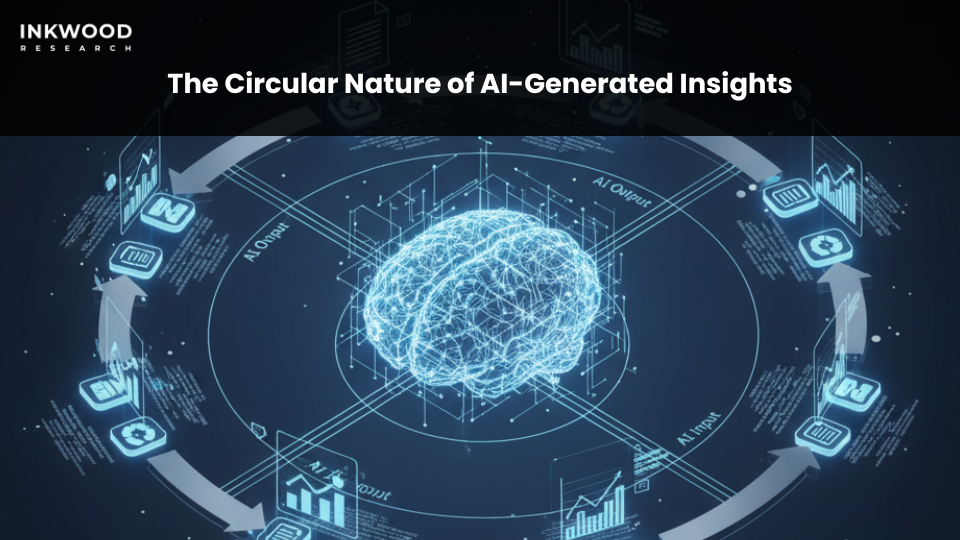
A fascinating paradox emerges when examining AI-powered market analysis. Because large language models train on publicly available content, they inevitably incorporate published research reports into their knowledge base. Therefore, when asked about market trends, AI often synthesizes information originally produced by research firms. This creates a circular reference system where AI’s “insights” essentially repackage existing professional analysis.
Moreover, this circularity means AI cannot generate truly novel market intelligence without access to proprietary data sources. While AI excels at reformatting and summarizing existing knowledge, it cannot produce the original primary research that forms the foundation of strategic intelligence. As a result, companies relying solely on AI may find themselves working with recycled insights that their competitors are also accessing.

When companies face multi-million dollar investment decisions or market entry strategies, the stakes become extraordinarily high. In these situations, surface-level ChatGPT responses prove insufficient for several reasons. First, AI cannot provide the authentication and verification protocols that professional researchers employ. Second, AI-generated data lacks the country-specific nuances essential for emerging markets where public information is sparse or unreliable.
For instance, understanding regulatory complexities in Southeast Asian markets or navigating distribution challenges in African countries requires boots-on-the-ground knowledge that doesn’t exist in publicly accessible databases.
Professional research firms maintain networks of local experts and conduct primary studies that capture these critical details. Furthermore, research also indicates that while enterprises are adopting generative AI rapidly, most recognize the continued need for verified, expert-curated intelligence.
Differentiation Strategies: Beyond Surface-Level Analysis

Professional market research firms differentiate their services through multiple strategic approaches. Primarily, they ensure authenticity through rigorous verification processes that AI cannot replicate. Each data point undergoes cross-referencing against proprietary databases and expert validation before publication.
Additionally, research firms offer multiple analytical depths. While AI provides surface-level insights scraped from internet sources, professional analysts deliver layered analysis examining historical trends, competitive dynamics, regulatory impacts, and future scenarios. This depth proves invaluable for strategic planning.
Customization represents another critical differentiator. When clients need niche or hard-to-find data, research teams conduct targeted primary studies and expert interviews. Recent projects increasingly involve specialized analysis at country and regional levels, providing granular insights impossible to obtain through AI tools. Furthermore, ongoing accessibility for client queries, clarifications, and data verification ensures that purchased research remains a living resource rather than a static document.
The Hybrid Future: AI + Human Intelligence

The most effective approach combines artificial intelligence efficiency with human analytical expertise. Forward-thinking research firms use AI for preliminary data gathering, pattern identification, and initial analysis. This allows human analysts to focus their expertise on interpretation, validation, and strategic recommendation development.
In practice, AI handles repetitive tasks like monitoring multiple data sources, flagging anomalies, and compiling baseline information. Subsequently, experienced analysts apply contextual understanding, verify accuracy against proprietary sources, and develop actionable insights. This division of labor maximizes both efficiency and accuracy.
Moreover, this hybrid model addresses client needs more comprehensively than either approach alone. Clients receive rapid preliminary insights through AI-assisted processes, followed by deep, verified analysis from experienced professionals. Some research firms now offer flexible purchasing options, including individual report chapters or customized sections, making professional intelligence more accessible while maintaining quality standards.
Key Takeaways
Several critical insights emerge from examining AI’s role in market research:
- Artificial intelligence excels at aggregating publicly available information, but cannot conduct original primary research or confidential expert interviews
- AI-generated insights often represent circular references, synthesizing information originally produced by professional research firms
- High-stakes decisions require the verification, authentication, and contextual understanding that experienced analysts provide
- Professional research offers multiple layers of depth, country-specific nuances, and customization impossible through AI tools alone
- The optimal approach combines AI efficiency for preliminary analysis with human expertise for strategic interpretation and validation
- Research firms differentiate through proprietary databases, primary research capabilities,
Conclusion
The question “Why not just use ChatGPT?” deserves thoughtful consideration rather than dismissal. Artificial intelligence has fundamentally transformed how we access and process information, bringing unprecedented efficiency to preliminary market analysis. However, strategic market intelligence requires more than aggregated public data; it demands primary research, expert validation, contextual interpretation, and verified insights that AI cannot yet deliver independently.
Ultimately, the future isn’t about choosing between AI-powered analysis and human expertise. Instead, it’s about strategically combining both approaches. Companies that leverage AI for efficiency while relying on professional research for accuracy and strategic depth will maintain competitive advantages in increasingly complex markets. Further, as technology evolves, this hybrid approach will likely become standard practice, with AI handling more sophisticated tasks while human analysts focus on higher-level strategy and interpretation.
Frequently Asked Questions (FAQs)
Not currently. While AI excels at compiling publicly available information, it cannot conduct confidential primary research, validate data against proprietary sources, or provide the contextual interpretation that experienced analysts offer for strategic decision-making.
Professional research firms leverage AI for preliminary data gathering, pattern identification, monitoring multiple sources, and initial analysis. This allows human analysts to focus on verification, interpretation, and developing strategic insights that require expert judgment.
Many research firms now offer flexible purchasing options, including individual report chapters or customized sections, making professional intelligence more accessible while maintaining analytical quality and depth for specific client needs.