Table of Contents
This analysis is brought to you by Inkwood Research, a leading market intelligence firm specializing in advanced delivery nutraceuticals market dynamics, bioavailability enhancement technologies, and functional nutrition innovation. Our research team draws on deep expertise in nanoencapsulation platforms, liposomal delivery systems, and precision nutrition strategies across North America, Europe, and Asia-Pacific. Through strategic partnerships with nutraceutical manufacturers, R&D institutions, and regulatory experts, we deliver actionable insights for enterprises navigating the next-generation nutraceuticals market.
TLDR
The global advanced delivery nutraceuticals market is growing from US$139.43 billion in 2026 to US$289.45 billion by 2034, driven by AI-powered formulation tools, bioavailability enhancement nutraceuticals technologies, and rising demand for personalized nutrition. North America leads with US$53.22 billion in 2026, while Asia-Pacific expands fastest at an 11.40% CAGR. Artificial intelligence is transforming how encapsulated nutraceuticals reach their target sites, from nanoencapsulation platforms to controlled release systems, making precision nutraceuticals a commercial reality at scale.
This blog is essential reading for nutraceutical executives, R&D directors, and formulation scientists evaluating AI-driven delivery innovations. Furthermore, investors tracking the global nutraceutical delivery technology market, regulatory strategists navigating clean label requirements, and procurement leaders sourcing advanced oral delivery systems will find targeted intelligence here. Healthcare professionals and product developers working on personalized nutraceutical delivery systems will also gain strategic, actionable insights from this analysis.
What Is the Advanced Delivery Nutraceuticals Market, and Why Does AI Matter?
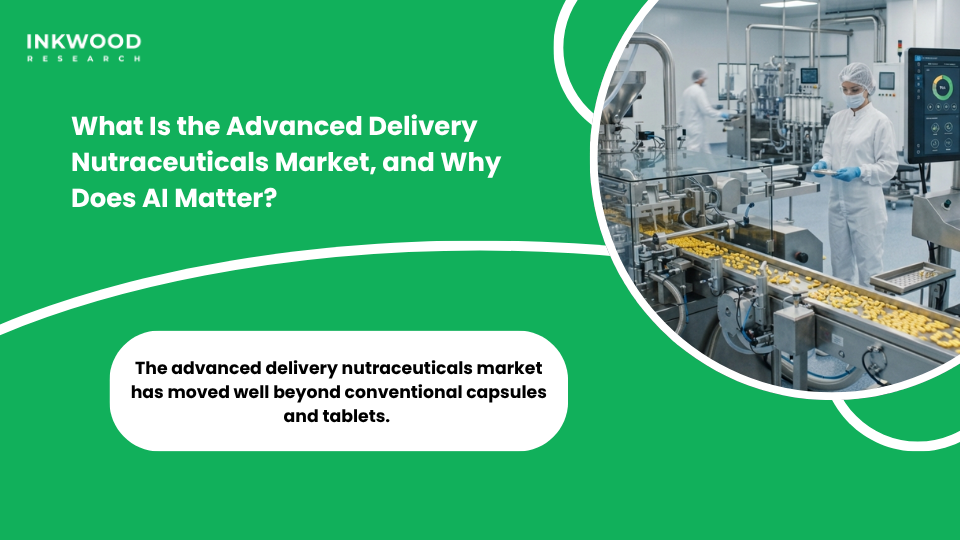
The advanced delivery nutraceuticals market has moved well beyond conventional capsules and tablets. Today, formulators are deploying nanoencapsulation technology, liposomal nutraceutical delivery systems, and controlled release platforms to ensure that active ingredients reach their target sites effectively. Moreover, artificial intelligence is accelerating every stage of this process, from ingredient screening to clinical outcome prediction.
The Market Opportunity in 2026 and Beyond
According to our analysis, the global advanced delivery nutraceuticals market is projected to grow from US$139.43 billion in 2026 to US$289.45 billion by 2034, reflecting a 9.56% CAGR.
This trajectory reflects sustained investment across three key areas:
- Encapsulated nutraceuticals market expansion across both therapeutic and lifestyle segments
- Rising consumer demand for bioavailability enhancement nutraceuticals with proven clinical outcomes
- Accelerating adoption of smart nutraceutical delivery platforms in consumer and clinical nutrition
The US Food and Drug Administration’s dietary supplement regulatory framework continues to shape formulation choices in North America, pushing manufacturers toward evidence-based delivery technologies that demonstrate measurable efficacy.
Why AI Is the Turning Point
Artificial intelligence is fundamentally changing how the nutraceutical delivery systems market operates. Specifically, AI tools are enabling formulation scientists to work faster, smarter, and with greater precision than ever before. Key capabilities include:
- Predictive modeling for nanoencapsulation in nutraceuticals, optimizing particle size and membrane permeability
- Machine learning algorithms that match functional ingredient delivery systems with target consumer profiles
- Automated screening for clean label delivery systems nutraceuticals, helping brands meet transparency demands
- AI-powered simulation that reduces early-stage formulation costs and time-to-market for personalized nutrition delivery technologies
Furthermore, brands that adopt AI tooling early are gaining a meaningful first-mover advantage in the functional nutraceuticals market growth race. Consequently, AI in nutraceutical formulation development has shifted from a research curiosity to a core competitive capability.
How Is AI Transforming Nutraceutical Bioavailability Enhancement Technologies?
Bioavailability has long been the central challenge in nutraceutical formulation. Many active compounds, including curcumin, omega-3 fatty acids, and fat-soluble vitamins, are poorly absorbed through conventional oral delivery. Accordingly, advances in advanced oral delivery systems nutraceuticals are changing that picture rapidly, and AI is at the center of this transformation.
Nanoencapsulation and AI-Driven Formulation
Nanoencapsulation technology in nutraceuticals creates microscopic carriers that protect active ingredients from degradation in the gastrointestinal tract. AI tools now optimize these carriers through several mechanisms:
- Predicting stability profiles for solid lipid nanoparticles nutraceuticals under varying pH and temperature conditions
- Identifying optimal encapsulation ratios for phytosome technology nutraceuticals using molecular docking simulations
- Reducing trial-and-error cycles in microencapsulation nutraceutical applications through generative design models
- Modeling drug-nutrient interaction kinetics to improve sustained-release nutraceutical formulations
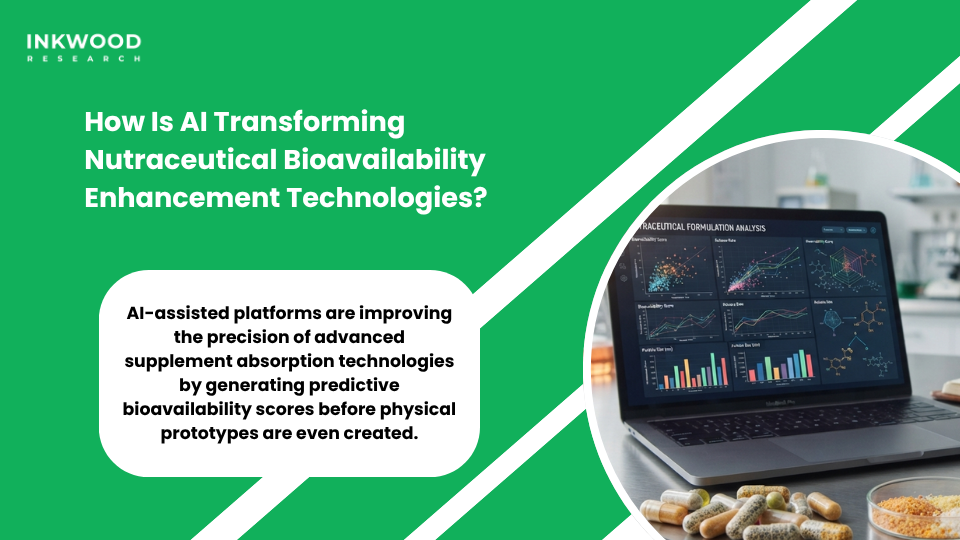
Additionally, AI-assisted platforms are improving the precision of advanced supplement absorption technologies by generating predictive bioavailability scores before physical prototypes are even created. This capability is compressing timelines significantly for brands competing in the innovative nutraceutical formulations market opportunities space.
Liposomal and Lipid-Based Delivery Systems
Liposomal nutraceutical delivery systems represent one of the most clinically validated approaches to bioavailability enhancement. The lipid bilayer structure mimics cell membranes, thereby improving nutrient absorption through both endocytosis and direct fusion pathways.
Meanwhile, the lipid-based nutraceutical delivery systems market growth is being driven by:
- Growing clinical evidence supporting phospholipid-encapsulated vitamins and minerals
- Rising consumer acceptance of advanced supplement absorption technologies
- Investment by both startups and large ingredient suppliers in innovative nutraceutical formulations market opportunities
- AI-optimized formulation tools that accelerate liposome sizing, stability testing, and scalability assessment
Inkwood Research | Client Case Study
A leading North American nutraceutical brand approached Inkwood Research to understand competitive positioning in the encapsulated nutraceuticals market. Our team analyzed technology gaps in their current liposomal nutraceutical delivery systems portfolio, mapped competitor innovations in nanoencapsulation in nutraceuticals, and identified high-growth white spaces in the controlled release nutraceuticals market forecast. Based on our findings, the client repositioned its R&D pipeline toward AI-assisted formulation platforms, resulting in a faster route to differentiated product launches and a stronger competitive posture in the functional nutraceuticals market growth segment.
What Does the North America Advanced Delivery Nutraceuticals Market Look Like?
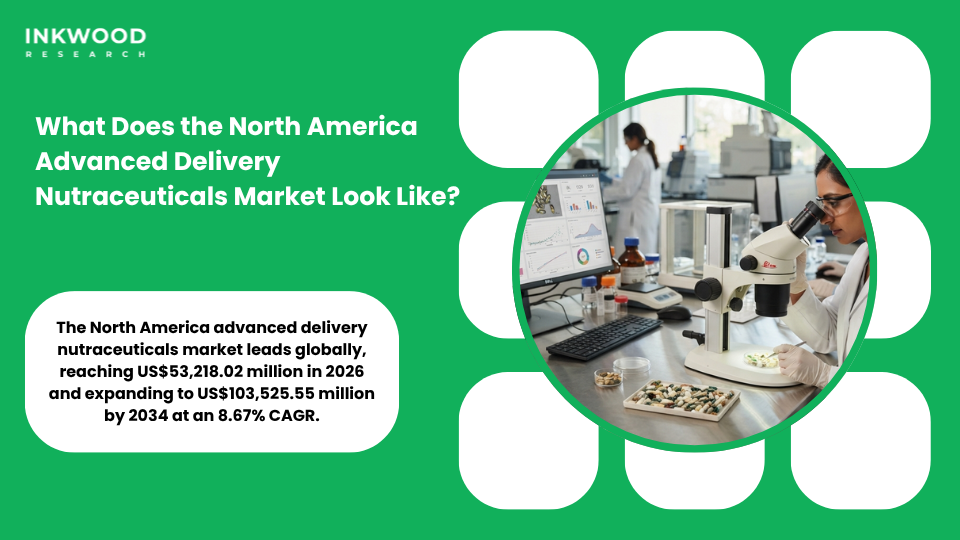
The North America advanced delivery nutraceuticals market leads globally, reaching US$53,218.02 million in 2026 and expanding to US$103,525.55 million by 2034 at an 8.67% CAGR. Several structural drivers underpin this leadership position.
Key Drivers in the US and Canada
- Strong consumer awareness of bioavailability enhancement supplements, technology, and evidence-based nutrition
- Robust investment in nutraceutical R&D trends and investment opportunities across academic-industry partnerships
- High penetration of advanced oral delivery systems nutraceuticals through specialty retail and e-commerce channels
- FDA-compliant innovation frameworks that incentivize nanotechnology in dietary supplements applications
- Growing demand for personalized nutraceutical delivery systems tailored to individual genetic and microbiome profiles
Furthermore, US consumers increasingly seek precision nutraceuticals market trends solutions that deliver targeted outcomes. AI-driven platforms capable of generating personalized formulations at scale are consequently attracting significant venture investment across North America.
Regulatory Tailwinds
The FDA’s guidance on nanotechnology in food and dietary supplements has clarified pathways for novel carriers, including solid lipid nanoparticles, nutraceuticals and novel nutraceutical carriers market entrants. Consequently, companies with well-documented safety and efficacy data for their delivery systems are now better positioned to commercialize advanced supplement absorption technologies at speed.
How Is Europe’s Nutraceutical Delivery Systems Market Evolving?
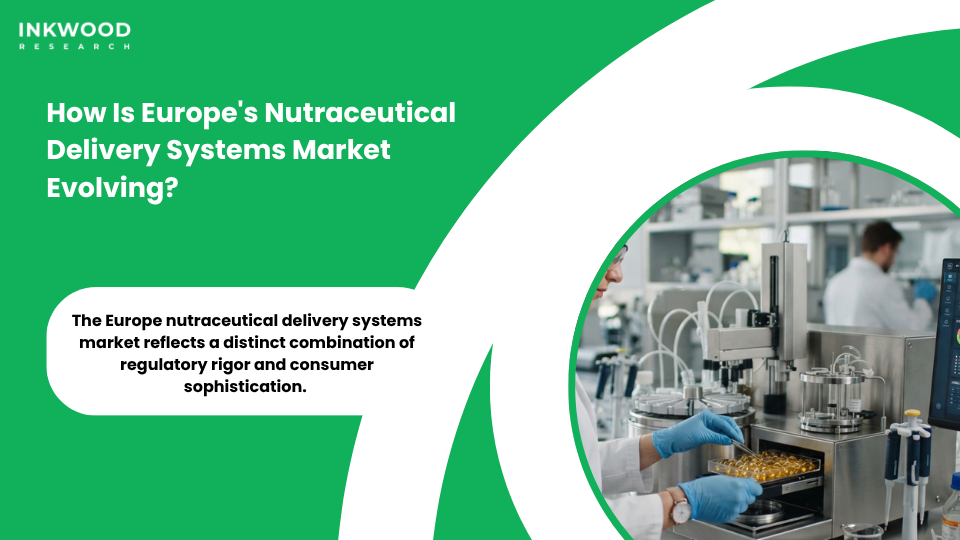
The Europe nutraceutical delivery systems market reflects a distinct combination of regulatory rigor and consumer sophistication. Growing from US$35,092.67 million in 2026 to US$70,820.72 million by 2034 at a 9.17% CAGR, it is the second-largest region globally and a critical battleground for advanced delivery innovation.
Clean Label and Sustainability Pressures
European consumers and regulators are placing increasing pressure on clean-label delivery systems nutraceuticals. This trend is meaningfully reshaping formulation priorities, driving demand for:
- Plant-derived encapsulation materials in microencapsulation nutraceutical applications
- Reduced additive profiles in sustained-release nutraceutical formulations
- Transparent sourcing documentation for functional ingredient delivery systems market participants
Additionally, the EU’s framework for health claims under Regulation (EC) No 1924/2006 continues to shape what manufacturers can communicate about bioavailability enhancement nutraceuticals, pushing the market toward substantiated, clinically verified delivery platforms.
Innovation Clusters and R&D Investment
Germany, the Netherlands, and the UK host some of the world’s most active nutraceutical innovation market competitive landscape clusters. These ecosystems combine academic R&D in phytosome technology, nutraceuticals, and lipid-based systems, strong pharmaceutical-nutraceutical crossover expertise applicable to advanced oral delivery systems, and growing venture investment in precision nutraceuticals market trends and AI formulation startups. Moreover, European contract research organizations are increasingly specializing in advanced nutraceutical delivery systems market size 2026 benchmarking, giving brands access to faster validation pathways.
Inkwood Research | Client Case Study
A European ingredients manufacturer engaged Inkwood Research to map the competitive landscape in the lipid-based nutraceutical delivery systems market growth. Our analysis benchmarked phytosome technology nutraceuticals innovations across ten major competitors, modeled growth trajectories for clean-label delivery systems nutraceuticals, and identified underserved application segments. The client used our findings to refine its product roadmap and target underpenetrated opportunities within the Europe nutraceutical delivery systems market trends, resulting in a revised go-to-market strategy with stronger regional differentiation.
Why Is Asia-Pacific the Fastest-Growing Region for Nutraceutical Innovation?
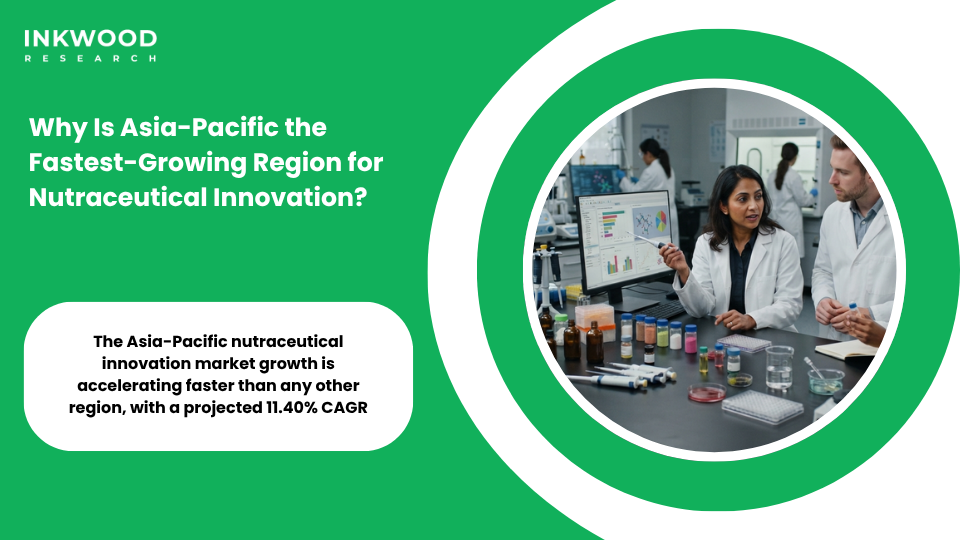
The Asia-Pacific nutraceutical innovation market growth is accelerating faster than any other region, with a projected 11.40% CAGR; it is projected to carry the market from US$39,117.09 million in 2026 to US$92,781.60 million by 2034. Several converging forces are driving this momentum.
China and India as Growth Engines
- China’s expanding middle class is fueling demand for encapsulated nutraceuticals market products with demonstrated efficacy
- India’s Ayurveda-influenced nutraceutical sector is adopting phytosome technology nutraceuticals to modernize traditional formulations
- Government-backed nutrition programs across both markets are elevating awareness of the functional nutraceuticals market growth opportunities
- Rapid e-commerce growth is opening new distribution channels for enhanced absorption of dietary supplements market products
- Domestic manufacturing investment is reducing reliance on imported carriers, supporting competitive nutraceutical R&D trends and investment opportunities
Furthermore, both China and India are channeling government resources into preventive healthcare programs, creating a strong policy tailwind for the advanced nutraceutical delivery systems market size 2026 expansion across the region.
Smart Nutraceutical Delivery Platforms in APAC
AI-driven smart nutraceutical delivery platforms are gaining real traction across the Asia-Pacific. Startups and established players are deploying machine learning tools for personalized nutrition delivery technologies tailored to Asian dietary and health profiles, AI-powered quality control systems for microencapsulation nutraceutical applications, and predictive analytics for controlled release nutraceuticals market forecast modeling. Consequently, Asia-Pacific is not simply a manufacturing hub for the next generation nutraceuticals market; it is fast becoming an innovation origin point as well.
Which Companies Are Leading Advanced Nutraceutical Delivery Innovation?
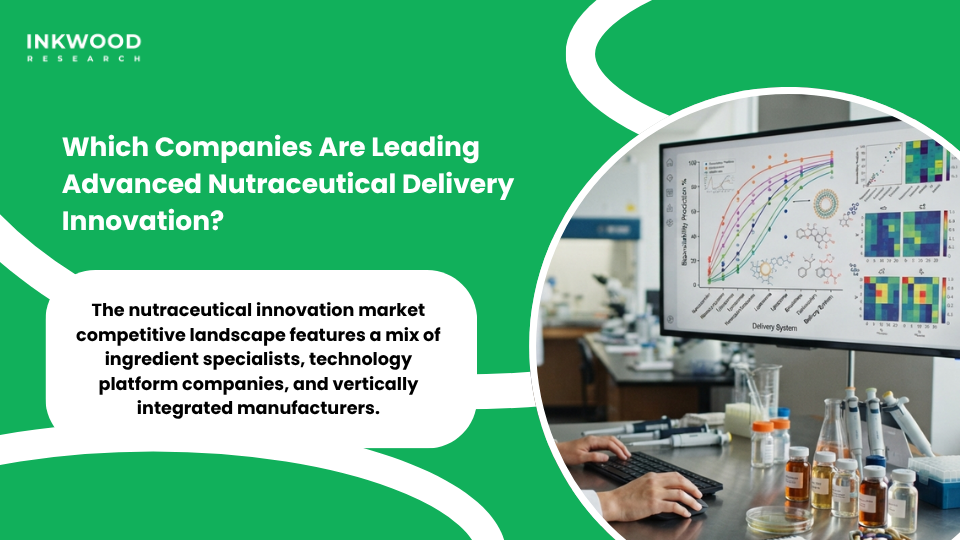
The nutraceutical innovation market competitive landscape features a mix of ingredient specialists, technology platform companies, and vertically integrated manufacturers. Several organizations stand out for their recent advances in targeted nutraceutical delivery technologies:
- BASF SE: Has expanded its liposomal nutraceutical delivery systems portfolio through strategic R&D investments in encapsulation and bioavailability optimization
- DSM-Firmenich: Has accelerated AI-assisted formulation capabilities, particularly in sustained-release nutraceutical formulations and personalized nutrition delivery
- Balchem Corporation: Continues to advance microencapsulation platforms, targeting both the North America and Asia-Pacific advanced delivery nutraceuticals market segments
- Lonza Group: Is deepening its nanoencapsulation technology in nutraceuticals capabilities, supporting pharmaceutical-grade precision for functional nutrition applications
Additionally, a growing wave of biotech-nutraceutical startups is entering the space, deploying AI in nutraceutical formulation development to challenge established players on speed, personalization, and cost efficiency.
Key Takeaways
- Global market: Advanced delivery nutraceuticals market grows from US$139.43 billion in 2026 to US$289.45 billion by 2034 at a 9.56% CAGR
- AI impact: Artificial intelligence is now central to nutraceutical bioavailability enhancement technologies, from nanoencapsulation in nutraceuticals to predictive formulation design
- Regional leadership: North America advanced delivery nutraceuticals market leads globally; Asia-Pacific nutraceutical innovation market growth at 11.40% CAGR signals the next center of gravity
- Europe: Europe nutraceutical delivery systems market trends are shaped by clean label demands, EU health claim regulations, and strong innovation cluster activity
- Personalization: Companies investing in personalized nutraceutical delivery systems and smart nutraceutical delivery platforms are positioned for the highest value growth
- Competitive edge: AI in nutraceutical formulation development is moving from experimental to essential across all three regions
Conclusion
The intersection of artificial intelligence and the advanced delivery nutraceuticals market is not a future scenario; it is the present reality reshaping how products are formulated, validated, and delivered to consumers worldwide. The global nutraceutical delivery technology market is growing rapidly, and organizations that embed AI into their formulation strategy will set the pace for the decade ahead.
Inkwood Research provides the market intelligence and strategic analysis needed to navigate the functional nutraceuticals market growth landscape with confidence.
Connect with our team to explore how our insights can support your innovation strategy in advanced nutraceutical delivery systems.
Frequently Asked Questions (FAQs)
The global market is valued at US$139.43 billion in 2026, growing to US$289.45 billion by 2034 at a 9.56% CAGR, driven by AI-powered formulation tools and bioavailability enhancement technologies.
AI models optimize encapsulation parameters, predict absorption profiles, and reduce formulation cycles for liposomal and nanoencapsulation systems, compressing development timelines significantly.
North America leads with US$53.22 billion in 2026. However, Asia-Pacific is expanding the fastest at an 11.40% CAGR, making it the most dynamic growth region through 2034.
Key technologies include nanoencapsulation in nutraceuticals, liposomal delivery, solid lipid nanoparticles, phytosome systems, sustained release nutraceutical formulations, and controlled release platforms.
EU regulations and consumer preferences are driving demand for plant-derived, additive-minimal encapsulation materials and clinically substantiated claims across European markets.
Personalized nutraceutical delivery represents a significant shift from “one-size-fits-all” supplements to precision, AI-tailored formulations designed to match individual health profiles, biomarkers, and genetic makeup.