Table of Contents

This analysis is brought to you by Inkwood Research, a leading market intelligence firm specializing in Asia-Pacific healthcare markets, hospital-in-the-home innovation, and acute care delivery systems. Our research team combines extensive experience analyzing Australian HITH programs, Chinese community health infrastructure, and remote patient monitoring adoption across APAC. Through strategic partnerships with healthcare networks, policy consultants, and technology developers across Australia and China, we deliver actionable intelligence for enterprises navigating the Asia-Pacific acute care at home market.
TLDR
Asia-Pacific is emerging as one of the most dynamic frontiers for acute care at home growth, driven by Australia’s mature hospital-in-the-home model and China’s Healthy China 2030 initiative reshaping community-based care at extraordinary scale. The Australia acute care at home market is projected to grow from US$376.70 million in 2026 to US$1,791.10 million by 2034 at a 21.52% CAGR. Meanwhile, the China acute care at home market is forecast to reach US$4,624.18 million by 2034 from US$886.70 million in 2026 at a remarkable 22.93% CAGR, making it one of the fastest-growing hospital at home market opportunities globally.
This blog is essential reading for Australian hospital executives, health technology investors, and APAC market entry strategists evaluating the Asia-Pacific acute care at home market. Additionally, policymakers tracking China’s community health reforms, digital health platform developers, remote patient monitoring providers, and global healthcare consultants assessing the China acute care at home market will find targeted, evidence-based intelligence here.
Why Is the Asia-Pacific Acute Care at Home Market Growing So Rapidly?

Across Asia-Pacific, a combination of aging demographics, rising chronic disease prevalence, and healthcare system capacity pressures is accelerating the shift to home-based acute care delivery. Australia brings decades of operational experience through its Hospital in the Home (HITH) model, while China is leveraging national policy ambition and digital infrastructure at a scale few other health systems can match. Together, these two markets represent distinct but complementary stories about how the acute care at home market is evolving in very different healthcare contexts.
Furthermore, the post-pandemic period has normalized virtual consultations and remote patient monitoring across APAC, lowering the cultural and logistical barriers that previously slowed adoption. As a result, both the Australia acute care at home market and the China acute care at home market are growing at rates that significantly outpace the global average for the hospital at home market, creating compelling opportunities for healthcare executives and investors alike.
Key Insights from the 2026 Global Hospital in the Home Summit in Sydney
The Hospital in the Home Society of Australasia (HISA) convenes the Global Hospital in the Home Summit as a gathering point for clinicians, policymakers, and healthcare innovators advancing home-based acute care delivery worldwide. The 2026 edition in Sydney centers on several themes that reflect both the maturity of the Australia acute care at home market and the broader APAC opportunity.
Key themes anticipated for Sydney 2026 include:
- Workforce models for scaling acute care home services beyond metropolitan centers into regional and rural settings
- Technology standardization for RPM and digital health platform integration across diverse hospital systems
- Value-based care reimbursement frameworks for hospital at home services that support sustainable, scalable delivery
- Lessons from Australia’s HITH programs that are directly applicable to emerging APAC markets, including India, Thailand, and Southeast Asia
- International collaboration on acute care home treatment market regulation and patient safety frameworks
Moreover, the summit serves as a platform where Australian health systems share what’s working in deploying acute care at home services at scale. Consequently, global attendees leave with practical intelligence that informs their own national programs, making Sydney 2026 a genuinely consequential event for the acute home healthcare market worldwide.
How Has Australia Built a Leading Hospital at Home Market?

Australia is widely regarded as a global pioneer of the hospital-in-the-home model, with structured HITH programs operating across every major state for more than three decades. The model allows hospitals to formally admit patients to a “virtual bed” in their home, delivering IV antibiotics, wound care, and post-surgical monitoring under the clinical governance of a hospital service. This is not a step-down or community nursing model; it is acute hospital care, delivered at home with full clinical accountability.
The Australian Government Department of Health and Aged Care has committed over AU$4.3 billion to expand home care services under the Support at Home program, reflecting a policy commitment to home-based care that extends from aged care into acute clinical settings. Additionally, state-level health departments in Victoria, New South Wales, and Queensland have developed HITH programs that serve thousands of patients annually. As a result, the Australia acute care at home market benefits from both mature infrastructure and sustained policy investment.
What Makes Australia’s HITH Model Distinct from Other Hospital at Home Programs?
- Clinical governance: patients are formally admitted to the hospital under HITH, ensuring full acute care standards apply
- Multidisciplinary teams: nurses, pharmacists, physiotherapists, and physicians collaborate in the home setting
- Electronic monitoring: real-time vital sign data is transmitted to hospital monitoring desks throughout the episode of care
- Insurance coverage: HITH is covered under Australia’s Medicare and private health insurance frameworks
What Are the Core Drivers of the Australia Acute Care at Home Market?

Several structural factors are accelerating the acute home healthcare market in Australia beyond its already-established HITH foundation. Understanding these drivers is essential for any stakeholder entering or expanding within this space:
- Elective surgery recovery: HITH is being used to shorten post-surgical inpatient stays, freeing hospital beds for higher-acuity patients
- Telehealth normalization: Australia’s national telehealth framework, significantly expanded since 2020, has embedded virtual care into routine clinical practice
- Aged care reform: The transition to the Support at Home model is creating integration points between aged care and acute home care delivery
- Regional access equity: HITH programs are extending specialist-level acute care to rural communities where hospital access remains limited
Furthermore, Australia’s investment in digital health infrastructure, particularly the My Health Record national patient record system and the Australian Digital Health Agency’s interoperability agenda, provides the data backbone that home-based acute care teams need to manage high-acuity patients safely outside a hospital setting.
How Is China’s Healthy China 2030 Initiative Expanding Home-Based Acute Care?
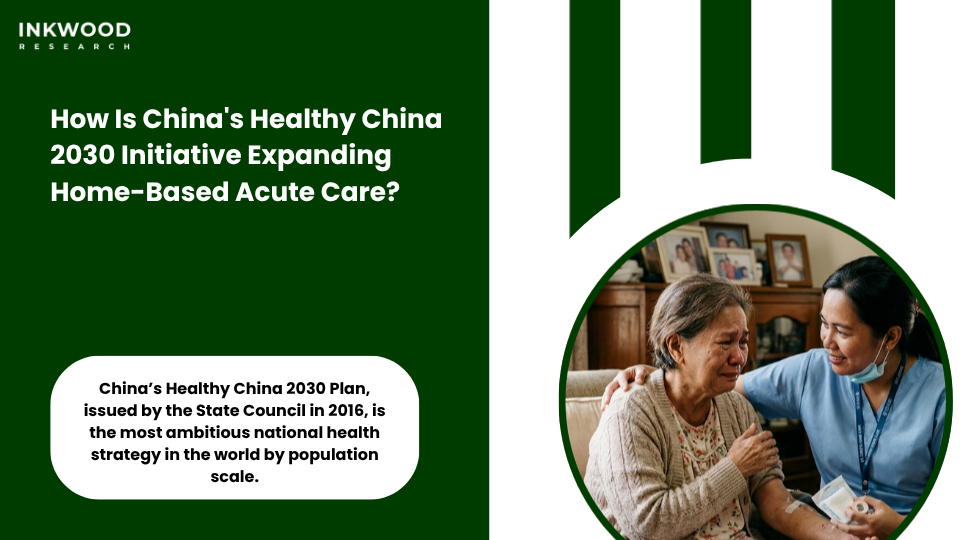
China’s Healthy China 2030 Plan, issued by the State Council in 2016, is the most ambitious national health strategy in the world by population scale. Among its core objectives is the goal of creating a ‘15-minute healthcare circle’, ensuring that over 90% of residents can access quality medical services within 15 minutes of their home by 2030. This structural commitment to community-based care is the policy foundation on which China’s expanding home-based acute care market is being built.
Critically, this initiative extends well beyond wellness and prevention. China’s Internet Plus Healthcare policy framework, which encourages the development of online hospitals, telemedicine platforms, and AI-assisted diagnostics, has created a rapidly growing digital care ecosystem that increasingly supports acute-level home treatment. Consequently, the China acute care at home market is being shaped by the intersection of state-directed infrastructure investment and rapidly scaling private digital health platforms that reach patients in both urban centers and rural communities.
What Role Do Community Health Centers Play in China’s Home-Based Acute Care Expansion?
- Over 36,000 community health centers and stations operate across urban China, serving as front-line nodes for home care delivery
- Rural health clinics provide primary and acute care touchpoints in more than 630,000 villages nationwide
- The Healthy China 2030 plan mandates integrated care pathways linking community centers with secondary and tertiary hospitals
What Does the China Acute Care at Home Market Opportunity Look Like?
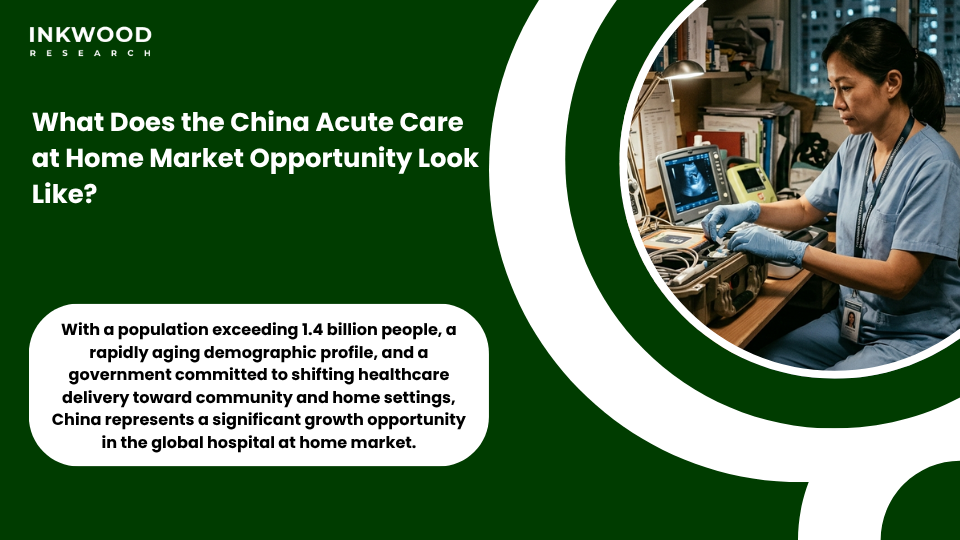
The scale of opportunity in the China acute care at home market is difficult to overstate. With a population exceeding 1.4 billion people, a rapidly aging demographic profile, and a government committed to shifting healthcare delivery toward community and home settings, China represents a significant growth opportunity in the global hospital at home market. The National Health Commission of China is overseeing a regulatory framework for Internet Hospitals that now enables certified physicians to diagnose, prescribe, and follow up with patients entirely online.
Combined with national initiatives to deploy AI-based remote patient monitoring tools through community health centers, the infrastructure for acute care at home services in China is scaling faster than anywhere else in the world. Moreover, China’s digital health giants are investing heavily in extending their platforms from chronic disease management into acute care pathways, a transition that is fundamentally reshaping what the China acute care at home market looks like for both domestic and international stakeholders.
Who Are the Key Players Shaping the APAC Acute Home Healthcare Market?

The competitive landscape across the Asia-Pacific acute care at home market features a diverse mix of established health system operators, private insurers, and digital health platforms, each building from a different starting point.
Australia
- Silver Chain Group: One of Australia’s largest not-for-profit home care providers, Silver Chain operates HITH programs across Western Australia and South Australia, delivering IV therapies, wound management, and post-acute monitoring
- Medibank Private: Actively investing in home-based acute care programs that reduce hospital admissions and costs while improving member health outcomes
- Calvary Health Care: A nationally operating health system running HITH programs across multiple states, with particular strength in post-surgical and palliative acute care at home services
China
- Ping An Health (平安健康): One of China’s largest digital health platforms, providing telemedicine, AI diagnostics, and chronic disease management services, increasingly extended to acute home care pathways
- WeDoctor (微医): A digital health platform with a nationwide network of internet hospitals, providing licensed physician consultations and follow-up care that supports home-based acute treatment
- Alibaba Health (阿里健康): Leveraging Alibaba’s logistics and digital infrastructure to deliver medication management, telemedicine, and health monitoring services for home-based patients at scale
Key Takeaways
- The Australia acute care at home market is projected to grow from US$376.70 million in 2026 to US$1,791.10 million by 2034 at a 21.52% CAGR
- The China acute care at home market is forecast to reach US$4,624.18 million by 2034 from US$886.70 million in 2026 at a 22.93% CAGR
- Australia’s Hospital in the Home model, supported by the Government’s AU$4.3 billion Support at Home commitment, is one of the world’s most operationally mature hospital at home programs
- China’s Healthy China 2030 plan targets a 15-minute healthcare circle for 95% of residents, directly driving the infrastructure for community-level and home-based acute care
- The Sydney 2026 Global Hospital in the Home Summit will surface critical insights on workforce models, technology standardization, and value-based reimbursement for the acute care at home services industry
- Key players, including Silver Chain Group, Medibank, Ping An Health, WeDoctor, and Alibaba Health, are building the operational and technological foundations of the APAC acute home healthcare market
Conclusion
The Asia-Pacific acute care at home market is being shaped by two distinct but equally compelling forces: Australia’s decades-long operational excellence in hospital-in-the-home delivery, and China’s state-directed ambition to reimagine healthcare access for 1.4 billion people.
Both the Australia acute care at home market and the China acute care at home market are growing at rates that command serious attention from healthcare executives, investors, and technology developers globally. The Sydney 2026 Global Hospital in the Home Summit will bring these stories into focus, showcasing what the world’s most mature and most ambitious acute home healthcare market programs are building.
Inkwood Research provides the strategic intelligence and market analysis needed to navigate these opportunities with confidence.
Connect with our team to explore how our research can support your positioning in the Asia-Pacific acute care at home market.
Frequently Asked Questions
What is the size of the Australia acute care at home market?
The Australia acute care at home market is valued at US$376.70 million in 2026, projected to reach US$1,791.10 million by 2034 at a 21.52% CAGR.
What is the Global Hospital in the Home Summit in Sydney 2026?
The Sydney 2026 HISA summit convenes global clinicians and policymakers to advance hospital at home market innovations and share home-based acute care delivery best practices.
How does Australia's HITH model work for acute care patients?
Australia formally admits patients to virtual hospital beds at home, delivering acute-level clinical care under full hospital governance, covered by Medicare and private insurance.
What is China's Healthy China 2030 target for home-based care?
Healthy China 2030 aims to ensure 95% of residents have access to quality medical services within 15 minutes of their home, driving rapid home-based acute care infrastructure expansion.
What is the forecast for the China acute care at home market?
The China acute care at home market is projected to grow from US$886.70 million in 2026 to US$4,624.18 million by 2034 at a 22.93% CAGR.
Which companies lead the APAC acute home healthcare market?
Key players include Silver Chain Group and Medibank in Australia, alongside Ping An Health, WeDoctor, and Alibaba Health in the China acute care at home market.