Table of Contents

This analysis is brought to you by Inkwood Research, a leading market intelligence firm specializing in US healthcare policy, CMS reimbursement frameworks, and hospital at home program strategy. Our research team draws on deep expertise in Medicare and Medicaid reimbursement structures, acute home healthcare market dynamics, and health system program development across the United States. We deliver actionable intelligence for healthcare executives and investors navigating the evolving United States acute care at home market.
TLDR
The United States acute care at home market is at a defining inflection point. Legislative action has transformed what began as a pandemic-era waiver into a permanent feature of the US healthcare landscape. According to our analysis, the market is projected to grow from US$6,068.08 million in 2026 to US$21,541.02 million by 2034, at a CAGR of 17.16%. Reimbursement clarity, technology maturation, and expanding health system capacity are together powering this growth, and the Consolidated Appropriations Act of 2026 is the pivot that made it possible.
This blog is directly relevant for US hospital administrators, health system executives, and home health technology investors. Additionally, reimbursement strategy consultants, Medicare and Medicaid policy analysts, telehealth platform providers, and venture capital firms tracking the United States acute care at home market will find rigorous, policy-grounded intelligence to support strategic planning and investment decisions in this rapidly evolving space.
What Is the Current State of the United States Acute Care at Home Market?
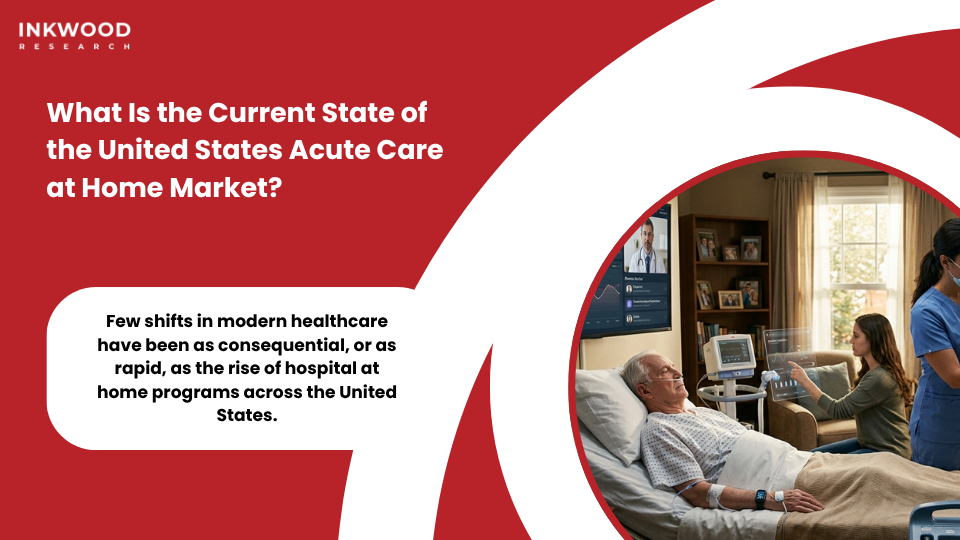
Few shifts in modern healthcare have been as consequential, or as rapid, as the rise of hospital at home programs across the United States. The United States acute care at home market is projected to grow from US$6,068.08 million in 2026 to US$21,541.02 million by 2034, at a CAGR of 17.16%. This trajectory reflects a healthcare system that is fundamentally rethinking where and how acute medical care is delivered.
The foundation for this transformation was laid during the COVID-19 pandemic, when the Centers for Medicare and Medicaid Services (CMS) launched its Acute Hospital Care at Home (AHCAH) waiver program. This authorization allowed approved hospitals to provide inpatient-level care in patients’ homes, removing regulatory barriers that had previously confined acute care to hospital settings. What followed was a rapid, large-scale demonstration of both clinical viability and patient demand.
From Emergency Waiver to Mainstream Policy
The AHCAH program quickly proved its value. Hospitals that had never considered home-based acute care enrolled hundreds of patients across conditions ranging from pneumonia and congestive heart failure to sepsis and post-surgical recovery. Patient satisfaction scores consistently exceeded those of traditional inpatient settings. Moreover, readmission rates and clinical outcome data showed results equivalent to, and in several cases better than, conventional hospitalization.
Congressional action followed steadily. The Consolidated Appropriations Act of 2023 extended the AHCAH waiver, and subsequent legislation continued this trajectory. By 2026, the hospital at home market in the US had moved decisively from a waiver-based experiment to an established, reimbursement-supported care delivery model, and the United States acute care at home market is growing rapidly as a result.
A private equity firm focused on healthcare technology engaged Inkwood Research to assess investment opportunities within the United States acute care at home market. Our analysis covered regulatory risk, reimbursement sustainability, competitive positioning, and technology enablement across the home-based acute care ecosystem. The firm used our findings to build a focused investment thesis and subsequently deployed capital into two high-growth platform companies in the space.
How Did the Consolidated Appropriations Act of 2026 Change Hospital at Home?
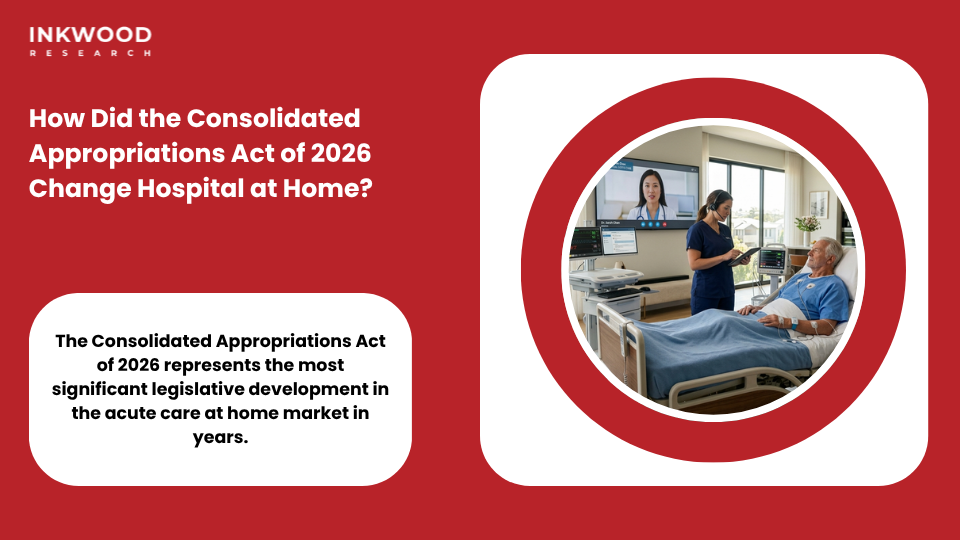
The Consolidated Appropriations Act of 2026 represents the most significant legislative development in the acute care at home market in years. Rather than another short-term extension, the Act addressed the structural uncertainty that had long constrained health system investment in hospital at home programs. For the first time, health systems could plan long-term infrastructure investments with genuine confidence that the reimbursement foundation would hold.
Several provisions have had immediate and measurable market impact across the United States acute care at home market:
- Reimbursement continuity: The Act extended and clarified Medicare payment rates for inpatient-equivalent services delivered at home, giving health systems the financial confidence to invest in long-term program infrastructure.
- Expanded patient eligibility: More patients now qualify for home-based acute care under Medicare, broadening the addressable patient population significantly for participating health systems.
- Telehealth provisions: The Act reinforced reimbursement for telehealth acute care services, supporting the virtual daily visit model that underpins most hospital at home programs.
- Connected care technology coverage: New provisions addressed coverage of remote patient monitoring devices and AI-enabled care platforms as necessary components of approved programs.
What This Means for Health System Strategy
The implications for health systems are significant. Before the Act, uncertainty around reimbursement made many organizations hesitant to invest in the infrastructure required for large-scale acute care home services. Now, with clearer financial frameworks in place, hospitals and health networks have begun expanding their programs meaningfully. Furthermore, the structural alignment between legislative intent and clinical evidence has reduced regulatory risk to a level that institutional investors can confidently underwrite, unlocking a new wave of capital for the hospital at home market.
What Does Reimbursement Look Like for Home-Based Acute Care in the US?
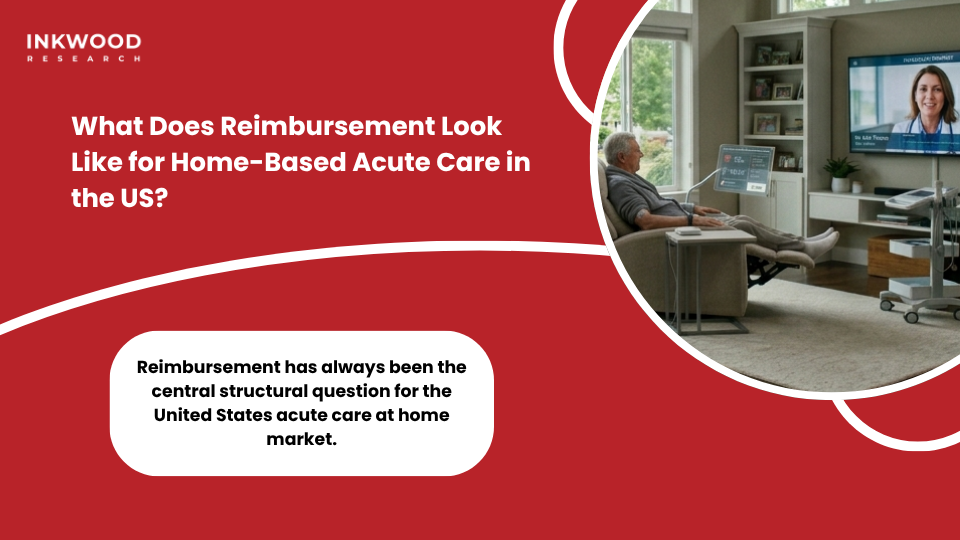
Reimbursement has always been the central structural question for the United States acute care at home market. Under the AHCAH framework codified by the 2026 Act, hospitals approved by CMS receive Medicare reimbursement at rates equivalent to traditional inpatient care for the same diagnosis-related groups (DRGs). This parity model is foundational; it means that health systems face no financial penalty for choosing a home setting over a hospital bed.
Payer Expansion Beyond Medicare
Medicare has been the primary payer driving the hospital at home market, but commercial payers are accelerating their engagement. Several major US health insurers have begun developing value-based contracting models that include acute home healthcare as a covered benefit. Moreover, Medicaid programs in a growing number of states have introduced or expanded waivers supporting home-based acute care delivery, broadening the market well beyond fee-for-service Medicare.
Additionally, employer-sponsored health plans are recognizing the cost advantages of acute care at home market programs. As more payers move toward outcomes-based contracting, the home-based acute care market is becoming a preferred delivery channel, not just a clinical alternative. This multi-payer momentum is one of the most consequential structural shifts in the United States acute care at home market today.
Aligning with this, a major US health insurer engaged Inkwood Research to evaluate the financial impact of expanding home-based acute care market coverage in its commercial plans. Our analysis modeled utilization patterns, cost-per-episode comparisons, and member satisfaction outcomes across three acute conditions. The insurer subsequently launched a pilot program covering acute care at home services, with full rollout planned based on pilot performance data.
How Are US Health Systems and Technology Companies Responding?
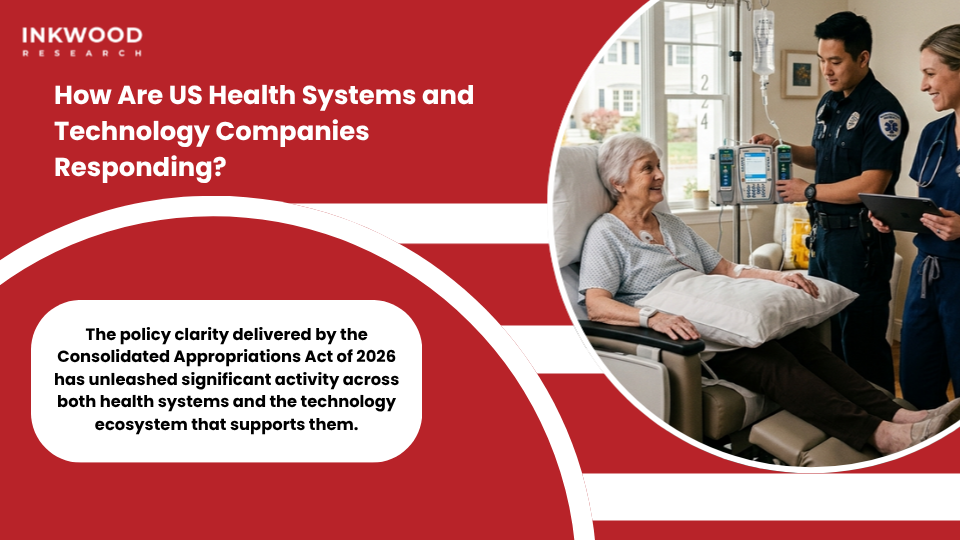
The policy clarity delivered by the Consolidated Appropriations Act of 2026 has unleashed significant activity across both health systems and the technology ecosystem that supports them. Major health systems are scaling programs, and specialized technology companies are competing intensely to build the platforms that power hospital at home services at scale.
Key players shaping the United States acute care at home market include:
- Medically Home: Partners with leading academic medical centers, including Massachusetts General Hospital, to deliver hospital-level care through its technology platform. Following the 2026 Act, the company has expanded health system partnerships significantly.
- Dispatch Health: Deploys mobile acute care teams to patient homes, integrating with payers and health systems nationwide. Its model has scaled rapidly with improved reimbursement certainty under the new legislative framework.
- Contessa Health (acquired by Amedisys): Offers a hospital at home model focused on post-surgical and medical acute conditions, with payer partnership arrangements across the US and a strong position in the acute home healthcare market.
- Best Buy Health / Current Health: A continuous wearable monitoring platform that underpins remote monitoring acute care services for multiple US hospital at home programs, enabling real-time clinical oversight at scale.
- Biofourmis: Provides an AI-powered remote care platform with predictive analytics that identifies patient deterioration early, supporting clinical teams managing home-based acute care patients across major US health systems.
Technology providers, including Philips, Masimo, and Dexcom, are also supplying the connected monitoring devices that enable clinical teams to safely manage patients outside hospital walls, forming a critical layer of the acute care home services infrastructure.
What Challenges Still Face the Acute Care at Home Market?
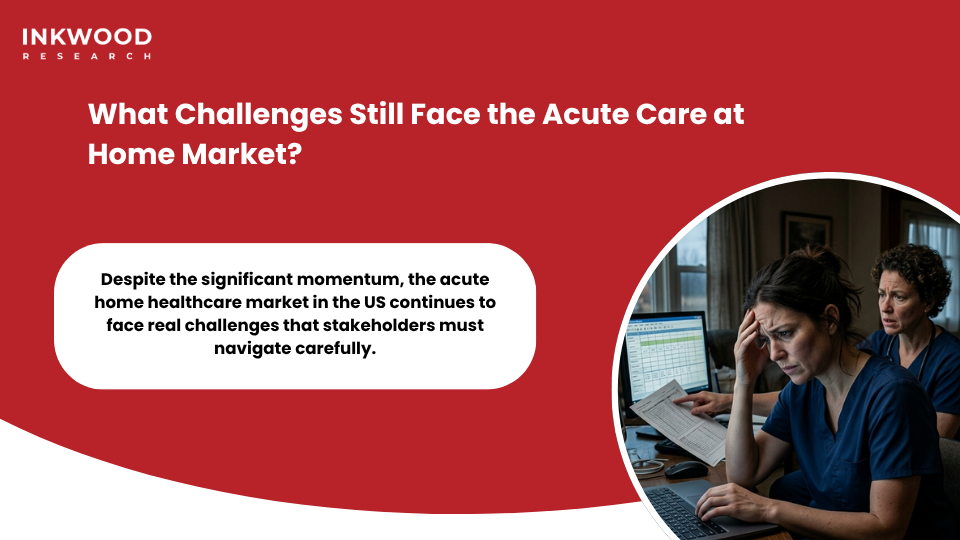
Despite the significant momentum, the acute home healthcare market in the US continues to face real challenges that stakeholders must navigate carefully. Understanding these barriers is as important as understanding the opportunity:
- Workforce capacity: Hospital at home programs require clinical staff who can coordinate both in-person home visits and remote monitoring oversight. Workforce shortages in nursing and advanced practice providers remain a meaningful constraint on program scale.
- Technology interoperability: Connecting remote monitoring platforms to electronic health records and clinical workflows is technically complex. Interoperability gaps still slow deployment at many health systems, limiting the efficiency gains that justify program investment.
- Patient eligibility and selection: Not all patients are appropriate for home-based acute care. Clinical selection criteria must be carefully applied to maintain program safety standards and avoid adverse outcomes that could undermine confidence in the model.
- Geographic access: Urban health systems have built the most mature acute care home services programs. Rural and underserved communities, however, remain harder to reach, limited by both technology infrastructure and clinical staffing models capable of supporting home visits at scale.
Addressing these challenges is the next frontier for the United States acute care at home market. The companies and health systems that solve them effectively will define the next phase of growth and capture a disproportionate share of a market projected to exceed US$21 billion by 2034.
Key Takeaways
- The United States acute care at home market is projected to grow from US$6,068.08 million in 2026 to US$21,541.02 million by 2034 at a CAGR of 17.16%.
- The Consolidated Appropriations Act of 2026 has transformed hospital at home programs from a waiver-based experiment to a legislatively supported, reimbursement-stable care delivery model.
- Medicare payment parity for acute care home services is the financial foundation enabling health systems to invest confidently in long-term program infrastructure.
- Commercial payers and Medicaid programs are accelerating engagement with the home-based acute care market, broadening the addressable market well beyond Medicare fee-for-service.
- Technology companies, including Medically Home, Dispatch Health, Biofourmis, and Best Buy Health, are building the platforms powering hospital at home market programs at scale across the US.
- Workforce capacity, technology interoperability, and geographic access remain the key challenges shaping the next phase of the acute home healthcare market.
Conclusion
The Consolidated Appropriations Act of 2026 has done more than extend a program; it has ratified a fundamentally different model of acute care delivery in the United States. The United States acute care at home market is no longer asking whether hospital-level home care is clinically viable or financially sustainable. It has answered both questions decisively. The challenge now is execution: scaling programs efficiently, expanding access equitably, and continuing to drive the technology innovation that makes safe home-based acute care possible at scale.
Inkwood Research provides the market intelligence and strategic analysis needed to act with confidence in this evolving landscape. Connect with our team to explore how our insights can support your positioning in the United States acute care at home market.
Frequently Asked Questions
How large is the United States acute care at home market?
The market is projected to grow from US$6,068.08 million in 2026 to US$21,541.02 million by 2034 at a CAGR of 17.16%.
What did the Consolidated Appropriations Act of 2026 change for hospital at home?
It extended Medicare reimbursement, expanded patient eligibility, reinforced telehealth payment, and covered connected monitoring technology for home-based acute care programs.
Does Medicare cover hospital at home services in the US?
Yes. CMS reimburses approved hospital at home programs at inpatient-equivalent rates under the Acute Hospital Care at Home framework.
Which conditions can acute care at home treat in the US?
Common conditions include pneumonia, heart failure, COPD exacerbation, urinary tract infections, sepsis, and post-surgical recovery.
Which companies are leading the US hospital at home market?
Medically Home, Dispatch Health, Contessa Health, Biofourmis, and Best Buy Health are key platform providers shaping the US market.
What are the main barriers to scaling acute home healthcare in the US?
Workforce shortages, technology interoperability gaps, patient selection complexity, and geographic access constraints are the primary barriers.