Table of Contents
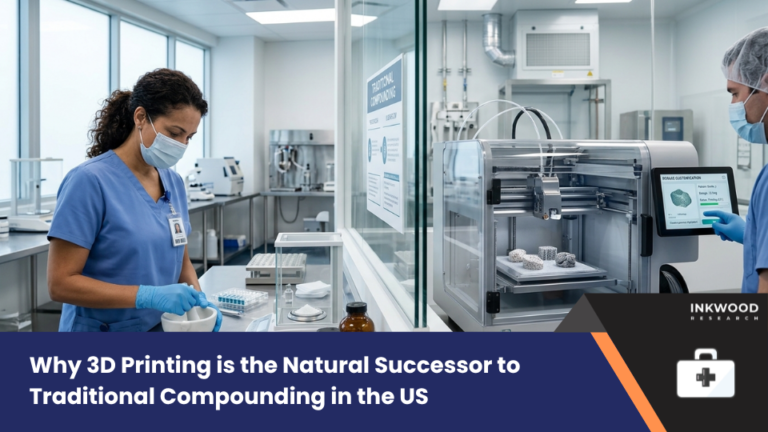
This analysis is brought to you by Inkwood Research, a leading market intelligence firm specializing in US pharmaceutical manufacturing innovation, FDA regulatory ecosystems, and advanced drug delivery technology. Our research team draws on deep expertise in pharmaceutical compounding regulations, 3D printing drug manufacturing, and personalized medicine adoption across hospital pharmacies, specialty clinics, and biotech manufacturers. Through partnerships with US pharmaceutical innovators and regulatory specialists, we deliver intelligence that supports confident decision-making in the United States pharmaceutical 3D printing manufacturing market.
TLDR
Traditional pharmaceutical compounding has served patients well for decades, but its limitations in precision, scale, and dose variability are becoming harder to ignore. The United States pharmaceutical 3D printing manufacturing market is projected to grow from US$209.17 million in 2026 to US$589.37 million by 2034, at a 13.82% CAGR. Companies like Aprecia Pharmaceuticals and Triastek are already demonstrating what happens when digital fabrication replaces manual compounding. The result is more precise, more reproducible, and increasingly accessible 3D printed drugs that are ready for mainstream clinical use.
This blog is directly relevant for US hospital pharmacists, specialty compounding pharmacy operators, and pharmaceutical R&D executives evaluating next-generation drug production options. Additionally, healthcare investors tracking the pharmaceutical additive manufacturing market, regulatory affairs professionals working within FDA frameworks, and clinical supply chain strategists planning for on-demand drug manufacturing will find targeted, fact-grounded insights here.
What Is Traditional Compounding, and Where Does It Fall Short?
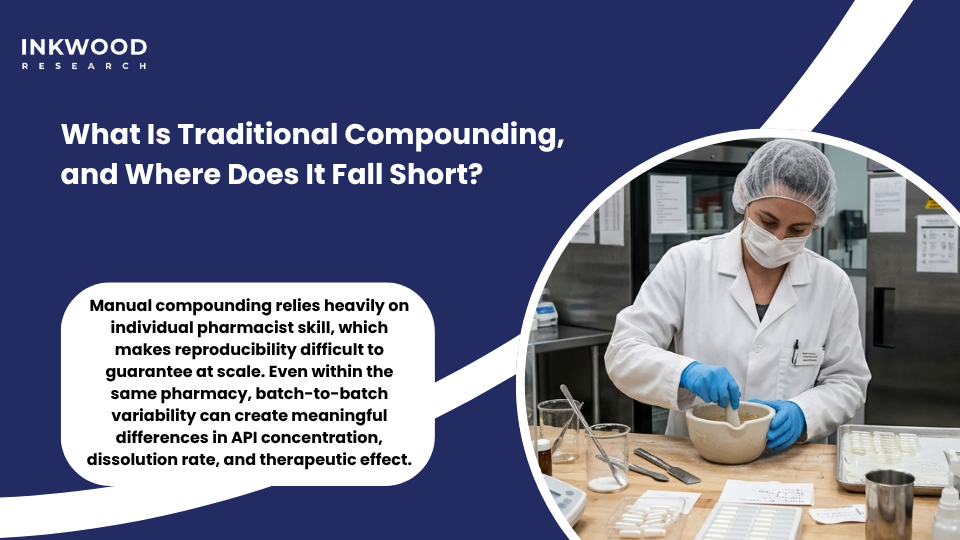
For as long as pharmacy has existed, compounding has played a critical role. When a commercially available drug doesn’t fit a patient’s needs because of an allergy, an unusual dose requirement, or a formulation issue, a compounding pharmacist steps in and creates a customized solution. That flexibility has been genuinely valuable, particularly for pediatric patients, hospice care, and individuals with rare conditions. However, as clinical expectations have evolved, the structural limitations of traditional compounding have become increasingly apparent.
Manual compounding relies heavily on individual pharmacist skill, which makes reproducibility difficult to guarantee at scale. Even within the same pharmacy, batch-to-batch variability can create meaningful differences in API concentration, dissolution rate, and therapeutic effect. Additionally, the FDA’s regulatory framework for compounding pharmacies distinguishes sharply between small-volume custom preparation and commercial-scale manufacturing. That distinction, while necessary, creates a ceiling on how far traditional compounding can evolve to meet growing demand for personalized medicine.
Why Precision and Scale Are the Two Problems 3D Printing Solves
The case for pharmaceutical 3D printing as the logical successor to compounding rests on two core arguments: precision and scalability. Digital fabrication controls API concentration, release architecture, and tablet geometry at a level that manual preparation simply cannot match. Moreover, because each production run follows an identical digital blueprint, the variability that undermines traditional compounding is fundamentally eliminated.
Scalability follows from that same digital foundation. A compounding pharmacy can serve dozens of patients per day; a pharmaceutical additive manufacturing facility can serve thousands, while still producing individualized formulations for each one. Consequently, on-demand drug manufacturing through 3D printing addresses both the clinical precision gap and the capacity constraint that have historically limited what compounding could achieve.
What is the Size of the United States Pharmaceutical 3D Printing Manufacturing Market?
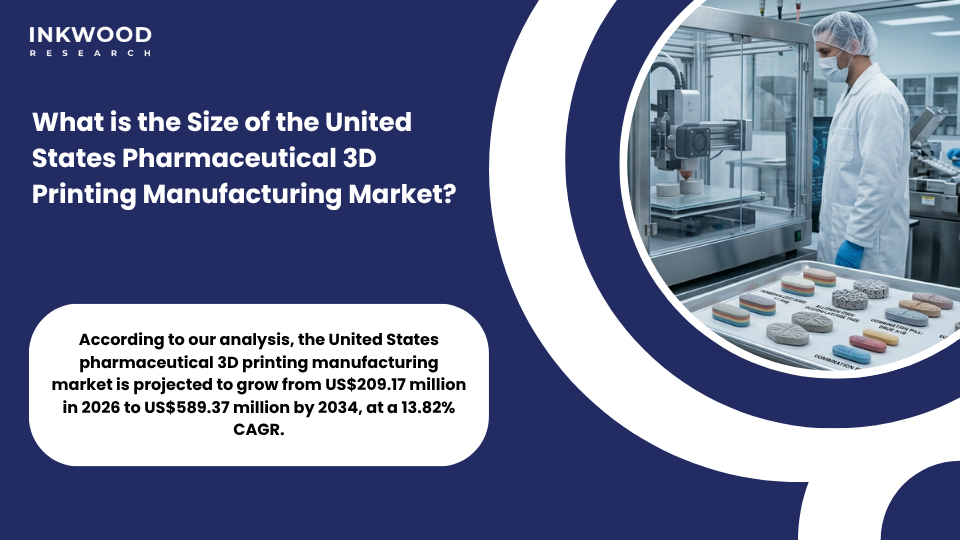
The commercial momentum behind this shift is substantial. According to our analysis, the United States pharmaceutical 3D printing manufacturing market is projected to grow from US$209.17 million in 2026 to US$589.37 million by 2034, at a 13.82% CAGR. That trajectory reflects a market transitioning from early clinical proof of concept into mainstream pharmaceutical production. It is not a niche technology story anymore.
Several structural drivers are sustaining this expansion. US pharmaceutical manufacturers are investing in pharmaceutical additive manufacturing to reduce dependency on centralized production facilities that proved fragile during supply chain disruptions. Furthermore, hospital pharmacies are exploring in-house 3D printed oral dosage forms as a practical bridge between the clinical precision of compounding and the regulatory reliability of licensed manufacturing. The result is a market growing from multiple directions simultaneously.
How Does Pharmaceutical 3D Printing Improve on Compounding?
The clearest way to understand what pharmaceutical 3D printing offers over traditional compounding is to look at what it changes across four dimensions that matter most clinically:
- Dose precision: 3D printing deposits API in programmed quantities per layer, producing dose accuracy that is far more reproducible than hand-prepared compounded formulations.
- Release architecture: Multi-compartment tablet geometries enable programmable release profiles. An immediate-release outer shell combined with a delayed-release core is achievable in a single 3D printed drug form that no compounding pharmacist can replicate manually.
- Formulation complexity: Multi-drug combinations, unusual excipient profiles, and allergen-free formulations are all achievable within a single controlled release drug manufacturing workflow.
- Documentation and traceability: Digital manufacturing generates an automatic audit trail for every production run, meeting pharmaceutical regulatory requirements more reliably than manual compounding records.
Beyond these operational advantages, personalized medicine 3D printing opens a clinical frontier that compounding only partially addressed. Pediatric patients requiring weight-adjusted dosing, elderly patients on complex multi-drug regimens, and individuals with rare diseases needing formulations that no commercial product provides are all candidates for 3D printed oral dosage forms that a hospital pharmacy or specialty manufacturing partner can produce on demand.
Which US Companies Are Leading the Pharmaceutical 3D Printing Charge?
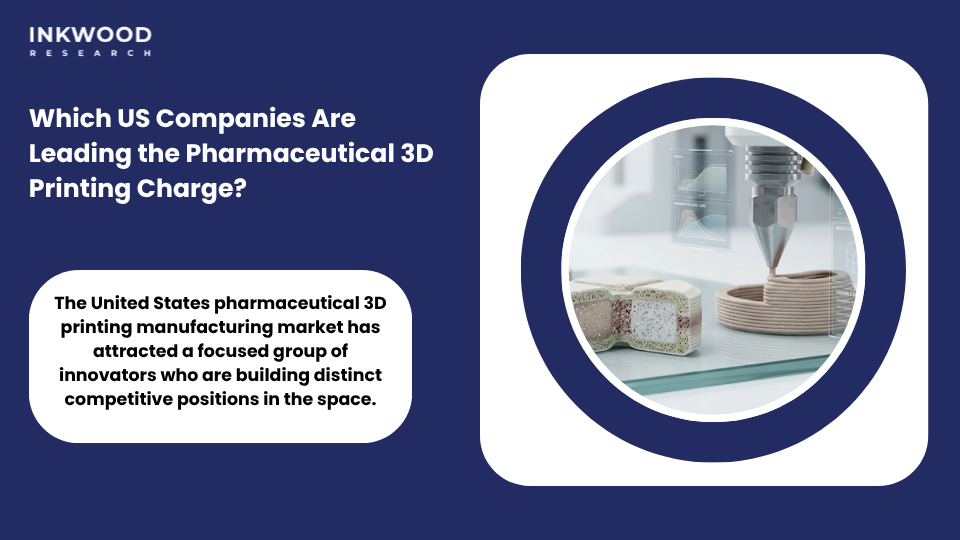
The United States pharmaceutical 3D printing manufacturing market has attracted a focused group of innovators who are building distinct competitive positions in the space. Rather than chasing the same applications, leading companies have each carved out a specific niche within the broader pharmaceutical additive manufacturing landscape.
Aprecia Pharmaceuticals: The Benchmark for FDA-Approved 3D Printed Drugs
Aprecia Pharmaceuticals stands as the foundational proof of concept for the entire US pharmaceutical 3D printing market. In 2015, the company received FDA approval for Spritam (levetiracetam), the world’s first FDA-cleared 3D printed drug, produced using its proprietary ZipDose binder jetting platform. Spritam dissolves almost instantly in the mouth, which is clinically significant for epilepsy patients who struggle to swallow conventional tablets. That approval established a regulatory precedent that the entire industry has since built upon.
Aprecia has continued expanding its ZipDose application pipeline beyond epilepsy, exploring fast-disintegrating formulations across multiple therapeutic areas. These include central nervous system (CNS) disorders, personalized medicine, and specialized oral drug delivery. Furthermore, its technology is well-suited to the compounding successor narrative: it addresses the same patient populations that compounding pharmacies traditionally serve, but through a licensed, reproducible, and scalable manufacturing process.
Triastek: Advancing Controlled Release Through Melt Extrusion 3D Printing
Triastek is one of the most technically ambitious players in the pharma 3D printing manufacturing market, with a platform built around pharmaceutical-grade melt extrusion deposition. What makes Triastek distinctive is its focus on controlled release drug manufacturing through precise geometric structures. By printing drug products with engineered internal architectures, the company produces formulations where API release rate and location in the GI tract are programmed at the fabrication stage.
Triastek’s pipeline has achieved FDA Investigational New Drug (IND) acceptance for multiple 3D printed drug candidates, including treatments for rheumatoid arthritis and insomnia. That regulatory milestone is a meaningful signal: the FDA is willing to engage with complex 3D printing drug manufacturing approaches when the clinical data support them. Moreover, Triastek’s presence in both China and the US positions it well within the global pharmaceutical additive manufacturing market, even as its near-term focus remains on the FDA-regulated US pathway.
Emerging Players: Pete Pharma and the Next Generation of US Innovators
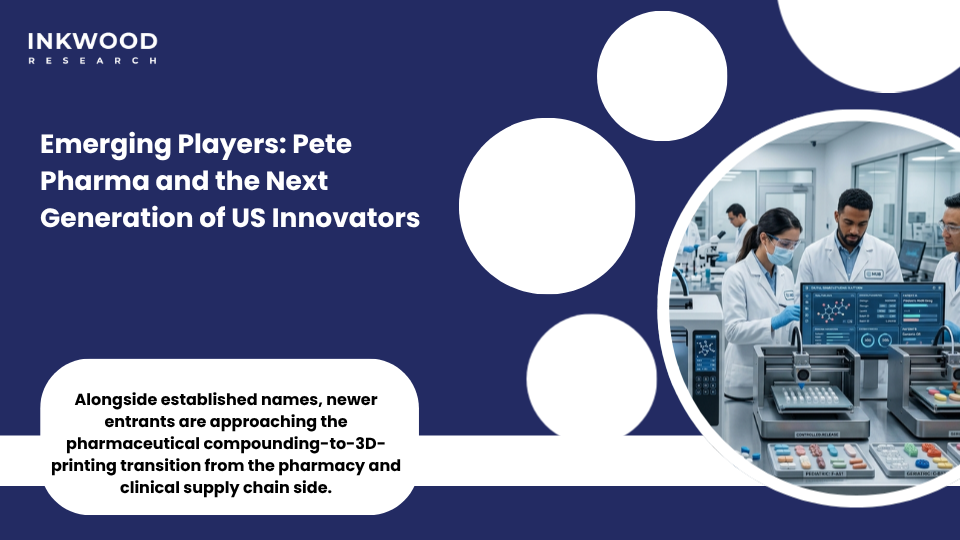
Alongside established names, newer entrants are approaching the pharmaceutical compounding-to-3D-printing transition from the pharmacy and clinical supply chain side. Pete Pharma represents the kind of emerging company exploring how pharmaceutical 3D printing can function at the intersection of specialty pharmacy operations and personalized drug delivery, targeting patient populations where conventional commercial dosing options remain inadequate.
This pharmacy-adjacent positioning is particularly relevant to the compounding successor story. As on-demand drug manufacturing technology matures, smaller, nimble companies with strong clinical relationships and regulatory know-how are well-placed to serve niche patient populations that large-scale manufacturers have no economic incentive to prioritize. Consequently, the competitive landscape in the United States pharmaceutical 3D printing manufacturing market is not dominated solely by scale-focused manufacturers but is increasingly shaped by specialists who understand both the pharmacy workflow and the technology.
What Does the FDA Say About 3D Printed Drug Manufacturing?
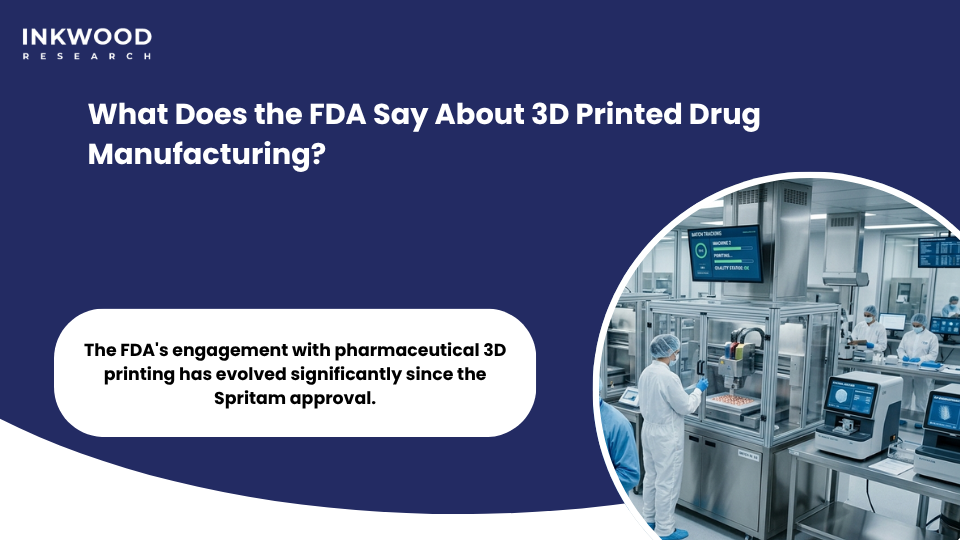
The FDA’s engagement with pharmaceutical 3D printing has evolved significantly since the Spritam approval. The agency has been building a regulatory framework that can accommodate additive manufacturing without forcing it into frameworks designed for conventional tablet presses. The FDA’s guidance on technical considerations for additive-manufactured devices, while focused initially on medical devices, has influenced how the agency approaches pharmaceutical additive manufacturing process validation.
For pharmaceutical manufacturers, three areas of FDA engagement are particularly consequential:
- Process validation: The FDA expects manufacturers to demonstrate that each 3D printing drug manufacturing run produces a consistent drug product within specification, using real-time process data rather than end-product testing alone.
- Material characterization: Excipients and APIs processed through 3D printing may behave differently than in conventional formulations, and the FDA expects comprehensive characterization data.
- Scale-up strategy: Moving from clinical-batch to commercial-volume pharmaceutical additive manufacturing requires demonstrating process equivalence, a challenge that is technically complex but increasingly tractable as the technology matures.
Despite these requirements, the direction is clearly positive. The FDA’s Emerging Technology Program (ETP) actively supports manufacturers working on novel production approaches, and pharmaceutical 3D printing has been a focus area within that program. The regulatory pathway is not simple, but it is navigable.
Key Takeaways
- The United States pharmaceutical 3D printing manufacturing market is projected to grow from US$209.17 million in 2026 to US$589.37 million by 2034, at a 13.82% CAGR.
- Pharmaceutical 3D printing addresses the two core limitations of traditional compounding: dose variability and an inability to scale personalized production without sacrificing reproducibility.
- Aprecia Pharmaceuticals’ FDA-approved Spritam remains the definitive benchmark for 3D printed drugs in the US, while Triastek’s IND acceptances signal that more complex formulations are following the same regulatory path.
- In terms of controlled release drug manufacturing and personalized medicine, 3D printing for pediatric, geriatric, and rare disease patients represent the highest near-term clinical value within the US market.
- The FDA’s Emerging Technology Program and ongoing engagement with pharmaceutical additive manufacturing indicate a regulatory environment that is evolving to support, not obstruct, commercial-scale 3D drug production.
- Emerging pharmacy-adjacent companies are approaching on-demand drug manufacturing from a clinical supply chain angle, expanding the competitive landscape beyond large-scale manufacturers.
Conclusion:
Traditional compounding built the foundation for personalized drug preparation in the US, and it deserves credit for the clinical flexibility it created. However, the pharmaceutical 3D printing market is now offering something compounding never could: precision personalization that is reproducible, scalable, and FDA-compatible. Aprecia, Triastek, and emerging players like Pete Pharma are each demonstrating, in different ways, what a pharmacy of the future built on digital fabrication can deliver.
The United States pharmaceutical 3D printing manufacturing market is not replacing compounding pharmacies overnight. Rather, it is absorbing the best of what compounding offers while solving the problems compounding could never fully address. For pharmaceutical executives, investors, and clinical supply strategists, understanding that transition is essential to positioning correctly in the decade ahead.
Inkwood Research provides the market intelligence needed to navigate the evolving US pharmaceutical additive manufacturing landscape.
Connect with our team to explore how our analysis can support your strategy.
Frequently Asked Questions
What is the United States pharmaceutical 3D printing manufacturing market size?
The market is valued at US$209.17 million in 2026, projected to reach US$589.37 million by 2034, growing at a 13.82% CAGR.
What was the first FDA-approved 3D printed drug in the US?
Spritam (levetiracetam), approved by the FDA in 2015, is the first FDA-cleared 3D printed drug, manufactured using binder jetting by Aprecia Pharmaceuticals.
How does pharmaceutical 3D printing differ from traditional compounding?
3D printing offers digital precision, reproducible dose accuracy, programmable release profiles, and automated traceability that manual compounding pharmacies cannot consistently replicate at scale.
What role does Triastek play in the US 3D printed drugs market?
Triastek advances controlled-release drug manufacturing through melt extrusion 3D printing, with multiple FDA IND acceptances confirming a viable regulatory pathway for complex printed formulations.
Is on-demand drug manufacturing using 3D printing FDA-compliant?
Yes, within the FDA’s Emerging Technology Program, manufacturers can engage directly with the FDA to develop compliant on-demand pharmaceutical 3D printing manufacturing processes.
What are the biggest applications of pharmaceutical additive manufacturing in the US?
Personalized medicine, pediatric dose calibration, controlled release drug formulations, and rare disease drug production are the primary clinical applications driving US pharmaceutical 3D printing growth.