Table of Contents
This analysis is brought to you by Inkwood Research, a leading market intelligence firm specializing in North American renewable energy technologies, automation systems, and circular economy investments. Our research team combines extensive experience analyzing photovoltaic recycling automation, material recovery innovations, and domestic manufacturing strategies across the United States. Based on our proprietary research methodologies and strategic partnerships with American recycling startups, solar manufacturers, and investment funds, we deliver actionable insights that empower strategic decision-making for enterprises navigating the United States solar panel recycling market transformation.
TLDR
Automation transforms America’s solar panel recycling landscape as investors recognize strategic opportunity beyond environmental compliance. The market reached US$147.86 million in 2026 and projects growth to US$515.22 million by 2034. Companies like SOLARCYCLE pioneer proprietary technologies extracting 95% material value through automated processes. This approach creates domestic supply chains, reducing import dependence while establishing America’s recycling infrastructure leadership position globally.
Venture capital investors evaluating cleantech opportunities, solar manufacturers planning domestic supply chain strategies, automation technology providers seeking market applications, renewable energy developers managing asset lifecycles, and policy makers designing circular economy frameworks will discover comprehensive insights into automation-driven recycling models, investment dynamics, and strategic positioning shaping America’s photovoltaic waste management evolution.
U.S. Solar Panel Recycling Market: Why Investors Are Betting Big on Automation-Driven Solar Scrap

Wall Street doesn’t typically get excited about waste management. Yet solar panel recycling attracts significant venture capital despite operating in an industry most investors overlook. The reason becomes clear when examining what these companies actually do—they extract valuable materials from retired equipment while positioning America for manufacturing independence.
The United States faces a unique challenge as millions of panels approach retirement without adequate recycling infrastructure. Other nations prepared through decades of policy development. America, however, takes a characteristically different path by letting private innovation drive solutions. Consequently, startup companies race to capture market share before regulations mandate participation.
Automation distinguishes American recycling ventures from international competitors. Rather than labor-intensive manual processes, U.S. companies invest heavily in proprietary technologies that maximize efficiency. Furthermore, these innovations create intellectual property moats protecting early market positions. Investors bet that technological advantages translate into sustainable competitive benefits.
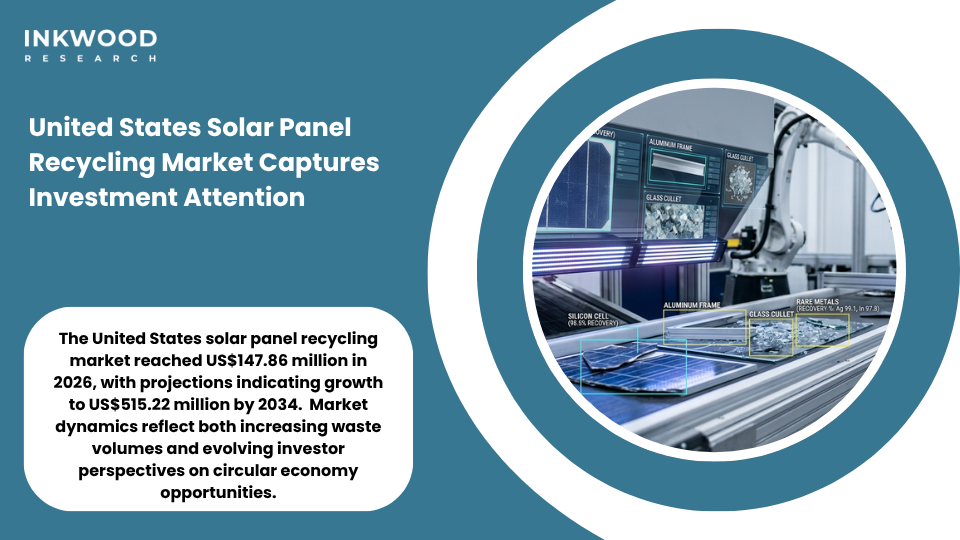
The United States solar panel recycling market reached US$147.86 million in 2026, with projections indicating growth to US$515.22 million by 2034. This represents a compound annual growth rate of 16.89% during the forecast period. Market dynamics reflect both increasing waste volumes and evolving investor perspectives on circular economy opportunities.
SOLARCYCLE epitomizes the investment thesis driving capital allocation toward recycling infrastructure. Since launching in 2022, the company secured over $70 million in funding from technology investors, including Microsoft, Fifth Wall, and HG Ventures. These backers recognize strategic positioning beyond simple waste processing.
Investment appeal stems from multiple converging trends. Solar deployment continues to accelerate across residential, commercial, and utility sectors. Each installation creates future recycling demand when panels reach end-of-life. Meanwhile, domestic manufacturing initiatives require reliable material sources. Recycling provides both environmental solutions and supply chain benefits simultaneously.
SOLARCYCLE Demonstrates Scalable Recycling Model
SOLARCYCLE’s operations prove recycling achieves profitability at scale. The company processed 480,406 panels in 2024 while doubling capacity at its Odessa, Texas, facility. Expansion includes adding two next-generation processing lines that enhance both throughput and material purity.
The company’s Georgia project represents the industry’s most ambitious undertaking. This facility will process 10 million panels annually while manufacturing solar glass from recovered materials. Creating closed-loop supply chains where recycled glass returns directly to panel production demonstrates circular economy principles in practice.
SOLARCYCLE aims to recycle nearly 1 million panels by the end of 2025, doubling that volume in 2026. This growth trajectory reflects partnerships with over 80 solar companies seeking sustainable end-of-life solutions. Moreover, it validates investor confidence in market expansion potential as retirement volumes accelerate.
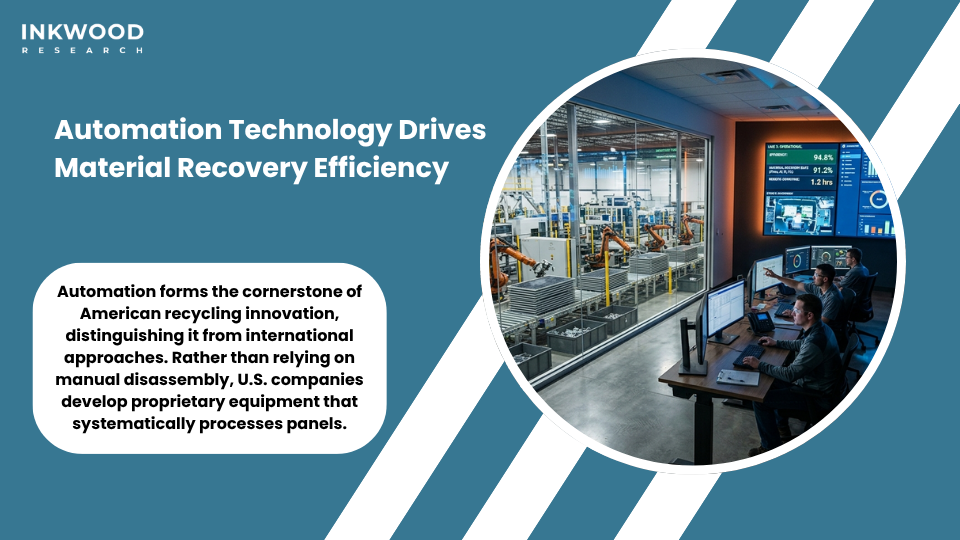
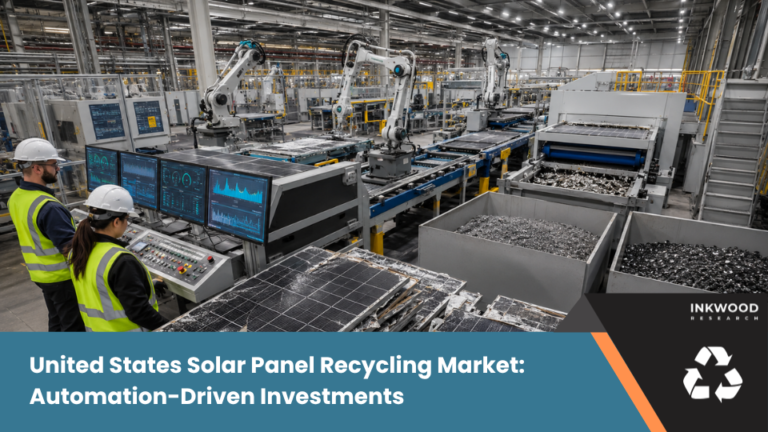
Automation forms the cornerstone of American recycling innovation, distinguishing it from international approaches. Rather than relying on manual disassembly, U.S. companies develop proprietary equipment that systematically processes panels. Moreover, these technologies enable high throughput while maintaining the material purity essential for remanufacturing applications.
SOLARCYCLE’s proprietary processes extract up to 95% of panel value compared to industry standards below 50%. This performance advantage stems from automated systems that precisely separate materials. Aluminum frames, junction boxes, and glass covers undergo mechanical removal. Subsequently, shredding and separation systems recover silicon, silver, and copper from remaining laminates.
Automation addresses labor costs that challenge recycling economics. Manual disassembly proves expensive and inconsistent in material quality. Conversely, automated systems operate continuously with predictable outputs. This reliability attracts manufacturers seeking consistent recycled material supplies for production processes.
Proprietary Technology Creates Competitive Advantages
Intellectual property protection distinguishes American recycling ventures from commodity processing businesses. Companies patent specific separation techniques, chemical processes, and equipment designs. These protections create barriers preventing easy replication by competitors. Consequently, early market entrants establish defensible positions.
Research and development investments continue advancing capabilities. SOLARCYCLE operates a state-of-the-art R&D center in Mesa, Arizona, employing metallurgists, chemists, and engineers. This team optimizes recovery processes while developing new applications for recycled materials. Furthermore, the Department of Energy grants support innovation, reducing reliance on virgin material extraction.
Technology development focuses on recovering high-purity materials suitable for demanding applications. Silver recovery particularly matters given its critical role in photovoltaic cell manufacturing. Advanced separation techniques extract silver meeting specifications for new panel production. Subsequently, this capability enhances recycled material value significantly.
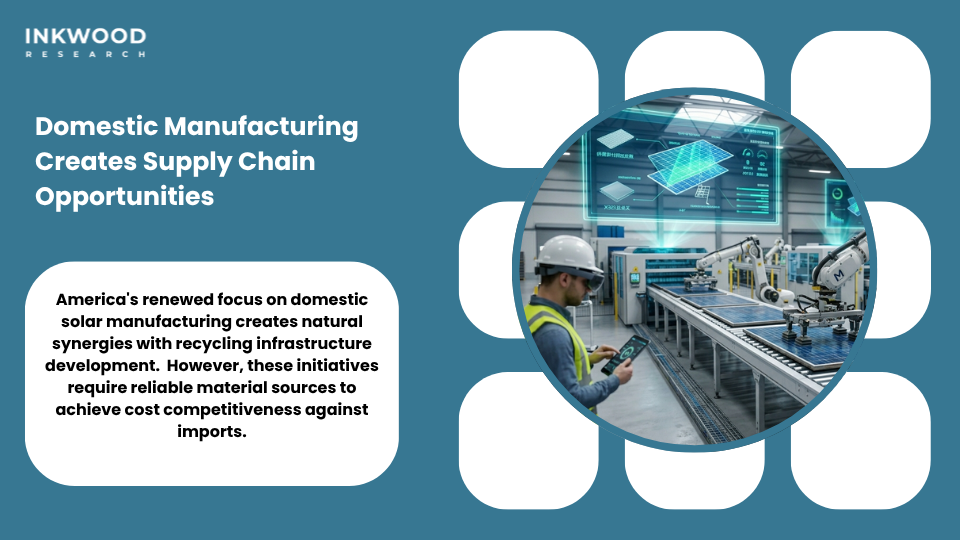
America’s renewed focus on domestic solar manufacturing creates natural synergies with recycling infrastructure development. The Inflation Reduction Act incentivizes U.S.-based production through tax credits and subsidies. However, these initiatives require reliable material sources to achieve cost competitiveness against imports.
Recycled materials address this challenge by providing domestic alternatives to imported components. Qcells partnered with SOLARCYCLE to incorporate recovered aluminum, silver, copper, silicon, and low-iron glass into new production. This first-of-its-kind agreement between a major manufacturer and an advanced recycler demonstrates circular economy viability.
Supply chain resilience represents another strategic benefit. International disruptions repeatedly demonstrated the vulnerability of import-dependent manufacturing. Domestic recycling creates buffer capacity, reducing exposure to trade conflicts or logistics breakdowns. Furthermore, it supports national security objectives by strengthening critical material access.
Manufacturer Partnerships Validate Business Models
Strategic partnerships between recyclers and manufacturers provide market validation, attracting additional investment. Additionally, Canadian Solar became one of the first crystalline silicon module makers offering full recycling to U.S. customers. HELIENE is committed to multi-year purchases of domestic glass derived from recycled panels. These agreements demonstrate industry acceptance.
Partnerships also reduce customer acquisition costs for recycling companies. Manufacturers refer clients to trusted recycling partners while guaranteeing steady material streams. This creates predictable revenues supporting facility expansion plans. Moreover, it establishes industry standards encouraging broader adoption of recycling practices.
Certification programs enhance partnership value through standardized quality assurance. SOLARCYCLE participates in SEIA’s National PV Recycling Program, ensuring certified service delivery. Furthermore, ISO certifications covering quality, environmental management, and occupational safety provide additional credibility. These credentials differentiate professional operations from informal recyclers.
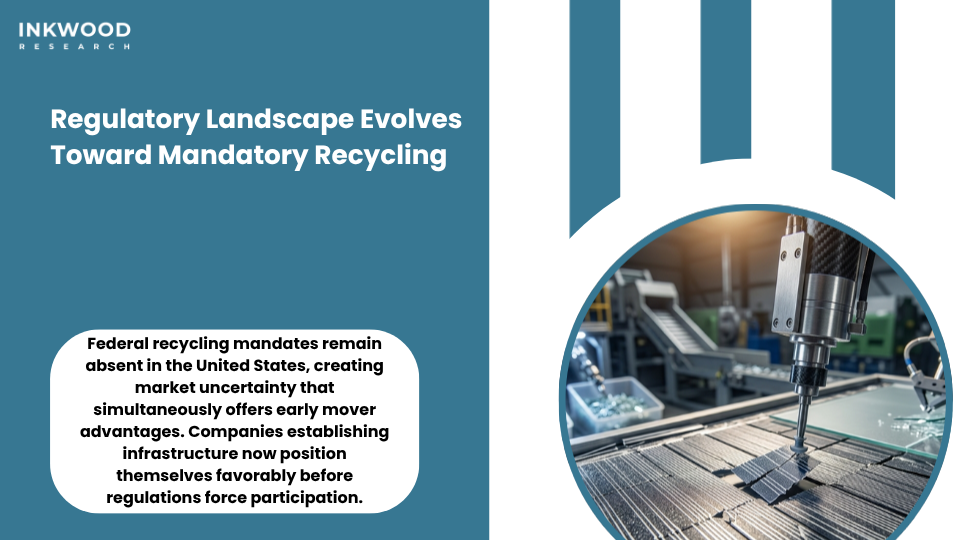
Federal recycling mandates remain absent in the United States, creating market uncertainty that simultaneously offers early mover advantages. Companies establishing infrastructure now position themselves favorably before regulations force participation. However, state-level actions indicate the direction of future requirements.
Several states enacted policies addressing solar panel end-of-life management. California and Washington mandate specific recycling considerations for utility-scale projects. Maine requires recyclable components to be processed by authorized facilities. North Carolina mandates reuse or recycling where practicable. These requirements establish precedents others may follow.
Extended Producer Responsibility programs represent a likely federal direction. European WEEE frameworks demonstrate proven approaches that U.S. policymakers study. However, American implementation would reflect domestic preferences for market-based solutions. Consequently, companies developing cost-effective voluntary programs gain an advantage if mandates arrive.
Industry Self-Regulation Anticipates Future Requirements
Solar industry associations proactively develop recycling frameworks, anticipating eventual mandates. SEIA established the National PV Recycling Program, creating networks of certified providers. This voluntary initiative demonstrates industry commitment while avoiding prescriptive government regulations.
Additionally, self-regulation allows flexibility as technologies and markets evolve. Rather than rigid requirements that quickly become outdated, industry-led programs adapt to emerging best practices. Furthermore, they enable companies to differentiate through superior performance rather than minimal compliance.
Environmental, Social, and Governance considerations increasingly drive corporate behavior independent of regulations. Investors and customers expect sustainable practices throughout product lifecycles. Solar companies recognize that recycling capabilities enhance market positioning. Consequently, this demand pull complements the regulatory push, creating comprehensive incentives.
Investment Thesis Extends Beyond Environmental Benefits
Investors evaluate solar panel recycling through multiple value creation lenses. Environmental impact provides initial appeal, particularly for sustainability-focused funds. However, financial returns ultimately determine capital allocation. The sector offers attractive economics combining growth markets, technology advantages, and strategic positioning.
Revenue streams include both recycling services and recovered material sales. Companies charge fees for panel collection and processing while generating income from selling aluminum, glass, silicon, and precious metals. Consequently, this dual revenue model provides stability as material prices fluctuate.
Market expansion potential attracts growth investors. Current recycling rates remain extremely low relative to total installed capacity. Also, as panels age and volumes increase, existing infrastructure will prove inadequate. Companies establishing operations now capture disproportionate market share as demand accelerates dramatically.
Key Takeaways
- Automation distinguishes American solar panel recycling from international competitors through proprietary technologies, achieving superior material recovery rates.
- SOLARCYCLE demonstrates scalable business models attracting significant venture capital investment. The company’s 95% value extraction rate versus industry standards below 50% validates technological advantages.
- Domestic manufacturing renaissance creates natural synergies with recycling infrastructure development.
- Partnerships between manufacturers and recyclers establish circular supply chains, reducing import dependence. These relationships provide market validation supporting additional facility expansion investments.
- Regulatory evolution toward mandatory recycling appears inevitable despite current federal inaction.
- State-level requirements establish precedents while industry self-regulation demonstrates proactive approaches. Companies building infrastructure now position themselves advantageously before requirements force broader participation.
- Investment thesis combines environmental impact with compelling financial economics. Dual revenue streams from recycling services and material sales provide stability.
- Market expansion potential as retirement volumes accelerate offers substantial growth opportunities for early infrastructure developers.
Conclusion: Automation Transforms Waste into Strategic Asset
The United States approaches solar panel recycling characteristically—through private innovation and market mechanisms rather than regulatory mandates. This path creates opportunities for companies developing superior technologies that capture value others miss. Automation enables American recyclers to compete effectively against lower-cost international alternatives.
On the other hand, investors recognize that recycling represents more than waste management. It provides critical materials supporting domestic manufacturing while reducing environmental impact. Companies like SOLARCYCLE demonstrate that these objectives align profitably rather than conflict. Consequently, capital continues flowing toward circular economy infrastructure.
Future success requires continued technological advancement as panel designs evolve. However, intellectual property protections and operational experience create competitive moats. The foundation built by early market entrants positions them favorably as recycling becomes a universal solar industry practice.
Ready to explore investment opportunities in solar panel recycling automation?
Inkwood Research delivers comprehensive market intelligence and strategic analysis tailored to your needs. Contact our expert team for actionable insights driving successful circular economy investments.
Frequently Asked Questions (FAQs)
The U.S. solar panel recycling market attracts investors due to automation-driven material recovery, rising photovoltaic waste volumes, and increasing demand for domestically sourced solar manufacturing materials.
Automation enables continuous processing, higher recovery efficiency, and lower labor costs, improving the overall economics of solar panel recycling operations.
Growing state-level regulations suggest potential future federal mandates, encouraging companies to invest early in recycling infrastructure and technology.
Rapid solar capacity expansion and aging photovoltaic installations are expected to significantly increase end-of-life panel volumes over the next decade.
Recovered materials such as silicon, silver, aluminum, copper, and glass are valuable for domestic solar module and electronics manufacturing.
Recycling reduces environmental waste, recovers critical materials, and supports a sustainable supply chain for the expanding renewable energy sector.