Table of Contents

This analysis is brought to you by Inkwood Research, a leading market intelligence firm specializing in North American energy infrastructure, liquefied natural gas export developments, and global natural gas trade dynamics. Our research team combines extensive experience analyzing US shale gas production, LNG terminal operations, and international energy security frameworks. Based on our proprietary research methodologies and strategic partnerships with US energy authorities, export terminal operators, and pipeline companies, we deliver actionable insights that empower strategic decision-making for global enterprises navigating America’s emerging role as a leading LNG supplier.
TLDR
The United States emerges as the world’s largest liquefied natural gas exporter, fundamentally reshaping global energy security dynamics. Gulf Coast terminals process abundant shale gas production into exportable LNG serving European and Asian markets. Infrastructure expansion continues through 2030 as developers add substantial new capacity. Export growth supports domestic natural gas production while providing allies with alternatives to geopolitically risky suppliers. This transformation positions America as a critical global energy supplier for decades ahead. Market dynamics continue evolving as capacity additions accelerate.
Energy executives, infrastructure developers, natural gas producers, export terminal operators, shipping companies, international energy traders, policy analysts, geopolitical strategists, pipeline companies, and global energy consumers will gain valuable insights into the US LNG market evolution, export capacity expansion, supply chain dynamics, regulatory frameworks, and strategic implications for international energy security and natural gas trade patterns worldwide.
United States LNG Market Outlook
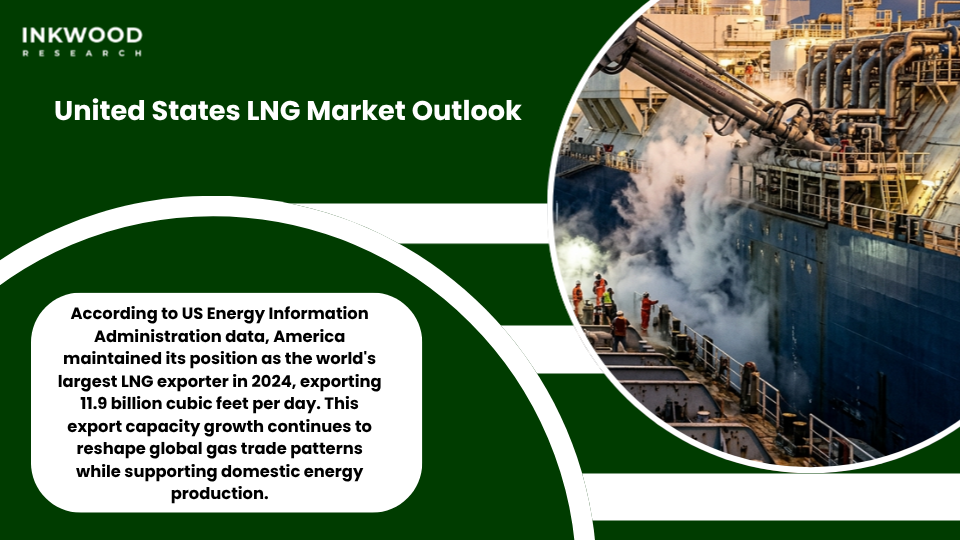
The United States LNG market undergoes a remarkable transformation, establishing America as a global leader in liquefied natural gas exports. This development fundamentally alters international energy security dynamics as allies gain access to reliable American natural gas production. Consequently, abundant shale gas resources from Pennsylvania to Texas flow through expanding Gulf Coast terminals reaching markets across Europe and Asia.
According to US Energy Information Administration data, America maintained its position as the world’s largest LNG exporter in 2024, exporting 11.9 billion cubic feet per day. This export capacity growth continues to reshape global gas trade patterns while supporting domestic energy production. Moreover, LNG terminals under construction promise further capacity increases through 2030. Understanding these developments proves essential for stakeholders navigating evolving international energy markets.
America’s Ascent to Global LNG Export Leadership
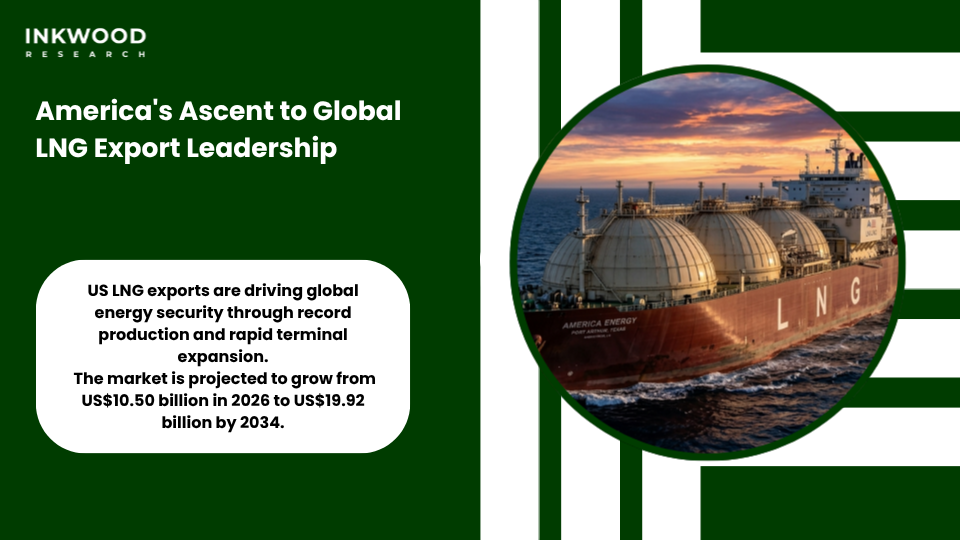
The United States achieved unprecedented status as the world’s largest liquefied natural gas exporter through rapid infrastructure development and abundant resource availability. Our projections indicate the US LNG market growth from US$10.50 billion in 2026 to US$19.92 billion by 2034, representing 8.33 percent annual expansion. This trajectory reflects continued terminal additions and growing international demand for American LNG.
US exports provide critical supply diversification for allies seeking alternatives to concentrated supplier dependencies. Moreover, American LNG enables European energy security following disruptions in Russian pipeline supplies. Furthermore, according to EIA Natural Gas Monthly data, the United States exported 11.9 billion cubic feet per day of LNG in 2024, maintaining its global leadership position.
Australia and Qatar, the second and third largest exporters, maintained relatively stable export volumes between 10.2 and 10.7 billion cubic feet per day annually. This competitive positioning demonstrates American industry’s rapid capacity expansion over the past decade. Additionally, US export growth stems from both new terminal developments and optimization of existing facilities exceeding nameplate capacities.
Record Export Volumes Drive Market Growth
US LNG export volumes reached record levels throughout 2024 despite temporary facility outages affecting production. The daily rate of liquefied natural gas exports in October 2025 was 33.8% higher than in October 2024, marking the highest monthly rate since EIA began tracking LNG exports in 1997.
These statistics underscore accelerating export momentum as additional capacity enters service. Consequently, American natural gas increasingly supplies global markets previously dependent on Middle Eastern and Russian sources. However, export growth faces constraints from pipeline infrastructure connecting production regions to coastal terminals. Permitting delays and construction challenges occasionally limit feedgas delivery capabilities.
Nevertheless, according to EIA Today in Energy analysis, utilization of LNG export capacity across operational terminals averaged 104% of nominal capacity in 2024. This high utilization demonstrates industry efficiency, maximizing existing infrastructure while additional capacity advances through development pipelines. Moreover, terminal operators implement technical improvements extending beyond original design specifications.
Gulf Coast Infrastructure Dominates Export Capacity

The Gulf Coast region concentrates the majority of American LNG export infrastructure due to proximity to major shale gas production areas and deep-water port facilities. Terminals in Texas and Louisiana process feedgas from the Permian Basin, Haynesville Shale, and Eagle Ford formations. These strategic locations minimize transportation costs while enabling efficient vessel loading for Atlantic and Pacific basin destinations.
Gulf Coast facilities anchor American export capabilities serving diverse global markets. Additionally, planned capacity expansions concentrate on this proven development corridor. Furthermore, Sabine Pass initiated America’s modern LNG export era when Cheniere Energy commissioned the facility in 2016. This terminal pioneered regulatory frameworks and technical approaches enabling subsequent project developments.
Cameron LNG, Corpus Christi LNG, and Freeport LNG followed, establishing the Gulf Coast as a global LNG production center. Moreover, these facilities employ proven technology from established equipment suppliers, ensuring operational reliability. Terminal capacity ranges from small-scale facilities to massive complexes processing multiple billion cubic feet daily.
Expanding Terminal Portfolio Along Coast
Additional terminals advance through construction, including Plaquemines LNG, Golden Pass, and Corpus Christi Stage III expansions. According to EIA projections, North American LNG export capacity could more than double by 2029 with planned additions. These developments position the Gulf Coast as an increasingly dominant global LNG supply region, rivaling established producers.
American export infrastructure development attracts substantial capital investment from both domestic and international energy companies seeking market participation. However, terminal development faces environmental permitting challenges and local community concerns regarding industrial impacts. Some proposed facilities encounter opposition, delaying or preventing project advancement.
However, market demand and favorable economics continue driving development interest despite regulatory hurdles. Our research indicates selective project progression with well-capitalized developers achieving commercial operations while marginal proposals face extended timelines or cancellation. Additionally, existing terminal expansion often proves more feasible than greenfield development given established infrastructure and regulatory precedent.
Shale Gas Revolution Enables Export Growth
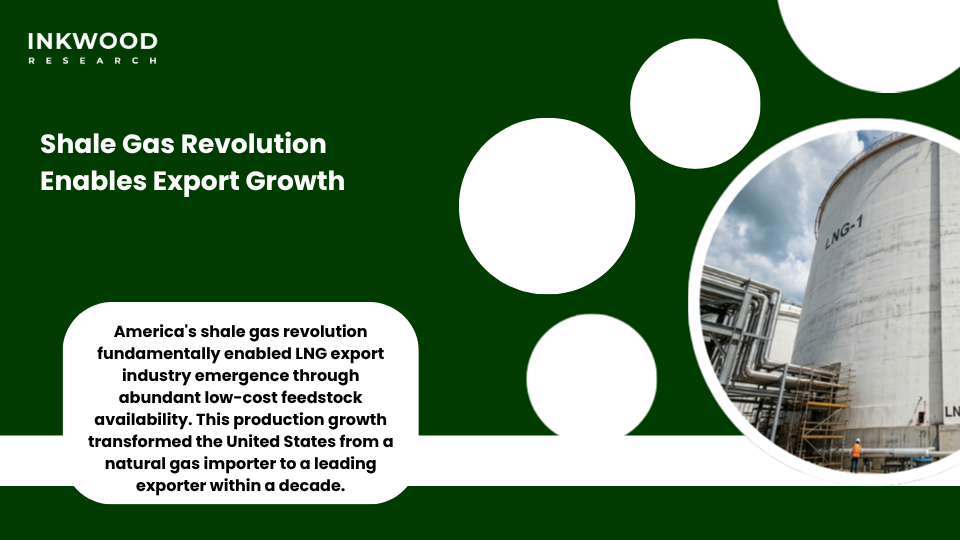
America’s shale gas revolution fundamentally enabled LNG export industry emergence through abundant low-cost feedstock availability. Horizontal drilling and hydraulic fracturing technologies unlocked massive natural gas resources across the Marcellus, Permian, and other formations. This production growth transformed the United States from a natural gas importer to a leading exporter within a decade. Domestic natural gas prices remain internationally competitive despite rising production costs.
Moreover, proved reserves continue growing as operators develop previously uneconomic resources. According to EIA data, preliminary dry natural gas production in October 2025 reached 107.2 billion cubic feet per day, 4.2% higher than October 2024 levels. This production growth supports both domestic consumption and expanding export commitments.
Additionally, natural gas remains abundant relative to demand, given continued production efficiency improvements. Pipeline infrastructure developments enhance connectivity between production regions and coastal terminals, enabling feedgas deliveries supporting export operations.
Production Economics Support Export Competitiveness
Henry Hub natural gas pricing benchmarks American LNG competitiveness in international markets. Relatively low domestic prices enable competitive delivered costs to European and Asian buyers despite liquefaction and transportation expenses. This price advantage attracts long-term purchase commitments from international consumers seeking reliable, affordable supplies.
American LNG competes effectively against established suppliers despite higher liquefaction costs compared to some international facilities. However, rising production costs as operators deplete premium drilling locations could affect long-term competitiveness. Additionally, pipeline capacity constraints occasionally create regional price basis differentials, impacting profitability.
Nevertheless, technological improvements continue to enhance production efficiency, offsetting natural resource depletion. Our analysis suggests American natural gas production maintains a growth trajectory through 2030, supporting planned export capacity additions. Moreover, associated gas production from oil-focused drilling provides additional supply supporting overall market balance.
European Energy Security Through US Supplies

European markets emerged as the primary destination for American LNG following Russian pipeline supply disruptions. According to EIA analysis, Europe (including Türkiye) accounted for 53% of total US LNG exports in 2024, down from 66% in 2023. This substantial volume provides critical energy security for European allies managing reduced Russian gas availability.
American LNG enables European industrial operations and residential heating despite geopolitical supply disruptions. Moreover, flexible cargo destinations allow responsive supply allocation matching market demand. Furthermore, European regasification capacity expansions enabled increased LNG imports, replacing pipeline volumes. New floating storage and regasification units (FSRUs) and onshore terminals across the Netherlands, Germany, and other countries enhance import capabilities.
These infrastructure investments demonstrate European commitment to supply diversification away from concentrated dependencies. Additionally, long-term purchase agreements with American suppliers provide volume certainty supporting European energy security planning. Such contracts balance spot market flexibility with baseload supply guarantees.
Diversification Away from Russian Dependencies
European buyers increasingly value supply source diversification beyond purely economic considerations. Geopolitical reliability weighs heavily in procurement decisions following Russian supply weaponization during the Ukraine conflict. American LNG provides a politically aligned alternative supporting transatlantic energy cooperation.
European utilities and governments prioritize American supply relationships despite occasionally higher costs compared to alternative sources. This strategic thinking reshapes traditional purely economic procurement approaches. However, European natural gas demand faces long-term decline as renewable energy deployment accelerates and energy efficiency improves.
This demand trajectory could reduce European LNG import requirements post-2030, affecting American export opportunities. Nevertheless, near-term European dependence on LNG imports remains substantial, supporting continued American exports. Our research suggests European demand sustains significant American LNG volumes through the late 2020s before potential moderation. Additionally, European LNG provides seasonal flexibility supporting renewable energy integration requirements.
Growing Asian Market Presence

Asian markets increasingly absorb American LNG as production capacity exceeds European requirements. According to EIA data, Asia’s share of US LNG exports increased from 26% in 2023 to 33% in 2024. This growing presence reflects Asian buyers seeking supply diversification and American exporters pursuing market expansion beyond European concentration.
Established Asian importers like Japan and South Korea supplement traditional suppliers with American volumes. Moreover, emerging markets, including Bangladesh and Thailand, develop import capabilities targeting American LNG. Furthermore, American LNG competes in Asian markets against closer suppliers, including Australia and Qatar, despite longer shipping distances.
Flexible cargo allocation and spot market participation enable American exporters serving Asian demand during high-price periods. Additionally, some Asian buyers secure long-term American supply contracts providing volume certainty and price stability. These commercial relationships reflect confidence in American production sustainability and export reliability over extended timeframes.
Competing with Established Asian Suppliers
American exporters leverage operational flexibility advantages against traditional Asian suppliers. Destination flexibility provisions enable cargo optimization responding to price signals across markets. This commercial structure contrasts with some legacy contracts restricting cargo destinations. American LNG trades more dynamically than some competing supplies, enhancing market liquidity.
Moreover, portfolio players arbitrage price differentials between Atlantic and Pacific basins using American export flexibility. However, shipping economics favor closer suppliers during normal market conditions, given lower transportation costs. Australian and Qatari supplies typically deliver to Asian markets more cost-effectively than American cargoes.
Nevertheless, market tightness and supply disruptions periodically favor American volumes despite distance disadvantages. Our analysis suggests American LNG maintains a meaningful Asian market share through flexible commercial structures and reliable production. Additionally, growing Asian demand absorbs incremental supplies from multiple sources, including American exports.
Future Capacity Expansion Through 2030
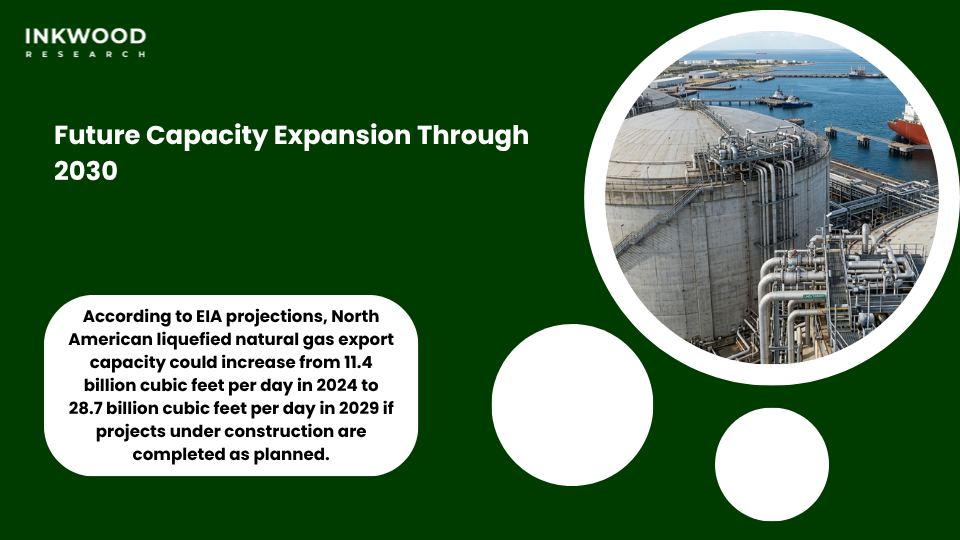
Substantial LNG export capacity additions advance through development, targeting operational status before 2030. According to EIA projections, North American liquefied natural gas export capacity could increase from 11.4 billion cubic feet per day in 2024 to 28.7 billion cubic feet per day in 2029 if projects under construction are completed as planned.
This remarkable expansion more than doubles current capacity, establishing North America as a dominant global LNG supplier. American export infrastructure development continues despite periodic policy uncertainties affecting project economics. Furthermore, five major US LNG export projects currently under construction represent a combined export capacity of 9.7 billion cubic feet per day.
Plaquemines LNG shipped its first cargo in December 2024, becoming the eighth operational US LNG terminal. Golden Pass, Corpus Christi Stage III, Rio Grande, and Port Arthur projects target initial production through the 2026-2027 timeframe. These developments reflect substantial capital commitments from major energy companies anticipating sustained global demand.
Regulatory Environment and Project Economics
The regulatory environment significantly influences project development timelines and investment decisions. Federal Energy Regulatory Commission approvals and Department of Energy export authorizations represent critical milestones for project advancement. Additionally, environmental assessments under the National Environmental Policy Act require a comprehensive analysis, delaying some project schedules.
These regulatory processes balance energy development with environmental protection and community interests, creating complex approval frameworks. However, policy uncertainties occasionally affect investment confidence and project financing. Export authorization reviews and potential policy changes create development risks that developers must navigate.
Nevertheless, market fundamentals and long-term demand projections generally support continued capacity development despite periodic uncertainty. Our research indicates selective project progression with well-positioned developments achieving final investment decisions, while marginal proposals face challenges securing commitments. Moreover, existing terminal expansions often prove more economically attractive than greenfield facilities, given established infrastructure.
Geopolitical Implications of US Export Dominance
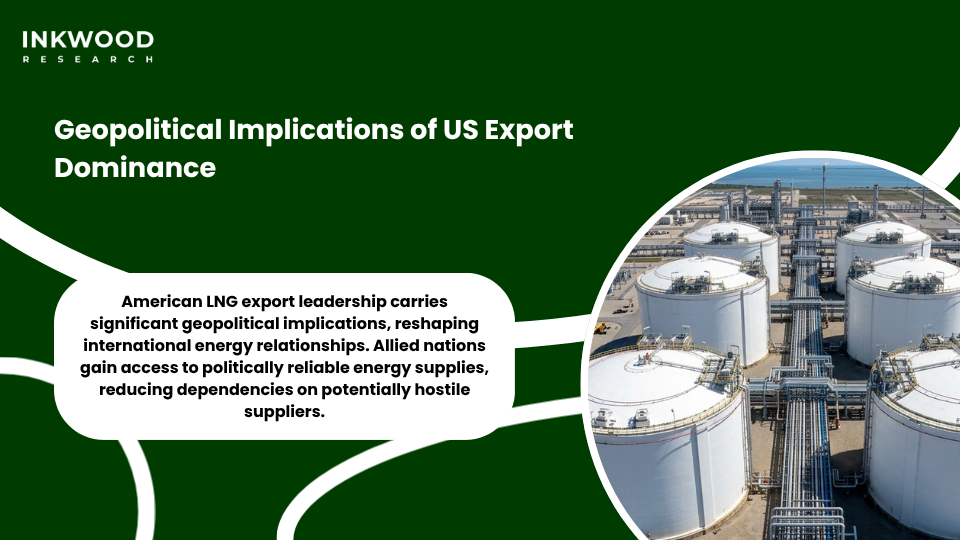
American LNG export leadership carries significant geopolitical implications, reshaping international energy relationships. Allied nations gain access to politically reliable energy supplies, reducing dependencies on potentially hostile suppliers. This supply diversification enhances Western energy security while limiting adversary leverage through energy exports.
American natural gas becomes a strategic commodity beyond purely commercial considerations. Moreover, LNG export capabilities strengthen America’s geopolitical influence through energy diplomacy. Furthermore, European and Asian allies prioritize American LNG despite occasionally higher costs, given supply reliability and political alignment.
This strategic thinking reflects lessons from Russian energy weaponization, demonstrating the dangers of concentrated supplier dependencies. American exports provide insurance against supply disruptions from geopolitically unstable regions. Additionally, long-term supply relationships strengthen transatlantic and trans-Pacific partnerships through mutual energy security interests. These connections extend beyond commercial transactions into broader strategic cooperation.
Energy as Foreign Policy Tool
American policymakers increasingly recognize LNG exports as a foreign policy instrument supporting allied nations. Export authorizations consider geopolitical factors alongside purely economic criteria. This approach contrasts with traditional natural resource exports focused exclusively on commercial returns. The American natural gas trade reflects broader strategic objectives supporting democratic allies and countering authoritarian energy influence.
Moreover, LNG infrastructure investments in allied nations strengthen economic and political ties. However, balancing domestic energy affordability against export priorities creates occasional policy tensions. Some stakeholders argue that exports increase domestic natural gas prices, affecting American consumers and industries.
Nevertheless, economic analyses generally indicate minimal domestic price impacts from LNG exports given production responsiveness. Our research suggests American natural gas markets accommodate both growing domestic consumption and expanding exports through production increases. Additionally, export revenues support domestic energy industry development, benefiting the American economy overall.
Key Takeaways
- The United States emerged as the world’s largest liquefied natural gas exporter through rapid infrastructure development and abundant shale gas resources. This transformation fundamentally altered global energy security dynamics, providing allies with reliable supply alternatives to geopolitically risky sources.
- Moreover, the Gulf Coast terminal concentration establishes American export dominance, supporting both European and growing Asian market requirements. American LNG export leadership continues to reshape international natural gas trade patterns.
- Furthermore, substantial capacity expansions advancing through development promise more than doubling existing export capabilities by 2030. These projects reflect sustained international demand and favorable American production economics supporting continued investment.
- However, regulatory processes and policy uncertainties occasionally affect development timelines, requiring careful navigation by project developers. Nevertheless, market fundamentals support continued American export growth over the coming decades.
- Additionally, geopolitical considerations increasingly influence international LNG trade beyond purely economic factors. Allied nations value supply reliability and political alignment even when prices exceed alternatives.
- This strategic thinking strengthens American geopolitical influence through energy diplomacy while supporting allied energy security. Subsequently, American natural gas exports serve both commercial and strategic objectives, enhancing national interests across multiple dimensions.
Conclusion:
America’s liquefied natural gas export revolution represents one of the most significant energy market developments this century. The transformation from importer to leading global supplier occurred remarkably quickly, enabled by shale gas production growth and infrastructure development. This export leadership provides substantial benefits, including enhanced allied energy security, strengthened geopolitical influence, and a robust domestic energy industry supporting the American economy. Moreover, continued capacity expansions promise sustained American dominance in global LNG trade.
Based on our analysis, American LNG exports will remain a critical component of the global energy security architecture for decades ahead. European and Asian markets depend increasingly on American supplies, providing alternatives to concentrated supplier risks. Furthermore, flexible commercial structures and reliable production support American competitiveness despite geographical disadvantages compared to some suppliers. Successfully navigating regulatory processes and maintaining production growth will determine whether America fully realizes its export potential.
For organizations seeking deeper insights into the United States LNG market developments or American natural gas export strategies, Inkwood Research offers comprehensive market intelligence and consulting services.
Contact our team to explore how these evolving dynamics align with your strategic objectives and operational planning requirements across global energy markets.
Frequently Asked Questions
How do US LNG exports affect domestic natural gas prices in the United States?
Most analyses indicate that LNG exports have a limited long-term impact on US natural gas prices because domestic gas production typically increases in response to higher demand, while regional price variations are more often driven by pipeline infrastructure constraints rather than export volumes
What regulatory approvals are required for new US LNG export terminal projects?
US LNG export projects must obtain approvals from the Federal Energy Regulatory Commission for terminal construction, authorization from the Department of Energy for exports to non-free trade agreement countries, and environmental assessments under federal and state regulatory frameworks
Can US LNG export capacity continue expanding beyond 2030?
US LNG export capacity is expected to grow beyond 2030 due to abundant shale gas resources and sustained global demand for natural gas, although expansion may moderate after major capacity additions planned for the late 2020s
How does US shale gas production support the growth of LNG exports?
Large-scale shale gas production from basins such as the Permian and Marcellus provides abundant feedstock for LNG liquefaction plants, enabling the United States to remain one of the world’s leading LNG exporters
Why is the United States becoming a major supplier in the global LNG market?
The United States has emerged as a major LNG supplier due to its vast natural gas reserves, flexible LNG contract structures, advanced liquefaction infrastructure, and strong global demand for diversified energy supply sources
What factors could influence future US LNG export growth and investment?
Future LNG export growth in the United States will depend on global natural gas demand trends, regulatory policies, infrastructure expansion, environmental considerations, and long-term supply agreements with international buyers