Table of Contents
This analysis is brought to you by Inkwood Research, a leading market intelligence firm specializing in European pharmaceutical manufacturing innovation, UK biotech ecosystems, and Swiss precision medicine technology. Our research team combines deep expertise in MHRA and Swissmedic regulatory frameworks, pharmaceutical 3D printing commercialization pathways, and precision drug delivery innovation across the United Kingdom and Switzerland. Through strategic partnerships with European pharmaceutical manufacturers and academic institutions, we deliver actionable insights for stakeholders navigating the United Kingdom pharmaceutical 3D printing manufacturing market and the Swiss precision medicine sector.
TLDR
The United Kingdom and Switzerland are approaching pharmaceutical 3D printing from two distinct but complementary directions. The United Kingdom pharmaceutical 3D printing manufacturing market is projected to grow from US$32.46 million in 2026 to US$100.12 million by 2034, at a 15.12% CAGR, driven by a strong biotech startup ecosystem and NHS-linked clinical innovation. Meanwhile, the Switzerland pharmaceutical 3D printing manufacturing market is on track to expand from US$10.63 million in 2026 to US$33.45 million by 2034, at a 15.41% CAGR, anchored by precision medicine heritage and a pharmaceutical-chemical industry that is uniquely positioned to integrate additive manufacturing at a commercial scale.
This blog is directly relevant for European pharmaceutical manufacturers, UK biotech investors, and Swiss precision medicine executives evaluating pharmaceutical 3D printing opportunities. Additionally, regulatory strategists working across MHRA and Swissmedic frameworks, healthcare technology investors tracking the UK and Swiss pharma markets, and academic researchers commercializing drug delivery innovations will find targeted, evidence-backed intelligence here.
The UK and Switzerland: Two Distinct 3D Pharma Printing Stories
When looking across Europe’s pharmaceutical 3D printing market, the United Kingdom and Switzerland stand out as particularly compelling case studies, though for very different reasons. The UK brings a dynamic, startup-driven biotech culture, a major academic research base, and a national health system with a genuine appetite for clinical innovation. Switzerland, by contrast, brings something more structurally entrenched: a century-long tradition of pharmaceutical chemistry precision, global pharmaceutical companies with enormous R&D budgets, and a regulatory environment built to support complex manufacturing innovation.
Together, these two markets illustrate how the pharmaceutical additive manufacturing market is advancing on parallel tracks in Europe. Venture-backed startups in London and Manchester are proving out clinical feasibility; established multinationals in Basel and Zurich are proving out commercial scale. Both directions matter, and understanding each on its own terms is essential for anyone tracking the European 3D printed drugs market seriously.
How Is the United Kingdom Pharmaceutical 3D Printing Manufacturing Market Growing?
The United Kingdom pharmaceutical 3D printing manufacturing market is among Europe’s fastest-growing segments in pharmaceutical manufacturing technology. According to our analysis, the market is projected to expand from US$32.46 million in 2026 to US$100.12 million by 2034, at a 15.12% CAGR. That growth rate places the UK ahead of the broader European average, reflecting both the quality of UK biotech innovation and a regulatory environment that has been evolving to support advanced pharmaceutical manufacturing post-Brexit.
Several structural factors underpin this expansion. The UK’s pharmaceutical and life sciences sector has long been a core pillar of the national economy, supported by world-class universities, NIHR-funded clinical research, and NHS clinical networks that provide direct pathways to patient populations for novel drug delivery trials. Furthermore, the MHRA’s Innovation Office has actively supported companies developing novel manufacturing approaches, offering early regulatory dialogue that reduces development risk for companies advancing 3D printing drug manufacturing toward clinical and commercial scale.
What Role Does the NHS Play in UK Pharmaceutical 3D Printing Adoption?
The NHS creates a uniquely powerful clinical demand signal for personalized medicine 3D printing. Its scale, combined with centralized procurement and a genuine institutional commitment to clinical innovation, means that UK-developed 3D printed oral dosage forms have a direct route to meaningful clinical deployment if they clear MHRA requirements. Hospital pharmacy departments within NHS Trusts are already exploring point-of-care 3D printing for pediatric and palliative care applications, where dosing flexibility offers measurable patient benefit.
Additionally, NHS England’s focus on personalized and precision medicine as part of its Long Term Plan creates policy alignment with the clinical value proposition of pharmaceutical additive manufacturing. As that policy framework matures, procurement pathways for on-demand drug manufacturing within NHS settings are likely to become more defined, reducing adoption friction for UK-based innovators.
Which UK Biotech Companies Are Advancing Pharmaceutical 3D Printing?
The United Kingdom pharmaceutical 3D printing manufacturing market has produced several innovators who are building globally relevant platforms, often through strong academic-industry partnerships rooted in UK universities.
FabRx: Making Hospital Pharmacy 3D Printing Clinically Deployable
FabRx, founded out of University College London’s School of Pharmacy, is among the most commercially advanced biotech companies in the global pharma 3D printing manufacturing market. Its Printlets platform produces 3D printed oral dosage forms using pharmaceutical-grade materials through a printing process designed specifically for hospital pharmacy environments. The company has deployed its system in clinical settings across the UK and Spain, demonstrating that point-of-care pharmaceutical 3D printing is operationally viable beyond research labs.
FabRx’s focus on pediatric personalized medicine is particularly significant within the NHS context. Dose-flexible printed formulations for children with rare metabolic conditions, where no commercial product fits clinical needs, represent a direct and compelling application. Furthermore, the company has expanded its Printlets technology into multiple dosage categories, including chewable tablets and films, broadening its clinical reach across the 3D printed drugs market.
Craft Health and Emerging UK Academic Spinouts
Beyond FabRx, a broader ecosystem of UK academic institutions is producing spinout companies and collaborative research programs that are advancing drug delivery systems 3D printing toward commercial viability. Research groups at the University of Nottingham, the University of Bath, and King’s College London have all produced pharmaceutical 3D printing innovations with real commercialization potential, covering areas from SLS-printed fast-dissolving tablets to FDM-based controlled release formulations.
Craft Health, originally based in Singapore but with significant UK academic linkages, has demonstrated how pharmacy-integrated 3D printing can operate within regulated environments, producing personalized multi-drug formulations for chronic disease management. Its approach illustrates how 3D printing in pharmaceutical R&D is evolving from laboratory proof of concept into pharmacy-floor operational reality, a transition that UK institutions are well-placed to lead, given the NHS ecosystem surrounding them.
How Is Switzerland Approaching Precision Medicine Through 3D Drug Manufacturing?
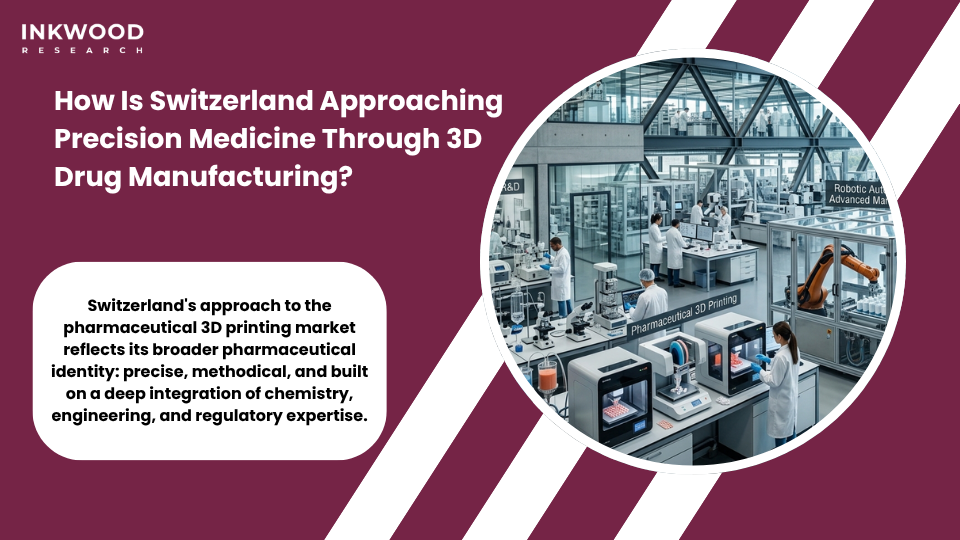
Switzerland’s approach to the pharmaceutical 3D printing market reflects its broader pharmaceutical identity: precise, methodical, and built on a deep integration of chemistry, engineering, and regulatory expertise. The Switzerland pharmaceutical 3D printing manufacturing market is projected to grow from US$10.63 million in 2026 to US$33.45 million by 2034, at a 15.41% CAGR, the highest rate among the European markets in our analysis, reflecting the exceptional momentum building in this precision-focused pharmaceutical environment.
What makes Switzerland’s trajectory distinctive is that its pharma 3D printing manufacturing market growth is driven not by startup experimentation but by large, established pharmaceutical companies integrating additive manufacturing into existing R&D and clinical manufacturing pipelines. That integration approach, embedding pharmaceutical additive manufacturing within mature regulatory and quality systems, is both slower to initiate and more durable once established. Moreover, the Swiss Agency of Therapeutic Products (Swissmedic) has been engaged with advanced manufacturing technology, providing a regulatory foundation that supports this integration-first approach.
How Is Switzerland’s Pharmaceutical Heritage an Advantage in 3D Drug Manufacturing?
Switzerland’s Basel-headquartered pharmaceutical cluster is home to some of the world’s largest drug companies, and its long tradition of high-precision chemical manufacturing translates directly into the quality demands of 3D printing drug manufacturing. API synthesis, formulation development, and analytical characterization, all critical to making 3D printed drugs viable, are capabilities Swiss pharmaceutical manufacturers have developed to exceptional standards over generations.
Moreover, the Swiss precision medicine agenda is creating explicit clinical demand for personalized medicine 3D printing applications. The country’s healthcare system, which combines universal access with genuine willingness to invest in clinically differentiated therapies, is receptive to the higher development costs that advanced drug formulation through additive manufacturing currently requires. As production economics improve, that receptiveness will translate into broader commercial adoption.
Which Companies Are Shaping the Switzerland Pharmaceutical 3D Printing Manufacturing Market?
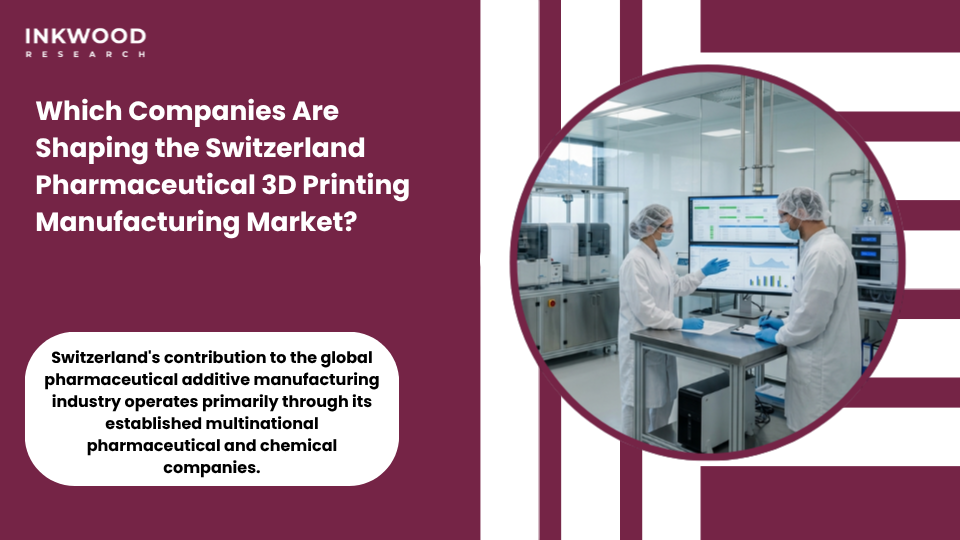
Switzerland’s contribution to the global pharmaceutical additive manufacturing industry operates primarily through its established multinational pharmaceutical and chemical companies. Each of these is integrating 3D printing into distinct parts of its drug development and manufacturing pipeline.
- Roche: Building on its Basel headquarters and global biologics manufacturing expertise, Roche is exploring additive manufacturing for drug delivery device fabrication and personalized diagnostic-therapy integration. Its Roche Institute of Human Biology represents a focused investment in precision biology that aligns directly with the clinical promise of precision drug delivery through 3D printing.
- Novartis: Novartis has been actively investing in advanced pharmaceutical manufacturing through its Novartis Institutes for BioMedical Research and its global manufacturing network. The company’s interest in continuous manufacturing and digital production technologies places it squarely within the emerging pharmaceutical 3D printing manufacturing market, particularly for small-batch and clinical trial manufacturing applications.
- Lonza: As one of the world’s largest pharmaceutical and biotech contract manufacturers, Lonza’s pharmaceutical manufacturing operations in Visp, Switzerland, provide a critical platform for the integration of additive manufacturing into contract drug production. Lonza’s scale and quality systems make it an important enabler of drug delivery systems 3D printing at commercial volume within the Swiss market.
- CSEM (Swiss Center for Electronics and Microtechnology): CSEM is developing pharmaceutical microfabrication and precision drug delivery technologies that bridge electronic engineering and pharmaceutical 3D printing. Its work on miniaturized drug delivery devices and printed pharmaceutical components represents a genuinely distinctive contribution to the Swiss 3D printing healthcare manufacturing market.
While regulatory pathways for 3D printed pharmaceuticals remain underdeveloped, the European Medicines Agency (EMA) is actively exploring frameworks to regulate 3D-printed pharmaceuticals, reflecting global momentum in this area.
Key Takeaways
- The United Kingdom pharmaceutical 3D printing manufacturing market grows from US$32.46 million in 2026 to US$100.12 million by 2034, at a 15.12% CAGR, driven by a dynamic biotech startup ecosystem and NHS-linked clinical innovation infrastructure.
- The Switzerland pharmaceutical 3D printing manufacturing market expands from US$10.63 million in 2026 to US$33.45 million by 2034, at a 15.41% CAGR, the strongest growth rate in this European analysis, anchored by precision pharmaceutical manufacturing heritage.
- FabRx is the UK’s most commercially advanced pharmaceutical 3D printing company, with its Printlets platform already deployed in NHS clinical settings for personalized pediatric dosing.
- Switzerland’s pharmaceutical additive manufacturing market is driven by established multinationals, Roche, Novartis, and Lonza, integrating 3D printing drug manufacturing into existing high-precision clinical and commercial manufacturing pipelines.
- The UK’s MHRA Innovation Office and Switzerland’s Swissmedic both provide regulatory engagement frameworks that reduce development risk for companies advancing pharmaceutical 3D printing toward clinical and commercial scale.
- Precision drug delivery, pediatric personalized medicine, and clinical trial manufacturing represent the highest-value near-term applications in both markets, reflecting shared European priorities in patient-centered pharmaceutical innovation.
Conclusion:
The United Kingdom and Switzerland are taking the pharmaceutical 3D printing market in two directions that, when looked at together, form a complete picture of where European pharmaceutical manufacturing innovation is heading. The UK’s startup energy, academic pipeline, and NHS clinical scale are testing the boundaries of what 3D printed drugs can achieve in a real-world healthcare system. Meanwhile, Switzerland’s precision heritage, multinational pharmaceutical infrastructure, and rigorous regulatory environment are building the commercial durability that the technology needs to reach its full potential.
For pharmaceutical companies, investors, and strategic planners operating in Europe, understanding both of these dynamics is essential. Inkwood Research delivers the market intelligence and regional depth needed to navigate the United Kingdom pharmaceutical 3D printing manufacturing market and the Switzerland pharmaceutical 3D printing manufacturing market with confidence.
Connect with our team to explore how our analysis can support your European positioning in pharmaceutical additive manufacturing.
Frequently Asked Questions
How large is the United Kingdom pharmaceutical 3D printing manufacturing market?
The UK market stands at US$32.46 million in 2026, projected to reach US$100.12 million by 2034, growing at a 15.12% CAGR.
What is driving pharmaceutical 3D printing growth in the UK?
NHS demand for personalized medicine, FabRx’s hospital-deployed Printlets platform, MHRA Innovation Office regulatory support, and strong academic-industry partnerships are the primary UK growth drivers.
How large is the Swiss pharmaceutical 3D printing manufacturing market?
The Swiss market is valued at US$10.63 million in 2026, on track to reach US$33.45 million by 2034 at a 15.41% CAGR, the highest European growth rate in this analysis.
Which Swiss companies are active in pharmaceutical additive manufacturing?
Roche, Novartis, Lonza, and CSEM are the primary contributors, each integrating 3D printing drug manufacturing into precision medicine R&D and commercial manufacturing pipelines.
What is FabRx and how does it contribute to the UK pharmaceutical 3D printing market?
FabRx is a UCL spinout producing clinical-grade 3D printed oral dosage forms for personalized medicine, already deployed in NHS hospital pharmacies for pediatric dosing applications.
How does pharmaceutical 3D printing support precision medicine in Switzerland?
Swiss 3D printing in pharma enables patient-specific API dosing, engineered release profiles, and advanced drug delivery systems that align directly with Switzerland’s precision medicine and personalized therapy priorities.