Table of Contents
This analysis is brought to you by Inkwood Research, a leading market intelligence firm specializing in UK commercial real estate technology, indoor environmental quality systems, and IoT sensor ecosystems. Our research team combines deep expertise in British workplace wellbeing regulation, WELL building certification trends, and smart building IoT adoption patterns across London, Manchester, Birmingham, and Edinburgh. Through strategic partnerships with UK property developers, facilities management specialists, and environmental technology providers, we deliver actionable intelligence for businesses navigating the United Kingdom air quality IoT sensors market.
TLDR
UK commercial offices are rethinking what a healthy workplace looks like, and indoor air quality monitoring is quickly becoming a central part of that conversation. Post-pandemic awareness of ventilation, combined with growing WELL building certification adoption and UK government clean air commitments, is driving significant investment in smart air quality sensors and IoT environmental sensors across the British office sector. According to our analysis, the United Kingdom air quality IoT sensors market is valued at US$116.77 million in 2026 and is projected to grow to US$393.20 million by 2034 at a 16.39% CAGR, the highest growth rate among the major European markets we track.
This blog is directly relevant for UK facilities managers, commercial property developers, and HR leaders designing healthier workplace environments. Additionally, IoT platform providers entering the UK commercial real estate market, wellbeing technology investors, and sustainability consultants advising clients on WELL certification and ESG performance will find practical, evidence-based insights throughout.
Why Is Indoor Air Quality Becoming a Business Issue for UK Offices?

Air quality in the workplace has moved from a compliance footnote to a genuine business priority across UK commercial real estate. The shift accelerated significantly after the pandemic, when ventilation and indoor environmental quality suddenly became front-page concerns for employers and employees alike. However, the momentum has not faded with the return to office; if anything, it has deepened as organisations recognise that indoor air quality monitoring has direct, measurable implications for productivity, absenteeism, and talent retention.
The UK government’s Clean Air Strategy, along with updated CIBSE guidance on ventilation and indoor air quality, provides the technical and regulatory framework within which UK office operators are making these investments. Together, they signal that air quality monitoring sensors market solutions are no longer optional upgrades for forward-thinking offices; they are increasingly expected by tenants, investors, and regulators alike.
According to our analysis, the United Kingdom air quality IoT sensors market is valued at US$116.77 million in 2026 and is on track to reach US$393.20 million by 2034, reflecting a 16.39% CAGR, the strongest growth rate among major European markets. That trajectory reflects the UK office sector’s growing recognition that smart air quality sensors market investment is tied directly to the commercial value of the buildings themselves.
How Do IoT Air Quality Sensors Actually Improve the Office Environment?
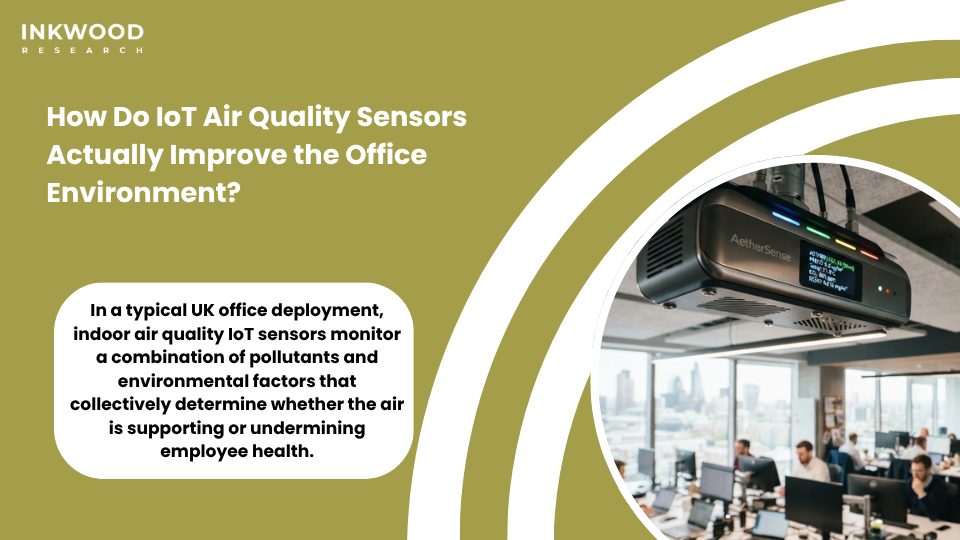
The practical case for IoT environmental sensors market solutions in commercial offices is straightforward, though the specifics are worth understanding. Traditional office ventilation systems operate on fixed schedules or basic occupancy assumptions, often ventilating spaces at the same rate regardless of actual air quality conditions. Moreover, real-time air quality monitoring IoT solutions fundamentally change this dynamic by providing continuous, granular data that building management systems can act on immediately.
In a typical UK office deployment, indoor air quality IoT sensors monitor a combination of pollutants and environmental factors that collectively determine whether the air is supporting or undermining employee health. The key parameters include:
- CO2 concentration: Elevated carbon dioxide levels, even well below regulatory limits, are associated with reduced cognitive performance and increased fatigue. Real-time IoT monitoring platforms track CO2 continuously, triggering ventilation adjustments before occupants experience symptoms.
- Particulate matter (PM2.5 and PM10): Fine particles from outdoor pollution, building materials, and human activity accumulate in enclosed spaces. IoT air quality monitoring market sensors detect these concentrations and flag when filtration systems need to activate or intensify.
- Volatile organic compounds (VOCs): Off-gassing from furniture, cleaning products, and electronic equipment contributes to sick building syndrome. Continuous monitoring identifies VOC spikes in real time, enabling targeted ventilation responses.
- Humidity: Both excessively dry and excessively humid environments affect respiratory health and comfort. Smart air quality sensors track relative humidity alongside air pollutants, providing a more complete picture of indoor environmental quality.
Additionally, cloud-connected air quality monitoring systems aggregate data across multiple floors and zones. This allows facilities and managers to identify patterns, such as a meeting room with consistently poor air quality, or a floor where CO2 peaks sharply after lunchtime, and address them systematically rather than reactively.
What UK Standards and Certifications Are Driving Smart Sensor Adoption?
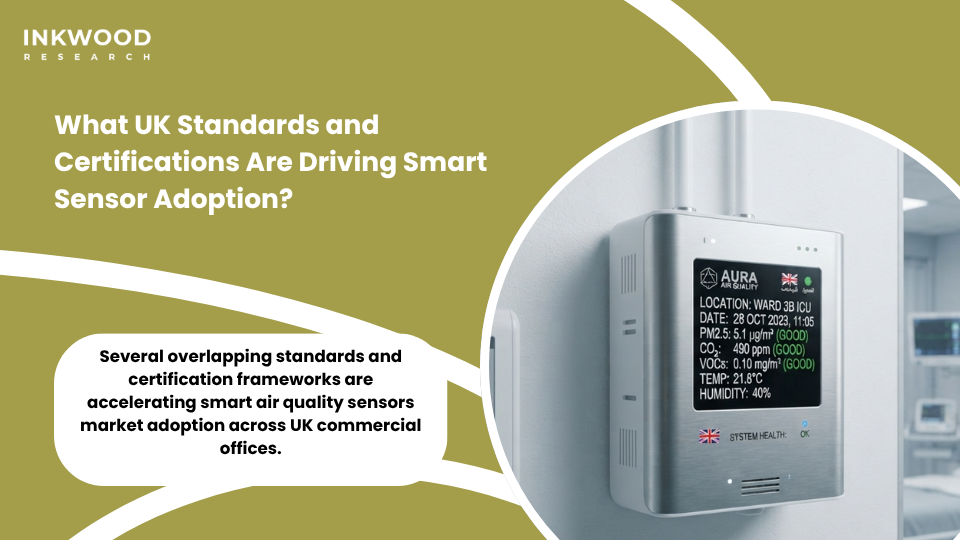
Several overlapping standards and certification frameworks are accelerating smart air quality sensors market adoption across UK commercial offices. Each of these creates a different type of market demand:
WELL Building Standard
The WELL Building Standard, administered by the International WELL Building Institute, has gained considerable traction among UK commercial property developers and corporate occupiers. Its Air category sets performance requirements for indoor air quality monitoring systems, including continuous monitoring thresholds for CO2, PM2.5, PM10, and VOCs. Achieving and maintaining WELL certification requires exactly the kind of air quality IoT sensors market infrastructure that UK offices are now investing in, making certification a direct commercial driver for sensor deployment.
CIBSE TM65 and Ventilation Guidance
The Chartered Institution of Building Services Engineers (CIBSE) provides technical guidance that shapes ventilation design and indoor air quality sensors market specifications across UK commercial buildings. Its TM65 assessment methodology and updated ventilation guidance following the pandemic have both reinforced the case for continuous IoT air quality monitoring, particularly in spaces with variable occupancy patterns like open-plan offices, meeting rooms, and shared amenity areas.
- HSE Workplace Regulations
The Health and Safety Executive’s workplace regulations require employers to maintain adequate ventilation in all workplaces, with a clear expectation that air quality is regularly assessed. While these regulations do not mandate specific IoT air quality monitoring market technologies, they create the legal foundation that makes continuous monitoring a defensible and increasingly prudent investment for UK employers with large office estates.
How Are UK Companies Deploying Indoor Air Quality IoT Solutions?
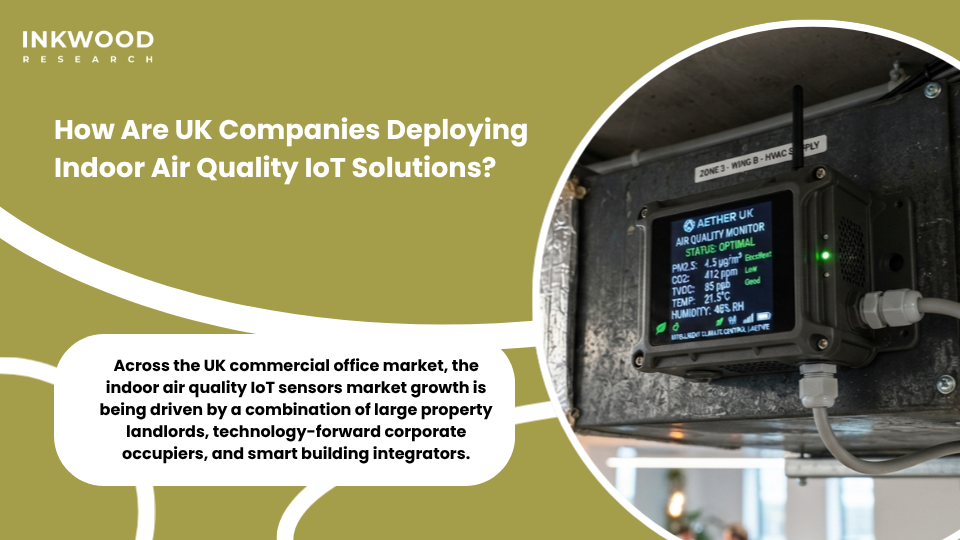
Across the UK commercial office market, the indoor air quality IoT sensors market growth is being driven by a combination of large property landlords, technology-forward corporate occupiers, and smart building integrators. The deployment patterns are revealing about where the United Kingdom air quality IoT sensors market is maturing fastest.
British Land, Landsec, and Derwent London, three of the UK’s largest commercial property groups, have all published commitments to healthy building standards that explicitly include continuous air quality monitoring across their major London office assets. This landlord-level adoption is significant because it establishes monitoring infrastructure as a baseline expectation for premium office space rather than a premium add-on.
On the technology side, several platforms are competing effectively for UK office deployments:
- Honeywell’s Forge building management platform integrates AI-powered air quality monitoring systems with HVAC control, allowing offices to automatically adjust ventilation in response to real-time sensor data. Its widespread adoption in UK corporate campuses makes it one of the most deployed cloud-connected air quality monitoring systems in the market.
- Siemens Desigo CC provides a comprehensive building automation backbone into which IoT environmental sensors for pollution control and wellbeing monitoring are integrated. Several major UK financial institutions and professional services firms use this platform across their office portfolios.
- Awair offers dedicated indoor air quality sensors market hardware combined with an enterprise dashboard that provides facility managers with floor-by-floor air quality visibility. Its clean interface and occupant-facing displays have made it particularly popular in the tech and media sector office market.
- IQAir has expanded its commercial office offering in the UK market, providing smart air quality sensors calibrated for professional environments alongside reporting tools that support WELL certification documentation requirements.
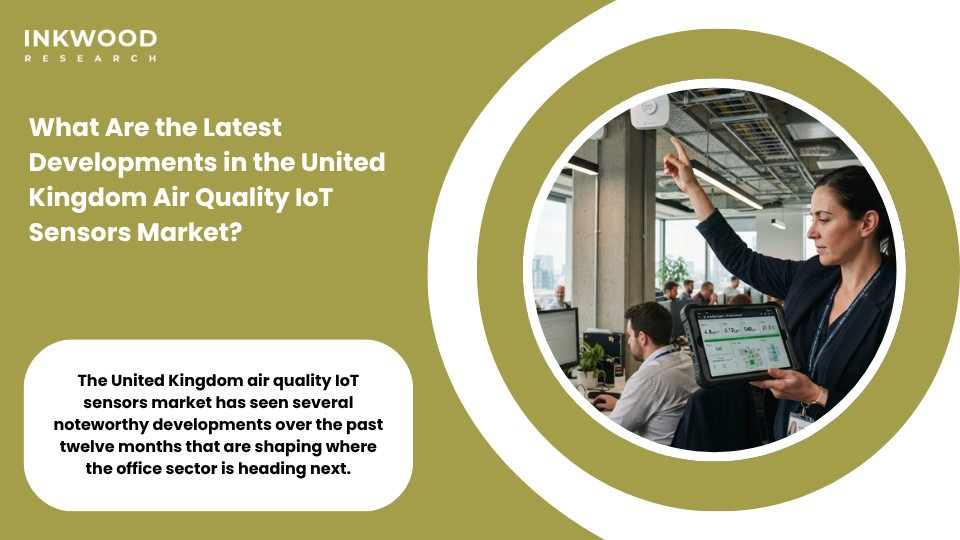
The United Kingdom air quality IoT sensors market has seen several noteworthy developments over the past twelve months that are shaping where the office sector is heading next. Rather than isolated product launches, these developments reflect a broader maturation of the market toward integrated, outcome-focused solutions:
- AI-driven predictive ventilation is moving from pilot to standard deployment across several large UK office developments. Rather than reacting to poor air quality after it occurs, AI-powered air quality monitoring systems now model occupancy patterns and external pollution levels to pre-condition office environments before occupants arrive, a step change in how real-time air quality monitoring IoT solutions are used in practice.
- Integration with HR and wellbeing platforms is an emerging trend, with indoor air quality monitoring systems data being connected to employee experience tools. Some UK employers are beginning to correlate air quality readings with self-reported wellbeing and productivity metrics, creating an evidence base that strengthens the business case for continued investment.
- UK Net Zero Buildings Standard consultation, led by the Department for Energy Security and Net Zero, is expected to incorporate indoor environmental quality requirements that will likely reference continuous IoT air quality monitoring market standards. This regulatory development is already influencing procurement decisions among major property groups preparing their portfolios for compliance.
- Tenant demand transparency is increasing, with occupiers now routinely requesting air quality data dashboards as part of lease negotiations in Grade A office markets. This shift is accelerating smart air quality sensors market deployment in refurbished and newly developed office buildings across London, Manchester, and Edinburgh.
Key Takeaways
- The United Kingdom air quality IoT sensors market is valued at US$116.77 million in 2026, growing to US$393.20 million by 2034 at a 16.39% CAGR, the strongest growth rate among major European markets.
- Post-pandemic awareness, WELL building certification, CIBSE guidance, and HSE workplace regulations are collectively driving IoT air quality sensor adoption across UK commercial offices.
- Indoor air quality IoT sensors monitor CO2, PM2.5, PM10, VOCs, and humidity continuously, enabling automated ventilation responses that support cognitive performance and employee health.
- British Land, Landsec, and Derwent London are establishing continuous air quality monitoring as a baseline expectation for premium UK office space rather than a premium add-on.
- Honeywell Forge, Siemens Desigo CC, Awair, and IQAir are the primary platforms competing in the UK commercial office IoT air quality deployment market.
- AI-driven predictive ventilation, HR platform integration, and Net Zero Buildings Standard consultation are the three most consequential near-term trends shaping the UK market’s next phase.
Conclusion:
The UK commercial office market is at a clear inflection point. Indoor air quality monitoring has moved from being a differentiating feature to a competitive expectation, and the United Kingdom air quality IoT sensors market is growing accordingly. For facilities managers, property developers, and technology providers, the question is no longer whether to invest in smart air quality sensors market solutions; it is how quickly and how comprehensively to do so. The regulatory signals, tenant expectations, and employee well-being evidence all point in the same direction.
Inkwood Research provides the market intelligence and strategic analysis needed to navigate the United Kingdom air quality IoT sensors market with confidence.
Connect with our team to explore how our insights can support your positioning in the UK’s evolving commercial air quality landscape.
Frequently Asked Questions
How large is the United Kingdom air quality IoT sensors market?
Our analysis values the market at US$116.77 million in 2026, growing to US$393.20 million by 2034 at a 16.39% CAGR.
Why are UK commercial offices investing in indoor air quality monitoring?
Post-pandemic awareness, WELL certification requirements, CIBSE guidance, and direct links between air quality and employee productivity are all driving investment.
What pollutants do UK office IoT air quality sensors typically monitor?
Smart office sensors commonly monitor CO2, particulate matter (PM2.5, PM10), volatile organic compounds, and humidity as the primary indoor air quality indicators.
How does WELL certification drive smart air quality sensor adoption in UK offices?
WELL’s Air category requires continuous monitoring of key pollutants, making IoT air quality sensor infrastructure a mandatory component of certification compliance.
Which companies provide indoor air quality IoT solutions for UK offices?
Honeywell, Siemens, Awair, and IQAir are among the leading providers of smart indoor air quality monitoring platforms for UK commercial office environments.
What is driving the UK air quality IoT sensors market's high growth rate?
WELL certification demand, HSE workplace compliance, AI-integrated smart building upgrades, and tenant-driven air quality transparency are collectively sustaining strong market growth.