Table of Contents
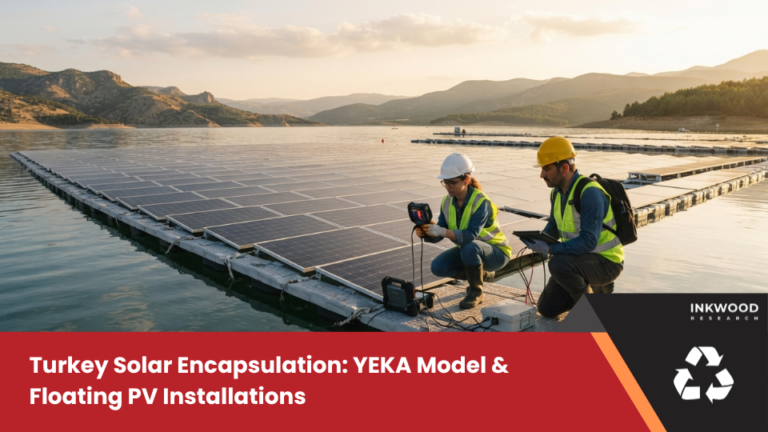
This analysis is brought to you by Inkwood Research, a leading market intelligence firm specializing in Eastern Mediterranean renewable energy markets, Turkish photovoltaic sector dynamics, and emerging economy solar deployment strategies. Our research team combines extensive experience analyzing YEKA regulatory frameworks, floating photovoltaic technologies, crystalline silicon supply chains, and solar encapsulation material requirements. Based on our proprietary research methodologies and strategic partnerships with Turkish energy authorities, renewable project developers, and photovoltaic manufacturers, we deliver actionable insights that empower strategic decision-making for enterprises navigating Turkey’s accelerating solar market transformation and material supply opportunities.
TLDR
Turkey’s solar capacity doubled within two years, reaching 20 GW by 2024 as the Renewable Energy Resource Area model facilitates large-scale project development. Floating photovoltaic regulations unlock water surface installations while localization incentives drive domestic manufacturing investments. Simplified legislation accelerates unlicensed generation adoption as the Ministry targets project 77 GW of solar capacity by 2035. Solar’s share of electricity generation reached 7.5%, with encapsulation demand growing correspondingly as material suppliers evaluate Turkish market opportunities, offering regional positioning for European and Middle Eastern access.
Renewable energy investors, photovoltaic manufacturers, encapsulation material suppliers, project developers, policy analysts, Turkish market entrants, regional trade strategists, floating solar specialists, and sustainable infrastructure planners will gain valuable insights into Turkey’s solar expansion dynamics, YEKA framework advantages, manufacturing incentives, regulatory environment, and material supply chain opportunities in rapidly growing markets.
Explosive Capacity Growth Exceeding Government Targets
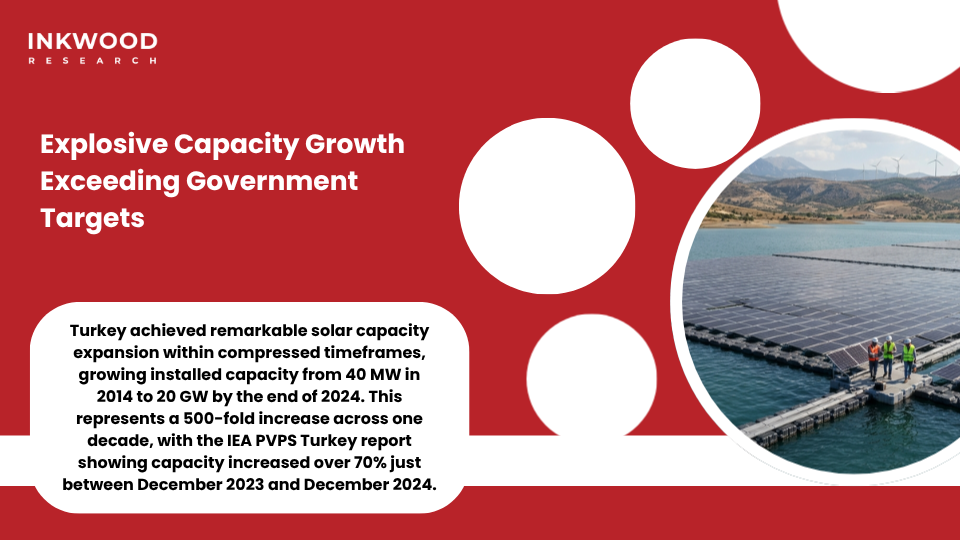
Turkey achieved remarkable solar capacity expansion within compressed timeframes, growing installed capacity from 40 MW in 2014 to 20 GW by the end of 2024. This represents a 500-fold increase across one decade, with the IEA PVPS Turkey report showing capacity increased over 70% just between December 2023 and December 2024. Subsequently, such acceleration demonstrates Turkey’s commitment to renewable energy transformation driven by supportive policies and investor confidence.
Surpassing 2025 Targets 1.5 Years Early
Ministry of Energy and Natural Resources established an 18 GW capacity target for end-2025, though installations reached this milestone by August 2024. Moreover, Turkey exceeded expectations by 17 months, reflecting policy effectiveness and investor confidence while necessitating more ambitious target revisions, acknowledging market momentum. As a result, this achievement signals strong fundamentals supporting continued rapid growth.
Rapid deployment creates corresponding demand for photovoltaic components and materials as module manufacturers require steady solar encapsulation supplies supporting production volumes. Installation growth directly translates to material consumption increases, leading suppliers to anticipate sustained demand growth, aligning with capacity expansion trajectories. Also, Turkey solar encapsulation market opportunities expand proportionally with the deployment acceleration across all market segments.
Electricity Generation Share Reaching Meaningful Levels
Solar energy provided 7.5% of Turkey’s total electricity generation in 2024, with annual output reaching 26 terawatt-hours, supporting grid operations. This contribution, representing a significant increase of 39% compared to the previous year, continues growing as installations accelerate. Besides, geographic diversity spreads generation across regions to reduce transmission constraints. Distributed generation particularly benefits from simplified regulations enabling deployment closer to consumption points.
On the other hand, capacity factor improvements enhance energy output relative to nameplate capacity as technology advances increase module efficiency and system performance. Optimized site selection maximizes solar resource utilization, meaning these factors combine to deliver greater electricity generation from installed capacity. Hence, solar’s grid contribution grows faster than capacity additions alone suggest, improving the technology’s value proposition.
YEKA Model Driving Large-Scale Development and Localization
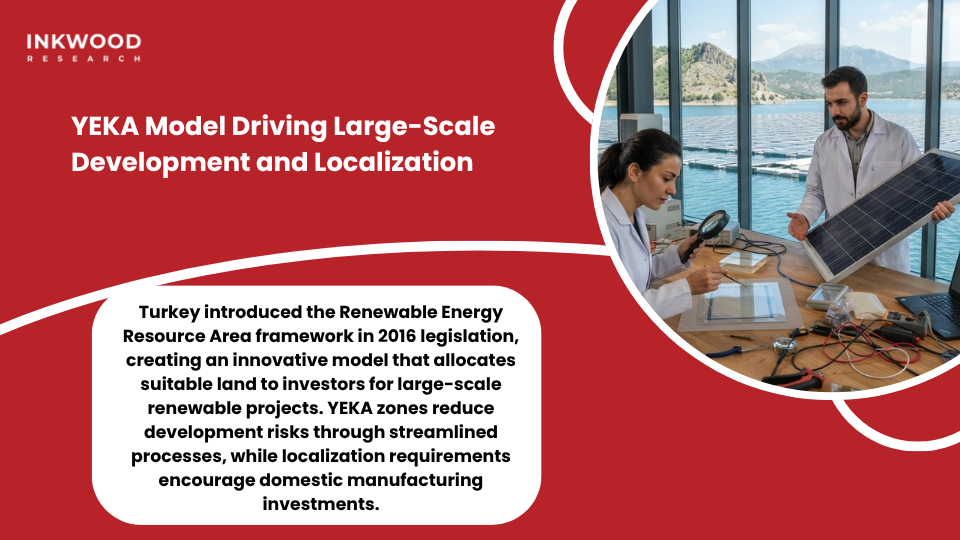
Turkey introduced the Renewable Energy Resource Area framework in 2016 legislation, creating an innovative model that allocates suitable land to investors for large-scale renewable projects. YEKA zones reduce development risks through streamlined processes, while localization requirements encourage domestic manufacturing investments. The framework simultaneously addresses deployment and industrial development objectives in a coordinated approach.
YEKA Tender Results and Project Implementation
Authorities tendered 3 GW solar capacity through YEKA mechanisms to date, with projects totaling 1.5 GW capacity already achieving implementation. Recent tenders in 2024 allocated another 800 MW, announced in February 2025, attracting major developers and financing through competitive processes. Plus, winners commit to local content requirements supporting supply chain development while securing long-term revenue streams.
YEKA improvements in 2024 enhanced investor attractiveness significantly through shortened post-tender permitting processes that reduce development timelines. Accordingly, transmission fee exemptions improve project economics, while financial incentives offset higher initial costs. These modifications address investor concerns identified through earlier tender experiences, leading competition to intensify in recent allocation rounds.
Localization Requirements Catalyzing Manufacturing Investments
YEKA contracts mandate minimum domestic content percentages for project components, creating demand certainty that supports manufacturing facilities. Module producers established operations serving local markets, while component suppliers evaluate Turkey opportunities where solar encapsulation materials qualify for local content credit when produced domestically. As a result, this structured approach builds industrial capacity systematically.
Foreign manufacturers partnered with Turkish entities to access YEKA opportunities through technology transfer agreements that bring expertise while satisfying localization objectives. Joint ventures combine international experience with local market knowledge, accelerating capability development compared to purely domestic efforts. Additionally, Turkey benefits from rapid knowledge acquisition through these strategic partnerships that transfer manufacturing know-how.
Floating Photovoltaic Regulations Opening New Frontiers
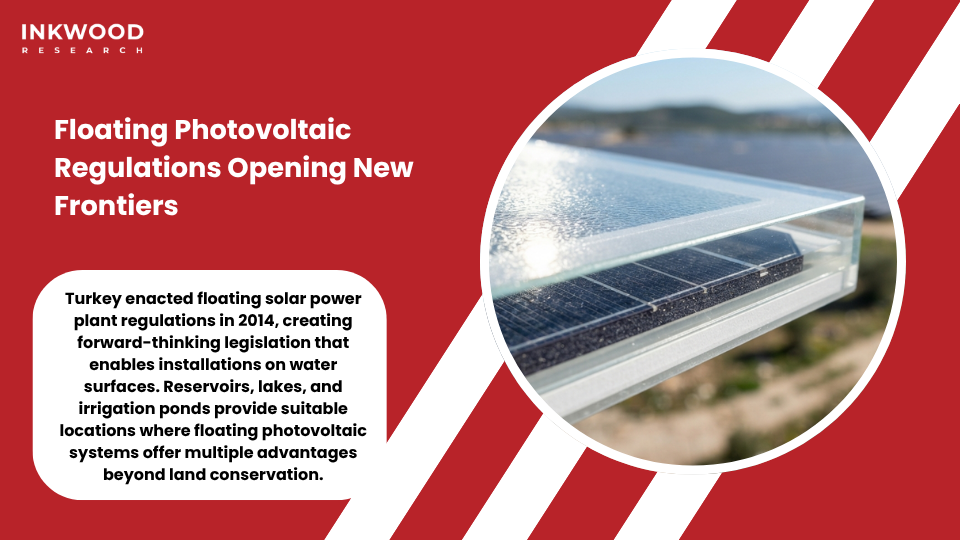
Turkey enacted floating solar power plant regulations in 2014, creating forward-thinking legislation that enables installations on water surfaces. Reservoirs, lakes, and irrigation ponds provide suitable locations where floating photovoltaic systems offer multiple advantages beyond land conservation. Plus, water cooling improves module efficiency compared to ground-mounted installations, while coverage reduces evaporation, preserving water resources.
Technical Advantages and Environmental Benefits
Floating installations achieve higher capacity factors through temperature regulation as water proximity moderates panel temperatures, improving electrical performance. Moreover, studies demonstrate efficiency gains versus equivalent land-based systems, while installations avoid agricultural land competition, addressing food security concerns. Dual-use approaches maximize resource utilization by generating electricity while preserving productive uses of land.
Evaporation reduction provides significant water conservation benefits where surface coverage limits solar exposure, decreasing water loss. This proves particularly valuable in water-stressed regions as Turkey’s climate creates substantial evaporation from open water bodies. Additionally, floating photovoltaic systems deliver environmental co-benefits beyond renewable electricity generation, addressing multiple resource challenges simultaneously.
Material Requirements for Floating Solar Encapsulation
Floating installations demand enhanced moisture resistance from encapsulation materials as constant water proximity increases humidity exposure. Besides, corrosive environments accelerate material degradation without proper protection, making advanced polymers with superior barrier properties essential. Polyolefin elastomers offer advantages over traditional ethylene-vinyl acetate formulations in these demanding applications.
Module durability requirements intensify for floating applications where mechanical stresses from wave action and anchoring systems affect structural integrity. Edge sealing becomes critical in preventing water ingress pathways, leading material suppliers to develop specialized formulations addressing floating photovoltaic challenges. As a result, these premium products command higher pricing justified by enhanced performance requirements and longer service life.
Unlicensed Generation Simplification Accelerating Adoption
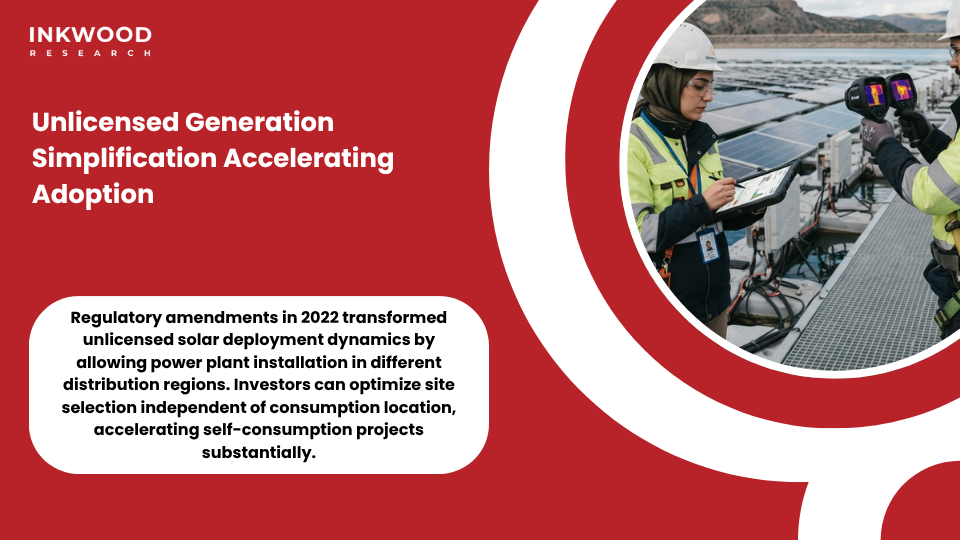
Regulatory amendments in 2022 transformed unlicensed solar deployment dynamics by allowing power plant installation in different distribution regions. Investors can optimize site selection independent of consumption location, accelerating self-consumption projects substantially. Accordingly, commercial and industrial facilities particularly benefit from expanded options that enable strategic placement of generation assets.
Self-Consumption Economics Driving Commercial Adoption
Businesses reduce electricity costs through on-site generation, where avoided retail rates provide attractive payback periods. Energy independence buffers against price volatility, while manufacturing facilities with high consumption profiles achieve substantial savings. Moreover, cnlicensed generation presents compelling value propositions for commercial users seeking to control energy expenses and improve cost predictability.
Installation growth reduced negative grid interconnection impacts as distributed generation lessens transmission congestion compared to large centralized plants. Plus, local consumption absorbs production without straining infrastructure, while simplified permitting accelerates project timelines. These regulatory improvements removed barriers hindering earlier adoption, unleashing pent-up demand from commercial and industrial users.
Residential and Agricultural Market Segments
Homeowners increasingly adopt rooftop solar systems, taking advantage of simplified processes where financing availability improves as markets mature. Conversely, equipment costs declined, making residential systems economically viable, while net metering or virtual net metering arrangements enhance value propositions. These factors combine to drive residential market expansion across Turkey’s growing middle class.
Agricultural operations utilize solar generation to offset irrigation and processing costs, with remote locations benefiting from energy independence, reducing grid dependency. In this regard, farming operations possess suitable land and roof surfaces for installations, while agricultural electricity rates create favorable economics. This sector represents significant untapped potential for distributed generation growth in Turkey’s rural regions.
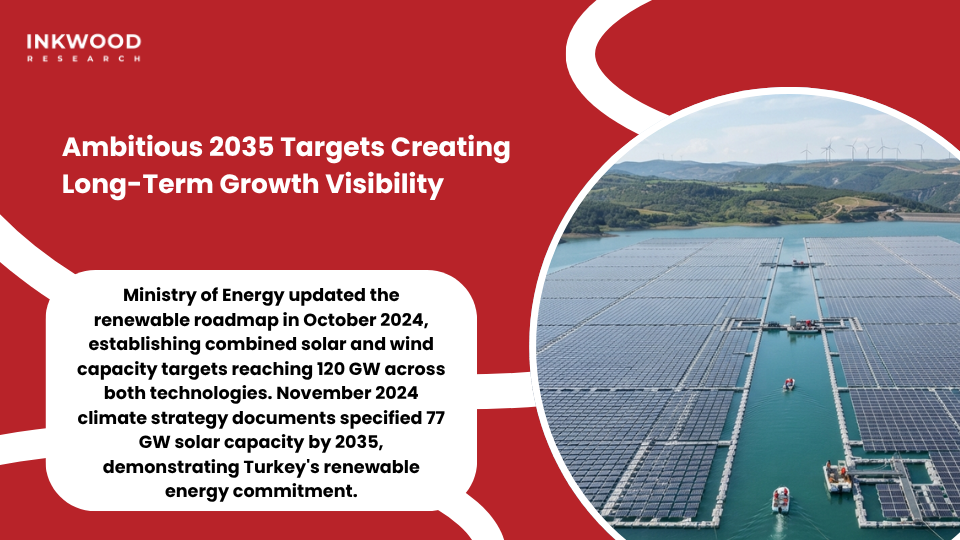
Ministry of Energy updated the renewable roadmap in October 2024, establishing combined solar and wind capacity targets reaching 120 GW across both technologies. November 2024 climate strategy documents specified 77 GW solar capacity by 2035, demonstrating Turkey’s renewable energy commitment. Market participants gain long-term visibility supporting investment decisions across the value chain.
Capacity Addition Requirements Through 2035
The current 20 GW capacity must nearly quadruple to reach the 77 GW target, requiring 57 GW additions across the remaining decade. Moreover, annual installation rates must average approximately 5-6 GW to sustain momentum, demanding robust supply chains and manufacturing capabilities. Component suppliers prepare capacity expansions anticipating sustained demand that supports long-term business planning.
Solar encapsulation material requirements scale proportionally with module production, as Turkey solar encapsulation market growth reflects deployment trajectories. Material consumption per gigawatt depends on module efficiency and configuration, though massive capacity additions ensure strong demand fundamentals. Accordingly, suppliers evaluate market entry timing to capture growth opportunities while building customer relationships early.
Regional Energy Security and Climate Objectives
Solar expansion reduces fossil fuel import dependence, enhancing energy security as Turkey imports significant natural gas, supporting electricity generation. Renewable capacity displaces imported fuels, improving trade balances, while climate commitments necessitate emissions reductions. Moreover, solar deployment contributes toward international obligations while delivering economic benefits through reduced energy import bills.
Electricity demand growth accompanies economic development, requiring generation capacity additions where solar provides cost-effective capacity meeting growing consumption. Distributed generation reduces transmission investment requirements, creating system-level benefits that strengthen rationales for aggressive solar targets. Additionally, policy support continues as multiple objectives align favorably around renewable energy expansion.
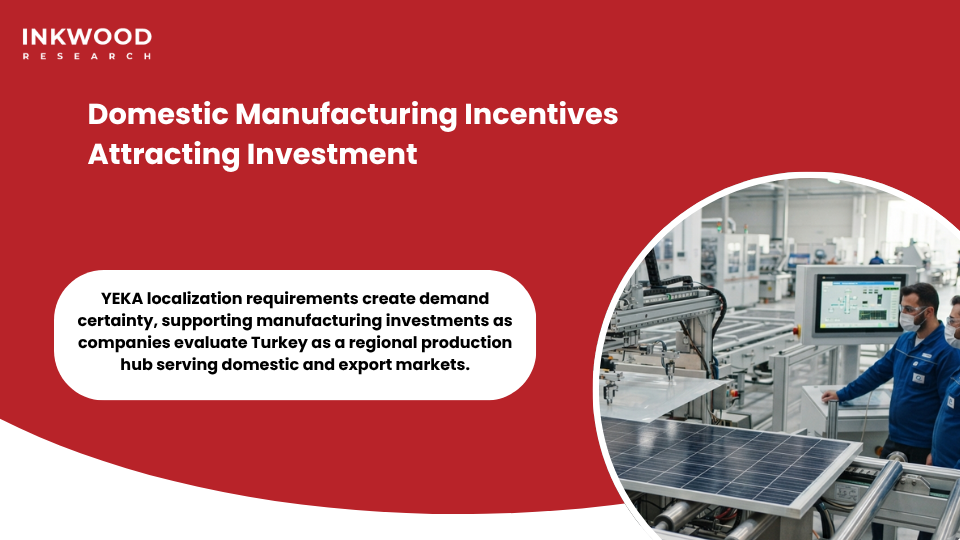
YEKA localization requirements create demand certainty, supporting manufacturing investments as companies evaluate Turkey as a regional production hub serving domestic and export markets. Accordingly, geographic positioning enables access to European, Middle Eastern, and Central Asian customers, while trade agreements facilitate market access across multiple regions. These advantages attract international manufacturers seeking strategic locations.
Module Assembly and Component Manufacturing
Several module assembly facilities commenced operations in recent years, serving domestic demand while building export capabilities. Component localization proceeds gradually as supply chains develop, with imported cells and materials initially dominating. Plus, upstream integration increases as the market scales, creating opportunities for material suppliers to evaluate throughout this evolution.
Solar encapsulation production requires moderate capital investment compared to cell manufacturing, allowing material suppliers to establish operations relatively quickly. Proximity to module assemblers reduces logistics costs and improves responsiveness, while local production satisfies YEKA domestic content requirements. Subsequently, these factors support favorable economics for encapsulation manufacturing in Turkey’s growing solar ecosystem.
Technology Transfer and Skill Development
International partnerships bring manufacturing expertise and technology through joint ventures that facilitate knowledge transfer to Turkish partners. Aligning with this, training programs develop skilled workforces operating advanced production lines, while universities contribute engineering graduates and research capabilities. This ecosystem development supports sustainable industry growth beyond short-term project implementation.
Government support extends beyond YEKA mandates to broader industrial policy, where investment incentives reduce facility development costs. Further, tax advantages improve operational economics, while research funding supports technology development and process optimization. These comprehensive measures create favorable environments for manufacturing investments that position Turkey as a regional solar hub.
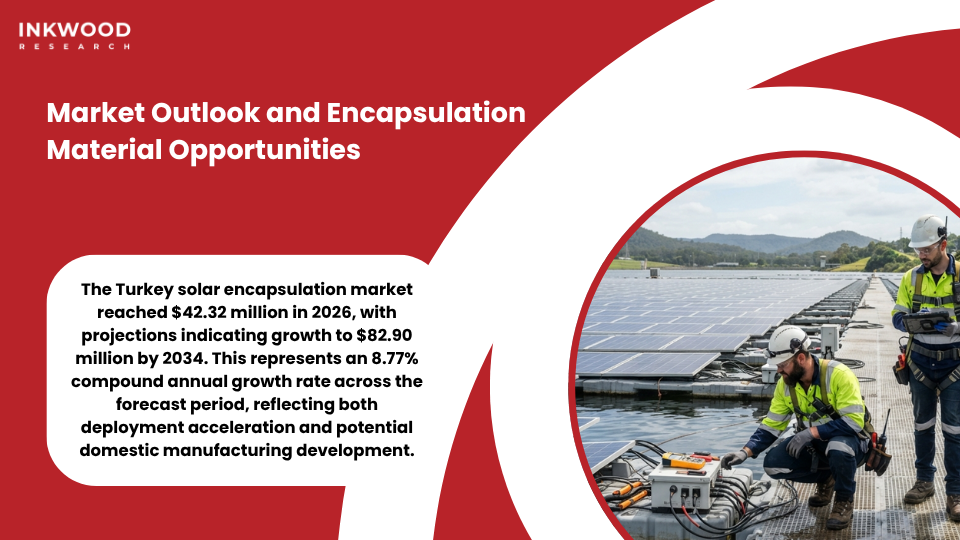
The Turkey solar encapsulation market reached $42.32 million in 2026, with projections indicating growth to $82.90 million by 2034. This represents an 8.77% compound annual growth rate across the forecast period, reflecting both deployment acceleration and potential domestic manufacturing development. Accordingly, material suppliers position strategically to capture emerging opportunities in this rapidly expanding market.
Competitive Landscape and Market Entry Strategies
Currently, imported materials dominate Turkish solar encapsulation supply as European and Asian suppliers serve module assemblers through distribution networks. YEKA localization creates incentives for domestic production, leading material manufacturers to evaluate investment opportunities. Plus, early entrants gain advantages in establishing customer relationships and market positions before competition intensifies.
Partnership approaches reduce entry risks compared to standalone investments by collaborating with Turkish chemical companies, leveraging existing infrastructure. Joint ventures combine solar expertise with local manufacturing capabilities, while partnerships facilitate regulatory navigation and customer access. Hence, these structures prove particularly effective for international suppliers seeking to minimize investment risk.
Technology Preferences and Material Specifications
Crystalline silicon modules dominate Turkish installations, similar to global patterns, making ethylene-vinyl acetate and polyolefin elastomers the primary encapsulation materials. Moreover, ground-mounted utility installations emphasize cost-effectiveness, favoring EVA, though floating photovoltaic applications require enhanced moisture protection. Material diversity serves different market segments and performance requirements effectively.
Quality standards increasingly influence material selection as markets mature, with module reliability directly affecting project economics through warranty obligations. Premium encapsulation materials gain adoption despite higher costs, where long-term performance justifies initial price premiums. Additionally, suppliers differentiating through quality and technical support capture higher-value segments as Turkey’s solar industry matures.
Key Takeaways
- Turkey achieved remarkable solar capacity growth by doubling installations within two years as YEKA renewable energy zones facilitate large-scale development while driving manufacturing localization.
- Floating photovoltaic regulations unlock water surface installations offering environmental co-benefits, while unlicensed generation simplification accelerates commercial and residential adoption across diverse market segments.
- Ambitious 2035 targets projecting 77 GW solar capacity create long-term growth visibility as domestic manufacturing incentives attract investments in module assembly and component production.
- The Turkey solar encapsulation market projects robust growth through 2034, with geographic positioning enabling regional market access beyond domestic demand.
- Material suppliers evaluate entry strategies, balancing investment timing and partnership approaches as floating applications demand enhanced moisture resistance, driving premium material adoption.
- Quality differentiation gains importance as markets mature, with strategic positioning requiring an understanding of regulatory frameworks, localization requirements, and technology preferences.
Conclusion:
Turkey’s solar sector experiences transformative growth driven by supportive policies, where the YEKA framework simultaneously addresses deployment and industrial development objectives. Floating photovoltaic regulations demonstrate innovative approaches to maximizing resource utilization, while simplified unlicensed generation accelerates distributed adoption across market segments.
Ambitious capacity targets provide long-term visibility, supporting supply chain investments as localization incentives attract manufacturing across the value chain. Solar encapsulation materials represent accessible entry opportunities for suppliers, with geographic positioning enabling Turkey to serve as a regional production hub connecting European, Middle Eastern, and Asian markets.
Market growth creates opportunities for material suppliers and technology partners where quality differentiation and technical support become competitive advantages. Based on our analysis, Turkey’s solar encapsulation market enters a sustained growth phase with strategic positioning today, capturing emerging opportunities throughout the coming decade.
For organizations seeking deeper insights into Turkish solar markets or regional expansion strategies, Inkwood Research offers comprehensive market intelligence and consulting services. Contact our team to explore how these opportunities align with your strategic objectives.
Frequently Asked Questions
How does the YEKA model support solar manufacturing localization?
The YEKA model requires minimum domestic content in renewable energy projects, creating stable demand that encourages local manufacturing investment and strengthens national solar supply chains.
What advantages do floating photovoltaic systems offer?
Floating solar installations improve module efficiency through natural water cooling, reduce water evaporation, and avoid competition for agricultural land.
Why are 2035 solar capacity targets significant for market participants?
Long-term solar capacity targets provide investment certainty, support supply chain expansion, and encourage manufacturing and infrastructure development across the renewable energy sector.
How do floating solar projects improve renewable energy efficiency?
Floating photovoltaic systems benefit from lower operating temperatures and reduced shading, which can increase energy generation compared to some land-based solar installations.
Why do governments use localization policies in renewable energy markets?
Localization policies promote domestic manufacturing, reduce reliance on imports, create jobs, and strengthen national renewable energy industries.
How do long-term renewable energy targets influence solar market growth?
Clear government targets encourage private investment, support project pipelines, and help manufacturers plan production capacity to meet future solar deployment demand.