Table of Contents

This analysis is brought to you by Inkwood Research, a leading market intelligence firm specializing in Southeast Asian technology ecosystems, emerging market battery manufacturing, and ASEAN electronics supply chains. Our research team combines extensive experience analyzing Thailand’s industrial development policies, foreign direct investment patterns, and technology transfer initiatives across automotive, electronics, and renewable energy sectors. Based on our proprietary research methodologies and strategic partnerships with Thai Board of Investment officials, battery manufacturers, electronics multinationals, and regional development agencies, we deliver actionable insights that empower strategic decision-making for global enterprises evaluating Thailand’s rapidly evolving technology landscape and manufacturing opportunities.
TLDR
Thailand emerges as Southeast Asia’s innovation powerhouse, with the Thailand flexible thin film and printed battery market growing from US$30.22 million in 2025 to US$105.83 million by 2032 at 19.60% CAGR. Government incentives attract global flexible battery manufacturers to establish production facilities for electric vehicles, consumer electronics, and smart devices. Investments in environmentally friendly batteries, data centers, and thin film battery technology position Thailand as a critical hub for flexible energy storage innovation in the Asia-Pacific markets.
International manufacturers evaluating Asian production locations, electric vehicle companies sourcing thin film lithium batteries, electronics brands requiring flexible battery market access, investment firms analyzing Southeast Asian opportunities, and government economic development agencies gain strategic insights. Additionally, battery technology developers seeking partnerships, supply chain managers optimizing regional operations, renewable energy developers, and data center operators benefit from understanding Thailand’s evolving printed electronics energy storage ecosystem and infrastructure advantages.
Flexible Thin Film and Printed Battery Market: Thailand’s Technology Transformation
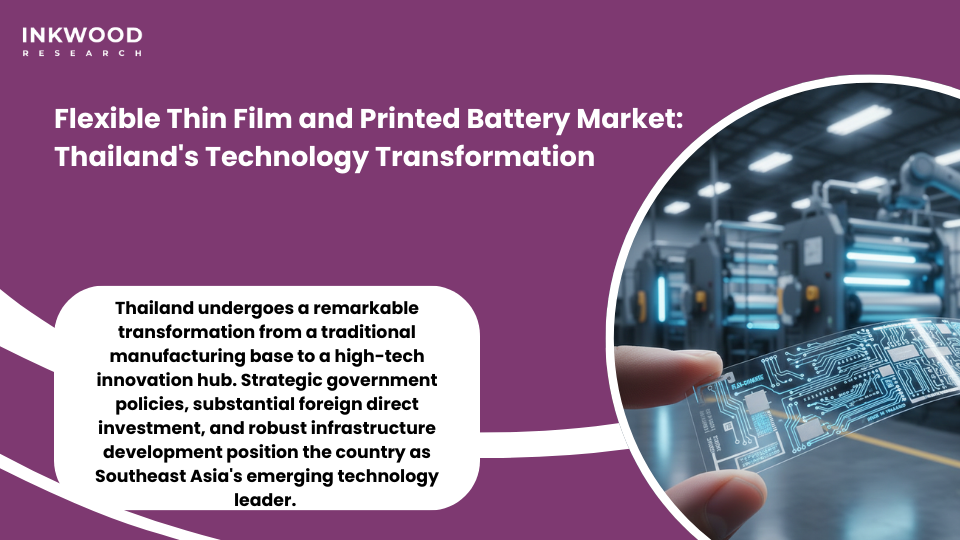
Thailand undergoes a remarkable transformation from a traditional manufacturing base to a high-tech innovation hub. Strategic government policies, substantial foreign direct investment, and robust infrastructure development position the country as Southeast Asia’s emerging technology leader. As a result, the Thailand flexible thin film and printed battery market demonstrates impressive growth potential aligned with these broader economic shifts.
Market valuations reached $30.22 million in 2025, with projections indicating expansion to $105.83 million by 2032. This represents a 19.60% CAGR reflecting accelerating adoption across automotive, electronics, and energy storage applications. According to investment data:
- Thailand Board of Investment applications surged 94% year-over-year in value, reaching record ฿37 trillion (US$42.2 billion) in the first nine months of 2025.
- Foreign direct investment flows primarily into high-tech industries, including digital infrastructure and smart electronics manufacturing.
- The electrical appliances and electronics sector attracted 382 project applications totaling ฿1 billion (US$5.6 billion) in investments.
- Notable commitments include ฿5 billion (US$1.5 billion) from Chinese investors in high-density battery manufacturing at the cell level.
Strategic Location and Infrastructure Advantages
Thailand’s geographic position provides strategic advantages within ASEAN markets. The country serves as a regional hub, accessing 650 million consumers across Southeast Asia. Additionally, infrastructure investments strengthen Thailand’s competitiveness. Laem Chabang port expansion, completing in 2027, will handle 18 million TEUs annually, ranking among the world’s top ten busiest ports.
Moreover, the upcoming 2026 land bridge project connects the Gulf of Thailand with the Andaman Sea, further promoting trade efficiency. These infrastructure enhancements reduce logistics costs and delivery times for manufacturers serving both Asian and global markets. Flexible battery manufacturers benefit from improved supply chain connectivity.
Additionally, Thailand maintains political stability and a business-friendly environment, attracting multinational corporations. Transparent regulations, intellectual property protections, and established legal frameworks provide confidence for long-term investments. Consequently, these factors prove especially important for technology-intensive industries requiring substantial capital commitments.
Skilled Workforce Development
Thailand invests heavily in education and workforce development, supporting technology industries. Universities offer specialized programs in electronics engineering, materials science, and manufacturing technology. Further, partnerships between educational institutions and industries ensure curriculum relevance, preparing graduates for actual market needs.
Furthermore, government programs provide training subsidies, encouraging companies to develop employee skills. These initiatives reduce labor costs while improving workforce quality. Additionally, technical schools and vocational training centers produce skilled workers supporting manufacturing operations throughout the country.
Electric Vehicle Manufacturing Hub
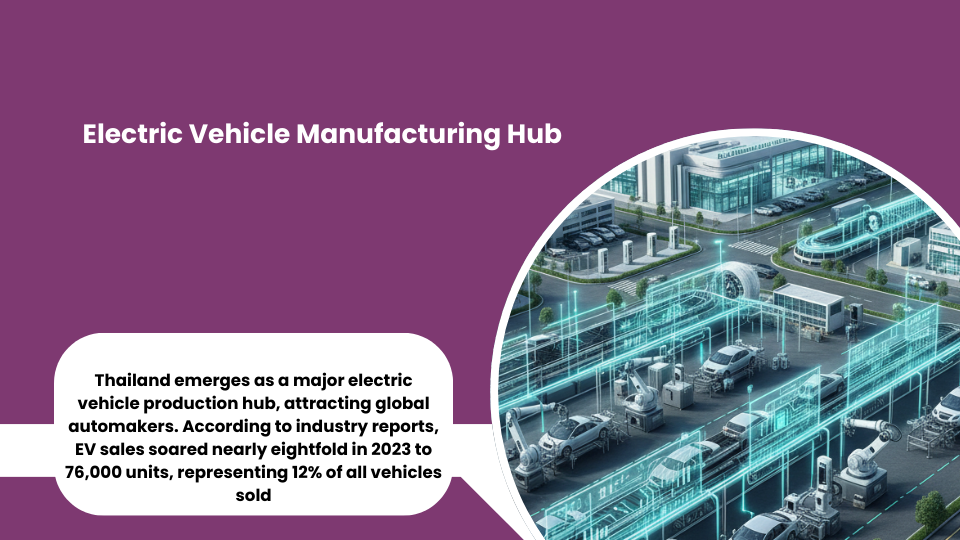
Thailand emerges as a major electric vehicle production hub, attracting global automakers. According to industry reports, EV sales soared nearly eightfold in 2023 to 76,000 units, representing 12% of all vehicles sold. Moreover, market share increased to 14% in Q1 2024, demonstrating accelerating adoption. The government targets its 30@30 strategy—30% of vehicles manufactured by 2030 being EVs.
Major Chinese automakers established a substantial manufacturing presence. BYD opened its state-of-the-art factory in Rayong’s Eastern Economic Corridor in July 2024, investing approximately US$900 million. The facility eventually produces 150,000 vehicles annually, playing a crucial role in BYD’s international expansion, particularly within ASEAN markets. Other Chinese companies, including Great Wall Motor, Hozon New Energy Automobile, SAIC Motor, Chongqing Changan Automobile, GAC Aion, and Chery Automobile, also set up production facilities.
Battery pack production represents a critical EV ecosystem component. In March 2024, SVOLT Energy Technology partnered with Banpu Next beginning EV battery pack production in Thailand. Additionally, Chinese manufacturer Sunwoda Electronic received approval in March 2025 to invest over US$1 billion in producing EV and energy storage system batteries at the cell level.
Supply Chain Development
Thai automotive parts manufacturers transition toward EV components, supplying local production. Changan announced partnerships with AAPICO Hitech and Thai Summit Group as part of procurement plans worth US$570,000 (20 million baht) supporting local EV production. These collaborations develop domestic supply chains, reducing import dependencies.
Moreover, the charging infrastructure is expanding rapidly throughout Thailand. Fast-growing networks of charging stations enable convenient EV adoption. Local manufacturing of chargers and significant automotive parts creates comprehensive ecosystems supporting vehicle production and usage. Furthermore, thin film lithium batteries power various EV-related applications beyond vehicle propulsion.
Additionally, battery recycling facilities attract investment as EV volumes grow. Sustainable battery lifecycle management becomes increasingly important. Companies establish operations recovering valuable materials from used batteries, creating circular economy models, reducing environmental impacts, while improving economics.
Market Dynamics and Competition
Thailand’s EV market growth outpaces most Southeast Asian neighbors. Government incentives, including tax breaks, subsidies, and other benefits, attract automakers and consumers. Additionally, these policies accelerate market development, creating opportunities for flexible battery manufacturers serving diverse applications within automotive ecosystems.
Furthermore, Thailand benefits from established automotive manufacturing expertise. The country produced vehicles for decades, developing skilled workforces and comprehensive supply chains. Plus, this foundation enables a rapid transition toward electric mobility as global markets shift from internal combustion engines.
Electronics and Semiconductor Ecosystem
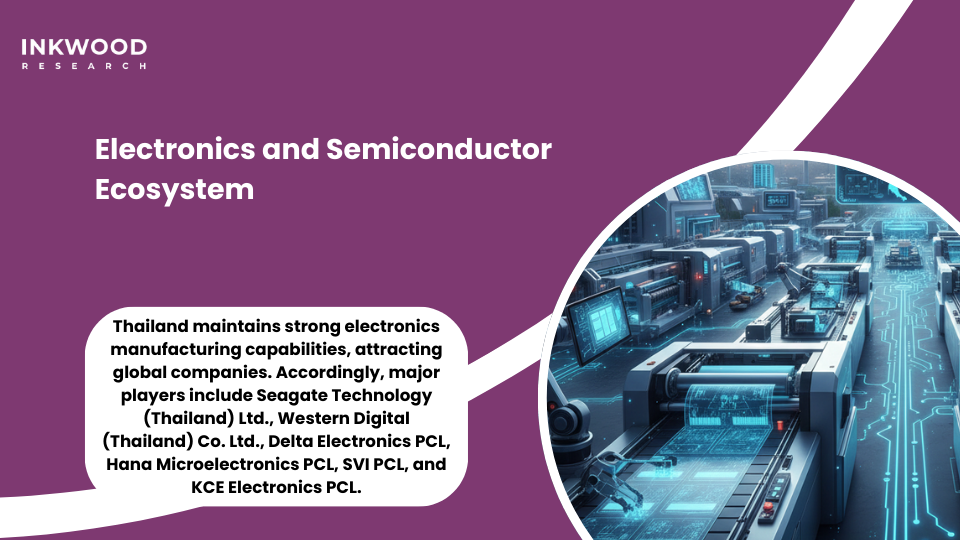
Thailand maintains strong electronics manufacturing capabilities, attracting global companies. Accordingly, major players include Seagate Technology (Thailand) Ltd., Western Digital (Thailand) Co. Ltd., Delta Electronics PCL, Hana Microelectronics PCL, SVI PCL, and KCE Electronics PCL. In 2022, Delta Electronics PCL generated nearly 120 billion Thai baht in revenue, leading domestic manufacturers.
The country strengthens its positions in printed circuit boards and power electronics. Government initiatives support infrastructure development, renewable energy prioritization, and workforce creation supporting these industries. Also, Thailand aims to solidify its leadership by attracting additional electronics manufacturing investments, leveraging existing capabilities.
Semiconductor supply chain integration represents a strategic priority. Thailand recognizes opportunities within global semiconductor ecosystems experiencing geographical diversification. According to industry analysis, Thailand’s exports grew significantly between 2019 and 2023, partially due to growing electronics manufacturing leadership.
Consumer Electronics Applications
Consumer electronics represent substantial markets for flexible thin film battery technologies. Smartphones, tablets, wearables, and IoT devices require compact, efficient power sources. Thailand’s electronics manufacturing sector increasingly produces these products for global brands.
Moreover, flexible displays and bendable devices create demand for conformable battery solutions. Polymer thin film battery technologies enable innovative product designs impossible with rigid batteries. Plus, electronics manufacturers partner with battery companies to develop integrated solutions, optimizing performance and user experience.
Additionally, hearable devices, including wireless earbuds and smart hearing aids, require miniaturized batteries. These applications demand high energy density in extremely small form factors. Advanced thin film battery technology, in this regard, enables products meeting stringent size and performance requirements.
IoT and Smart Device Growth
Internet of Things adoption accelerates across industries and consumer applications. Smart home devices, industrial sensors, and wearable fitness trackers proliferate globally. Thailand manufactures substantial volumes of these products for international brands.
Furthermore, smart cities initiatives throughout Southeast Asia drive IoT device demand. Sensors monitor traffic, air quality, energy consumption, and infrastructure conditions. Battery-powered wireless sensors deploy easily without wiring infrastructure costs. Flexible energy storage solutions support these distributed sensing networks.
Battery Manufacturing Investments
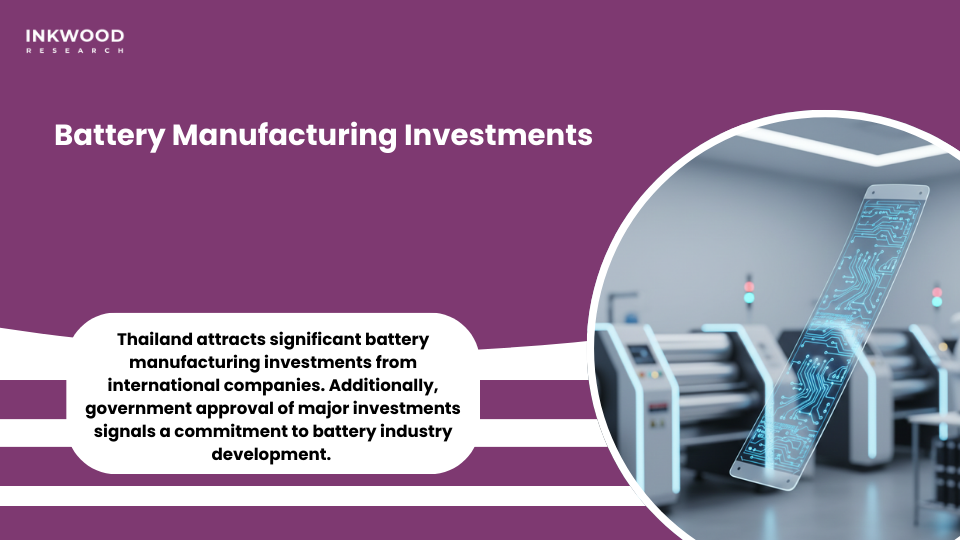
Thailand attracts significant battery manufacturing investments from international companies. In September 2024, 24M Technologies opened a manufacturing and research center in Rayong. The facility focuses on testing and developing 24M’s technologies, including binder-free battery production processes and eco-friendly recycling methods. Also, the center investigates Impervio battery separator technology, reducing lithium-ion battery fire risks.
Additionally, government approval of major investments signals a commitment to battery industry development. Sunwoda Electronics’ US$1 billion project producing EV and ESS batteries at the cell level represents Thailand’s largest battery manufacturing commitment. According to government announcements, the first factory expects to hire over 1,000 staff once production begins, with the entire project employing significantly greater numbers, including many Thai engineers and researchers.
Battery energy storage systems represent a growing focus area. Thailand requires more battery energy storage capacity to meet clean energy targets. The 2024 Power Development Plan draft calls for 10,000 MW of battery energy storage systems supporting renewable energy integration. However, actual demand likely exceeds this target as renewable production scales.
Research and Development Initiatives
Companies establish R&D facilities alongside production operations. These centers develop technologies suited for tropical climates and Southeast Asian markets. Plus, temperature tolerance, humidity resistance, and other environmental factors require specialized engineering.
Moreover, collaborations between manufacturers and Thai universities accelerate innovation. Research partnerships provide access to academic expertise while offering students practical experience. Also, government programs encourage these collaborations through funding and regulatory support.
Additionally, intellectual property development becomes increasingly important. Companies file patents protecting innovations developed in Thailand. As a result, this intellectual property creates value beyond manufacturing operations, positioning Thailand as an innovation center rather than merely a production location.
Local Supply Chain Development
Battery manufacturing requires extensive supply chains providing raw materials, components, and supporting services. International companies increasingly source materials regionally, reducing logistics costs and delivery times. Thai suppliers develop capabilities meeting quality and volume requirements.
Furthermore, chemical companies establish operations producing battery materials. Electrolytes, cathode materials, and separator films require specialized manufacturing expertise. Thailand’s chemical industry possesses foundational capabilities supporting expansion into battery materials production.
Data Centers and Energy Storage Demand
Data center investments surge in Thailand, driven by digital transformation throughout Southeast Asia. Thailand is pushing to become a leading digital hub with new investments in digital infrastructure, including recent approvals for four data center projects totaling approximately ฿100 billion (USD 3.1 billion). Singapore led FDI applications with ฿359.8 billion (US$11.1 billion), followed by Hong Kong SAR, Mainland China, the United Kingdom, and Japan.
Data centers require substantial energy storage and backup power systems. Uninterruptible power supplies protect against grid outages, ensuring continuous operations. Additionally, load balancing systems optimize energy consumption, reducing operational costs. These applications demand reliable, high-performance battery technologies.
Furthermore, the country’s leadership is strengthened through its role as the leading automotive production base, having evolved from a components assembler into a top manufacturing and export hub. Further, robust data center infrastructure drives significant battery backup solution demand.
Renewable Energy Integration
Thailand recently increased its target for renewable energy electricity generation to 51% by 2037 in its latest draft Power Development Plan (PDP 2024). Solar, wind, and hydroelectric installations require energy storage systems to manage intermittent generation. Batteries store excess energy produced during peak generation periods, releasing power during high-demand or low-generation periods.
Moreover, grid stability applications require fast-responding energy storage. Batteries provide frequency regulation services, maintaining power quality as renewable generation fluctuates. Consequently, these ancillary services become increasingly valuable as renewable penetration increases.
Additionally, distributed energy resources, including rooftop solar installations, benefit from battery storage. Homes and businesses maximize self-consumption of generated power, reducing grid dependence. Environmentally friendly batteries appeal to sustainability-conscious consumers and businesses.
Telecommunications Infrastructure
5G network deployments require extensive infrastructure, including base stations and edge computing facilities. These installations demand reliable backup power, ensuring continuous service during grid disruptions. Moreover, batteries provide this reliability, supporting critical communications infrastructure.
Furthermore, remote base stations in underserved areas may rely entirely on renewable energy and battery storage. Solar-powered installations with battery backup deliver connectivity without grid connections. These applications require long-life, low-maintenance battery systems, optimizing the total cost of ownership.
Government Policies and Investment Incentives
The Thailand Board of Investment provides comprehensive incentive packages attracting technology investments. According to BOI Secretary General Narit Therdsteerasukdi, “The fact that investment application value received in the first nine months of 2025 already exceeds 22% higher than applications for whole 2024 shows investors recognize Thailand’s economic potential. This reflects success of our commitment to high-tech sectors at the heart of our investment strategy.”
Tax incentives significantly reduce investment costs. Companies receive corporate income tax exemptions for specified periods based on industry classification and investment size. Moreover, additional benefits include import duty exemptions on machinery and raw materials used in production. These incentives improve investment economics, making Thailand competitive against alternative locations.
Moreover, targeted industries receive enhanced support. The government identifies battery energy storage as an S-Curve industry, designating sectors critical for future economic development. These industries receive preferential treatment, including longer tax holidays, larger investment grants, and streamlined approval processes.
Eastern Economic Corridor Development
The Eastern Economic Corridor represents Thailand’s premier development zone targeting high-tech industries. Located in Rayong, Chonburi, and Chachoengsao provinces, the EEC offers enhanced infrastructure, simplified regulations, and additional incentives. Many battery and EV manufacturers locate facilities within the EEC, leveraging these advantages.
Furthermore, the EEC Digital Park provides specialized facilities for technology companies. Advanced telecommunications, reliable power supplies, and proximity to airports and seaports create ideal environments for electronics and battery manufacturers. Also, clustering effects emerge as related companies locate near each other, facilitating collaboration and supply chain efficiency.
Additionally, universities within the EEC conduct research supporting local industries. Public-private partnerships fund research programs addressing industry challenges. These collaborations accelerate technology development while training skilled workers.
Environmental Regulations and Sustainability
Thailand implements environmental regulations encouraging sustainable manufacturing practices. Battery producers must comply with waste management, emissions, and chemical handling requirements. However, regulations remain less stringent than in many developed markets, balancing environmental protection with industrial competitiveness.
Moreover, government programs support environmentally friendly batteries development. Funding supports research into sustainable materials, recycling technologies, and reduced environmental impact manufacturing processes. These initiatives align with global sustainability trends, positioning Thai manufacturers advantageously.
Key Takeaways
- Market Growth: The Thailand flexible thin film and printed battery market expands from US$30.22 million in 2025 to US$105.83 million by 2032 at a 19.60% CAGR, driven by automotive, electronics, and energy storage applications.
- EV Manufacturing Hub: Thailand emerges as Southeast Asia’s electric vehicle production leader, with major manufacturers establishing facilities producing 150,000+ vehicles annually and creating comprehensive battery ecosystems.
- Investment Surge: Foreign direct investment applications reached record ฿37 trillion (US$42.2 billion) in the first nine months of 2025, with significant commitments to battery manufacturing and smart electronics production.
- Electronics Strength: Established electronics manufacturing capabilities position Thailand advantageously for flexible battery market growth, serving consumer electronics, IoT devices, and semiconductor applications.
- Data Center Boom: Thailand is pushing to become a leading digital hub with new investments in digital infrastructure, including recent approvals for four data center projects totaling approximately ฿100 billion (USD 3.1 billion).
- Government Support: Board of Investment incentives, including tax holidays, duty exemptions, and streamlined approvals, attract flexible battery manufacturers establishing regional operations.
- Supply Chain Integration: Local suppliers develop capabilities supporting battery manufacturing, creating comprehensive ecosystems from raw materials through finished products.
- Sustainability Focus: Environmental initiatives and renewable energy targets drive environmentally friendly batteries development and energy storage system deployments.
Conclusion:
Thailand’s emergence as Southeast Asia’s technology hub creates unprecedented opportunities for flexible thin film battery industry growth. Strategic government policies, substantial foreign investments, and robust infrastructure development position the country advantageously within global supply chains. The convergence of electric vehicle manufacturing, electronics production, and data center expansion creates diverse markets for battery technologies.
Based on our analysis, Thailand’s flexible battery market growth trajectory remains strong throughout the forecast period. Companies establishing operations now position themselves advantageously, accessing rapidly growing regional markets. The country’s commitment to high-tech industries ensures continued policy support and infrastructure investment.
Looking forward, Thailand’s technology ecosystem will likely expand beyond its current focus areas. Opportunities emerge in renewable energy integration, smart city development, and advanced manufacturing. Thin film battery technology innovations will enable these applications, supporting Thailand’s economic transformation and regional leadership.
Ready to explore opportunities in Thailand’s dynamic printed electronics energy storage market? Contact Inkwood Research for comprehensive market intelligence and strategic guidance, navigating Thailand’s rapidly evolving technology landscape.
Frequently Asked Questions
Why are global battery manufacturers choosing Thailand for production facilities?
Thailand offers compelling advantages, including a strategic ASEAN location, substantial government incentives, robust infrastructure, and skilled workforce availability. Tax holidays, duty exemptions, and streamlined approvals reduce investment costs significantly. Additionally, proximity to major automotive and electronics brands provides immediate market access. The Eastern Economic Corridor offers enhanced infrastructure and additional incentives, attracting high-tech manufacturers.
How does Thailand's EV market growth impact flexible battery demand?
Thailand’s ambitious 30@30 strategy targets 30% EV production by 2030, creating substantial battery demand. Beyond vehicle propulsion batteries, EVs require numerous auxiliary thin film lithium batteries powering sensors, control systems, and user interfaces. Charging infrastructure expansion demands energy storage systems and backup power solutions. Additionally, battery pack assembly operations attract suppliers providing components, including polymer thin film battery technologies for specialized applications.
What role do data centers play in Thailand's battery market growth?
Data center investments totaling create massive energy storage and backup power demand. Facilities require uninterruptible power supplies, ensuring continuous operations during grid disruptions. Additionally, load balancing systems optimize energy consumption using flexible energy storage solutions. Thailand’s emergence as a regional digital hub attracts hyperscale data centers serving Southeast Asian markets. Furthermore, 5G telecommunications deployments require backup power at base stations throughout the country.