Table of Contents
This analysis is brought to you by Inkwood Research, a leading market intelligence firm specializing in Nordic sustainability initiatives, battery lifecycle management, and circular economy frameworks for electric vehicle systems. Our research team combines extensive experience analyzing carbon footprint reduction strategies, battery recycling technologies, and environmental policy effectiveness across Sweden, Norway, Denmark, and Finland. Based on our proprietary research methodologies and strategic partnerships with Swedish automotive manufacturers, environmental agencies, battery recycling operators, and clean energy providers, we deliver actionable insights that empower strategic decision-making for global enterprises navigating Sweden electric vehicle battery market transformation and sustainable mobility transitions.
TLDR
Sweden’s electric vehicle battery market reaches US$822.65 million in 2025, projected to US$1.73 billion by 2032 through comprehensive carbon reduction initiatives. Electric vehicle battery market sustainability advances through lifecycle emissions management, recycling programs, and clean energy integration. Swedish EV battery recycling initiatives recover 95% of materials, minimizing environmental impacts. Sustainable EV battery solutions leverage fossil-free electricity, reducing production emissions significantly. EV battery lifespan optimization and second-life applications support global electric vehicle battery market decarbonization objectives.
This carbon footprint analysis benefits environmental sustainability directors, automotive lifecycle assessment specialists, circular economy strategists, battery recycling operators, and regulatory compliance managers. Climate policy analysts evaluating Nordic best practices, investment teams assessing sustainable EV battery solutions, procurement specialists prioritizing low-carbon supply chains, and corporate ESG officers implementing decarbonization roadmaps will gain valuable intelligence on Sweden’s comprehensive EV battery carbon reduction framework.
Sweden’s Climate Leadership: Setting Global Standards
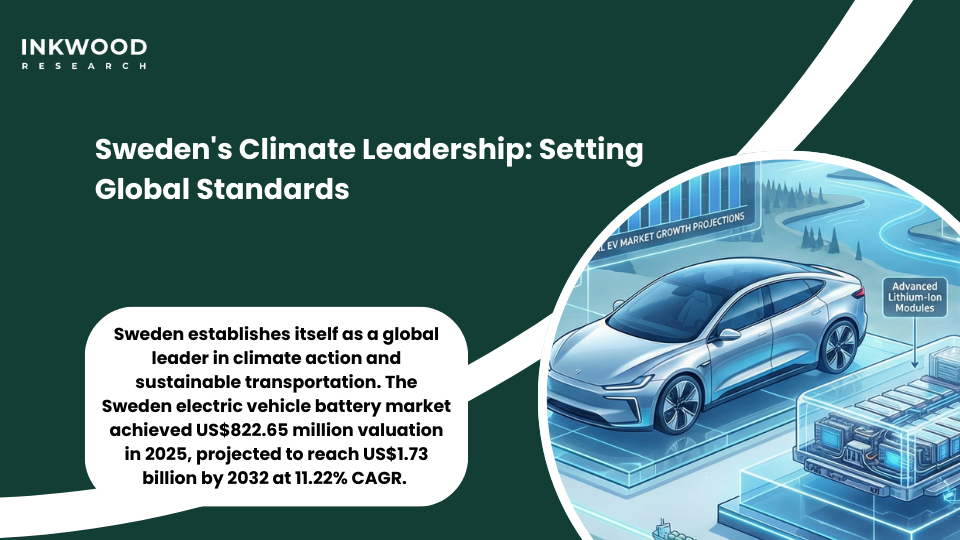
Sweden establishes itself as a global leader in climate action and sustainable transportation. The Sweden electric vehicle battery market achieved US$822.65 million valuation in 2025, projected to reach US$1.73 billion by 2032 at 11.22% CAGR. This growth reflects comprehensive decarbonization strategies throughout automotive value chains.
Ambitious Climate Targets and Policy Framework
Sweden is a global leader in decarbonisation with targets to cut greenhouse gas emissions 59% by 2030 compared with 2005, achieving net-zero by 2045. These legally binding commitments drive systematic policy implementation. Moreover, interim targets ensure consistent progress toward long-term objectives.
Sweden’s legally binding 2045 net zero emissions target equates to an 85% domestic GHG emissions cut from 1990 levels. The comprehensive framework includes binding interim targets and regular climate action plan updates. Additionally, an independent Climate Policy Council assesses policies yearly, providing expert recommendations.
Electric Vehicle Market Penetration
December 2024 saw plugin EVs take 62.8% share in Sweden, with full battery-electrics at 40.8%. Full year 2024 powertrain shares stood at 35.0% BEV, 23.4% PHEV, and only 7.0% diesel. In all, this remarkable adoption rate demonstrates consumer commitment to sustainable transportation.
Thanks to supportive policies, Sweden reported a high EV sales share at 60% in 2023, helping displace significant oil product demand. However, policy reversals in 2023 may challenge 2030 transport emissions targets. Consequently, additional policy actions become necessary to ensure trajectory maintenance.
Carbon Pricing Mechanism
Sweden was the first country to introduce carbon pricing (1991) and has the highest carbon price globally, proven effective at driving decarbonisation. This market-based mechanism incentivizes emissions reductions across all economic sectors. Industries invest in cleaner technologies, avoiding substantial carbon costs.
Carbon pricing revenues fund green technology development and infrastructure investments. The system creates clear economic incentives favoring low-carbon alternatives. Furthermore, predictable carbon costs enable long-term business planning. This policy tool demonstrates exceptional effectiveness compared to regulatory alternatives.
Reducing Production Phase Carbon Emissions
Battery production represents the most carbon-intensive phase of electric vehicle lifecycles. Sweden addresses this challenge through comprehensive strategies leveraging clean electricity and sustainable manufacturing practices.
Fossil-Free Electricity Advantage
Sweden’s electricity generation stems predominantly from hydropower and nuclear sources. Most of Sweden’s electricity supply comes from hydro and nuclear, along with a growing wind contribution. Additionally, this low-carbon grid provides manufacturing advantages compared to coal-dependent regions.
Sweden has maintained relatively low emissions from battery production, averaging less than half that of China. Clean electricity dramatically reduces production-phase carbon footprints. Consequently, Swedish-manufactured batteries demonstrate superior environmental profiles.
Industrial Decarbonization Programs
Sweden’s industrial sector focuses on low-emission hydrogen as a key decarbonisation pathway. Programs like Industrial Leap support emissions-reduction solutions development and deployment. Further, government funding accelerates technology adoption across manufacturing sectors.
Battery manufacturers benefit from comprehensive industrial support programs. Research and development subsidies advance cleaner production processes. Meanwhile, infrastructure investments facilitate renewable energy integration. In all, these coordinated efforts reduce manufacturing carbon intensities systematically.
Green Transformation in Northern Sweden
Favourable conditions in northern Sweden shape green industrial transformation, boosting economic prospects. Access to abundant renewable electricity attracts battery manufacturing investments. Consequently, production concentrates in regions with the cleanest energy sources.
Northern facilities leverage hydropower and wind resources extensively. Meanwhile, cold climates provide natural cooling, reducing energy consumption. Moreover, proximity to Nordic automotive manufacturers minimizes transportation emissions. These geographic advantages create optimal low-carbon manufacturing ecosystems.
EU Battery Regulation Compliance
The recently agreed EU sustainable-battery strategy introduces carbon footprint labeling by 2024. Moreover, it also mandates sustainability requirements, including recycled content, performance, and durability. Swedish manufacturers position themselves advantageously, meeting these stringent standards.
Carbon footprint disclosure requirements favor low-emission producers. In this regard, Swedish batteries demonstrate superior environmental credentials compared to global averages. Furthermore, transparent reporting builds consumer trust. Consequently, regulatory compliance becomes a competitive differentiator within European markets.
Comprehensive Lifecycle Carbon Footprint Analysis
Comprehensive lifecycle assessments reveal the true environmental impacts of electric vehicles. In this regard, Swedish research contributes valuable insights informing policy decisions and technology development priorities.
Production Phase Emissions Reality
Producing large lithium-ion batteries accounts for 40-60% of total EV production emissions. This significant proportion demands focused reduction efforts. However, grid decarbonization and manufacturing improvements reduce intensities continuously.
Global average GHG emissions from battery production could decline to 85 kg CO2e/kWh by 2025 as electricity grids decarbonize. Swedish production already achieves substantially lower emissions. Moreover, continued improvements drive further reductions.
Operational Emissions Benefits
Electric vehicles produce zero direct tailpipe emissions during operation. Total lifecycle emissions depend on electricity generation sources. Accordingly, heating is supplied mainly through bioenergy-based district heating and heat pumps in Sweden, creating a low-carbon energy ecosystem.
Swedish EVs charged with clean electricity demonstrate dramatic emissions advantages. Plus, lifecycle assessments show substantial benefits versus combustion vehicles. Furthermore, grid improvements continuously enhance environmental performance. Each year brings incremental carbon footprint reductions.
Critical Material Demand Reduction
Research estimates quantities of nickel, manganese, cobalt, lithium, and graphite required for Sweden’s EV transition. Moreover, studies identify measures limiting material demand, including shorter battery ranges enabled by charging infrastructure improvements.
Combined measures could achieve a 50-75% reduction in cumulative demand and 72-87% reduction in in-use stock by 2050. Here, reduction potentials exceed recycling contributions significantly. Therefore, demand-side measures prove more effective than supply-side solutions alone.
Debunking Misleading Studies
Earlier controversial Swedish research claimed EVs required 155,000 miles before environmental benefits materialized. However, the IVL study made peculiar assumptions far from the real-world truth, including zero emissions from petroleum extraction and refining.
Updated analyses demonstrate EVs achieve carbon parity much faster. Swedish conditions with clean electricity show benefits within 20,000-30,000 miles. Moreover, battery production emissions decline continuously. Contemporary research further confirms substantial environmental advantages throughout vehicle lifespans.
Advanced Battery Recycling and Circular Economy Programs
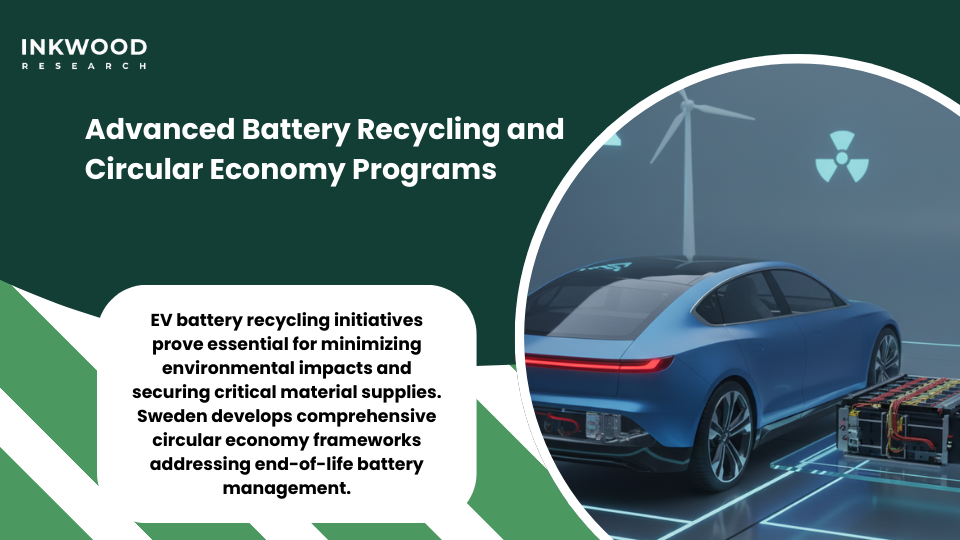
EV battery recycling initiatives prove essential for minimizing environmental impacts and securing critical material supplies. Sweden develops comprehensive circular economy frameworks addressing end-of-life battery management.
Material Recovery Technologies
Advanced recycling processes recover 95% of battery materials, including lithium, cobalt, and nickel. Hydrometallurgical techniques separate elements efficiently. Subsequently, recovered materials meet quality standards for new battery production. This circularity reduces mining requirements substantially.
Swedish companies invest heavily in recycling technology development. Further, pilot facilities demonstrate commercial viability at scale. Government support accelerates technology maturation timelines. Moreover, EU regulations mandate minimum recycled content levels, driving demand.
Second-Life Applications
Batteries retaining 70-80% capacity after automotive use serve stationary storage applications effectively. These second-life systems support renewable energy integration and grid stabilization. Consequently, battery value extends beyond vehicle lifespans significantly.
Repurposing programs connect the automotive and energy storage sectors. Used EV batteries provide cost-effective storage solutions. Meanwhile, extended utility delays recycling needs. This cascade approach maximizes resource efficiency comprehensively.
Extended Producer Responsibility
Swedish regulations implement extended producer responsibility frameworks. Manufacturers remain accountable for end-of-life battery management. Collection networks ensure proper disposal and recycling. These requirements internalize environmental costs appropriately.
Compliance programs establish collection points throughout distribution networks. Moreover, consumers return used batteries easily. Subsequently, certified recyclers process materials according to environmental standards. This comprehensive system achieves high collection and recycling rates.
Circular Economy Policy Framework
Government policies actively promote circular economy principles. Tax incentives favor products incorporating recycled materials. Meanwhile, landfill restrictions prevent improper disposal. Research funding supports circular economy innovation.
Industry collaborations develop standardized recycling protocols. Information sharing accelerates best practice adoption. Furthermore, international cooperation addresses cross-border battery flows. In all, these coordinated efforts maximize circularity across entire supply chains.
Transportation Sector Decarbonization Strategies
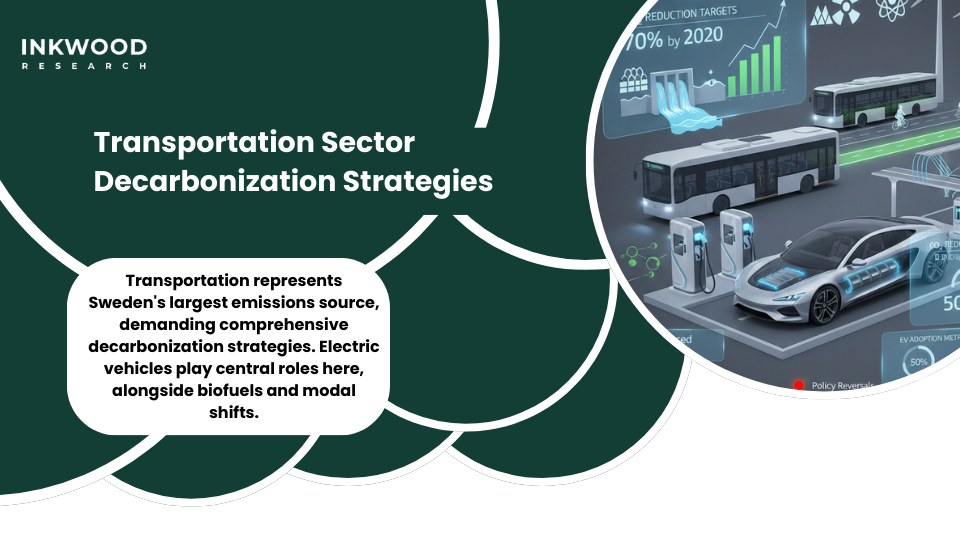
Transportation represents Sweden’s largest emissions source, demanding comprehensive decarbonization strategies. Electric vehicles play central roles here, alongside biofuels and modal shifts.
Challenging 2030 Targets
- Despite notable progress in deploying biofuels and EVs, policy shifts challenge Sweden meeting 2030 transport emissions targets of 70% reduction versus 2010 levels. Both areas saw significant policy reversals in 2023, potentially hindering progress.
- Most of Sweden’s greenhouse gas emissions come from the transport sector, which remains reliant on oil. Therefore, accelerated electrification proves essential. Additional policy actions addressing charging infrastructure and taxation become necessary.
Biofuel Integration Strategy
- Sweden has a high share of biofuels in transport fuel mix at 25% in 2022, helping displace oil consumption. Advanced biofuels serve applications difficult to electrify. However, mandate reductions in 2023 challenged deployment trajectories.
- The government’s decision to increase the blending mandate from 6% to 10% over 2025-30 is welcome development. This strengthened policy supports the 2030 EU targets. Nevertheless, mandates remain lower than previous levels. Furthermore, electricity penetration impacts biofuel demand dynamics.
Charging Infrastructure Development
- Comprehensive charging networks prove essential for EV adoption. Sweden develops an extensive public charging infrastructure supporting long-distance travel. Fast charging corridors connect major cities. Meanwhile, workplace and residential charging installations proliferate.
- Shorter battery ranges enabled by improved charging infrastructure represent key strategies for reducing material demand. Convenient charging availability alleviates range anxiety concerns. Consequently, smaller batteries become acceptable, reducing resource requirements.
Modal Shift Initiatives
- Transportation decarbonization extends beyond vehicle electrification. Modal shifts toward public transit, cycling, and walking reduce overall travel demand. Urban planning emphasizes compact development, minimizing transportation needs.
- Public transportation electrification accelerates through bus and rail investments. Bicycle infrastructure expansions encourage active transportation. Furthermore, telecommuting reduces commuting requirements. These complementary strategies comprehensively address transportation emissions.
Reducing Critical Material Demand Through Innovation
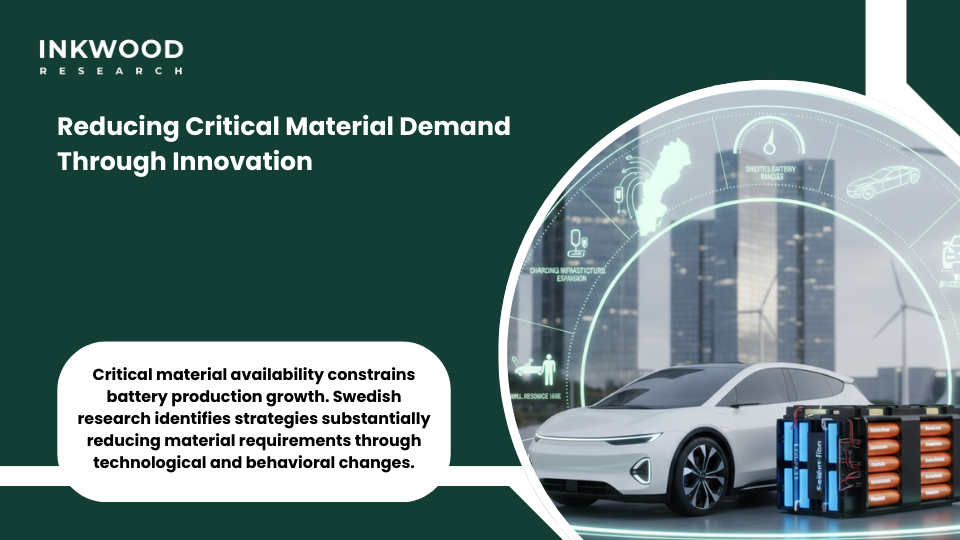
Critical material availability constrains battery production growth. Swedish research identifies strategies substantially reducing material requirements through technological and behavioral changes.
Battery Range Optimization
Notable reduction potentials exist for shorter battery range enabled by improved charging infrastructure. Many consumers overestimate range requirements. Consequently, oversized batteries waste resources unnecessarily.
Right-sizing batteries according to actual usage patterns reduces material consumption significantly. Most daily travel occurs within limited ranges. Therefore, smaller batteries suffice when the charging infrastructure ensures convenience. This optimization dramatically reduces critical material demands.
Vehicle Energy Efficiency Improvements
Increased vehicle energy efficiency reduces battery size requirements, maintaining equivalent ranges. Accordingly, aerodynamic improvements, lightweight materials, and efficient powertrains decrease energy consumption. Subsequently, smaller batteries provide adequate performance.
Swedish automotive manufacturers invest heavily in efficiency technologies. Research programs optimize entire vehicle systems comprehensively. Moreover, regulations incentivize continuous improvements. These combined efforts reduce battery material requirements substantially.
Reduced Travel Demand
Reduced travel demand compared to reference scenarios decreases total vehicle and battery requirements. Urban planning emphasizing mixed-use development minimizes travel distances. Remote work arrangements reduce commuting frequencies.
Digital services substitute for physical transportation in many cases. E-commerce optimizes delivery routes, reducing overall vehicle miles. Furthermore, shared mobility services improve utilization rates. These societal changes complement technological improvements effectively.
Alternative Battery Chemistries
Research into alternative battery chemistries addresses critical material constraints. While sodium-ion batteries eliminate lithium dependency, iron-based cathodes replace cobalt. These alternatives utilize abundant materials, reducing supply chain vulnerabilities.
Swedish research institutions contribute to chemistry development programs. Government funding supports breakthrough technology development. Meanwhile, industry partnerships accelerate commercialization timelines. These innovations promise sustainable battery production long term.
Competitive Landscape: Swedish Automotive and Battery Players
Sweden’s electric vehicle battery market features established automotive manufacturers and emerging battery technology companies. These players leverage Swedish sustainability credentials and technological expertise.
Volvo Cars: Electrification Leader
Volvo Cars commits to full electrification, targeting 100% electric sales by 2030. Their Recharge lineup expands continuously, offering diverse EV options. Moreover, supply chain sustainability receives prioritized attention throughout operations.
Volvo invests in battery technology development and manufacturing partnerships. Direct relationships with suppliers ensure sustainability standards compliance. Furthermore, transparency initiatives disclose carbon footprints comprehensively. These commitments strengthen brand positioning in premium markets.
Polestar: Performance Electrification
Polestar, Volvo’s performance electric brand, emphasizes sustainability alongside driving dynamics. Their lifecycle assessment methodologies set industry standards. Carbon footprint transparency demonstrates environmental leadership.
Polestar develops blockchain-based traceability systems tracking materials from mines to vehicles. This transparency addresses ethical sourcing concerns. Meanwhile, design innovations minimize material usage. Consequently, Polestar exemplifies sustainable performance vehicle development.
Northvolt: European Battery Champion
Northvolt emerges as European battery manufacturing champion with Swedish roots. Their gigafactories utilize 100% renewable energy, minimizing production emissions. Moreover, recycling capabilities recover materials for new battery production.
Partnerships with major automotive manufacturers secure long-term demand. Technology development focuses on sustainable chemistries and manufacturing processes. Furthermore, vertical integration controls supply chain carbon footprints. Northvolt’s success demonstrates viable European battery manufacturing.
Scania: Commercial Vehicle Electrification
Scania leads commercial vehicle electrification, addressing heavy-duty transportation emissions. Electric trucks and buses serve urban applications effectively. Meanwhile, charging infrastructure development supports commercial deployments.
Partnerships with energy companies ensure charging solution availability. Fleet operators transition gradually, reducing operational emissions. Furthermore, total cost of ownership analyses demonstrate economic viability. These developments accelerate commercial transportation electrification.
Latest Sustainability Initiatives and Technology Breakthroughs
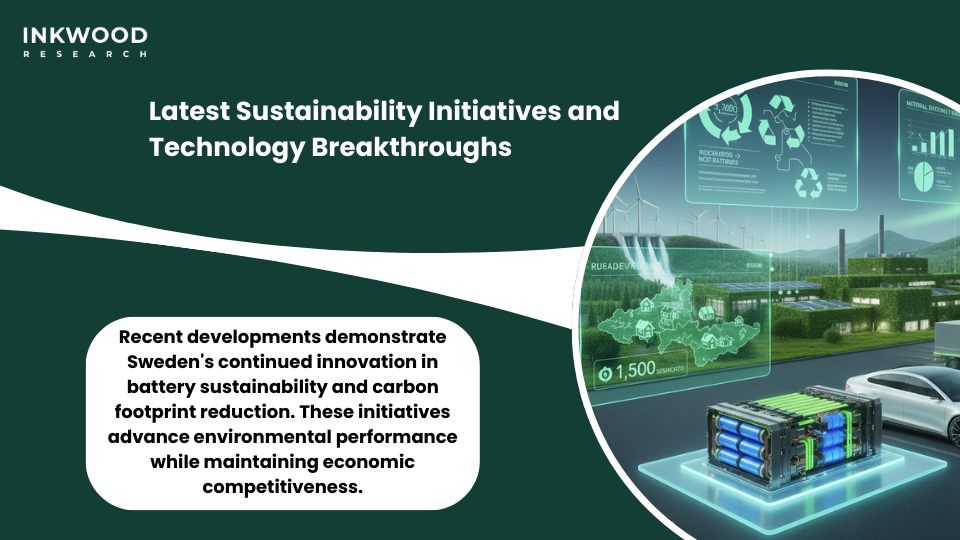
Recent developments demonstrate Sweden’s continued innovation in battery sustainability and carbon footprint reduction. These initiatives advance environmental performance while maintaining economic competitiveness.
Northvolt Recycling Facility
Northvolt operates Europe’s largest battery recycling facility, recovering 95% of materials. The hydrometallurgical process achieves high-purity outputs suitable for new battery production. Subsequently, recycled materials reduce mining dependencies substantially.
Facility expansion plans accommodate growing end-of-life battery volumes. Technology improvements increase recovery rates and processing efficiency. Moreover, cost reductions make recycling economically competitive. These advancements prove circular battery economy viability.
Targeted EV Purchase Subsidies
Sweden proposes targeted purchase subsidies for rural households with lower incomes. The scheme provides SEK 1,500 monthly over 36 months, totaling SEK 54,000. This equitable approach addresses adoption barriers in underserved communities.
Eligibility requirements target 177 designated municipalities with lower population density. Income thresholds ensure support reaches those needing assistance most. Furthermore, comprehensive incentive packages complement national programs. These targeted approaches accelerate adoption across demographic segments.
Commercial Vehicle Climate Premiums
From February 2024, Sweden’s Energy Agency initiated climate premium payouts for light electric trucks. The premium funds price differences between electric and comparable conventional models, supporting up to 30% of costs.
Commercial vehicle electrification reduces transportation sector emissions significantly. Fleet operators transition systematically, supported by financial incentives. Moreover, noise reduction benefits urban areas. These programs demonstrate comprehensive decarbonization approaches.
Material Efficiency Research
Swedish research institutions advance material efficiency understanding. Studies quantify demand reduction potentials from various strategies. Policy recommendations also inform government decision-making processes. Furthermore, international collaboration accelerates knowledge sharing.
Research findings demonstrate that demand reduction exceeds recycling contributions. This insight prioritizes efficiency improvements alongside circular economy initiatives. Consequently, comprehensive strategies address sustainability from multiple angles simultaneously.
Key Takeaways
- Sweden electric vehicle battery market reached US$822.65 million in 2025, growing to US$1.73 billion by 2032 at 11.22% CAGR
- Sweden maintains battery production emissions less than half of China’s through fossil-free electricity utilization
- Combined efficiency measures could achieve 50-75% cumulative material demand reduction and 72-87% in-use stock reduction by 2050
- Advanced recycling processes recover 95% of battery materials, including lithium, cobalt, and nickel, for reuse
- Sweden targets 59% GHG emissions reduction by 2030 and net-zero by 2045 through legally binding frameworks
- Global battery production emissions declining to 85 kg CO2e/kWh by 2025 as grids decarbonize worldwide
- The transport sector emissions reduction target of 70% by 2030 versus 2010 requires additional policy support
- Biofuels constitute 25% of the transport fuel mix, supporting applications difficult to electrify immediately
- EU sustainable battery strategy introduces carbon footprint labeling by 2024, favoring low-emission producers
Conclusion:
Sweden demonstrates comprehensive approaches to reducing electric vehicle battery carbon footprints throughout entire lifecycles. Clean electricity generation provides fundamental advantages in the production phase emissions. Meanwhile, advanced recycling technologies close material loops, minimizing waste and mining impacts.
Critical material demand reduction strategies prove even more impactful than recycling contributions. Battery range optimization, vehicle efficiency improvements, and travel demand reductions collectively achieve 50-75% material savings. These demand-side approaches complement supply-side circular economy initiatives effectively.
Swedish automotive manufacturers, including Volvo, Polestar, and Scania, prioritize sustainability throughout operations. Northvolt establishes European battery manufacturing viability through renewable energy integration and recycling capabilities. Together, these players advance sustainable EV battery solutions, setting global benchmarks.
Looking forward, continued policy support proves essential to maintaining decarbonization trajectories. Transportation sector challenges require additional charging infrastructure, taxation measures, and modal shift initiatives. However, Sweden’s comprehensive framework positions it advantageously to achieve ambitious climate targets.
Are you ready to implement carbon reduction strategies within your EV battery supply chain? Inkwood Research provides a comprehensive analysis of sustainability initiatives, lifecycle assessment methodologies, and circular economy frameworks.
Our expert analysts deliver actionable insights on reducing carbon footprints while maintaining competitiveness. Contact us today for a consultation on optimizing your battery sustainability strategies and environmental performance.
Frequently Asked Questions
How does Sweden reduce EV battery production carbon footprints?
Sweden leverages fossil-free electricity from hydropower and nuclear, achieving battery production emissions less than half of China’s levels. Manufacturing facilities have access to abundant renewable energy in northern regions, while industrial decarbonization programs support cleaner processes, reducing production phase carbon intensity significantly.
What material demand reduction is achievable through Swedish initiatives?
Research demonstrates that combined measures, including shorter battery ranges, improved energy efficiency, and reduced travel demand, could achieve 50-75% cumulative material demand reduction by 2050. These reduction potentials exceed recycling contributions, emphasizing demand-side efficiency importance over supply-side solutions alone.
How effective are Sweden's battery recycling programs?
Advanced recycling technologies recover 95% of battery materials, including lithium, cobalt, and nickel, suitable for new production. Second-life applications extend battery utility in stationary storage before recycling. Extended producer responsibility frameworks ensure high collection rates through comprehensive take-back systems.