Table of Contents
This analysis is brought to you by Inkwood Research, a leading market intelligence firm specializing in European battery technology ecosystems, electric vehicle supply chain integration, and regulatory compliance frameworks. Our research team combines extensive experience analyzing Spain’s battery testing equipment market developments, EU Battery Regulation implementations, and automotive industry validation protocols. Based on our proprietary research methodologies and strategic partnerships with Spanish automotive manufacturers, European testing certification bodies, battery technology research institutions, and Volkswagen Group validation networks, we deliver actionable insights empowering strategic decision-making for enterprises navigating Spain’s battery testing infrastructure evolution and European regulatory landscape.
TLDR
Spain’s battery testing equipment market is experiencing robust expansion driven by major gigafactory investments and European electric vehicle supply chain integration. Valued at $10.97 million in 2025, the market will reach $16.25 million by 2032 at a 5.78% CAGR. The Stellantis-CATL partnership and SEAT’s Test Center Energy demonstrate Spain’s strategic role in European battery development. However, challenges include limited domestic testing equipment manufacturing and continued import dependence for advanced hardware. Understanding EU Battery Regulation requirements, including CE marking, IEC standards, and carbon footprint declarations, becomes essential for manufacturers navigating Spain’s evolving battery testing landscape.
This comprehensive analysis serves automotive OEMs in establishing battery validation facilities in Spain under European supply chain strategies. Testing laboratory operators implementing IEC 62133 and UN 38.3 certification capabilities benefit from regulatory insights. Additionally, battery manufacturers navigating the EU Battery Regulation CE marking requirements gain critical compliance guidance. Quality assurance professionals developing testing protocols for European market access find actionable frameworks. Furthermore, investment analysts evaluating Spain’s battery ecosystem opportunities receive strategic market intelligence supporting informed decision-making.
Navigating European Regulatory Frameworks
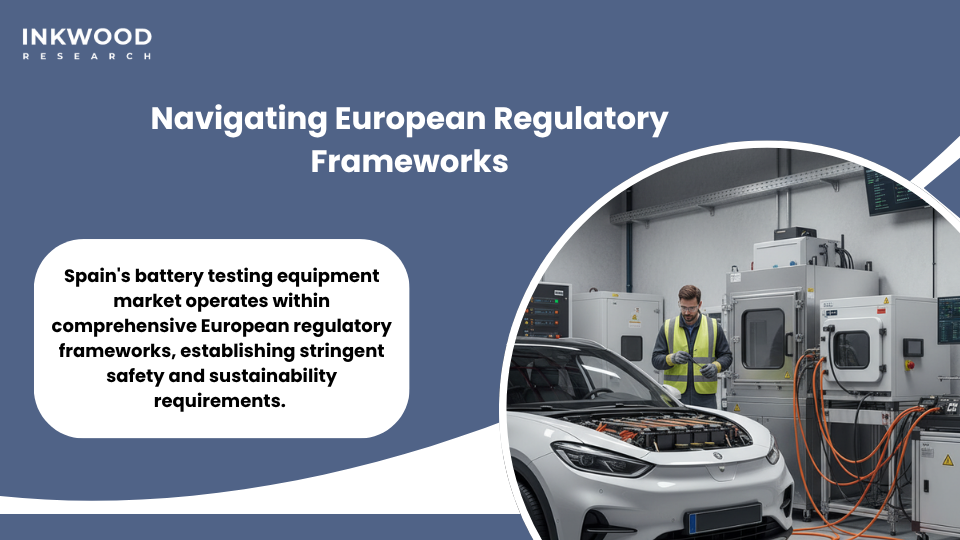
Spain’s battery testing equipment market operates within comprehensive European regulatory frameworks, establishing stringent safety and sustainability requirements. Manufacturers must navigate complex compliance landscapes, integrating national and EU-level standards. Consequently, understanding CE marking requirements, IEC 62133 protocols, and EU Battery Regulation provisions becomes essential for market success.
Spain’s market valued at $10.97 million in 2025 reflects the nation’s deepening role in European electric vehicle supply chains. Furthermore, projections indicating $16.25 million by 2032 demonstrate sustained growth driven by gigafactory investments and OEM R&D expansions. Meanwhile, the Stellantis-CATL partnership accelerates demand for local testing capacity.
However, challenges persist. Limited domestic manufacturing of advanced testing hardware necessitates continued import dependence. Additionally, aligning test standards across stakeholders requires coordination between manufacturers, certification bodies, and regulatory authorities. Therefore, strategic planning becomes critical for organizations establishing testing capabilities in Spain’s evolving battery ecosystem.
Understanding EU Battery Regulation Requirements
The EU Battery Regulation (2023/1542), implemented in February 2024, creates harmonized legislation for battery sustainability and safety. This regulation replaces the Battery Directive (2006/66/EC), effective August 2025. Consequently, manufacturers must understand evolving requirements throughout battery lifecycles.
CE marking became mandatory on August 18, 2024, for all batteries, regardless of whether used in products or supplied separately. Initially, carbon footprint, recycled content, and performance requirements for portable batteries remain excluded from CE marking. However, these provisions will be added progressively through 2025-2027.
Self-certification processes apply to portable batteries and industrial batteries under 2 kWh capacity. Nevertheless, larger systems require notified body involvement when carbon footprint and recycled content declarations become mandatory. Therefore, testing facilities must prepare for enhanced validation requirements as regulations mature.
IEC Standards Governing Battery Safety
IEC 62133 specifies requirements and tests for the safe operation of portable sealed secondary cells and batteries. This internationally recognized standard establishes benchmarks for lithium-ion battery safety worldwide. Furthermore, compliance demonstrates commitment to product safety and quality, reducing liability risks.
The standard addresses critical safety hazards, including overcharging, over-discharging, short-circuiting, and thermal runaway. Testing procedures verify batteries withstand abuse conditions without fire or explosion. Additionally, labeling and documentation requirements ensure proper handling throughout supply chains.
Related standards, including EN IEC 60086-4 for primary lithium batteries and EN IEC 62281 for transport safety, complement comprehensive validation frameworks. Therefore, testing laboratories must maintain capabilities across multiple standard requirements serving diverse market segments.
Spain’s Strategic Role in European Battery Ecosystem
Major automotive investments position Spain as a critical European battery development hub. The Stellantis-CATL partnership, establishing gigafactory operations, creates substantial testing infrastructure demands. Additionally, SEAT’s Test Center Energy at Martorell demonstrates in-country validation capabilities supporting Volkswagen Group brands.
This purpose-built facility encompasses 1,500-1,618 m² of laboratory space with 1.3 MW test capacity. Consequently, thousands of validation cycles annually support CUPRA, SEAT, SEAT MÓ, and other Group models. Moreover, the center integrates into Volkswagen’s global R&D network, shortening development cycles and improving safety verification.
SEAT Test Center Energy Capabilities
The Test Center Energy, launched with €7-8 million investment, enables in-house testing for prototype and production batteries. This capability reduces reliance on external laboratories, accelerating EV development timelines. Furthermore, partnerships with universities and suppliers facilitate testing of new chemistries, thermal management systems, and charging technologies.
Comprehensive validation encompasses cells, modules, packs, and charging systems throughout development and production phases. Equipment performs electrical, thermal, mechanical, and environmental testing, ensuring compliance with European standards. Additionally, the center supports broader Martorell electrification and battery production ambitions.
Strategic location within the manufacturing complex enables rapid iteration between testing and production. Therefore, engineers quickly implement improvements identified during validation programs. Moreover, proximity facilitates collaboration between testing specialists and vehicle development teams, optimizing battery integration.
Gigafactory Testing Requirements
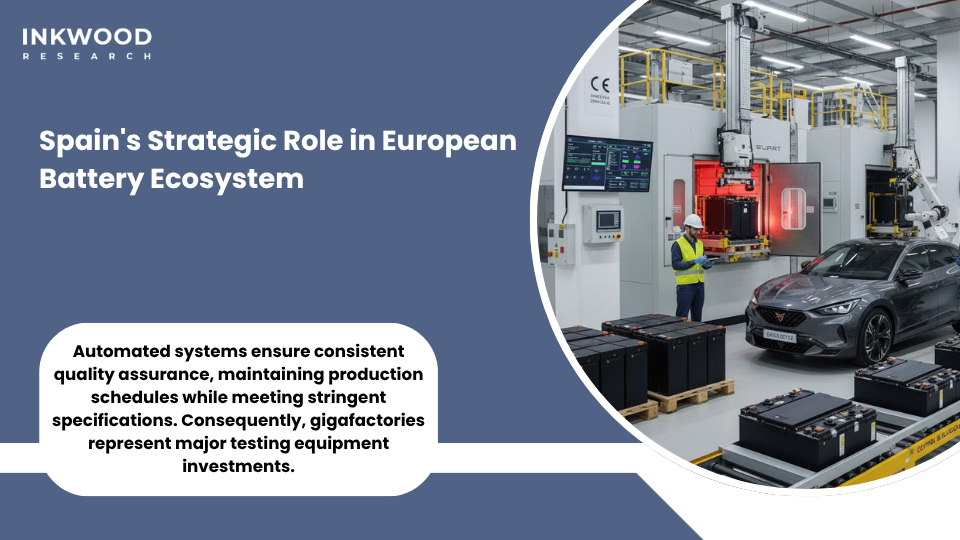
Large-scale battery production facilities require extensive inline testing, validating millions of cells monthly. Automated systems ensure consistent quality assurance, maintaining production schedules while meeting stringent specifications. Consequently, gigafactories represent major testing equipment investments.
Formation cycling equipment conditions cells, establishing stable performance characteristics. Subsequently, automated test channels verify capacity, internal resistance, and self-discharge rates. Additionally, end-of-line testing confirms pack-level functionality before vehicle installation.
Statistical process control systems monitor production trends, identifying issues before quality degradation. Therefore, testing data provides critical feedback enabling continuous improvement throughout manufacturing operations. Furthermore, traceability requirements under the EU Battery Regulation necessitate comprehensive documentation throughout production processes.
Portable Testing Equipment Applications
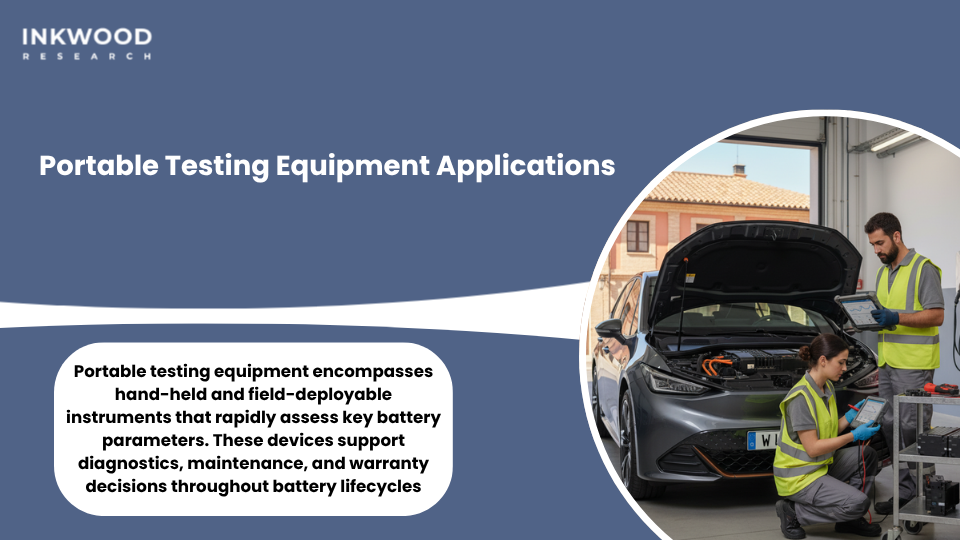
Portable testing equipment encompasses hand-held and field-deployable instruments that rapidly assess key battery parameters. These devices support diagnostics, maintenance, and warranty decisions throughout battery lifecycles. Moreover, portable solutions enable on-site evaluations without removing cells from systems.
Common test methods include conductance, AC-conductance, load testing, and pulse impedance measurements. These approaches balance speed and accuracy, enabling technicians to screen for degraded cells or mismatched internal resistance. Subsequently, results inform decisions regarding comprehensive laboratory testing.
After-Sales Service Applications
Rising EV after-sales service needs drive portable testing equipment adoption. Automotive technicians and service teams require rapid assessment capabilities for diagnosing battery-related issues. Consequently, portable instruments become essential tools throughout dealer and service center networks.
State-of-charge verification ensures accurate fuel gauge calibration, preventing customer dissatisfaction. Additionally, capacity fade assessments support warranty claim evaluations. Therefore, portable equipment enables efficient service operations, maintaining customer satisfaction while managing warranty costs.
Grid and telecom battery maintenance programs similarly benefit from portable testing capabilities. Field engineers perform routine assessments, identifying degraded systems before failures occur. Furthermore, expanding battery installations across renewable energy and telecommunications infrastructure creates sustained portable equipment demand.
Limitations and Complementary Laboratory Testing
Users must recognize portable tester limitations. These instruments provide rapid screening but cannot replace laboratory cyclers and calorimetric safety tests required by standards like IEC 62133 and UN 38.3 for certification and endurance characterization. Therefore, best practices combine field screening with comprehensive laboratory validation when accuracy and regulatory compliance require certainty.
Portable measurements offer estimates based on impedance correlations and empirical models. However, actual capacity determination requires full charge-discharge cycling under controlled conditions. Additionally, safety validation, including abuse testing, necessitates laboratory facilities with appropriate containment and monitoring capabilities.
Nevertheless, portable equipment provides valuable preliminary assessments guiding subsequent laboratory testing. Consequently, organizations optimize resources by performing detailed validations only on batteries, warranting comprehensive evaluation. This tiered approach balances thoroughness with efficiency throughout testing programs.
UN 38.3 Transportation Safety Requirements
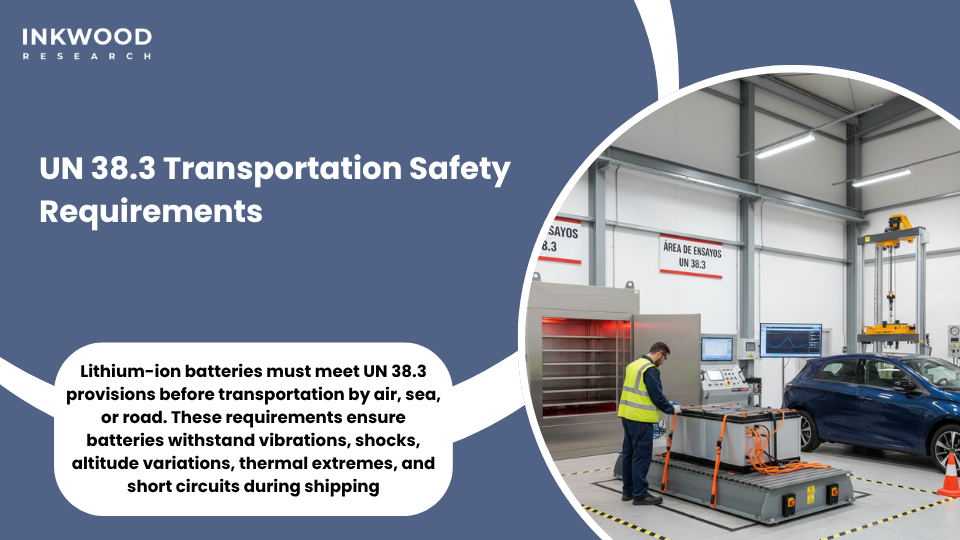
Lithium-ion batteries must meet UN 38.3 provisions before transportation by air, sea, or road. These requirements ensure batteries withstand vibrations, shocks, altitude variations, thermal extremes, and short circuits during shipping. Consequently, testing laboratories must maintain UN 38.3 certification capabilities supporting battery supply chains.
Testing procedures validate battery safety under simulated transportation conditions. Altitude simulation at 15,000 meters causes significant failure rates according to industry data. Therefore, robust battery designs incorporating appropriate safety features become essential for reliable transportation compliance.
Testing Protocol Components
UN 38.3 encompasses eight specific tests addressing diverse transportation hazards. Altitude simulation evaluates battery behavior under low-pressure conditions. Additionally, thermal cycling validates performance across temperature extremes encountered during shipping.
Vibration testing simulates transportation mechanical stresses. Subsequently, shock testing evaluates impact resistance during handling and potential drop scenarios. Furthermore, external short circuit and impact/crush tests assess safety under abuse conditions potentially occurring during accidents.
Overcharge and forced discharge tests validate battery protection systems, preventing catastrophic failures. Therefore, comprehensive testing programs ensure batteries safely withstand reasonably foreseeable transportation hazards. Moreover, proper test documentation enables smooth customs clearance across international borders.
Certification and Documentation Requirements
Manufacturers must maintain detailed test reports demonstrating UN 38.3 compliance. These documents accompany battery shipments throughout transportation chains. Additionally, dangerous goods declarations reference testing, ensuring regulatory compliance.
Samples and prototypes may ship as full Class 9 dangerous goods or with competent authority approval under less restrictive provisions. However, production batteries typically require complete UN 38.3 certification before commercial transportation. Therefore, early testing during development phases prevents launch delays.
Used and damaged batteries face separate packaging limitations requiring additional considerations. Consequently, second-life battery transportation necessitates careful evaluation, ensuring continued compliance despite degradation. Furthermore, regulatory frameworks continue evolving, addressing emerging battery technologies and applications.
Spain Battery Testing Equipment Market: Competitive Landscape and Market Players
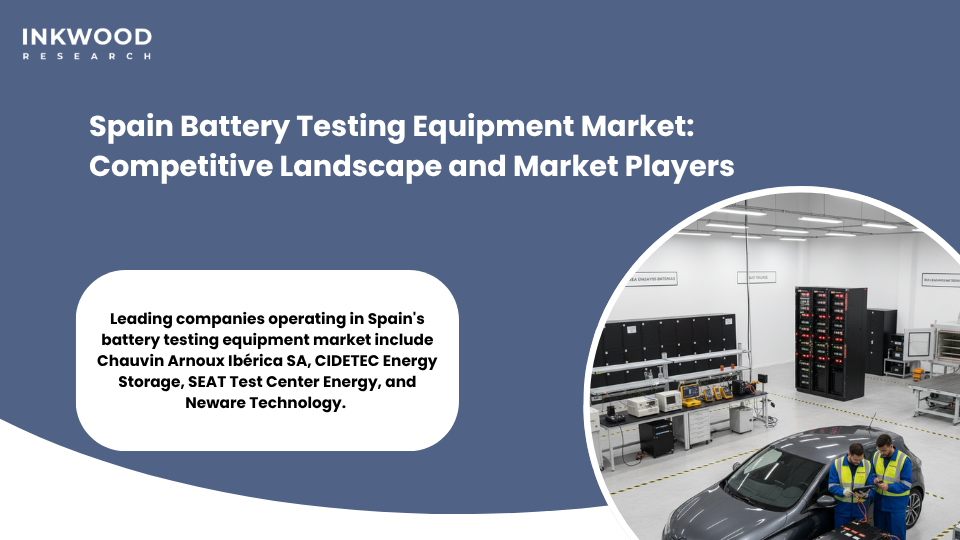
Leading companies operating in Spain’s battery testing equipment market include Chauvin Arnoux Ibérica SA, CIDETEC Energy Storage, SEAT Test Center Energy, and Neware Technology. These organizations provide comprehensive solutions supporting Spain’s battery ecosystem development.
Chauvin Arnoux Ibérica Capabilities
Chauvin Arnoux Ibérica delivers advanced electrical testing and measurement instruments throughout Spanish markets. Product portfolios encompass battery analyzers, power quality analyzers, and electrical safety testers supporting diverse applications. Furthermore, European engineering heritage ensures equipment reliability and measurement accuracy.
Technical support and calibration services maintain equipment performance throughout operational lifecycles. Additionally, training programs develop local expertise supporting effective technology utilization. Therefore, comprehensive customer support strengthens relationships while facilitating testing capability adoption.
Equipment compliance with international standards, including IEC and ISO frameworks, ensures broad applicability. Consequently, organizations serving multiple markets benefit from unified testing platforms, simplifying certification processes. Moreover, after-sales service networks provide responsive support, maintaining operational continuity.
CIDETEC Energy Storage Research
CIDETEC Energy Storage operates as a leading research institution advancing battery technologies. The organization conducts fundamental research, developing next-generation chemistries and systems. Additionally, CIDETEC collaborates with industrial partners, translating research breakthroughs into commercial applications.
Advanced testing capabilities enable comprehensive battery characterization supporting development programs. Equipment portfolios encompass electrochemical analysis systems, thermal management validation equipment, and safety testing facilities. Furthermore, expertise spans diverse battery chemistries, including lithium-ion, solid-state, and emerging technologies.
Industry partnerships facilitate technology transfer, accelerating innovation adoption throughout the Spanish battery ecosystem. Moreover, training programs develop a skilled workforce supporting Spain’s expanding battery sector. Therefore, CIDETEC plays critical roles beyond research, advancing overall industry capabilities.
Future Market Developments and Opportunities

Spain’s battery testing equipment market continues evolving, driven by technological advancements and regulatory developments. Solid-state batteries promise revolutionary improvements yet require specialized testing protocols. Consequently, laboratories must develop capabilities supporting emerging technologies.
Digital simulation and performance prediction software increasingly complements physical testing. Plus, advanced modeling reduces testing requirements while improving development efficiency. Therefore, integrated approaches combining simulation with targeted validation become best practices throughout battery development programs.
Automation and Robotics Integration
Growing adoption of automated and robotic test benches enhances laboratory throughput and consistency. Robotic systems perform repetitive testing procedures with superior repeatability compared to manual operations. Additionally, automation enables 24/7 operations, maximizing equipment utilization.
Collaborative robots working alongside human operators combine automation efficiency with human expertise. Subsequently, laboratories optimize resource allocation, focusing skilled personnel on complex evaluations while robots handle routine testing. Furthermore, automated data collection and analysis reduce errors while improving documentation quality.
Nevertheless, automation investments require careful justification. Smaller laboratories may find manual operations more economical depending on testing volumes. Therefore, strategic planning ensures automation investments align with business requirements and growth projections.
Industry-Research Collaboration Expanding
Increasing collaboration between industry and research institutes accelerates innovation throughout the Spanish battery ecosystem. Universities and research centers partner with manufacturers to develop specialized testing methodologies. Consequently, academic expertise combines with industrial requirements, advancing overall capabilities.
Joint research programs address emerging challenges, including multi-chemistry battery testing and rapid characterization techniques. Furthermore, collaborative initiatives develop a skilled workforce through student research projects and industry internships. Therefore, partnerships strengthen Spain’s long-term competitiveness in battery technologies.
European funding programs support collaborative research, accelerating capability development. However, organizations must strategically align research priorities with commercial opportunities, ensuring practical outcomes. Moreover, intellectual property frameworks require careful consideration of protecting innovations while enabling knowledge sharing.
Key Takeaways
- The EU Battery Regulation, establishing comprehensive sustainability and safety frameworks, requires CE marking compliance and progressive carbon footprint declaration implementation.
- IEC 62133 and UN 38.3 standards govern battery safety and transportation requirements essential for European and global market access.
- Major automotive industry investments, including Stellantis-CATL partnership and SEAT Test Center Energy, position Spain strategically within the European battery development ecosystem.
- Portable testing equipment enables rapid field assessments supporting EV after-sales service, while laboratory testing provides comprehensive certification validation.
- Limited domestic testing equipment manufacturing necessitates continued import dependence, challenging market participants with procurement and support considerations.
- Automation, digital simulation, and industry-research collaboration represent future development opportunities enhancing Spain’s battery testing capabilities and competitiveness.
Conclusion: Strategic Positioning in European Battery Markets
Spain’s battery testing equipment market occupies a strategic position within the European battery ecosystem. Major automotive investments and government support create sustained growth opportunities. However, success requires a comprehensive understanding of the EU Battery Regulation, IEC 62133, and UN 38.3 requirements.
Organizations must carefully balance domestic testing capability development with strategic partnerships accessing established laboratory networks. Furthermore, emerging technologies and automation opportunities require continuous capability evolution. Therefore, strategic planning becomes essential for navigating Spain’s dynamic battery testing landscape.
Inkwood Research provides comprehensive intelligence supporting successful market participation. Our team delivers strategic insights addressing European regulatory compliance, testing infrastructure development, and market entry strategies. Contact us to discuss how our expertise accelerates your success in Spain’s expanding battery testing ecosystem.
Frequently Asked Questions
How does the EU Battery Regulation CE marking differ from previous battery directive requirements?
EU Battery Regulation mandates CE marking for all batteries, including self-certification for portable and small industrial batteries. Progressive implementation adds carbon footprint, recycled content, and performance requirements with notified body involvement for larger systems.
What are the key differences between IEC 62133 and UN 38.3 testing standards?
IEC 62133 validates general battery safety under normal and abuse conditions. UN 38.3 specifically addresses transportation safety testing batteries under shipping conditions, including altitude, vibration, thermal, and impact scenarios.
How does portable testing equipment complement comprehensive laboratory validation?
Portable equipment provides rapid field screening for maintenance and warranty decisions. However, certification and comprehensive safety validation require laboratory testing with controlled conditions, abuse simulation capabilities, and detailed documentation meeting regulatory requirements.