Table of Contents
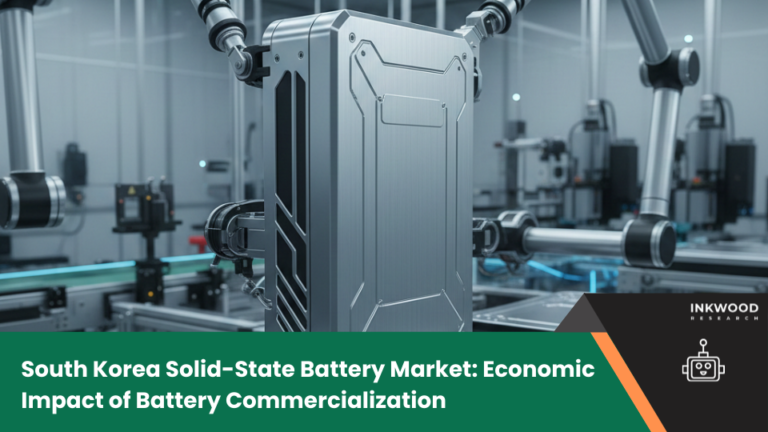
This analysis is brought to you by Inkwood Research, a leading market intelligence firm specializing in South Korean advanced manufacturing ecosystems, battery technology commercialization strategies, and East Asian industrial policy frameworks. Our research team combines extensive experience analyzing Korean chaebol investment patterns, government R&D incentive programs, semiconductor-battery technology convergence, and supply chain dynamics across LG Energy Solution, Samsung SDI, and SK On operations. Based on our proprietary research methodologies and strategic partnerships with Korean battery manufacturers, automotive OEMs, materials suppliers, and technology policy institutes, we deliver actionable insights that empower strategic decision-making for global enterprises navigating South Korea’s solid-state battery industrialization and economic transformation.
TLDR
South Korea positions itself as the global solid-state battery commercialization leader through unprecedented government-industry coordination. Over $20 billion in combined public-private investments target 2027 mass production timelines. LG Energy Solution, Samsung SDI, and SK On pursue distinct technology pathways while competing for market dominance. This strategic focus transforms Korea’s economic structure, creating high-value jobs, attracting foreign investment, and establishing critical supply chain advantages in the emerging energy storage economy.
This blog aims to serve investment analysts, government policy advisors, battery industry executives, supply chain strategists, automotive procurement professionals, and economic development specialists seeking detailed insights into South Korea’s solid-state battery commercialization strategy, economic impact projections, competitive dynamics, and implications for global battery market leadership.
South Korea’s Bold Industrial Strategy
South Korea’s economic future increasingly depends on dominating next-generation battery technologies. The government recognizes solid-state batteries as critical national security infrastructure. Consequently, unprecedented coordination between public agencies and private corporations drives aggressive commercialization timelines.
In April 2023, South Korea announced plans to invest 20 trillion won (US$15.046 billion) in the electric vehicle battery industry. This joint government-private sector initiative aims to establish Korea as the first nation to commercialize solid-state batteries at scale. Moreover, the strategy encompasses supply chain development, workforce training, and research infrastructure expansion.
The South Korea solid-state battery market reached US$135.96 million in 2026. Projections indicate explosive growth to US$1,779.55 million by 2034, representing a 37.92% CAGR. Consequently, this market expansion creates substantial economic value beyond battery manufacturing alone.
Strategic National Objectives
Korea’s Ministry of Trade, Industry, and Energy outlines three primary goals through solid-state battery development. First, securing unrivaled battery technologies protects against foreign competition. Second, building robust ecosystems enables supply chain independence. Third, creating new export markets generates sustainable economic growth.
By 2027, Korea targets commercializing solid-state batteries through accelerated development programs. Additionally, lithium-sulfur batteries are set to reach the market by 2025-2026, while lithium-metal configurations follow by 2028. This staged approach allows manufacturers to refine production processes progressively.
Economic Transformation Imperatives
South Korea faces mounting economic pressures requiring industrial restructuring. Traditional manufacturing sectors encounter fierce competition from lower-cost producers. Meanwhile, semiconductor industry growth shows signs of maturation. Therefore, battery technology represents a critical growth engine for Korea’s economic future.
Furthermore, solid-state batteries align with Korea’s broader carbon neutrality commitments. Clean energy transitions demand advanced storage solutions supporting renewable integration. Consequently, battery technology development serves both economic and environmental policy objectives simultaneously.
The Big Three: LG, Samsung, and SK Compete
Three Korean conglomerates drive the nation’s solid-state battery ambitions through distinct technical approaches. Each company leverages existing capabilities while pursuing breakthrough innovations. However, their divergent strategies reflect different market positioning and risk tolerance levels.
LG Energy Solution’s Conservative Approach
LG Energy Solution targets solid-state battery mass production by 2030. The company prioritizes pouch-type cell configurations, maximizing energy efficiency advantages. Moreover, LG believes pouch designs better facilitate pressure management, critical for ionic conductivity.
CEO Kim Dong-myung predicted that global battery demand would reach its lowest point in early 2025. Subsequently, recovery begins in 2026, though market dynamics may permanently shift. This cautious outlook influences LG’s measured solid-state development timeline.
LG’s strategy emphasizes manufacturing scalability over breakthrough performance. The company invests heavily in process engineering and production equipment development. Additionally, partnerships with materials suppliers ensure reliable component sourcing. Consequently, LG positions itself for rapid scaling once technology matures sufficiently.
The company’s extensive lithium-ion manufacturing experience provides competitive advantages. Existing facilities can potentially adapt to solid-state production with targeted modifications. Furthermore, customer relationships with major automakers facilitate technology adoption upon commercial readiness.
Samsung SDI’s Aggressive Timeline
Samsung SDI pursues prismatic cell-type solid-state batteries targeting 2027 mass production. The company believes aluminum casings provide superior safety against external shock. Moreover, prismatic configurations dominate over a significant share of the current EV battery market.
Samsung Electro-Mechanics plans mass production of oxide-based solid-state batteries by 2026. These batteries achieve 200 Wh/L energy density for wearable devices. Additionally, the company secured industry-leading energy density and capacity characteristics.
Samsung’s vertical integration across electronics, semiconductors, and chemicals enables unique synergies. Materials science expertise from display and semiconductor operations transfers to battery development. Furthermore, internal demand from Samsung’s consumer electronics division provides guaranteed initial markets.
Samsung SDI constructed a pilot production line called “S-Line” at its Suwon R&D Center. This facility focuses on developing advanced solid-state battery technologies, including cathode and solid electrolyte production systems. Subsequently, Samsung targets achieving full mass production capabilities by 2027.
SK On’s Partnership Strategy
SK On’s pilot line in Daejeon began operations in September 2025. The company partners with Solid Power for sulfide-based electrolyte technology development. Moreover, this collaboration accelerates commercialization, targeting a 2029 production launch.
Solid Power CEO John Van Scoter confirmed completing Site Acceptance Testing by November’s end. The collaboration extends beyond technology licensing toward full production system optimization. Additionally, SK On explores cooperation with LG Energy Solution and Hyundai Motor Group.
SK On’s strategy emphasizes external partnerships, mitigating technology development risks. Rather than developing proprietary solid electrolyte systems, the company licenses proven technologies. This approach potentially accelerates time-to-market while conserving R&D capital for manufacturing scale-up.
However, dependency on external technology providers creates strategic vulnerabilities. Competitors developing in-house capabilities may achieve better cost structures long-term. Nevertheless, SK On’s pragmatic approach reflects a realistic assessment of technology maturation challenges.
Investment Flows and Capital Allocation
Massive capital commitments underpin Korea’s solid-state battery ambitions. Both government funding and private sector investments flow toward research, production facilities, and supply chain development. Moreover, these investments represent Korea’s largest industrial policy initiative since the semiconductor industry development.
Government Financial Support
Korea’s K-Battery Strategy provides tax incentives and direct support for battery manufacturers. Government agencies facilitate collaboration between companies, universities, and research institutes. Additionally, a “Battery Park” (Hyundai Motor Group’s Future Mobility Battery Campus) launching by 2026 enables next-generation battery testing and development.
Public funding mechanisms include grants, low-interest loans, and infrastructure subsidies. Research institutions receive substantial support for materials science and manufacturing process innovations. Furthermore, workforce development programs ensure adequate skilled labor availability.
Government procurement policies favor domestically-produced batteries for public transportation electrification. Electric bus fleets and government vehicle purchases provide guaranteed near-term markets. Consequently, manufacturers secure revenue streams supporting initial production scaling.
Private Sector Commitments
By 2030, manufacturers plan to invest around 40 trillion won (US$30 billion) in battery R&D and production. LG Energy Solution, Samsung SDI, and SK Innovation commit substantial capital toward solid-state technology development. Moreover, these investments span materials research, pilot facilities, and full-scale manufacturing plants.
LG Chem and B&M invest approximately US$385 million in cathode material mass production. Annual capacity reaches 60,000 tonnes at facilities in Gumi by 2025. Similarly, other battery manufacturers secure materials through joint ventures and strategic partnerships.
Foreign direct investment follows Korean battery leadership. Solid Power opened its first overseas office in Seoul in January 2024. This deliberate strategy embeds the company deeper within Korea’s battery supply chain ecosystem. Additionally, other international suppliers establish Korean operations supporting battery manufacturers’ needs.
Supply Chain Development Investments
Copra BM partnered with BASF to build cathode active material plants in South Korea. These investments ensure reliable component supplies supporting expanded battery production. Furthermore, domestic materials manufacturing reduces foreign dependency risks.
Korea aims to quadruple cathode material capacity from 380,000 tons to 1.58 million tons over the next five years. Additionally, battery production equipment exports triple as Korean manufacturers establish global operations. Consequently, Korea’s battery ecosystem extends beyond cell manufacturing toward comprehensive supply chain control.
Economic Impact: Jobs, Exports, and GDP Growth
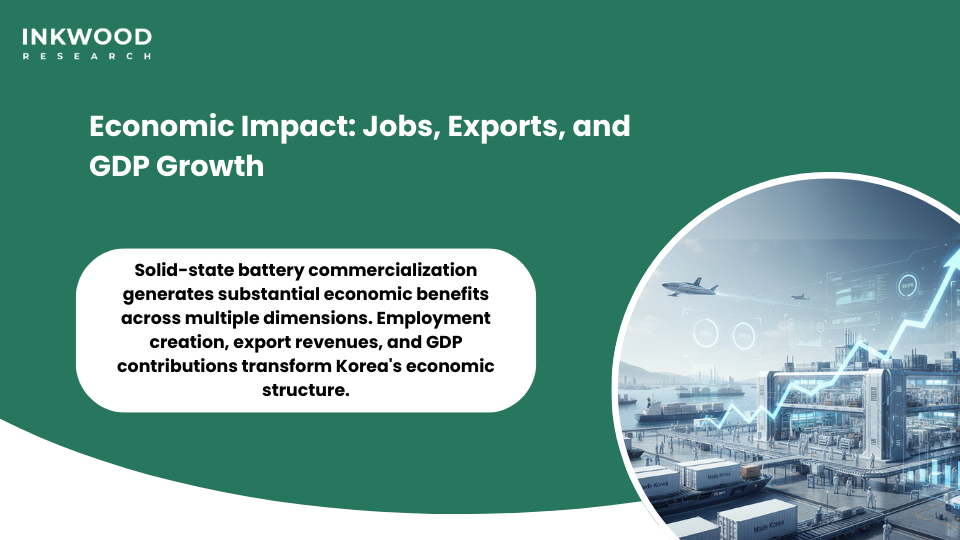
Solid-state battery commercialization generates substantial economic benefits across multiple dimensions. Employment creation, export revenues, and GDP contributions transform Korea’s economic structure. Moreover, these impacts extend beyond battery manufacturing toward supporting industries.
High-Value Employment Creation
Battery manufacturing employs highly-skilled workers commanding premium wages. Advanced battery production requires expertise in materials science, process engineering, quality control, and automation systems. Consequently, battery jobs offer attractive career opportunities for Korea’s educated workforce.
Research and development positions expand rapidly across battery chemistry, manufacturing processes, and application engineering. Universities develop specialized curricula supporting industry workforce requirements. Additionally, vocational training programs prepare technicians for production floor operations.
Supply chain development creates indirect employment opportunities. Materials suppliers, equipment manufacturers, and logistics providers hire additional workers supporting battery industry growth. Furthermore, these jobs are distributed geographically beyond concentrated manufacturing clusters.
Export Revenue Generation
Korea became the world’s leading exporter of cathode materials with a 35% year-on-year export surge. Battery cell exports similarly expand as global EV adoption accelerates. Moreover, solid-state batteries command premium pricing initially, maximizing revenue per unit sold.
Automotive partnerships provide substantial export opportunities. European and American automakers increasingly source batteries from Korean suppliers. Additionally, joint venture manufacturing facilities abroad generate royalty revenues and technology licensing fees.
Equipment and materials exports supplement battery cell sales. Korean manufacturers develop proprietary production technologies subsequently licensed globally. Consequently, Korea captures value across multiple battery industry segments simultaneously.
GDP and Trade Balance Contributions
Battery industry expansion significantly impacts Korea’s GDP growth trajectory. Research forecasts LG Energy Solution’s production capacity will triple from 173.5 GWh in 2021 to 1,079.5 GWh by 2030. Similarly, SK On expands from 40.0 GWh to 233.5 GWh while Samsung SDI grows from 37.5 GWh to 156.0 GWh over the same period.
These capacity expansions require massive capital investments, stimulating construction, equipment manufacturing, and infrastructure development. Additionally, ongoing operations generate sustained economic activity through wages, materials purchases, and energy consumption.
Trade balance improvements follow reduced import dependency. Domestically-produced batteries replace imports previously sourced from Chinese manufacturers. Furthermore, battery exports offset oil import costs as transportation electrifies globally.
Competitive Dynamics with China and Japan
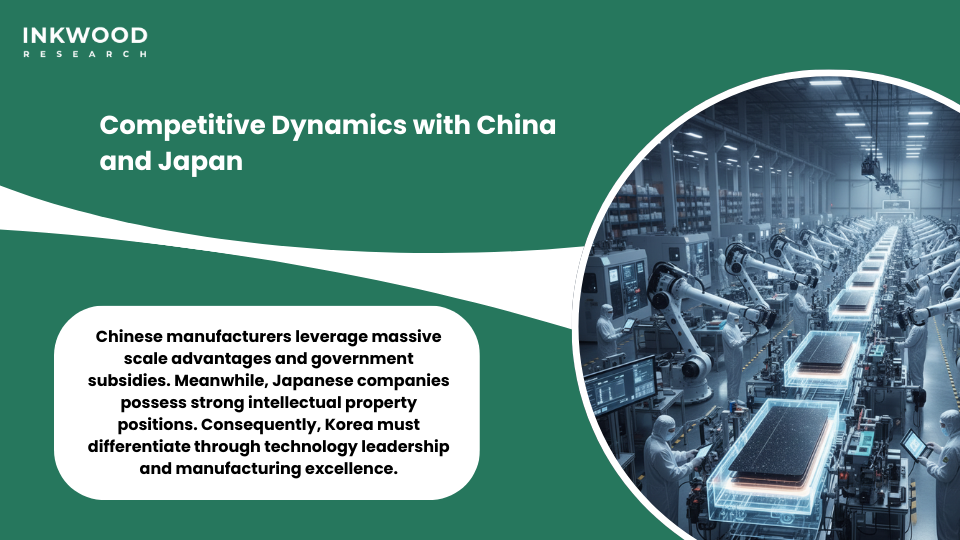
Korea’s solid-state battery strategy unfolds within intense regional competition. Chinese manufacturers leverage massive scale advantages and government subsidies. Meanwhile, Japanese companies possess strong intellectual property positions. Consequently, Korea must differentiate through technology leadership and manufacturing excellence.
Responding to Chinese Cost Advantages
Chinese battery giants CATL and BYD dominate production with cheaper lithium iron phosphate technologies. Korean manufacturers traditionally focused on premium nickel-based batteries, but are now adapting their strategies. Further, Samsung SDI and SK On target 2026 for LFP battery mass production, responding to market shifts.
China’s battery ecosystem benefits from vertically-integrated supply chains and state backing. Raw material access, manufacturing scale, and domestic market size create formidable advantages. Therefore, Korea cannot compete purely on cost across all battery segments.
Solid-state technology represents Korea’s opportunity, differentiating from Chinese competition. Premium performance characteristics justify higher pricing for advanced applications. Moreover, Korea’s quality reputation and manufacturing precision appeal to demanding automotive customers.
However, Chinese manufacturers aggressively pursue solid-state technology simultaneously. Dongfeng Motor targets September 2026 for solid-state battery mass production. Additionally, CATL dedicates over 1,000 researchers toward solid-state development, with prototype production underway.
Competing with Japanese Innovation
Japanese companies possess substantial intellectual property advantages in solid-state batteries. Toyota holds 1,331 global patents related to solid-state batteries, ranking first worldwide. Panasonic holds 272 patents, ranking second globally.
Toyota partnered with Sumitomo Metal Mining for cathode material development, targeting 2027 mass production. Additionally, Idemitsu Kosan invests ¥21.3 billion (US$142 million) in building lithium sulfide plants supporting Toyota’s solid-state battery programs.
Korea counters Japanese IP advantages through aggressive R&D investments and strategic partnerships. Additionally, Korean manufacturers’ superior manufacturing scale-up capabilities potentially enable faster commercialization despite later technology development starts.
Furthermore, Korea’s integrated chaebol structures facilitate rapid resource mobilization. Samsung, LG, and SK coordinate across materials, components, and systems more effectively than smaller Japanese competitors. Consequently, Korea may overcome initial disadvantages through execution excellence.
Supply Chain Integration and Vertical Control
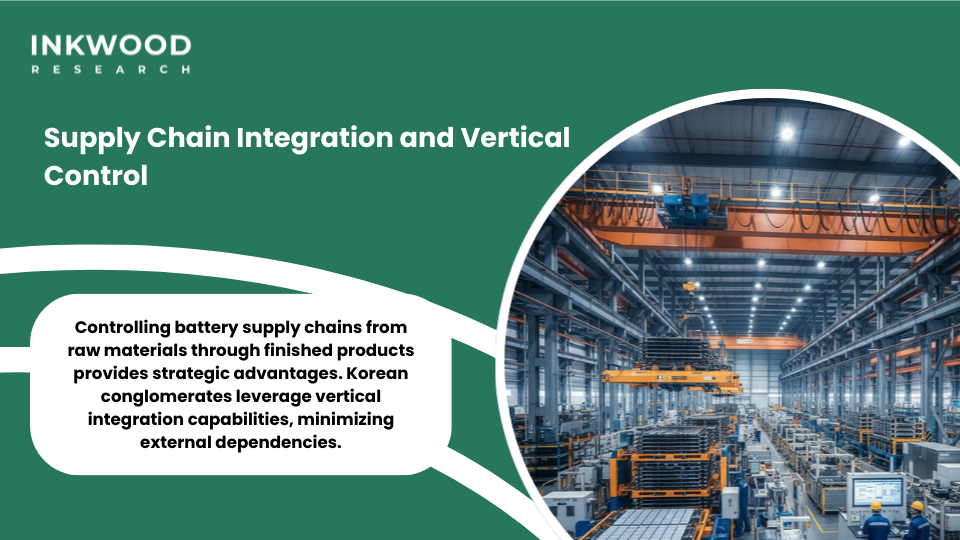
Controlling battery supply chains from raw materials through finished products provides strategic advantages. Korean conglomerates leverage vertical integration capabilities, minimizing external dependencies. Moreover, domestic supply chain development insulates against geopolitical disruptions.
Raw Material Security
Korea’s battery industry demonstrates competitiveness across four key materials: anode materials, cathode materials, separators, and electrolytes. Domestic production of these critical components reduces import vulnerability while ensuring quality control.
However, upstream raw material mining remains predominantly foreign-controlled. Lithium, nickel, and cobalt supplies depend on Australian, South American, and African sources. Therefore, Korea pursues long-term offtake agreements and equity investments in mining operations.
Solid-state batteries potentially reduce dependency on problematic materials. Eliminating liquid electrolytes removes dependence on certain organic solvents. Additionally, all-solid-state configurations enable lithium metal anodes, reducing graphite requirements.
Nevertheless, solid-state batteries introduce new material dependencies. Lithium sulfide for sulfide electrolytes requires specialized production capabilities. Oxide ceramics demand rare earth elements, including lanthanum and zirconium. Consequently, supply chain security challenges persist despite technology transitions.
Component Manufacturing Consolidation
Korean materials companies expand production capacities supporting battery industry growth. Cathode material exports surge as Korean suppliers establish global market leadership. Equipment manufacturers similarly grow alongside battery production expansion.
Vertical integration strategies vary among conglomerates. Samsung leverages existing chemical operations to produce battery materials internally. LG similarly draws upon petrochemical capabilities for electrolyte and separator production. Meanwhile, SK partners strategically rather than developing every component internally.
Consolidation benefits extend beyond cost advantages. Integrated operations facilitate faster innovation cycles as materials development coordinates directly with cell design. Furthermore, proprietary materials create differentiation opportunities versus competitors.
However, vertical integration requires substantial capital commitments across multiple technologies. Moreover, rapid solid-state technology evolution risks stranding investments in soon-obsolete materials. Therefore, manufacturers balance vertical control against flexibility maintaining.
Technology Roadmaps and Commercialization Timelines
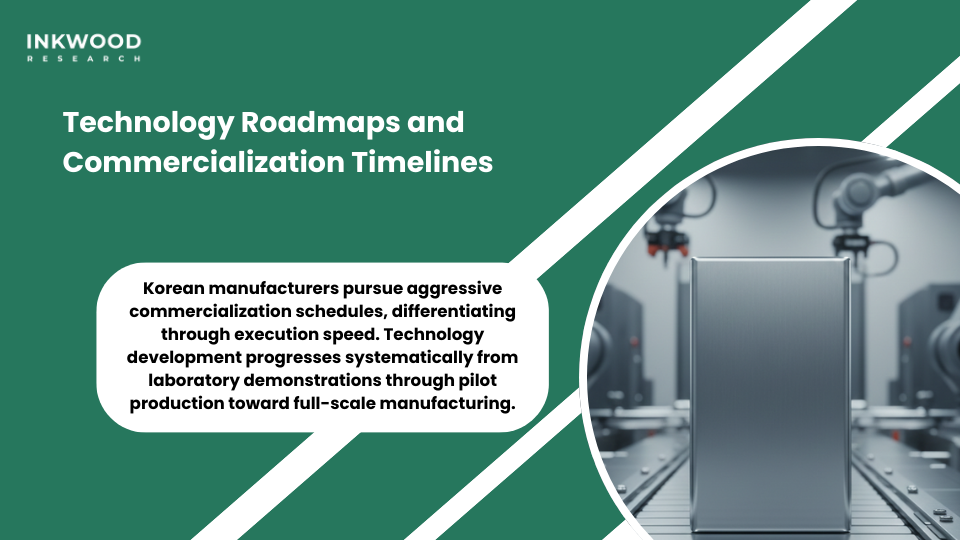
Korean manufacturers pursue aggressive commercialization schedules, differentiating through execution speed. Technology development progresses systematically from laboratory demonstrations through pilot production toward full-scale manufacturing. Moreover, staged approaches manage risks while building capabilities progressively.
Near-Term Milestones (2025-2026)
Samsung Electro-Mechanics supplies oxide-based solid-state battery prototypes throughout 2025. Subsequently, mass production commences in 2026, targeting wearable device applications initially. These smaller-scale deployments establish manufacturing competencies before automotive scaling.
Samsung SDI validates pouch-type solid-state battery samples throughout 2025. Technical verification completes enabling 2026-2027 manufacturing preparations. Subsequently, demonstration vehicles incorporating solid-state batteries undergo real-world testing programs.
These near-term activities establish production readiness while demonstrating technology viability. Automotive customers validate performance claims through extensive testing protocols. Moreover, early production experience identifies manufacturing challenges requiring resolution before full-scale deployment.
Medium-Term Production Scaling (2027-2029)
Samsung SDI targets 2027 official mass production of prismatic solid-state batteries. Production volumes increase progressively as manufacturing yields improve. Additionally, automotive partnerships expand, incorporating solid-state batteries across multiple vehicle models.
SK On aims for 2029 solid-state battery commercialization through the Solid Power partnership. The collaboration focuses systematically on improving production aspects, including cell reliability, process stability, and equipment utilization. Consequently, SK On benefits from Solid Power’s materials expertise while contributing manufacturing scale-up knowledge.
During this period, production capacities expand from tens of megawatt-hours toward the gigawatt-hour scale. Capital investments accelerate as technology de-risks and market demand materializes. Furthermore, cost reductions progress through economies of scale and process optimization.
Supply chain partners ramp production supporting battery manufacturer growth. Materials suppliers expand capacities, ensuring adequate component availability. Equipment manufacturers deliver specialized machinery supporting solid-state production requirements.
Long-Term Market Dominance (2030+)
LG Energy Solution targets 2030 for solid-state battery mass production, achieving full technology maturity. By this timeframe, solid-state configurations potentially achieve cost parity with advanced lithium-ion alternatives. Moreover, performance advantages justify adoption across mainstream automotive segments.
Korea aims to capture substantial global market share through early commercialization advantages. First-mover benefits include customer relationship development, production learning curves, and supply chain optimization. Additionally, intellectual property accumulation protects against late-entrant competition.
However, maintaining leadership requires continuous innovation as competitors advance. Chinese and Japanese manufacturers pursue solid-state technologies aggressively with potentially disruptive approaches. Therefore, Korea must sustain R&D investments, preventing technological obsolescence.
Despite aggressive strategies, substantial uncertainties threaten Korea’s solid-state battery ambitions. Technical challenges, market dynamics, and geopolitical factors create execution risks. Moreover, massive capital commitments amplify the consequences of potential failures.
Technical Execution Risks
Solid-state battery manufacturing remains largely unproven at a commercial scale. Pilot production successes may not translate to gigafactory operations smoothly. Additionally, yield rates significantly impact production economics, making manufacturing performance critical.
Interfacial stability issues persist across all electrolyte types. Long-term cycling performance under real-world conditions requires extensive validation. Furthermore, temperature extremes challenge solid-state battery operation in certain climates.
Cost reduction timelines depend on achieving projected production volumes. However, market adoption rates remain uncertain, creating chicken-egg dynamics. Consequently, manufacturers risk stranded investments if demand materializes more slowly than anticipated.
Market Competition Dynamics
Korean manufacturers currently operate factories at half capacity due to Chinese competition. Conventional lithium-ion battery oversupply pressures pricing and profit margins. Therefore, solid-state batteries must differentiate sufficiently to justify premium costs.
Additionally, lithium-ion technology continues to advance through incremental improvements. Silicon anodes, advanced electrolytes, and cell design optimizations extend performance without requiring complete technology transitions. Consequently, conventional batteries may satisfy market requirements longer than anticipated.
Alternative battery chemistries, including sodium-ion, lithium-sulfur, and aluminum-ion technologies, progress simultaneously. These approaches potentially leapfrog solid-state batteries, offering superior performance or lower costs. Therefore, Korea’s technology sector faces multi-directional competitive threats.
Geopolitical and Trade Tensions
U.S. battery manufacturing capacity expands dramatically from 55 GWh in 2021 toward 998 GWh by 2030. Domestic content requirements and subsidies favor American-produced batteries. Consequently, Korean manufacturers must establish U.S. production facilities despite higher operating costs.
Similarly, European markets increasingly prioritize local battery production. Regulatory frameworks and incentive structures encourage domestic manufacturing. Therefore, Korea’s export-oriented strategy faces mounting barriers requiring geographic diversification.
China’s dominance in raw materials and battery components creates strategic vulnerabilities. Trade tensions or supply disruptions could severely impact Korean production. Additionally, Chinese manufacturers’ aggressive capacity expansions threaten overcapacity scenarios, depressing industry profitability.
Key Takeaways
- South Korea’s solid-state battery strategy represents the nation’s most ambitious industrial policy initiative in decades. Over $20 billion in combined public-private investments target establishing global technology leadership. LG Energy Solution, Samsung SDI, and SK On pursue distinct commercialization approaches while competing intensely.
- Economic impacts extend beyond battery manufacturing alone. High-value employment creation, export revenue generation, and GDP contributions transform Korea’s economic structure. Moreover, supply chain development and vertical integration enhance national industrial capabilities.
- However, substantial risks threaten execution success. Technical challenges, market competition, and geopolitical tensions create uncertainties. Chinese manufacturers’ scale advantages and Japanese companies’ IP positions challenge Korea’s differentiation strategies.
- The 2027-2030 timeframe proves critical as pilot production scales toward commercial volumes. Success requires sustained R&D investments, manufacturing excellence, and strategic agility, adapting to evolving market conditions. Korea’s economic future increasingly depends on navigating these challenges successfully.
Conclusion: Korea’s High-Stakes Technology Gamble
South Korea stakes its economic future on solid-state battery leadership through unprecedented industrial policy coordination. The strategy aligns government support, corporate investments, and supply chain development toward aggressive commercialization timelines. Moreover, this approach reflects Korea’s historical success in transforming from a developing to an advanced economy status.
Nevertheless, solid-state batteries remain largely unproven commercially despite technological promise. Manufacturing challenges, cost structures, and market uncertainties create substantial execution risks. Additionally, intense competition from Chinese and Japanese rivals threatens Korea’s differentiation strategies.
The coming years determine whether Korea’s bold gamble succeeds or falters. Technical execution, market timing, and sustained investment commitment prove equally critical. Organizations monitoring this transformation must track Korean manufacturers’ progress indicators carefully.
Partner with Inkwood Research for comprehensive South Korea solid-state battery market intelligence. Our analysis services provide detailed competitive assessments, technology roadmap evaluations, and strategic recommendations supporting investment decisions and partnership strategies. Contact our team today to discuss your specific intelligence requirements.
Frequently Asked Questions
How much is South Korea investing in solid-state batteries?
South Korea commits over 20 trillion won (US$15 billion) through combined government and private sector investments targeting solid-state battery commercialization by 2027. Additionally, manufacturers plan approximately 40 trillion won (US$30 billion) in total battery industry investments through 2030, including solid-state technology development and production facilities.
Which Korean companies lead solid-state battery development?
LG Energy Solution targets 2030 mass production with pouch-type configurations, Samsung SDI pursues 2027 commercialization using prismatic cells, and SK On partners with Solid Power, aiming for 2029 production launch. Each company follows distinct technical approaches while competing for market leadership positions.
What economic benefits will solid-state batteries create for South Korea?
Solid-state battery commercialization generates high-value employment opportunities, substantial export revenues, and significant GDP contributions. The South Korean market grows from US$135.96 million in 2026 to US$1,779.55 million by 2034 at a 37.92% CAGR, creating extensive economic value across manufacturing, supply chain development, and supporting industries.