Table of Contents
This analysis is brought to you by Inkwood Research, a leading market intelligence firm specializing in Asia-Pacific energy storage technologies, Korean battery innovation ecosystems, and flexible electronics manufacturing landscapes. Our research team combines extensive experience analyzing polymer electrolyte systems, solid-state battery developments, and printed electronics commercialization across South Korea, Japan, China, and emerging Asian markets. Based on our proprietary research methodologies and strategic partnerships with Korean battery manufacturers, electronics giants, university research centers, and startup accelerators, we deliver actionable insights that empower strategic decision-making for global enterprises navigating Korea’s dynamic battery technology revolution.
TLDR
South Korea’s flexible thin film and printed battery ecosystem showcases intense competition between established giants and nimble startups. LG Energy Solution and Samsung SDI leverage manufacturing expertise while innovative companies develop specialized printed battery solutions. The South Korea flexible thin film and printed battery market reaches US$157.52 million in 2025, expanding to US$597.19 million by 2032 at a 20.97% CAGR. This dynamic landscape positions Korea as a global leader in thin film battery technology innovation, driving advances in flexible energy storage and ultra-thin batteries.
Battery industry executives developing flexible battery market strategies, investment analysts evaluating Korean technology companies, procurement professionals sourcing printed battery solutions, R&D leaders exploring organic printed battery technologies, and electronics manufacturers requiring low-profile battery systems gain valuable competitive intelligence. Additionally, startups seeking partnership opportunities, venture capital firms targeting energy storage investments, and policymakers understanding Korea’s innovation ecosystem benefit from comprehensive market player analysis and strategic positioning insights.
Korea’s Battery Innovation Dominance
South Korea established itself as a global battery powerhouse through decades of strategic investment and technological excellence. Major corporations like LG Energy Solution, Samsung SDI, and SK On dominate conventional lithium-ion markets while simultaneously exploring next-generation technologies. However, the South Korea flexible thin film and printed battery market tells a compelling story of competition between these giants and innovative startups.
Market valuations demonstrate impressive growth trajectories. According to our analysis, the South Korean market reached $157.52 million in 2025, with projections indicating expansion to $597.19 million by 2032. This represents a robust 20.97% CAGR, exceeding the global average. Several factors drive this exceptional growth, including government support, manufacturing expertise, and proximity to major electronics brands.
Korea’s competitive advantage stems from integrated supply chains. Companies maintain vertical integration from raw material processing through cell production and battery management system development. This comprehensive approach enables rapid innovation cycles impossible for fragmented competitors. Furthermore, close relationships with Samsung Electronics, LG Electronics, and Hyundai Motor Group provide immediate market access for new technologies.
Government Support and Policy Framework
The Korean government implements aggressive policies supporting battery technology development. Significant R&D funding flows through programs administered by the Ministry of Trade, Industry, and Energy. These initiatives target specific technology areas, including solid-state printed battery systems, flexible energy storage solutions, and advanced manufacturing processes.
Moreover, tax incentives encourage corporate investment in next-generation battery technologies. Companies receive substantial benefits for establishing research centers, filing patents, and commercializing innovations. These policies accelerate technology transfer from laboratory research to commercial production.
Additionally, Korea’s Fourth Industrial Revolution initiative emphasizes advanced manufacturing. Battery production facilities incorporate automation, artificial intelligence, and data analytics, optimizing quality and efficiency. These smart factories position Korean manufacturers advantageously against international competition.
LG Energy Solution: From Smartphones to Flexible Futures
LG Energy Solution represents Korea’s largest battery manufacturer by market capitalization, and the second-most valuable company in South Korea, after Samsung Electronics. The company supplies batteries powering electric vehicles, energy storage systems, and consumer electronics globally. Recently, LG expanded its focus toward flexible thin film and printed battery applications, recognizing emerging market opportunities beyond conventional formats.
According to industry reports, LG Energy Solution invests heavily in lithium iron phosphate (LFP) and advanced lithium-ion technologies. In 2025, the company announced plans to convert portions of its Tennessee and Ohio facilities for producing prismatic cells better suited for emerging applications. In turn, these investments signal strategic shifts toward diversified product portfolios.
The company’s research organization employs thousands of engineers developing next-generation battery technologies. LG established the Future Technology Center under CEO David Kim, accelerating work on solid-state, semi-solid, lithium-sulfur, and lithium-metal batteries. Vice President Geun-Chang Chung leads initiatives boosting energy density, safety, and cost efficiency while enhancing dry electrode and Cell to Pack technologies.
Strategic Partnerships and Market Positioning
LG Energy Solution pursues collaborative strategies with automotive manufacturers and electronics companies. Joint ventures with General Motors, Stellantis, and Honda provide stable demand supporting massive production capacity expansions. Furthermore, these partnerships also drive innovation as customers specify performance requirements, pushing technological boundaries.
Also, LG invests in startups developing complementary technologies. Strategic investments in companies like Sion Power Corporation, holding core patents in lithium-metal battery technologies, accelerate LG’s innovation roadmap. These acquisitions provide access to intellectual property and talent, accelerating development timelines.
Additionally, LG maintains strong relationships with material suppliers, ensuring access to critical resources. Partnerships with chemical companies and mining operations secure lithium, cobalt, nickel, and other essential materials. Supply chain resilience proves crucial given recent geopolitical tensions affecting raw material availability.
Technology Development Roadmap
LG targets solid-state battery mass production by 2030. These batteries promise higher energy density, improved safety, and extended cycle life compared to conventional lithium-ion technologies. However, challenges remain regarding manufacturing scalability and cost competitiveness. LG invests substantial resources in overcoming these obstacles.
Moreover, the company develops polymer thin film battery technologies for specialized applications. These products target medical devices, wearable electronics, and IoT sensors requiring compact, flexible power sources. Manufacturing processes adapted from existing production lines enable cost-effective commercialization.
Samsung SDI: Driving Solid-State Battery Revolution

Samsung SDI, Korea’s third-largest battery manufacturer, aggressively pursues solid-state battery commercialization. The company completed its S-Line pilot production facility in 2023, producing sample cells for automotive customers. According to recent developments, Samsung targets mass production beginning in 2027, ahead of competitors like LG Energy Solution.
Executive Vice President Go Joo-young explained during the SNE Battery Day that Samsung focuses on prismatic solid-state battery cells, maximizing safety benefits. Prismatic cells covered by aluminum resist external shocks better than pouch cells with film exteriors. This approach prioritizes safety in electric vehicles, ships, drones, and urban air mobility applications.
Samsung SDI also develops flexible thin film battery technologies for consumer electronics. Aligning with this, the company supplies batteries for smartphones, tablets, wearables, and other portable devices manufactured by Samsung Electronics and other brands. This diverse customer base provides insights into emerging application requirements.
Innovation Pipeline and Product Development
Samsung’s research organization explores multiple battery chemistries simultaneously. Beyond solid-state technologies, teams investigate lithium-sulfur, lithium-metal, and sodium-ion alternatives. This diversified approach hedges technological risks while positioning Samsung to capitalize on whichever technologies achieve commercial viability first.
Additionally, Samsung invests in roll-to-roll battery manufacturing processes suitable for printed battery production. These methods promise cost reductions enabling disposable battery applications in smart packaging, medical patches, and IoT sensors. Pilot production lines test various printing techniques and material formulations.
Furthermore, Samsung collaborates with universities and research institutions, advancing battery science. Joint programs with Seoul National University, KAIST, and international partners accelerate fundamental research. These collaborations produce patents and publications establishing Samsung’s technological leadership.
Competitive Strategy and Market Share
Samsung SDI competes aggressively across battery segments. The company supplies batteries for premium electric vehicles, including BMW, Audi, and Rivian. Strong relationships with automotive OEMs provide substantial revenue streams supporting R&D investments. According to market analysis, Samsung accelerates its 46-series cylindrical battery timeline, targeting early 2025 mass production ahead of original schedules.
Moreover, Samsung develops energy storage systems for residential and grid applications. The upgraded Samsung Battery Box 1.5 features 5.26 megawatt-hour capacity using high-nickel NCA cells. Safety innovations include module-embedded direct injection cooling technology, preventing thermal runaway events.
Jenax: The Flexible Battery Pioneer
Jenax represents Korea’s most prominent startup focusing exclusively on flexible thin film battery technologies. The company specializes in J.Flex batteries featuring unprecedented flexibility and durability. Unlike conventional batteries, J.Flex products withstand repeated bending, twisting, and stretching without performance degradation.
In March 2024, Jenax announced the J.Flex battery with increased energy density and flexibility. This breakthrough positions Jenax competitively in wearable devices, smart textiles, and electronic skin applications. The company’s innovations enable product designs impossible with rigid batteries.
Jenax batteries integrate into clothing, accessories, and body-worn medical devices seamlessly. Fashion designers collaborate with Jenax, creating garments incorporating embedded electronics powered by invisible, flexible batteries. These applications represent the convergence of fashion, technology, and energy storage.
Manufacturing Capabilities and Production Scale
Jenax established production facilities capable of mass-producing flexible batteries for commercial applications. Also, the company invested heavily in specialized equipment for handling flexible substrates throughout manufacturing processes. Quality control systems ensure consistent performance across production volumes.
Moreover, Jenax developed proprietary manufacturing techniques protecting intellectual property advantages. Patents covering battery structures, electrode formulations, and packaging methods create barriers against competitors. Further, this intellectual property portfolio attracts investment and partnership opportunities.
Additionally, Jenax supplies batteries to multiple industry segments. Healthcare companies incorporate J.Flex batteries into monitoring patches and therapeutic devices. Electronics manufacturers integrate batteries into innovative wearable products. Military and aerospace customers evaluate batteries for specialized applications.
Market Strategy and Growth Plans
Jenax pursues aggressive international expansion. The company targets markets in North America, Europe, and other Asian countries beyond Korea. Strategic partnerships with distributors and systems integrators accelerate market penetration. These relationships provide customer access while minimizing Jenax’s capital requirements.
Furthermore, Jenax invests continuously in R&D, advancing battery performance. Engineering teams work on improving energy density, extending cycle life, and reducing manufacturing costs. These improvements maintain competitive advantages as larger companies enter flexible battery markets.
Emerging Startups Disrupting the Ecosystem
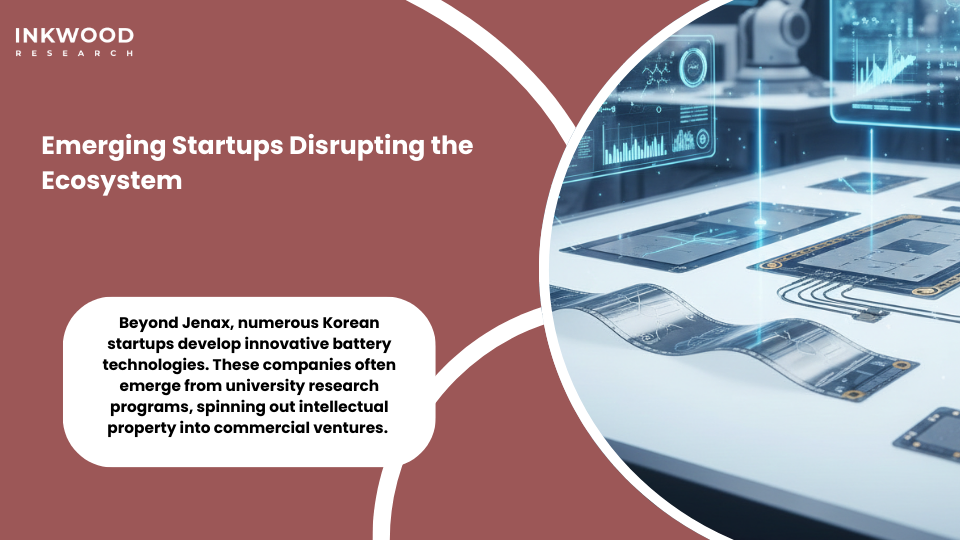
Beyond Jenax, numerous Korean startups develop innovative battery technologies. These companies often emerge from university research programs, spinning out intellectual property into commercial ventures. Government programs support startup formation through funding, mentorship, and facilities access.
On the other hand, several startups focus on organic printed battery technologies using sustainable materials. These batteries appeal to environmentally conscious customers and applications requiring biodegradable power sources. Manufacturing processes utilize printing techniques similar to those developed for organic LED displays.
Additionally, startups explore niche applications overlooked by major corporations. Specialized batteries for medical implants, aerospace sensors, and military equipment represent attractive markets with premium pricing. In all, these segments value performance over cost, enabling startups to compete despite limited production scale.
Incubator and Accelerator Support
Korea operates an extensive startup support infrastructure. Organizations like TIPS (Tech Incubator Program for Startup Korea) provide funding and mentorship to early-stage companies. Successful graduates include multiple battery technology startups achieving commercial success.
Moreover, corporate venture capital arms from LG, Samsung, and SK invest in promising startups. These investments provide capital while establishing relationships, potentially leading to acquisitions or partnerships. Startups gain not only funding but also market insights and technical expertise.
Additionally, university technology transfer offices facilitate startup formation. Researchers commercialize discoveries through licensing agreements or company formation. Korea’s major universities maintain active programs supporting entrepreneurship among faculty and students.
Technology Focus Areas
Emerging startups pursue diverse technological approaches. Some develop stretchable battery systems exceeding the flexibility limits of conventional flexible batteries. These products target applications requiring extreme mechanical compliance, such as electronic skin and soft robotics.
Others focus on ultra-low-cost printed batteries for disposable applications. Smart packaging, pharmaceutical compliance monitoring, and single-use diagnostics require batteries costing pennies rather than dollars. Innovative manufacturing processes enable economic viability at these price points.
Furthermore, startups explore novel chemistries addressing specific performance requirements. Zinc-air, aluminum-air, and other metal-air batteries promise high energy densities for particular applications. Though commercialization challenges remain, these technologies attract substantial research interest.
Manufacturing Infrastructure and R&D Investment
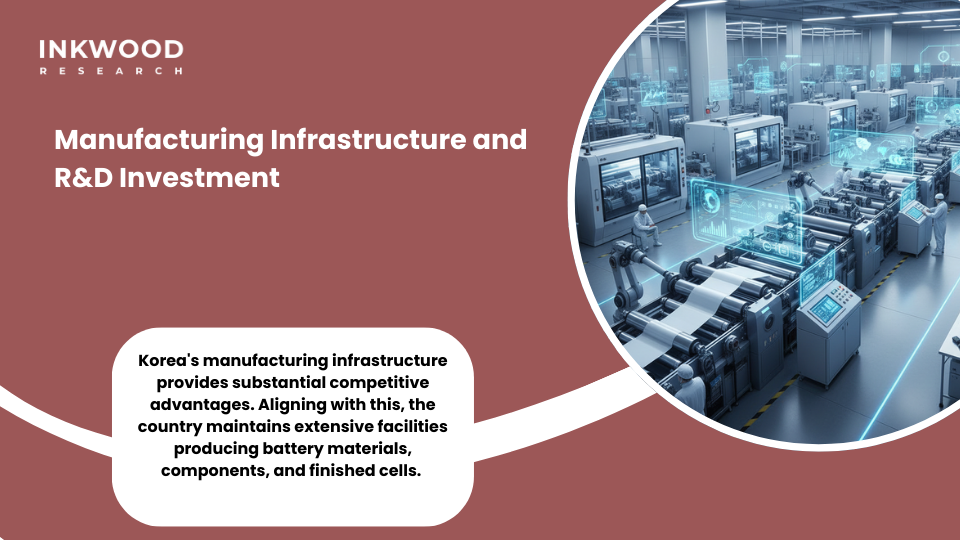
Korea’s manufacturing infrastructure provides substantial competitive advantages. Aligning with this, the country maintains extensive facilities producing battery materials, components, and finished cells. Integrated supply chains enable rapid prototyping and production scaling impossible in fragmented markets.
According to government data, Korean battery manufacturers invest billions in facility expansions. LG Energy Solution, Samsung SDI, and SK On collectively commit to building massive production capacity supporting projected demand growth. These investments position Korea to dominate emerging battery markets.
Advanced manufacturing technologies distinguish Korean facilities. Automation systems, artificial intelligence quality control, and data analytics optimize production efficiency. These systems reduce defect rates while improving yield, directly impacting cost competitiveness. Additionally, environmental controls ensure consistent manufacturing conditions critical for battery performance.
Research and Development Ecosystem
Korean battery companies invest heavily in R&D. Combined spending exceeds billions annually, funding thousands of researchers and engineers. In all, these investments focus on improving existing technologies while developing next-generation alternatives.
Moreover, collaborations between companies, universities, and research institutions accelerate innovation. Programs like the Korean Battery Alliance facilitate information sharing and joint research projects. These collaborations overcome challenges too large for individual organizations.
Additionally, Korea maintains world-class testing and certification facilities. Organizations like the Korea Testing Laboratory provide services ensuring products meet international safety and performance standards. These capabilities support export-oriented manufacturing strategies.
Skilled Workforce Development
Korea’s education system produces highly skilled engineers and scientists. Universities offer specialized programs in battery technology, electrochemistry, and materials science. Graduates fill positions in companies and research institutions, maintaining Korea’s technological leadership.
Furthermore, companies invest in ongoing employee training. Rapidly evolving technologies require continuous learning to maintain expertise. Corporate training programs, conference attendance, and advanced degree sponsorships keep workforce skills current.
Key Takeaways
- Market Growth: The South Korea flexible thin film and printed battery market expands from US$157.52 million in 2025 to US$597.19 million by 2032, representing a 20.97% CAGR exceeding global averages.
- Giant Leadership: LG Energy Solution and Samsung SDI leverage massive resources and manufacturing expertise while developing flexible battery technologies, complementing core product lines.
- Startup Innovation: Companies like Jenax pioneer stretchable battery applications, creating entirely new market categories through specialized technological focus.
- Solid-State Race: Samsung SDI targets 2027 mass production of solid-state printed battery systems while LG Energy Solution aims for 2030 commercialization, intensifying competitive dynamics.
- Manufacturing Excellence: Korean facilities incorporate advanced automation, artificial intelligence, and quality control systems, optimizing roll-to-roll battery manufacturing efficiency.
- Government Support: Strategic policies, R&D funding, and tax incentives accelerate battery technology development, positioning Korea as a global innovation leader.
- Vertical Integration: Comprehensive supply chains from materials through finished products enable rapid innovation cycles and cost advantages over fragmented competitors.
- Export Focus: Korean flexible battery manufacturers target international markets, particularly high-growth regions in Asia-Pacific, North America, and Europe.
Conclusion:
The South Korea flexible thin film and printed battery market ecosystem demonstrates remarkable dynamism, balancing established giants with innovative startups. LG Energy Solution and Samsung SDI bring manufacturing scale, capital resources, and market access. Meanwhile, companies like Jenax contribute specialized expertise and entrepreneurial agility. This competition drives rapid innovation, benefiting customers globally.
Based on our analysis, Korea’s integrated approach combining corporate power, startup creativity, and government support creates formidable competitive advantages. The country’s position seems secure for the foreseeable future, though challenges remain. International competitors invest heavily in battery technologies, particularly Chinese manufacturers achieving massive scale. Additionally, technological uncertainty regarding which battery chemistries achieve commercial dominance creates risks for heavy investors.
Nevertheless, Korea’s diversified ecosystem hedges these risks effectively. Multiple companies pursue varied technological pathways, ensuring the country maintains relevance regardless of which technologies prevail. Strategic flexibility combined with execution excellence positions Korea advantageously to navigate uncertain futures.
Ready to understand how Korean printed battery innovations can enhance your products? Contact Inkwood Research for detailed competitive intelligence and strategic guidance navigating Korea’s dynamic battery ecosystem.
Frequently Asked Questions
How does South Korea's flexible battery market differ from global competitors?
Korea combines massive corporate resources with entrepreneurial startup energy, creating unique ecosystem dynamics. Giants like LG and Samsung provide manufacturing scale and capital while startups like Jenax drive specialized innovation. This balance enables Korea to compete across market segments from high-volume commodity batteries to niche specialty applications requiring advanced polymer thin film battery technologies.
When will solid-state batteries become commercially available from Korean manufacturers?
Samsung SDI targets mass production beginning in 2027 for prismatic solid-state printed battery cells, while LG Energy Solution aims for 2030 commercialization, focusing on pouch-type cells. However, initial products will serve premium applications like high-performance electric vehicles before broader market deployment. Cost reductions and manufacturing refinements require several additional years before solid-state batteries achieve price parity with conventional lithium-ion technologies.
What advantages do Korean flexible battery manufacturers offer international customers?
Korean companies provide integrated solutions combining advanced technology, manufacturing quality, and supply chain reliability. Established relationships with major electronics brands ensure products meet stringent performance and safety requirements. Additionally, Korea’s proximity to Asian electronics manufacturing centers enables responsive customer support and rapid prototyping. Roll-to-roll battery manufacturing capabilities support cost-effective production at scales suitable for emerging applications.