Table of Contents
This analysis is brought to you by Inkwood Research, a leading market intelligence firm specializing in Asia-Pacific emissions trading systems, IoT environmental monitoring, and smart city sensor ecosystems. Our research team combines deep expertise in South Korea’s carbon market frameworks, K-ETS policy evolution, and IoT air quality monitoring adoption across Korean industrial zones, urban centers, and government-linked facilities. Through strategic partnerships with Korean technology providers and environmental policy stakeholders, we deliver actionable intelligence for enterprises navigating the South Korea air quality IoT sensors market.
TLDR
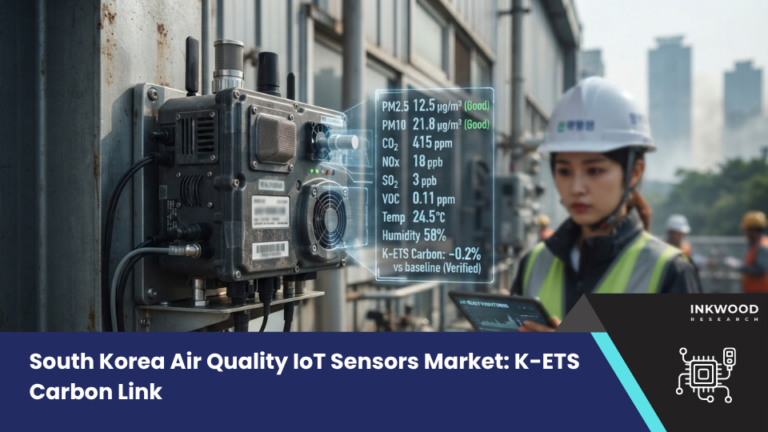
South Korea is doing something distinctly ambitious with its air quality infrastructure: connecting real-time IoT air quality monitoring directly to a functioning carbon trading market. The South Korea air quality IoT sensors market is projected to grow from US$57.20 million in 2026 to US$218.87 million by 2034, at a CAGR of 18.26%. This growth is shaped by the Korea Emissions Trading Scheme (K-ETS) and a government-wide push to make sensor data a cornerstone of environmental compliance and carbon accountability.
This blog is designed for carbon market strategists, environmental compliance officers, and IoT technology developers evaluating South Korea’s sensing landscape. Additionally, policy analysts tracking Asia-Pacific emissions frameworks, smart city planners, industrial facility managers navigating K-ETS obligations, and investors assessing the South Korea air quality IoT sensors market will find targeted, fact-grounded intelligence to inform strategic decisions.
What Is K-ETS Phase 4 and Why Does It Matter for IoT Sensors?
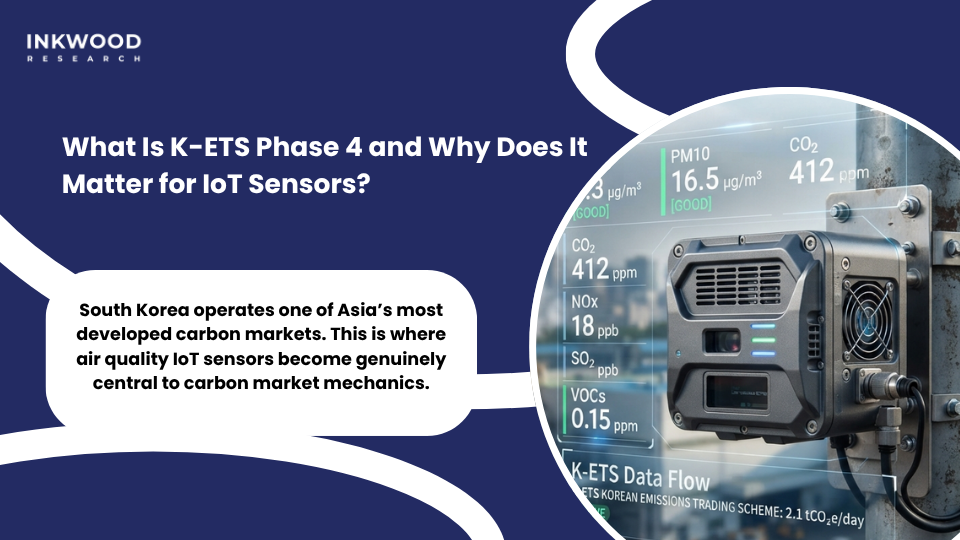
South Korea operates one of Asia’s most developed carbon markets. The Korea Emissions Trading Scheme (K-ETS), administered by the Greenhouse Gas Inventory and Research Center of Korea under the Ministry of Environment, has run through successive compliance phases since its 2015 launch. Phase 4, governing the period from 2026 onward, is expected to tighten allocation rules and expand the range of obligated entities, directly amplifying demand for credible, real-time emissions data.
This is where air quality IoT sensors become genuinely central to carbon market mechanics. Under the K-ETS framework, verified emissions data is the currency of compliance. Consequently, industrial facilities and large commercial operators are investing in IoT air quality monitoring infrastructure not only for environmental reasons, but because sensor-verified data directly informs their carbon allowance positions.
The Link Between Sensor Data and Market Credibility
What makes South Korea’s approach particularly noteworthy is the emphasis on data integrity. The K-ETS framework requires emissions reports to meet stringent Measurement, Reporting, and Verification (MRV) standards. Furthermore, as cloud-connected air quality monitoring systems become more sophisticated, the potential to integrate continuous sensor feeds into MRV workflows is becoming operationally real. This creates a compelling business case for upgrading legacy spot-measurement systems to continuous IoT air pollution monitoring systems capable of generating audit-ready data streams.
How Does Real-Time IoT Data Connect to Carbon Trading in Korea?
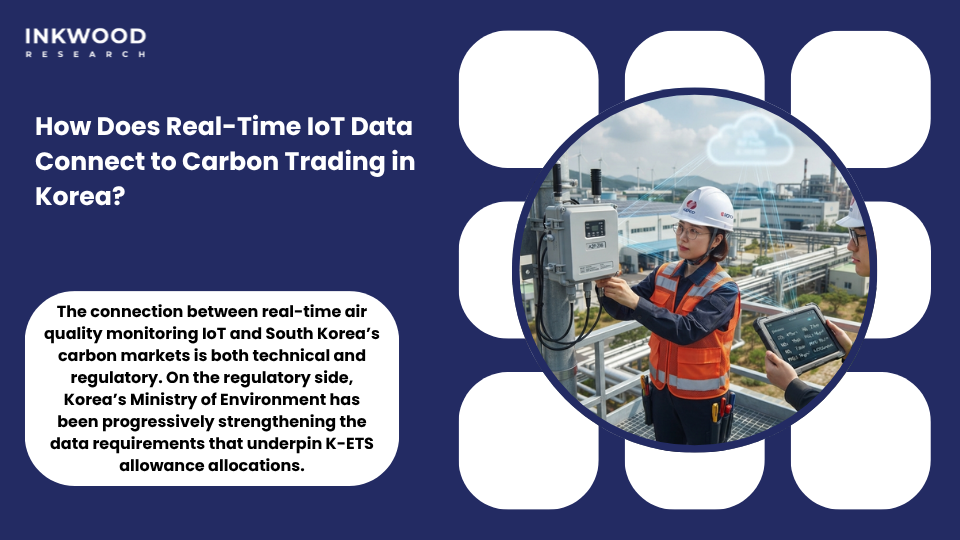
The connection between real-time air quality monitoring IoT and South Korea’s carbon markets is both technical and regulatory. On the technical side, modern smart air quality sensors can generate continuous, timestamped emissions data across a broad range of pollutants, CO₂, NOˣ, SO₂, and fine particulate matter, with the precision needed for compliance-grade reporting. On the regulatory side, Korea’s Ministry of Environment has been progressively strengthening the data requirements that underpin K-ETS allowance allocations.
For industrial operators, this convergence means that air pollution monitoring devices are no longer simply instruments of environmental goodwill. Instead, they are compliance infrastructure with direct financial implications. Facilities with robust, continuously monitored emissions data can demonstrate more accurately that their actual emissions align with, or fall below, their allocated allowances, potentially opening the door to allowance trading on favorable terms.
From Point Measurements to Continuous Monitoring Networks
Historically, Korean industrial emissions monitoring relied heavily on periodic sampling at specific stack points. However, the evolution of wireless air quality sensors and AI-based environmental sensors is enabling a shift toward continuous, network-wide monitoring. Additionally, platforms that aggregate data from multiple sensor points across a facility can identify emissions anomalies in real time, not months later during annual reporting cycles. This operational intelligence is reshaping how Korean industrial operators think about environmental management and carbon risk simultaneously.
What Is Driving South Korea’s Air Quality IoT Sensors Market?
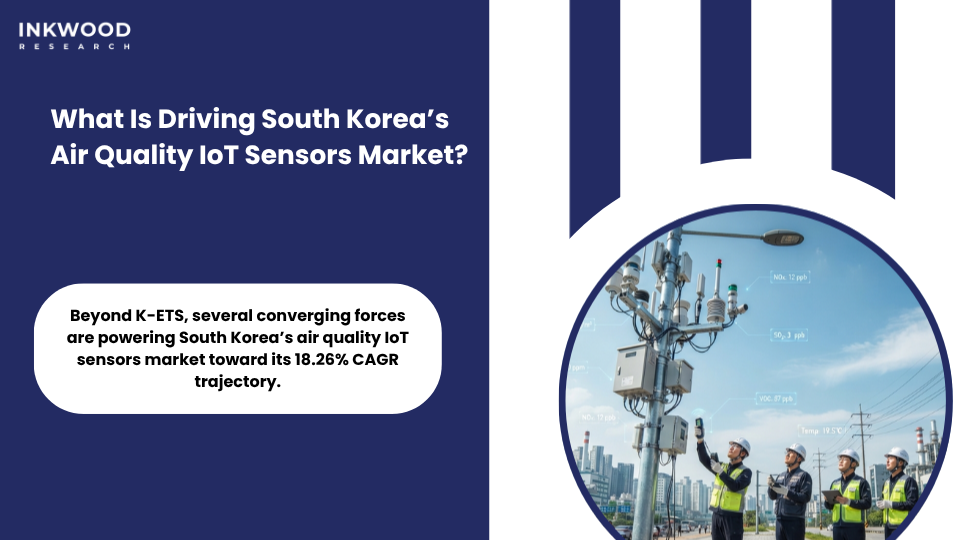
Beyond K-ETS, several converging forces are powering South Korea’s air quality IoT sensors market toward its 18.26% CAGR trajectory.
- Urban air quality concerns: South Korea experiences significant particulate matter challenges, partly linked to regional transboundary pollution and domestic vehicle and industrial emissions. The Ministry of Environment’s Clean Air Conservation Act mandates progressively tighter ambient air quality standards, creating sustained regulatory pull for monitoring infrastructure.
- Smart city investment: The Korean government’s active smart city development programs, particularly the Sejong and Busan Eco-Delta Smart City projects, explicitly incorporate smart city air quality monitoring as a core functional layer. These projects serve as reference implementations that other municipalities are following.
- Industrial modernization: Korean industrial giants, including POSCO, Hyundai, and LG Energy Solution, operate at a scale where even marginal improvements in emissions monitoring efficiency translate into significant cost and compliance advantages. Consequently, investment in industrial air quality sensors market solutions is a strategic priority, not a discretionary one.
- Public health awareness: Following several years of high-profile pollution episodes, Korean public awareness around air quality has reached a point where consumer demand for indoor air quality monitoring systems is driving a parallel residential and commercial market alongside the industrial segment.
How Are Smart Cities in Korea Integrating Air Sensing Networks?
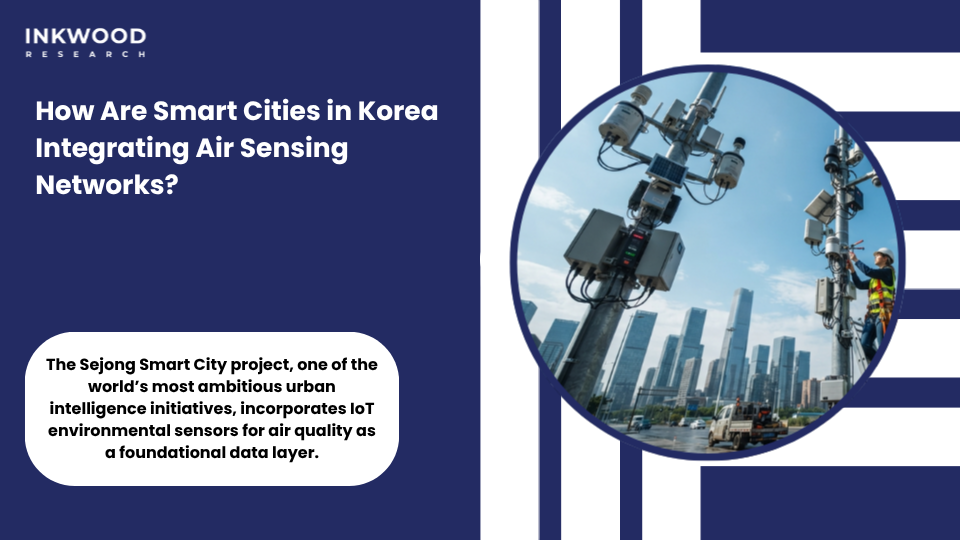
South Korea’s approach to smart city air quality monitoring is defined by integration at scale. The Sejong Smart City project, one of the world’s most ambitious urban intelligence initiatives, incorporates IoT environmental sensors for air quality as a foundational data layer. Real-time pollution data flows into the city’s central management platform, where it is combined with traffic, energy, and public health data to support coordinated urban decision-making.
Moreover, the Busan Eco-Delta Smart City project is piloting AI-powered air quality monitoring systems that use predictive modeling to anticipate pollution spikes before they occur. These systems ingest historical sensor data, traffic patterns, and weather forecasts to generate proactive alerts, giving city managers time to implement traffic management or industrial curtailment measures before air quality deteriorates.
Community-Level Sensing: Extending Coverage Beyond City Centers
Korean municipalities are increasingly deploying low-cost air quality sensors at the neighborhood level, complementing the larger monitoring stations maintained under national environmental programs. This granular approach generates the kind of hyperlocal data that residents, schools, and community health programs need to make day-to-day decisions. Furthermore, public-facing air quality dashboards, accessible via mobile apps, are normalizing engagement with real-time environmental data across all demographics.
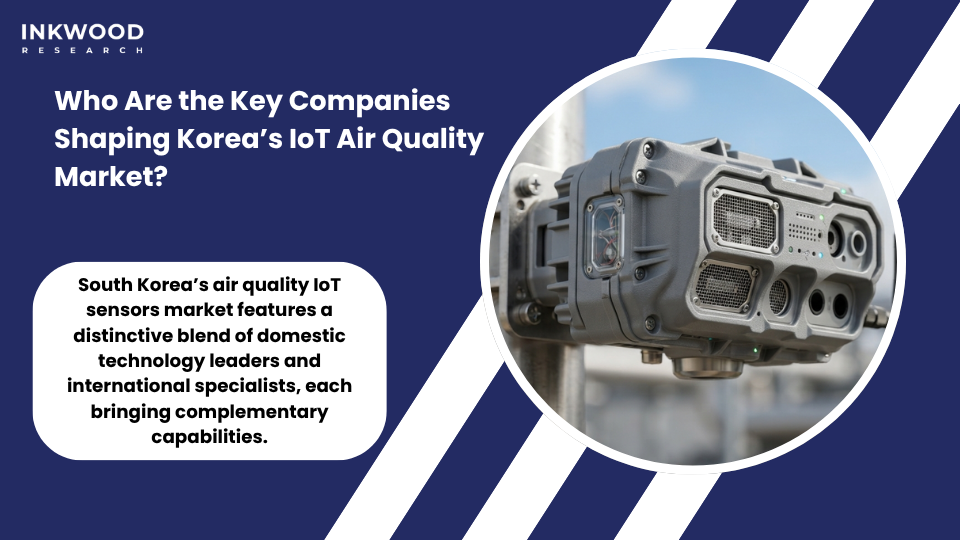
South Korea’s air quality IoT sensors market features a distinctive blend of domestic technology leaders and international specialists, each bringing complementary capabilities.
- Samsung is embedding indoor air quality monitoring systems into its SmartThings ecosystem, enabling connected homes and commercial buildings to monitor air quality alongside energy, security, and appliance management. This integration positions Samsung as a gateway for consumer-facing smart air quality sensors at scale.
- SK Telecom is leveraging its 5G network infrastructure to support real-time IoT monitoring platforms for environmental sensing, partnering with municipalities and industrial clients to deploy city-scale sensor networks. The low-latency connectivity of 5G is particularly valuable for applications where air quality events require immediate response.
- KT Corporation operates in the cloud-connected air quality monitoring systems space, providing data infrastructure that supports aggregation and analysis of sensor data from across Korea’s urban and industrial environments.
- LG Electronics brings its ThinQ AI platform to indoor air quality sensors, integrating monitoring capabilities into premium home appliances, including air purifiers and HVAC systems. Their approach blurs the boundary between sensing and remediation.
- Siemens and Honeywell, both with established Korean operations, serve the industrial air quality sensors market, supplying compliance-grade monitoring systems for manufacturing facilities, refineries, and power generation assets operating under K-ETS obligations.
Key Takeaways
- The South Korea air quality IoT sensors market is projected to grow from US$57.20 million in 2026 to US$218.87 million by 2034 at a CAGR of 18.26%, among the highest growth rates in the Asia-Pacific region.
- K-ETS Phase 4, entering effect from 2026, is set to deepen the operational link between real-time IoT air quality monitoring and carbon market compliance, elevating sensor data from a reporting input to a strategic business asset.
- Smart city projects, including Sejong and Busan Eco-Delta, are establishing smart city air quality monitoring as a foundational urban intelligence layer, not a supplementary service.
- AI-powered air quality monitoring systems and cloud-connected platforms are enabling predictive, rather than reactive, pollution management, as capabilities shift with significant implications for both urban and industrial operators.
- Domestic champions, including Samsung, SK Telecom, KT, and LG, are integrating IoT environmental sensors into consumer, enterprise, and city-scale platforms, building durable competitive positions.
- The K-ETS framework’s MRV requirements are creating structural, compliance-driven demand for continuous IoT air pollution monitoring systems across the Korean industry.
Conclusion:
South Korea’s air quality IoT sensors market is developing along a trajectory that no other Asian market has quite replicated. By anchoring environmental sensing within the operational logic of a live carbon trading scheme, Korea has created a demand dynamic where real-time IoT monitoring is simultaneously an environmental tool, a compliance instrument, and a financial asset. Furthermore, the convergence of K-ETS tightening, smart city expansion, and industrial modernization means that the growth drivers are mutually reinforcing rather than dependent on any single policy cycle.
Inkwood Research provides the market intelligence and strategic frameworks needed to navigate the South Korea air quality IoT sensors market with clarity and confidence. Connect with our team to explore how our analysis can support your market positioning, technology strategy, or investment decisions in Korea’s evolving environmental sensing landscape.
Frequently Asked Questions
What is the South Korea air quality IoT sensors market size?
The market grows from US$57.20 million in 2026 to US$218.87 million by 2034 at an 18.26% CAGR.
How does K-ETS Phase 4 drive demand for IoT air quality sensors?
K-ETS requires verified emissions data; continuous IoT sensors provide audit-ready monitoring streams that support carbon allowance compliance and trading decisions.
Which smart city projects in Korea use air quality IoT sensors?
Sejong Smart City and Busan Eco-Delta Smart City both integrate real-time IoT air quality monitoring as a core urban infrastructure layer.
What Korean companies are active in the air quality IoT sensors market?
Samsung, SK Telecom, KT Corporation, and LG Electronics are leading domestic players, alongside international firms like Honeywell and Siemens.
How do AI-powered air quality monitoring systems work in Korean cities?
They analyze historical sensor data and environmental inputs to predict pollution spikes, enabling proactive city management responses before air quality deteriorates.
What role does the Clean Air Conservation Act play in Korea’s IoT sensor market?
It mandates tighter ambient air quality standards, creating sustained regulatory pull for outdoor and indoor air quality monitoring infrastructure investment.