Table of Contents

This analysis is brought to you by Inkwood Research, a leading market intelligence firm specializing in United States renewable energy adoption, solar technology deployment patterns, and distributed power generation systems. Our research team combines deep expertise in analyzing residential and commercial photovoltaic installations, regulatory compliance frameworks, and clean energy policy impacts across American markets. Based on our proprietary research methodologies and strategic partnerships with solar installers, utility providers, and energy technology manufacturers, we deliver actionable insights empowering strategic decision-making for businesses navigating the rapidly evolving U.S. solar microinverter landscape.
TLDR
The United States solar microinverter market demonstrates remarkable momentum, reaching US$1.45 billion in 2026 with projections to US$4.68 billion by 2034 at a 15.82% CAGR. American homeowners and businesses increasingly choose these compact power electronics devices that optimize individual panel performance. Federal tax incentives, state-level renewable energy mandates, and NEC safety code compliance drive widespread adoption. Leading manufacturers like Enphase Energy dominate with domestically produced units supporting grid resilience. Integration with battery energy storage addresses time-of-use rates while three-phase commercial products expand beyond residential applications.
Solar installation contractors seeking to understand U.S. market dynamics will discover practical insights into customer preferences and regulatory drivers. Property owners evaluating solar technology options can compare microinverter benefits against traditional configurations. State and local policymakers developing clean energy programs will appreciate the examination of adoption barriers and incentive effectiveness. Financial analysts covering renewable energy companies need a comprehensive understanding of competitive positioning and technology trends shaping American solar markets.
Why Solar Microinverters Gain Traction Across America
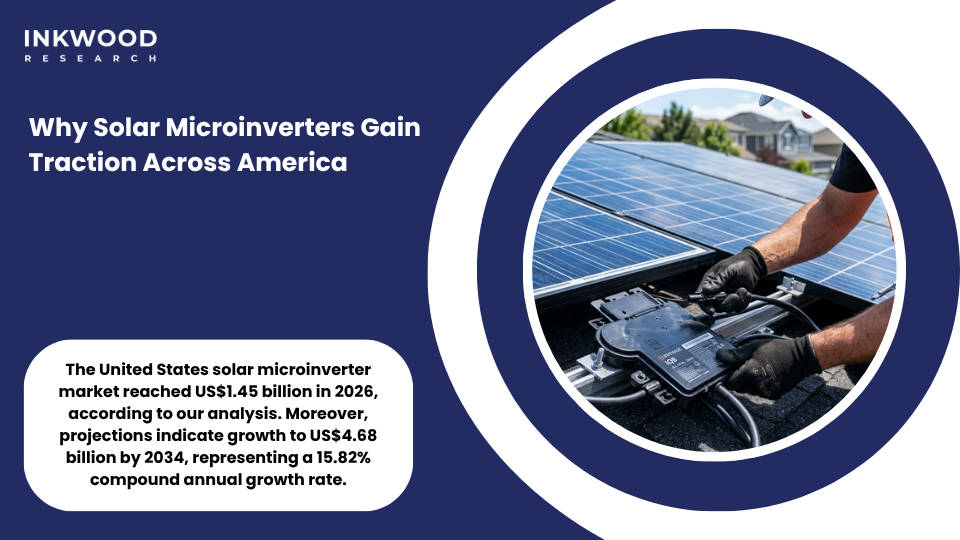
American homeowners face a fundamental choice when installing photovoltaic systems. Traditional string inverters connect panels in series, while solar microinverters attach to individual modules. This decision affects system performance, safety compliance, and long-term economics.
Market momentum clearly favors distributed architectures. The United States solar microinverter market reached US$1.45 billion in 2026, according to our analysis. Moreover, projections indicate growth to US$4.68 billion by 2034, representing a 15.82% compound annual growth rate.
Understanding Solar Microinverter Functionality for American Installations
These compact power electronics devices mount directly beneath solar panels. Each unit converts direct current from its dedicated module into grid-compatible alternating current. Consequently, rooftop wiring carries only AC electricity rather than high-voltage DC strings.
This architectural approach delivers practical benefits. Shading from trees, chimneys, or nearby structures affects only the impacted panel. Meanwhile, unshaded modules continue producing maximum power.
Moreover, panel-level monitoring provides unprecedented visibility. System owners track individual module performance through smartphone applications. Early detection of underperforming panels enables prompt maintenance interventions.
Comparing Solar Microinverter Performance Against String Configurations
String inverter systems group panels into circuits sharing a single conversion device. This design works well for unshaded, uniformly oriented installations. However, real-world rooftops rarely match these ideal conditions.
American homes feature complex roof geometries. For instance, multiple roof planes face different directions with varying tilt angles. Solar microinverters excel in these scenarios, optimizing each panel independently.
Efficiency considerations warrant examination. Aligning with this, string inverters typically achieve 96-97% conversion efficiency, and advanced solar microinverter models now reach 97.5% through gallium nitride technology.
Regulatory Frameworks Driving U.S. Solar Microinverter Adoption
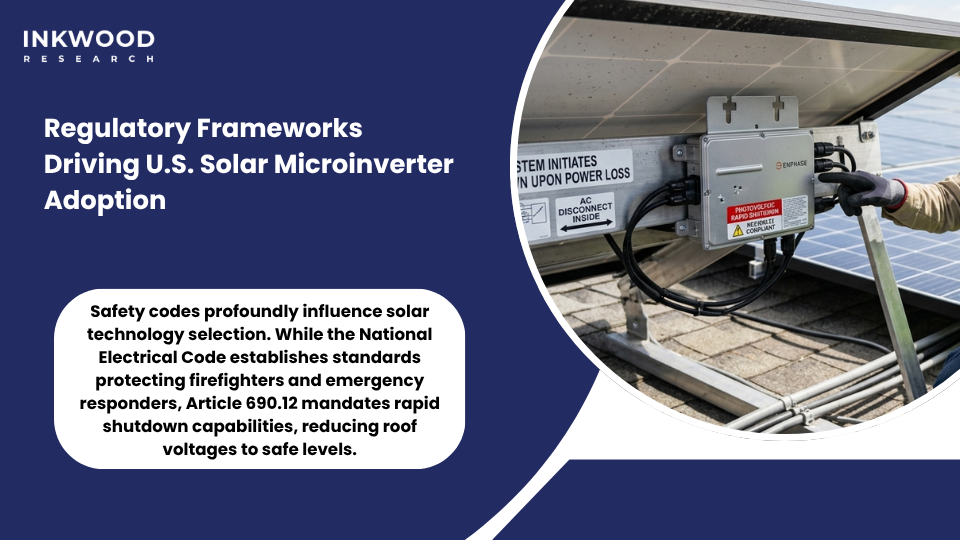
Safety codes profoundly influence solar technology selection. While the National Electrical Code establishes standards protecting firefighters and emergency responders, Article 690.12 mandates rapid shutdown capabilities, reducing roof voltages to safe levels.
Solar microinverters inherently comply with these requirements. Their distributed architecture eliminates high-voltage DC on rooftops. Moreover, string inverter systems require additional shutdown devices, increasing installation complexity and cost.
Federal Incentive Programs Supporting Solar Microinverter Installations
Investment tax credits substantially improve project economics. Moreover, the Inflation Reduction Act provides manufacturing incentives for domestically produced renewable energy equipment. American-made solar microinverters qualify for these benefits, strengthening competitive positioning.
On the other hand, production tax credits directly reduce system costs. Manufacturers pass Section 45X benefits through pricing adjustments, while leading companies report that these credits contribute significantly to gross margins while enabling competitive retail prices.
Grid Interconnection Standards and Solar Microinverter Compliance
Utilities require distributed generation systems to meet IEEE 1547 standards. These specifications govern voltage regulation, frequency response, and grid support functions. Additionally, modern solar microinverters integrate advanced features satisfying these technical requirements.
Anti-islanding protection prevents backfeeding during outages, while systems immediately disconnect when detecting loss of grid voltage. This capability protects utility workers performing repairs on de-energized lines.
Additionally, voltage and frequency ride-through functions support grid stability. Rather than disconnecting during minor disturbances, advanced inverters maintain operation. This resilience becomes increasingly important as renewable energy penetration grows.
Residential vs. Commercial Applications in American Markets
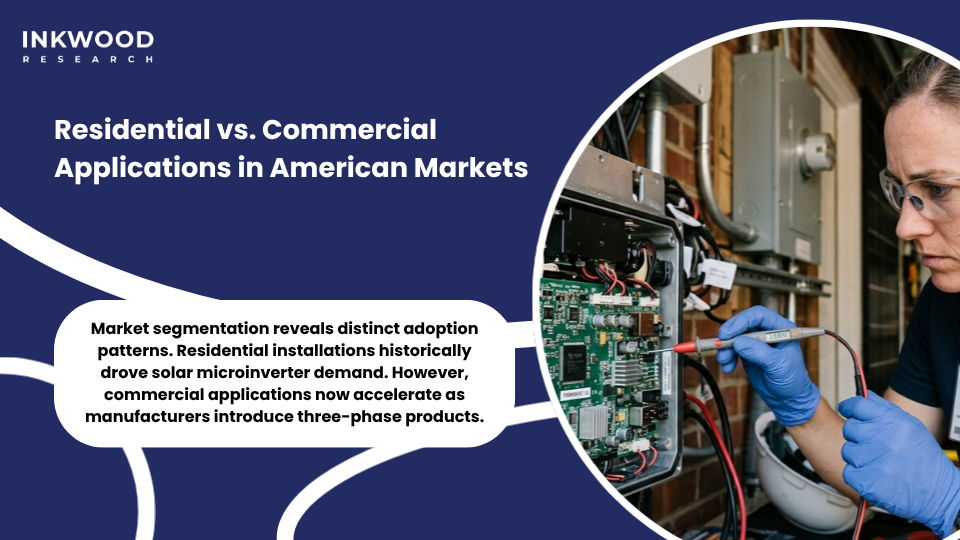
Market segmentation reveals distinct adoption patterns. Residential installations historically drove solar microinverter demand. However, commercial applications now accelerate as manufacturers introduce three-phase products.
Residential Solar Microinverter Market Characteristics
Homeowners prioritize system reliability and aesthetic appeal. In this regard, solar microinverters deliver both attributes through proven designs and minimal rooftop equipment. Twenty-five-year warranties align with typical homeownership timelines.
According to U.S. Energy Information Administration data, solar installations added 32.5 gigawatts of new capacity in 2025. While residential systems represent a substantial portion of this deployment, distributed generation increasingly supplements centralized utility-scale projects.
Customer acquisition strategies emphasize education. In this regard, installation contractors demonstrate panel-level monitoring capabilities during sales presentations. Meanwhile, visual dashboards showing real-time production resonate with tech-savvy homeowners.
Commercial Solar Microinverter Deployment Opportunities
Commercial buildings present unique challenges for photovoltaic installations. For example, rooftops feature HVAC equipment, exhaust vents, and skylights, creating complex shading patterns. Module-level optimization proves particularly valuable in these environments.
Three-phase electrical systems dominate commercial applications. Traditional solar microinverters targeted single-phase residential installations and, accordingly, recent product launches specifically address 480-volt three-phase requirements.
Enphase Energy introduced its IQ9N-3P commercial microinverter in January 2026. This device handles 480Y/277-volt configurations without external transformers. Such innovations expand addressable markets beyond residential segments.
State-Level Market Dynamics and Regional Variations
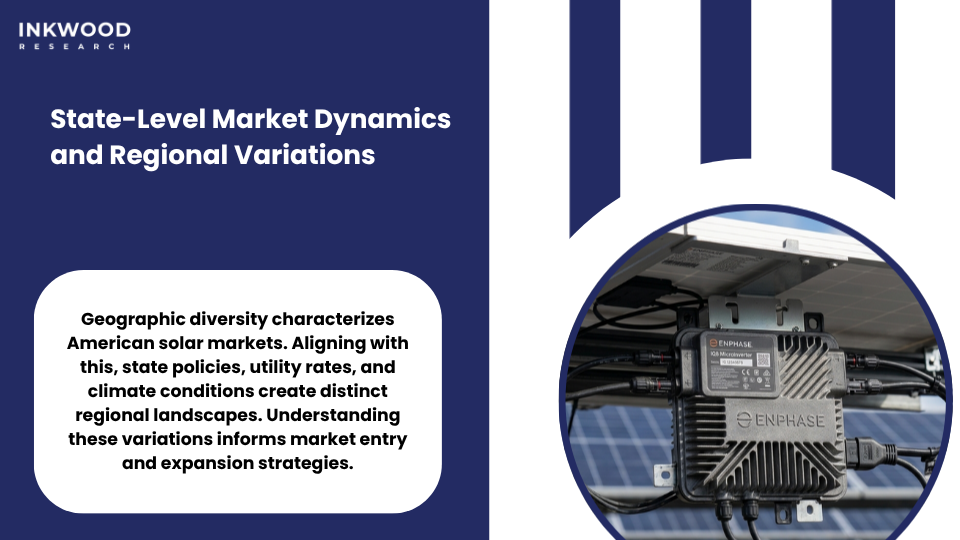
Geographic diversity characterizes American solar markets. Aligning with this, state policies, utility rates, and climate conditions create distinct regional landscapes. Understanding these variations informs market entry and expansion strategies.
California’s Evolving Solar Microinverter Market Landscape
California established itself as America’s solar technology leader, with generous net metering policies historically incentivizing residential installations. However, the 2023 transition to NEM 3.0 fundamentally altered economics.
Export rate reductions reached 75% under new regulations. Consequently, battery energy storage integration became economically essential. Plus, solar microinverter systems pair naturally with AC-coupled battery configurations.
This shift actually strengthens microinverter value propositions. While panel-level monitoring enables sophisticated energy management strategies, systems optimize self-consumption while minimizing grid dependence.
Texas Solar Microinverter Growth Driven by Market Dynamics
Texas demonstrates remarkable renewable energy expansion. The state leads utility-scale solar deployment while residential adoption accelerates. Moreover, as per EIA statistics, Texas added 3.2 gigawatts of solar capacity in the first half of 2025 alone.
On the other hand, deregulated electricity markets create unique opportunities. While homeowners negotiate directly with retail electricity providers, time-of-use rates incentivize solar generation paired with battery storage.
Further, grid reliability concerns drive adoption. Recent winter storms demonstrated the vulnerability of centralized power systems and, consequently, distributed generation with backup capabilities gains appeal.
Northeast Regional Solar Microinverter Adoption Patterns
States including Massachusetts, New York, and New Jersey maintain aggressive renewable energy targets. Solar Renewable Energy Certificates provide additional revenue streams. These financial mechanisms improve project returns despite higher installation costs.
Urban environments present installation challenges, as dense development creates shading from neighboring structures. Solar microinverters mitigate these impacts through panel-level optimization.
Manufacturing and Supply Chain Considerations

Domestic production capabilities influence competitive dynamics. While supply chain resilience gained prominence following pandemic disruptions, American manufacturing offers strategic advantages beyond logistics.
Domestic Content Requirements for Solar Microinverter Projects
Federal infrastructure spending mandates Buy America compliance. Projects using domestically manufactured components qualify for enhanced tax credits. As a result, this policy creates competitive advantages for American production facilities.
Enphase Energy operates manufacturing plants in the United States. Their solar microinverters carry DOM designations indicating domestic origin. Subsequently, these products satisfy federal procurement requirements while supporting local economies.
Component Sourcing and Technology Transfer Implications
Power electronics rely on semiconductor components, with global supply chains presenting vulnerabilities alongside opportunities. Moreover, advanced materials like gallium nitride drive performance improvements.
Technology development continues rapidly as research institutions collaborate with manufacturers on next-generation designs. Silicon carbide semiconductors offer alternatives to gallium nitride in certain applications, as well.
Economic Factors Influencing Purchase Decisions

Investment decisions balance upfront costs against lifetime value as solar microinverter systems command premium prices compared to string configurations. However, comprehensive economic analysis reveals compelling financial cases.
Financing Options for Solar Microinverter Installations
Purchase methods significantly impact consumer adoption. Cash purchases, loans, leases, and power purchase agreements each serve different customer segments. Besides, third-party ownership models reduce or eliminate upfront costs.
Solar loans maintain system ownership while spreading payments as homeowners capture federal tax credits directly. Plus, monthly payments often match or undercut previous utility bills.
Lease and PPA structures appeal to different demographics. While customers avoid maintenance responsibilities while enjoying electricity savings, third-party owners monetize tax incentives, passing benefits through reduced rates.
Warranty Coverage and Long-Term Protection for Solar Microinverter Systems
Equipment warranties provide financial security. Premium solar microinverter manufacturers offer 25-year coverage, and this protection spans the expected operational lifetime of photovoltaic panels.
Failure rate data support warranty confidence, with Enphase Energy reporting 0.05% annual failure rates—one unit per 2,000 deployed. Such reliability minimizes replacement expenses throughout system lifetimes.
Comprehensive coverage addresses component failure. While manufacturers replace defective units at no cost to system owners, some programs include labor coverage, further reducing total ownership costs, as well.
Key Takeaways
- The United States solar microinverter market reached US$1.45 billion in 2026, projecting growth to US$4.68 billion by 2034.
- This 15.82% compound annual growth rate reflects strong adoption across residential and emerging commercial segments.
- Federal manufacturing incentives support domestic production while enhancing competitive positioning.
- Regulatory drivers, including NEC 690.12 rapid shutdown requirements, favor microinverter architectures.
- State-level policy variations create distinct regional markets, with California, Texas, and Northeast states leading deployment.
- Net metering changes accelerate battery energy storage integration, amplifying microinverter value propositions.
- Competitive landscape centers on Enphase Energy’s market leadership while APsystems and emerging manufacturers target cost-conscious segments.
- Three-phase commercial products expand beyond traditional residential applications.
- Gallium nitride technology delivers 97.5% efficiency alongside improved thermal management.
- Total cost of ownership analysis reveals compelling economics despite premium upfront pricing.
- Twenty-five-year warranties, enhanced energy harvest, and reduced maintenance expenses justify investment.
- Diverse financing options, including loans, leases, and PPAs, accommodate various customer preferences.
Ready to evaluate solar microinverter technology for your specific application?
Inkwood Research delivers comprehensive market analysis and strategic guidance.
Contact our team to explore how distributed power electronics can optimize your renewable energy investments.
Frequently Asked Questions
How do solar microinverters comply with NEC safety codes?
Solar microinverters convert DC power to AC at each panel, eliminating high-voltage DC on rooftops and inherently meeting NEC 690.12 rapid shutdown safety requirements.
Why are solar microinverters popular in U.S. residential solar markets?
Homeowners prefer microinverters for their panel-level monitoring, enhanced electrical safety, and improved performance in complex rooftop layouts with shading.
What drives solar microinverter adoption in commercial solar installations?
Commercial microinverter systems support three-phase power configurations and perform well in rooftops with HVAC equipment and shading that benefit from module-level optimization.
How do microinverters improve solar system monitoring in the United States?
Microinverters allow real-time panel-level monitoring, enabling homeowners and installers to quickly identify performance issues and maximize system efficiency.
Why are microinverters suitable for complex rooftop solar installations?
Microinverters allow each panel to operate independently, making them ideal for roofs with multiple orientations, shading obstacles, or irregular layouts.
How do microinverters enhance solar system reliability in residential projects?
Because each panel has its own inverter, a failure affects only one module rather than the entire solar array, improving overall system reliability.