Table of Contents
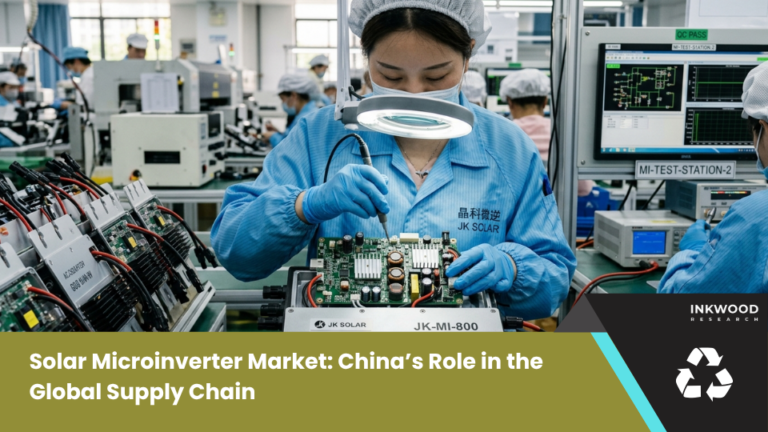
This analysis is brought to you by Inkwood Research, a leading market intelligence firm specializing in Asia-Pacific renewable energy ecosystems, solar technology manufacturing trends, and power electronics supply chain dynamics. Our research team combines extensive experience analyzing China’s clean energy industrial policies, photovoltaic systems innovation, and global solar microinverter market integration. Based on our proprietary research methodologies and strategic partnerships with Chinese manufacturers, international distributors, and energy technology analysts, we deliver actionable insights that empower strategic decision-making for global enterprises navigating China’s dominant position in solar equipment manufacturing.
TLDR
China dominates global solar microinverter supply chains through massive manufacturing scale, integrated photovoltaic systems production, and aggressive renewable energy deployment. The China solar microinverter market reached US$806.38 million in 2026, projecting growth to US$3,056.28 million by 2034 at an 18.12% CAGR. Chinese manufacturers leverage vertical integration from power electronics components to finished products, enabling competitive pricing that reshapes international markets. Meanwhile, domestic installations accelerate as the country deploys 315 gigawatts of solar capacity annually while surpassing 1,200 gigawatts of cumulative solar installations, creating both supply and demand dynamics that influence global clean energy transitions.
International solar equipment buyers seeking to understand Chinese manufacturing capabilities and sourcing strategies will discover practical insights into supply chain dynamics. Energy technology investors evaluating Asia-Pacific market opportunities can leverage our analysis of China’s solar microinverter market growth trajectory and competitive landscape. Renewable energy consultants advising clients on low-carbon-intensive technologies need a comprehensive understanding of how Chinese production influences global pricing and availability. Policymakers developing domestic solar manufacturing initiatives must consider China’s integrated approach to photovoltaic systems production and its implications for international competitiveness.
Manufacturing Dominance in China Solar Microinverter Production
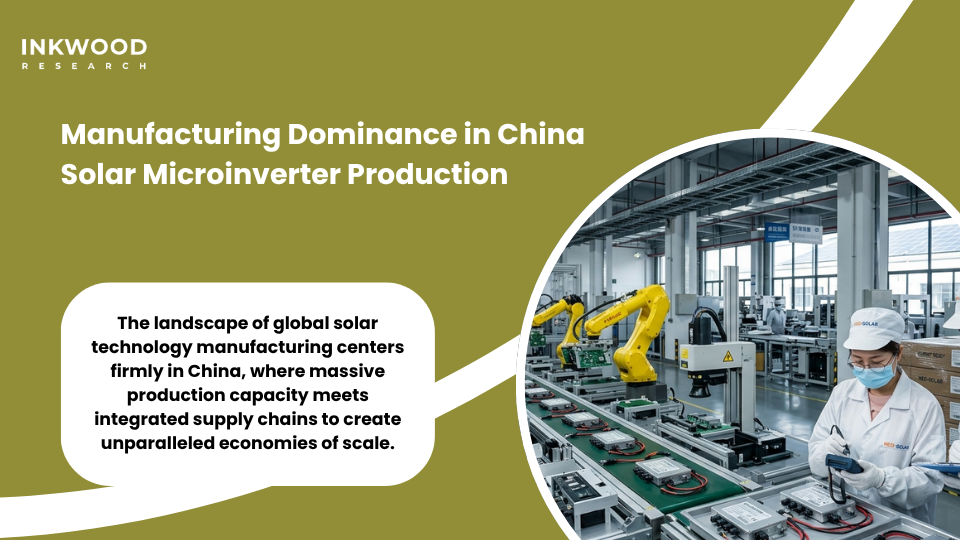
The landscape of global solar technology manufacturing centers firmly in China, where massive production capacity meets integrated supply chains to create unparalleled economies of scale. Chinese factories produce not just solar microinverters but the entire ecosystem of components required for photovoltaic systems, from semiconductor chips to aluminum housing, all within concentrated industrial zones that minimize logistics costs and maximize production efficiency.
This comprehensive manufacturing infrastructure enables Chinese companies to offer solar microinverters at price points that international competitors struggle to match, fundamentally reshaping how the global renewable energy industry sources critical power electronics components.
Moreover, the scale of Chinese production creates downstream effects throughout the supply chain, influencing everything from raw material demand to shipping logistics, while establishing pricing benchmarks that ripple across international markets and force non-Chinese manufacturers to reconsider their competitive strategies.
Scale Advantages of China Solar Microinverter Manufacturing
Production volumes in Chinese solar microinverter factories dwarf those of facilities elsewhere, with individual plants capable of producing hundreds of thousands of units monthly through highly automated assembly lines that operate continuously. Moreover, this manufacturing scale creates natural cost advantages that extend beyond simple unit economics, as Chinese producers negotiate better terms with component suppliers, achieve higher utilization rates on capital equipment, and spread fixed costs across larger production runs.
Furthermore, the concentration of solar technology manufacturing in China means that skilled technicians, specialized equipment suppliers, and logistics providers all cluster around production zones. As a result, this creates an ecosystem where knowledge transfer happens organically, and supply chain friction is minimized through geographic proximity.
The result? Chinese manufacturers can iterate product designs quickly, respond to market demand shifts rapidly, and maintain quality standards while achieving price points that reflect genuine cost advantages rather than temporary subsidies or dumping strategies.
Government Support for Solar Microinverter Industry Development
Chinese industrial policy explicitly prioritizes renewable energy equipment manufacturing as a strategic sector, providing manufacturers with benefits ranging from favorable financing terms to streamlined permitting processes for facility expansions.
Accordingly, provincial governments compete to attract solar technology producers by offering land at below-market rates, building customized infrastructure including specialized electrical substations, and creating industrial parks dedicated specifically to clean energy manufacturing. Additionally, government-backed research institutions collaborate with manufacturers on technology development, sharing resources and intellectual property in ways that accelerate innovation while reducing individual companies’ research and development costs.
These policy frameworks don’t simply subsidize production they create an enabling environment where manufacturers can invest confidently in capacity expansion, knowing that domestic demand will continue growing through government mandates for renewable energy deployment while export markets remain accessible through competitive advantages built on genuine manufacturing efficiency rather than temporary incentives.
Domestic Market Growth Driving Global Innovation
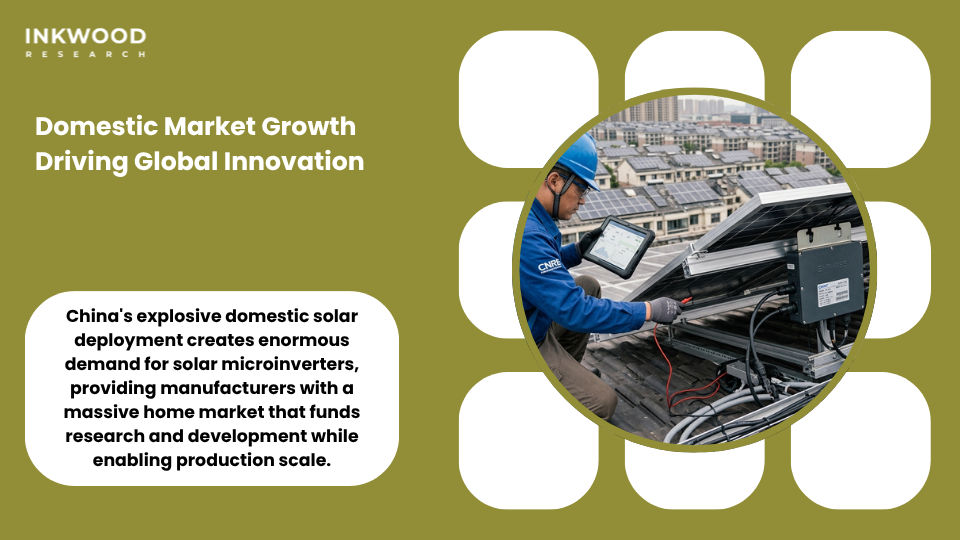
China’s explosive domestic solar deployment creates enormous demand for solar microinverters, providing manufacturers with a massive home market that funds research and development while enabling production scale. According to China’s National Energy Administration, the country added 315 gigawatts of solar capacity in 2025 alone, bringing cumulative installations above 1,200 gigawatts.
This deployment pace dwarfs other markets—more solar capacity came online in China during 2025 than exists in total across most developed nations—creating sustained demand that justifies continuous manufacturing investment. Moreover, it also enables producers to refine technologies through real-world installations before targeting export markets.
Consequently, Chinese solar microinverter manufacturers test innovations at scale domestically, gathering performance data from millions of installed units across diverse climate zones and grid conditions. These insights inform product improvements and create competitive advantages when refined technologies enter international markets where installation bases remain smaller and learning cycles consequently longer.
Residential Rooftop Adoption in China Solar Microinverter Market
Chinese residential solar installations increasingly favor distributed generation configurations where solar microinverters deliver clear advantages over traditional string inverter systems. Particularly, this is evident in urban environments where rooftop orientations vary and shading from adjacent buildings creates performance challenges.
Government incentive programs encourage homeowners to install solar through feed-in tariffs and simplified grid connection procedures, while manufacturers develop products specifically optimized for Chinese residential electrical systems and grid requirements. Meanwhile, the growing Chinese middle class demonstrates increasing environmental awareness and willingness to invest in clean energy technologies, creating organic demand that complements policy-driven installations.
As a result, this residential market segment particularly values the panel-level monitoring capabilities that solar microinverters provide, as homeowners actively track their energy production through smartphone applications and optimize their consumption patterns. Accordingly, behaviors that differ from markets where residential solar adoption remains primarily financially motivated rather than reflecting genuine consumer interest in energy management.
Commercial and Industrial Solar Microinverter Applications
Chinese commercial buildings and industrial facilities deploy solar at remarkable rates, driven by electricity cost considerations and corporate sustainability commitments that increasingly influence business decisions. Plus, factory rooftops across China’s manufacturing heartland now feature extensive photovoltaic installations, many utilizing solar microinverters to optimize production despite complex roof geometries and equipment that creates shading patterns.
Furthermore, China’s rapid urbanization generates constant construction of commercial buildings where solar integration happens from the design phase rather than as retrofits, enabling optimized system configurations that maximize solar microinverter advantages. The scale of this commercial deployment creates feedback loops where installation experiences inform manufacturer product development, and contractors develop specialized expertise in microinverter installation techniques.
On the other hand, ecosystem partners, including monitoring software providers and maintenance companies, build businesses around distributed solar architectures that further accelerate market adoption through improved service availability and competitive pricing for installation and ongoing support.
Vertical Integration Strategies Reshaping Supply Chains
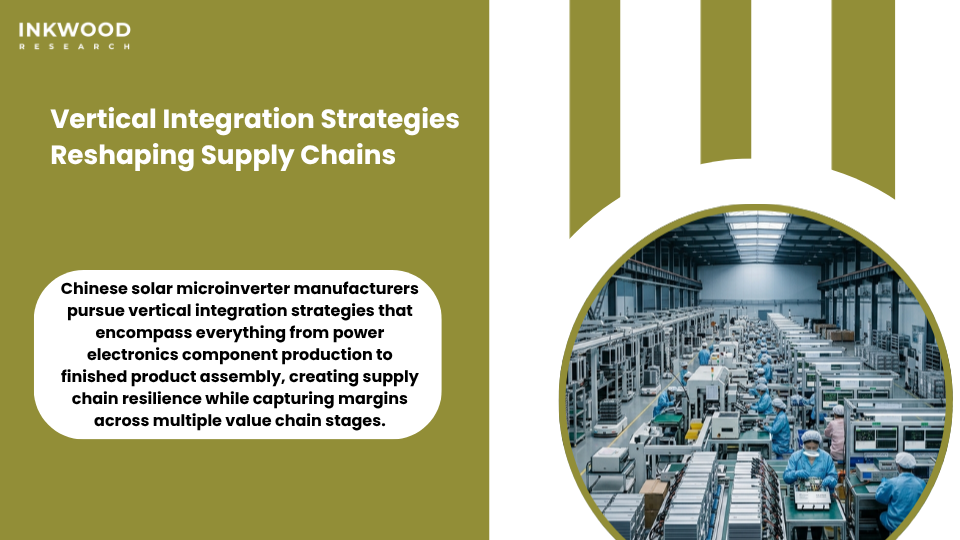
Chinese solar microinverter manufacturers pursue vertical integration strategies that encompass everything from power electronics component production to finished product assembly, creating supply chain resilience while capturing margins across multiple value chain stages.
Companies invest in semiconductor fabrication facilities that produce the specialized chips required for power conversion, aluminum extrusion plants that manufacture housing components, and printed circuit board assembly operations that integrate electronic components onto boards designed in-house. Conversely, this integration strategy contrasts sharply with manufacturers in other regions, who typically source components from multiple suppliers and focus primarily on final assembly and quality control.
Moreover, vertical integration enables Chinese manufacturers to optimize designs across the entire product architecture rather than accepting constraints imposed by off-the-shelf components, resulting in solar microinverters that achieve better performance-per-dollar metrics through holistic engineering approaches that consider manufacturing efficiency alongside technical specifications.
Component Manufacturing Ecosystem in China Solar Microinverter Industry
The concentration of component suppliers around solar microinverter manufacturing hubs creates unique ecosystem advantages where innovation happens collaboratively between manufacturers and their suppliers. Specialized firms produce capacitors optimized for photovoltaic applications, while others focus on developing transformers or inductors that meet the specific requirements of power electronics used in renewable energy conversion.
These suppliers maintain close relationships with solar microinverter manufacturers, often co-developing components to meet evolving performance requirements or cost targets. Additionally, the geographic proximity of suppliers to manufacturers enables just-in-time inventory strategies that minimize working capital requirements while maintaining production flexibility to respond quickly to demand fluctuations.
Further, this clustered supplier network also facilitates knowledge transfer, as engineers move between companies, carrying technical expertise and design philosophies that gradually diffuse throughout the industry. They also raise the overall technical sophistication of the entire China solar microinverter manufacturing ecosystem.
Export Dynamics and International Market Penetration
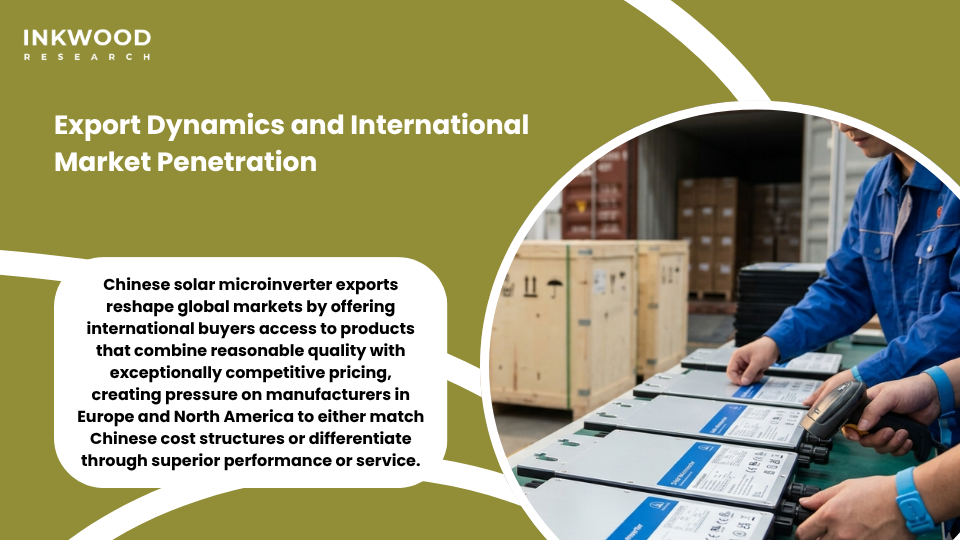
Chinese solar microinverter exports reshape global markets by offering international buyers access to products that combine reasonable quality with exceptionally competitive pricing, creating pressure on manufacturers in Europe and North America to either match Chinese cost structures or differentiate through superior performance or service.
Export-focused Chinese companies invest heavily in obtaining international certifications, including UL listings for North American markets and CE marking for European sales, demonstrating product compliance with varying safety and performance standards across different regions. Furthermore, Chinese exporters increasingly establish local sales and support operations in target markets, hiring native-language technical staff and creating regional inventory to provide faster delivery and improved customer service.
These localization efforts address historical weaknesses in Chinese manufacturers’ go-to-market strategies while maintaining the fundamental cost advantages that make their products attractive to price-sensitive customers in developing markets. Additionally, they are also appealing to mainstream buyers in developed economies who recognize that Chinese solar microinverters now offer reliability comparable to alternatives while maintaining significant price advantages.
Trade Considerations for China Solar Microinverter Exports
International trade policies increasingly scrutinize Chinese solar equipment imports, with various countries implementing tariffs or domestic content requirements designed to protect local manufacturing while pursuing renewable energy deployment goals. These trade barriers create complexity for Chinese exporters who must navigate varying regulatory frameworks across different markets, sometimes establishing manufacturing operations outside China to access markets where import restrictions prove prohibitive.
Nevertheless, the fundamental cost advantages of Chinese production often remain substantial even after tariff additions, meaning that Chinese solar microinverters continue flowing into international markets despite trade friction. Meanwhile, Chinese manufacturers respond to trade challenges by forming partnerships with international distributors who provide market access and local support, while Chinese companies focus on manufacturing efficiency and product development.
This creates hybrid business models that leverage Chinese production advantages while addressing market access challenges through strategic partnerships with established players in target markets who bring distribution networks and market knowledge to complement Chinese manufacturing capabilities.
Technology Development and Power Electronics Advancement
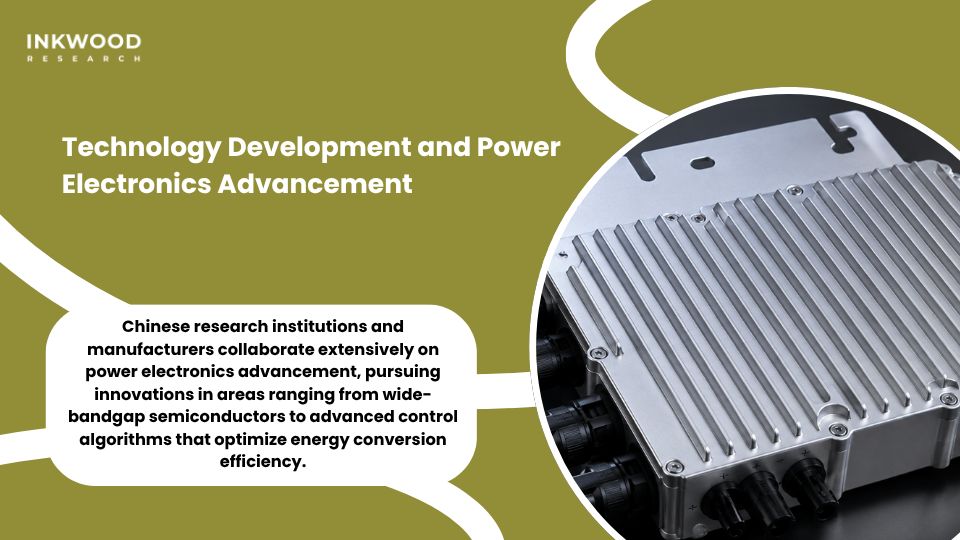
Chinese research institutions and manufacturers collaborate extensively on power electronics advancement, pursuing innovations in areas ranging from wide-bandgap semiconductors to advanced control algorithms that optimize energy conversion efficiency. Government funding supports basic research at universities while manufacturers invest in applied development that translates laboratory findings into commercial products, creating an innovation pipeline that moves discoveries from research to market relatively quickly compared to regions where academic research and commercial development remain more separated.
Moreover, China’s large domestic market enables manufacturers to deploy new technologies at scale, gathering real-world performance data that informs subsequent iterations and accelerates the refinement process from initial product launch to mature, optimized offerings. This rapid iteration cycle is enabled by domestic deployment scale and tight integration between research and manufacturing.
Furthermore, it also allows Chinese companies to move through technology learning curves faster than competitors in smaller markets where limited deployment constrains opportunities for gathering performance feedback and identifying optimization opportunities through systematic analysis of field data collected from diverse installations across varying operating conditions.
Efficiency Improvements in China Solar Microinverter Designs
Conversion efficiency gains represent a persistent focus for Chinese solar microinverter manufacturers, who recognize that even marginal improvements translate into meaningful competitive advantages when multiplied across millions of units. Engineers pursue efficiency through multiple approaches, including optimizing circuit topologies, selecting superior components, and refining control algorithms that minimize switching losses while maintaining stable output.
Additionally, thermal management innovations reduce operating temperatures that otherwise degrade component performance and system longevity, with manufacturers developing sophisticated heat sink designs and thermal interface materials that dissipate heat more effectively. These incremental improvements accumulate into products that now achieve conversion efficiencies exceeding 97%, approaching the theoretical limits imposed by physics. They also suggest that future gains will require more fundamental innovations rather than continued refinement of existing approaches.
Consequently, this shifts research focus toward emerging technologies. These include silicon carbide semiconductors and advanced magnetic materials, promising step-change improvements rather than gradual efficiency gains from conventional silicon-based power electronics.
Key Takeaways
- China dominates global solar microinverter manufacturing through integrated supply chains, massive production scale, and supportive government policies that create sustainable competitive advantages rather than temporary subsidies.
- The China solar microinverter market reached US$806.38 million in 2026, projecting growth to US$3,056.28 million by 2034, representing an 18.12% compound annual growth rate driven by domestic deployment and export expansion.
- Chinese manufacturers leverage vertical integration strategies that encompass component production through final assembly, enabling cost structures that international competitors struggle to match while maintaining reasonable quality standards that meet market requirements across diverse applications from residential rooftops to commercial installations.
- Domestic solar deployment creates massive demand that funds research and development while enabling production scale, with China adding 315 gigawatts of solar capacity in 2025, according to the National Energy Administration.
- This deployment pace creates feedback loops where manufacturers refine technologies through real-world installations before targeting export markets, accumulating performance data and operational insights that inform product improvements and create competitive advantages.
- Meanwhile, Chinese solar microinverter exports reshape international markets by offering competitive pricing that pressures manufacturers in other regions to either match Chinese costs or differentiate through superior performance, creating global market dynamics that increasingly favor Chinese producers even in developed economies where quality concerns historically limited Chinese market share.
Ready to navigate China’s influence on global solar microinverter markets?
Inkwood Research provides comprehensive market intelligence and strategic consultation services to help businesses understand supply chain dynamics and competitive positioning.
Contact our team to discuss how Chinese manufacturing trends impact your renewable energy procurement strategies and how to optimize sourcing decisions in an evolving global landscape where Chinese production capabilities continue expanding while international trade policies create ongoing complexity for procurement professionals and market strategists.
Frequently Asked Questions (FAQs)
China dominates solar microinverter manufacturing due to integrated supply chains, large-scale production capacity, and supportive government policies that strengthen cost competitiveness.
China’s solar microinverter market reached about US$806.38 million in 2026 and is projected to grow to US$3,056.28 million by 2034 at a CAGR of 18.12%, supported by strong domestic solar installations.
Chinese solar microinverters offer competitive pricing, efficient manufacturing, and improving product quality, making them attractive options for global solar system developers.
China’s extensive solar manufacturing ecosystem provides access to components, electronics supply chains, and skilled labor that support large-scale microinverter production.
Chinese companies are expanding internationally to capture growing solar markets while establishing regional service networks and distribution partnerships.
High production volumes, vertical integration, and advanced manufacturing efficiencies allow Chinese suppliers to maintain lower costs in global markets.