Table of Contents
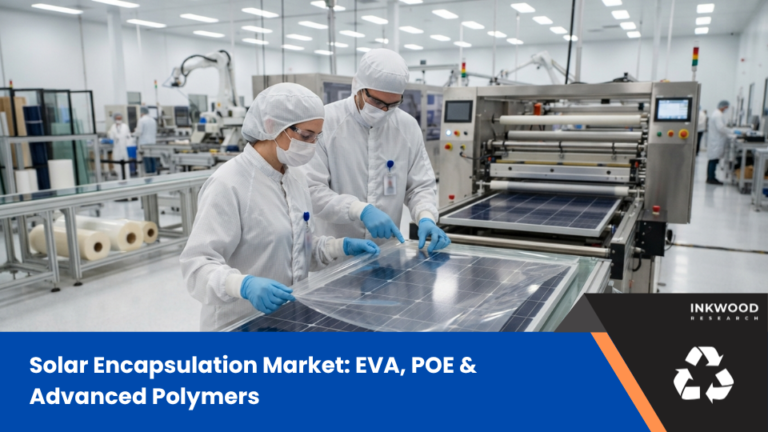
This analysis is brought to you by Inkwood Research, a leading market intelligence firm specializing in renewable energy technologies, photovoltaic module innovations, and advanced polymer applications. Our research team combines extensive experience analyzing solar encapsulation materials, crystalline silicon technologies, and sustainable energy solutions across global markets. Based on our proprietary research methodologies and strategic partnerships with solar manufacturers, material science researchers, and renewable energy associations, we deliver actionable insights that empower strategic decision-making for enterprises navigating the solar industry’s material evolution.
TLDR
Solar encapsulation materials protect photovoltaic cells while ensuring optimal light transmission. Traditional ethylene-vinyl acetate dominates current markets, though advanced polymers gain momentum. Polyolefin elastomers offer superior moisture resistance for next-generation modules. Thermoplastic polyurethane and polyvinyl butyral serve specialized applications. Meanwhile, crystalline silicon technology continues evolving alongside thin-film alternatives. Manufacturers balance performance requirements against cost pressures. Material innovation directly impacts module reliability and energy output. The global solar encapsulation market projects significant expansion through 2034.
Solar module manufacturers, material science researchers, renewable energy investors, photovoltaic technology developers, polymer engineers, sustainability executives, clean energy consultants, and supply chain managers will gain valuable insights into encapsulation material trends, performance characteristics, manufacturing innovations, and market dynamics shaping the solar industry’s material selection strategies and long-term technological roadmap.
What is Solar Encapsulation?
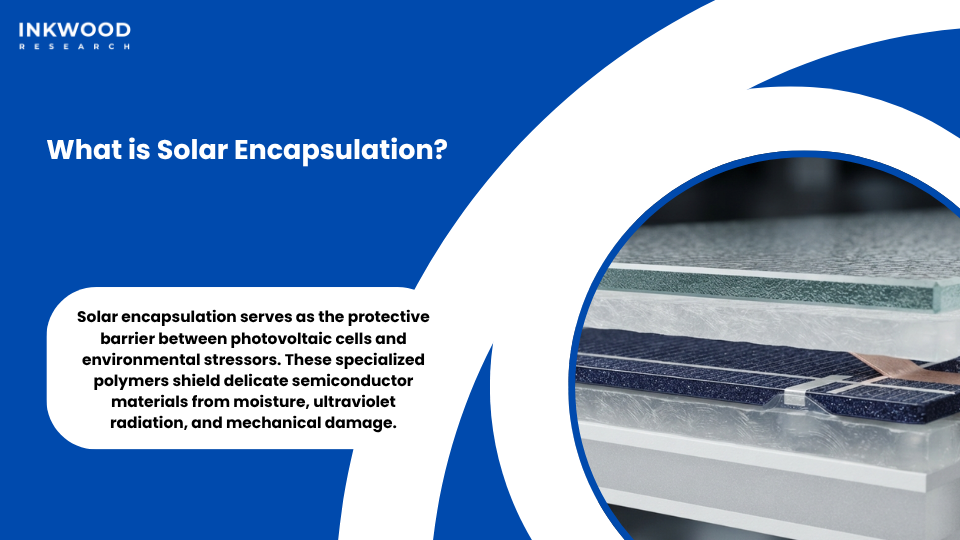
Solar encapsulation serves as the protective barrier between photovoltaic cells and environmental stressors. These specialized polymers shield delicate semiconductor materials from moisture, ultraviolet radiation, and mechanical damage. Moreover, encapsulants must maintain optical transparency throughout decades of outdoor exposure. The material selection directly influences module reliability, energy conversion efficiency, and overall system economics.
Material Performance Requirements for Solar Encapsulation
Photovoltaic modules operate under demanding conditions across diverse climates. Consequently, encapsulation materials must resist yellowing, delamination, and chemical degradation. According to research published in the IEA PVPS Task 13 report, module failures often trace back to encapsulant deterioration. Developers require materials balancing multiple competing factors.
Optical transmission remains paramount for maximizing energy output. Even minor reductions in light passage translate to significant power losses over time. Meanwhile, adhesion strength prevents delamination between glass, cells, and backsheet layers. Thermal stability enables operation across temperature extremes without material degradation. Chemical resistance protects against acetic acid formation and potential-induced degradation.
Crystalline Silicon and Thin-Film Technology Considerations
Different photovoltaic technologies demand tailored encapsulation approaches. Crystalline silicon modules, representing the industry’s dominant segment, typically employ dual-layer encapsulation. Thin-film solar technologies like cadmium telluride present unique requirements due to their manufacturing processes. Similarly, building-integrated photovoltaic applications necessitate specialized material properties for architectural integration.
The global solar encapsulation market reached $7.09 billion in 2026. Projections indicate growth to $13.43 billion by 2034, representing an 8.31% compound annual growth rate. This expansion reflects the broader renewable energy sector’s momentum and increasing photovoltaic deployment worldwide. Furthermore, material innovation continues to drive performance improvements and cost reductions.
EVA’s Continued Market Dominance Despite Challenges
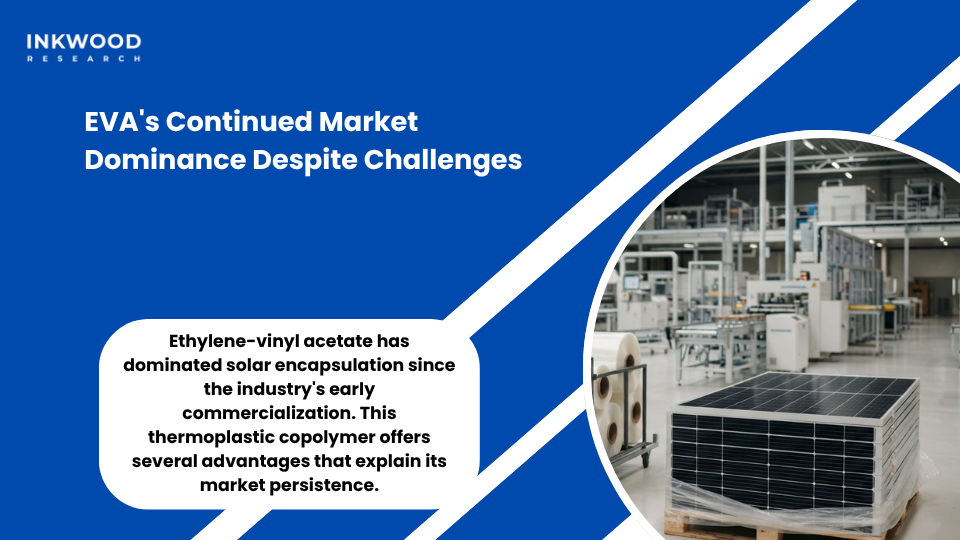
Ethylene-vinyl acetate has dominated solar encapsulation since the industry’s early commercialization. This thermoplastic copolymer offers several advantages that explain its market persistence. EVA exhibits excellent optical clarity in virgin form. Processing equipment for EVA lamination has become widely standardized. Additionally, material costs remain competitive compared to advanced alternatives.
Market Share Dynamics in the Global Solar Encapsulation Market
According to the China Photovoltaic Industry Association, EVA-based products maintained a 54% market share in 2024. However, this represents a gradual decline from previous years. Nevertheless, established manufacturing infrastructure favors continued EVA utilization. Lamination processes optimized for ethylene-vinyl acetate require significant capital investment to modify. Therefore, many producers hesitate to transition completely toward alternative materials.
Cost pressures throughout the solar supply chain amplify material selection sensitivity, and module prices fell below $0.10 per watt during 2024. Consequently, manufacturers scrutinize every component for potential savings. EVA’s established supply chains and competitive pricing create inertia against rapid material transitions. Yet performance limitations increasingly drive exploration of advanced polymers.
Addressing EVA’s Performance Limitations in Solar Encapsulation
Moisture permeability represents EVA’s primary weakness for photovoltaic applications. Water vapor transmission enables corrosion and electrical degradation within modules. Furthermore, acetic acid formation during degradation accelerates metal contact corrosion. These issues particularly impact humid climate deployments and floating photovoltaic installations where moisture exposure intensifies.
Ultraviolet exposure causes yellowing and reduced optical transmission over time. This degradation directly diminishes energy output throughout module lifespans. Research indicates traditional EVA formulations show measurable performance decline after 15-20 years. However, additive packages and improved formulations mitigate some degradation pathways. Stabilizer systems enhance long-term reliability but increase material costs proportionally.
POE Emergence in Advanced Module Architectures
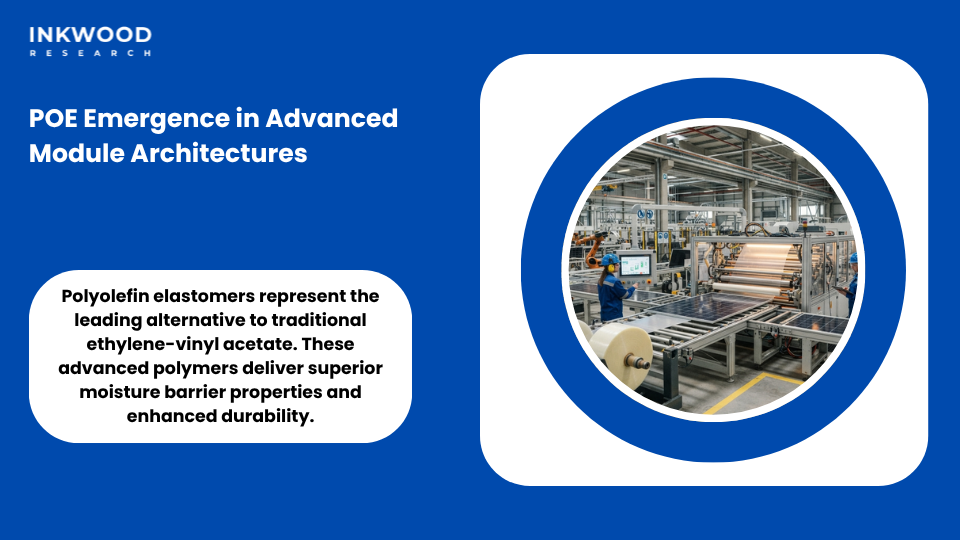
Polyolefin elastomers represent the leading alternative to traditional ethylene-vinyl acetate. These advanced polymers deliver superior moisture barrier properties and enhanced durability. POE materials particularly suit next-generation n-type solar cell technologies. Consequently, manufacturers increasingly adopt polyolefin encapsulation for premium product lines targeting long-term performance.
Technical Advantages Driving POE Adoption in Solar Encapsulation
Water vapor transmission rates for POE measure significantly lower than EVA equivalents. This characteristic proves crucial for preventing potential-induced degradation in high-voltage systems. Moreover, polyolefin materials exhibit superior resistance to acetic acid formation. Chemical stability reduces corrosion risks throughout extended operational periods. Volume resistivity remains higher, supporting better electrical isolation.
Ultraviolet stability surpasses conventional ethylene-vinyl acetate formulations. Polyolefin elastomers maintain optical transmission with minimal yellowing over decades. Therefore, energy output degradation proceeds more slowly compared to EVA-encapsulated modules. Field data increasingly validates POE’s performance advantages under real-world operating conditions. However, limited long-term deployment history compared to EVA creates some uncertainty.
Cost Considerations Limiting Widespread POE Deployment
Raw material costs for polyolefin elastomers substantially exceed ethylene-vinyl acetate pricing. This economic reality constrains rapid market transformation despite technical superiority. Additionally, processing requirements differ from established EVA lamination parameters. Equipment modifications and operator training represent additional transition barriers. Supply chain maturity lags behind EVA’s decades of infrastructure development.
Nevertheless, premium module manufacturers justify higher material costs through performance guarantees. Extended warranties and superior energy yields create value propositions offsetting initial expenses. Furthermore, bifacial module designs benefit substantially from POE’s enhanced moisture protection. According to industry data, bifacial modules represented 77.6% of Chinese crystalline silicon production in 2024. This architectural trend accelerates demand for advanced encapsulation materials.
EPE Laminates Balancing Performance and Economics
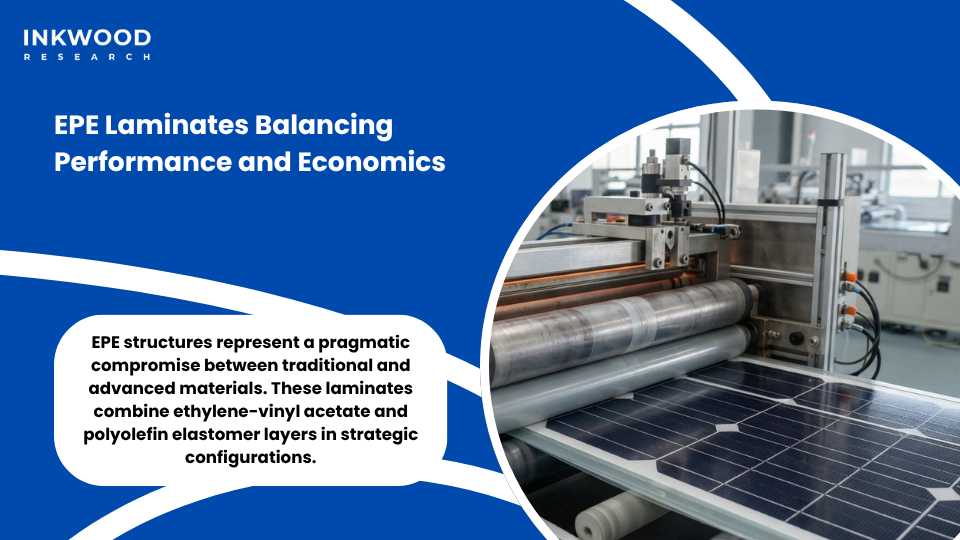
EPE structures represent a pragmatic compromise between traditional and advanced materials. These laminates combine ethylene-vinyl acetate and polyolefin elastomer layers in strategic configurations. The EVA-POE-EVA architecture places moisture-sensitive materials between protective POE barriers. Consequently, manufacturers achieve improved performance without fully transitioning to polyolefin encapsulation.
Market Adoption Trends for EPE Solar Encapsulation
EPE laminate market share grew from 28% in 2023 to 37% in 2024. This rapid adoption reflects the structure’s balanced value proposition. Module producers reduce material costs compared to full POE encapsulation while improving moisture protection versus pure EVA. Processing compatibility with existing equipment facilitates easier technology transitions. Furthermore, supply chain development for EPE materials has accelerated rapidly.
Different layer thickness ratios enable customization for specific applications. Some manufacturers emphasize moisture protection for humid climates through thicker POE layers. Others optimize cost structures for drier environments with minimal POE content. This flexibility supports diverse market segments and geographic requirements. Material suppliers continue developing optimized formulations for various performance targets.
Performance Validation and Long-Term Reliability
Field testing increasingly validates EPE laminate performance across diverse climates. Accelerated aging studies suggest improved durability compared to traditional EVA. However, the material combination requires careful interface engineering to prevent delamination. Adhesion between EVA and POE layers demands precise processing control. Lamination temperature profiles must account for different material properties and curing characteristics.
Ongoing research explores optimal layer configurations for specific cell technologies. N-type solar cells particularly benefit from EPE’s enhanced electrical isolation properties. Meanwhile, p-type architectures may achieve sufficient performance with EVA-dominated structures. The technology crystalline silicon interface continues evolving alongside encapsulation material development. Manufacturers must synchronize material selection with broader module design strategies.
Alternative Materials for Specialized Applications
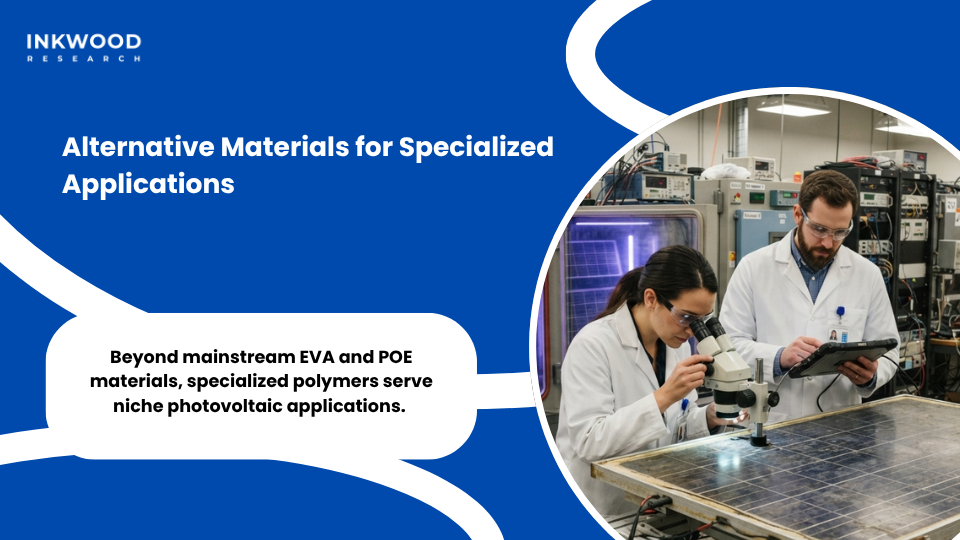
Beyond mainstream EVA and POE materials, specialized polymers serve niche photovoltaic applications. Thermoplastic polyurethane offers exceptional mechanical properties for flexible modules. Polyvinyl butyral provides proven automotive lamination expertise, translating to building-integrated photovoltaic systems. Additionally, emerging materials like polydimethylsiloxane and ionomers address specific technical challenges.
Thermoplastic Polyurethane for Flexible Solar Encapsulation
TPU materials excel in applications requiring mechanical flexibility and impact resistance. Lightweight photovoltaic modules benefit from thermoplastic polyurethane’s resilience. Mobile solar applications, portable power systems, and curved architectural installations utilize TPU encapsulation. Moreover, the material maintains performance across wide temperature ranges. Chemical resistance surpasses standard ethylene-vinyl acetate formulations.
Processing complexity and higher costs limit widespread TPU adoption. Furthermore, optical properties require careful formulation to match EVA’s transmission characteristics. Nevertheless, premium applications justify material expenses through enhanced functionality. Research continues to optimize thermoplastic polyurethane formulations specifically for thin-film solar technologies. Material development focuses on reducing yellowing and improving long-term stability.
Polyvinyl Butyral Applications in Building-Integrated Photovoltaic
PVB brings decades of automotive and architectural glazing experience to photovoltaic applications. This heritage ensures proven durability and safety characteristics. Building-integrated photovoltaic installations particularly benefit from polyvinyl butyral’s established performance record. Acoustic damping properties provide additional value in architectural contexts. Furthermore, PVB enables seamless integration with standard glass lamination processes.
Moisture sensitivity represents PVB’s primary limitation for solar applications. The material requires edge sealing to prevent water ingress and delamination. Additionally, processing temperatures differ from EVA-optimized equipment. Cost structures favor polyvinyl butyral for premium architectural products rather than utility-scale deployments. Nevertheless, specialized applications continue driving PVB development for photovoltaic markets.
Glass Thickness Trends and Reliability Considerations
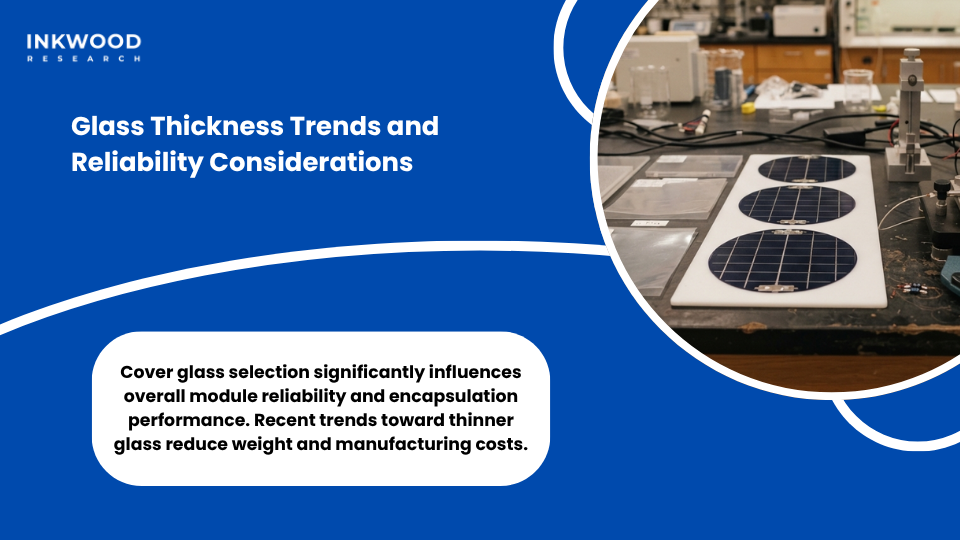
Cover glass selection significantly influences overall module reliability and encapsulation performance. Recent trends toward thinner glass reduce weight and manufacturing costs. However, mechanical protection and impact resistance decline correspondingly. This tradeoff creates ongoing debate within the solar industry regarding optimal specifications. Encapsulation materials must adapt to evolving glass configurations.
Industry Migration Toward Thinner Glass Substrates
Traditional 3.2mm glass has given way to 2.0mm alternatives in cost-sensitive markets. This reduction delivers immediate material savings and lighter modules. Transport logistics benefit from reduced weight in large-scale installations. Furthermore, thinner glass potentially enables larger module formats. Manufacturing efficiency improves through faster processing cycles. Nevertheless, reliability concerns temper enthusiasm for aggressive thickness reduction.
According to field incident data, modules using 2.0mm glass exhibit higher breakage rates under hail impact. Conversely, 3.2mm glass demonstrates superior durability during severe weather events. This performance difference particularly matters in hail-prone regions. Insurance considerations and warranty obligations influence glass selection beyond initial cost calculations. Long-term reliability increasingly factors into specification decisions.
Encapsulation Interaction with Glass Configuration
Thinner glass places greater stress on encapsulation adhesion during thermal cycling. Differential expansion between materials intensifies with reduced glass rigidity. Therefore, encapsulant properties become more critical in thin-glass designs. Adhesion promoters and improved formulations compensate for mechanical vulnerability. Material development increasingly focuses on enhanced bonding strength.
Edge seal integrity gains importance as glass thickness decreases. Moisture ingress pathways multiply with compromised structural rigidity. Consequently, advanced encapsulation materials like POE offer advantages in thin-glass architectures. The synergy between glass specification and encapsulant selection demands integrated optimization. System-level engineering replaces component-focused development approaches.
Market Projections and Investment Opportunities
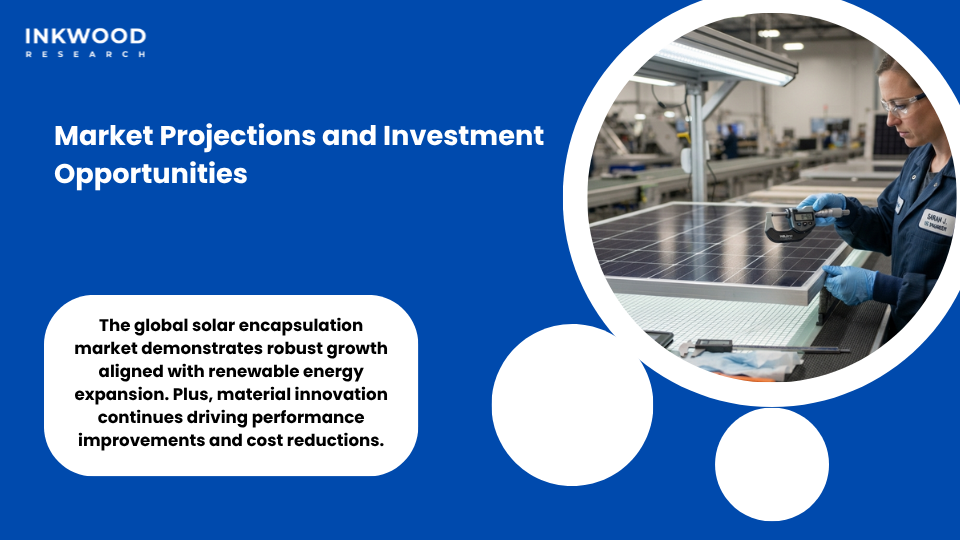
The global solar encapsulation market demonstrates robust growth aligned with renewable energy expansion. Plus, material innovation continues driving performance improvements and cost reductions. Investment opportunities span material development, manufacturing capacity, and application engineering. Strategic positioning requires understanding regional dynamics and technological trajectories.
Regional Market Dynamics in Solar Encapsulation
Asia-Pacific dominates both photovoltaic manufacturing and encapsulation material production. China’s integrated supply chains deliver cost advantages across the value chain. However, diversification trends support growth in Southeast Asia and India. European markets emphasize premium materials and long-term performance guarantees. Meanwhile, North American developments focus on domestic supply chain resilience and advanced technologies.
Emerging applications create differentiated market segments beyond traditional ground-mounted installations.
- Floating photovoltaic systems demand enhanced moisture resistance, driving POE adoption.
- Building-integrated photovoltaic installations require specialized materials meeting architectural standards.
- Agricultural photovoltaic configurations present unique environmental exposures.
Each application segment rewards tailored material solutions.
Technology Development Roadmap for Solar Encapsulation
Research priorities include recyclability, reduced environmental impact, and enhanced performance. Circular economy principles increasingly influence material selection and product design. Furthermore, processing innovations aim to reduce lamination energy consumption. Automated quality control systems improve consistency while reducing labor requirements. Data analytics optimize formulations for specific performance targets.
Perovskite solar cell commercialization will demand new encapsulation approaches. These emerging technologies present different stability challenges than crystalline silicon. Similarly, tandem cell architectures require materials compatible with multiple semiconductor layers. Material suppliers investing in next-generation photovoltaic compatibility position advantageously. The technology crystalline silicon interface continues evolving alongside new cell architectures.
Key Takeaways
- Solar encapsulation materials critically influence photovoltaic module reliability and performance. Ethylene-vinyl acetate maintains market dominance through established infrastructure and competitive costs.
- However, polyolefin elastomers gain share in premium applications requiring superior moisture resistance. EPE laminates offer balanced solutions combining performance improvements with economic viability.
- Alternative materials like thermoplastic polyurethane and polyvinyl butyral serve specialized niches. Building-integrated photovoltaic and flexible applications benefit from material diversity.
- Meanwhile, glass thickness trends toward reduction, creating new encapsulation challenges. Material development must address reliability concerns in thin-glass architectures.
- The global solar encapsulation market projects substantial growth through 2034. Regional dynamics, application diversity, and technology evolution create differentiated opportunities.
- Investment in advanced materials and processing capabilities positions suppliers for long-term success. Renewable energy expansion ensures sustained demand for innovative encapsulation solutions.
Conclusion
Material innovation drives continuous improvement in solar module reliability and efficiency. Traditional ethylene-vinyl acetate faces competitive pressure from advanced polymers offering superior performance. Market dynamics balance cost sensitivity against long-term reliability requirements. Consequently, diverse material solutions serve different market segments and applications.
Polyolefin elastomers represent the leading alternative for premium modules. EPE laminates provide pragmatic compromises enabling gradual technology transitions. Furthermore, specialized materials address niche requirements in building-integrated photovoltaic and flexible systems. Glass thickness trends complicate encapsulation engineering but create opportunities for enhanced formulations.
The global solar encapsulation market’s projected growth reflects renewable energy’s expanding role. Technology development roadmaps emphasize sustainability, recyclability, and next-generation photovoltaic compatibility. Stakeholders investing in material science and manufacturing capabilities will capture growing market opportunities. Based on our analysis, encapsulation innovation remains central to photovoltaic industry advancement.
For organizations seeking deeper insights into solar encapsulation markets or material selection strategies, Inkwood Research offers comprehensive market intelligence and consulting services. Contact our team to explore how these trends align with your strategic objectives.
Frequently Asked Questions (FAQs)
Polyolefin elastomers offer superior moisture resistance, prevent acetic acid formation, and maintain higher optical transmission compared to EVA encapsulants, improving long-term solar module reliability.
EPE laminates combine EVA and POE layers to improve moisture protection and durability while maintaining lower material costs than full POE encapsulation.
Thinner glass increases mechanical stress on encapsulation materials during temperature changes and can raise the risk of module damage under severe weather conditions.
Encapsulation materials protect photovoltaic cells from moisture, UV radiation, and mechanical stress, significantly influencing solar panel lifespan and performance stability.
Advanced materials such as POE and EPE improve module reliability, reduce degradation risks, and support the long-term performance requirements of modern high-efficiency solar panels.
Manufacturers consider moisture resistance, optical transmission, adhesion strength, cost efficiency, and compatibility with module design when selecting encapsulation materials.