Table of Contents
This analysis is brought to you by Inkwood Research, a leading market intelligence firm specializing in Middle East energy transition strategies, lithium processing technologies, battery recycling infrastructure development, and Gulf Cooperation Council industrial diversification programs. Our research team combines extensive experience analyzing Saudi Arabia’s Vision 2030 initiatives, battery supply chain economics, critical minerals processing, and regional automotive manufacturing ecosystems across the Middle East and North Africa. Based on our proprietary research methodologies and strategic partnerships with Gulf industrial developers, battery technology providers, lithium processors, and renewable energy organizations, we deliver actionable insights that empower strategic decision-making for global enterprises navigating Middle East battery recycling opportunities and critical materials markets.
TLDR
Saudi Arabia transforms from an oil economy to a battery supply chain powerhouse through strategic lithium processing investments and EV battery recycling infrastructure. The kingdom became the first Middle Eastern nation to establish battery-processing capacity in 2021 through partnerships with EV Metals Group. The Saudi Arabia battery recycling market reached US$172.51 million in 2026, projected to grow to US$460.12 million by 2034 at a remarkable 13.05% CAGR. Meanwhile, the country develops domestic EV manufacturing, targeting 500,000 vehicles annually by 2030.
Middle East energy transition strategists evaluating battery industry opportunities, automotive manufacturers exploring regional supply chain partnerships, lithium processing investors assessing Gulf Cooperation Council markets, sustainability consultants advising on critical mineral sourcing, battery recycling entrepreneurs identifying emerging market entry points, and government policymakers developing circular economy frameworks will discover strategic insights here. Additionally, international mining companies and technology providers seeking Middle Eastern partnerships benefit from this analysis.
Saudi Arabia’s Strategic Pivot to Battery Supply Chain
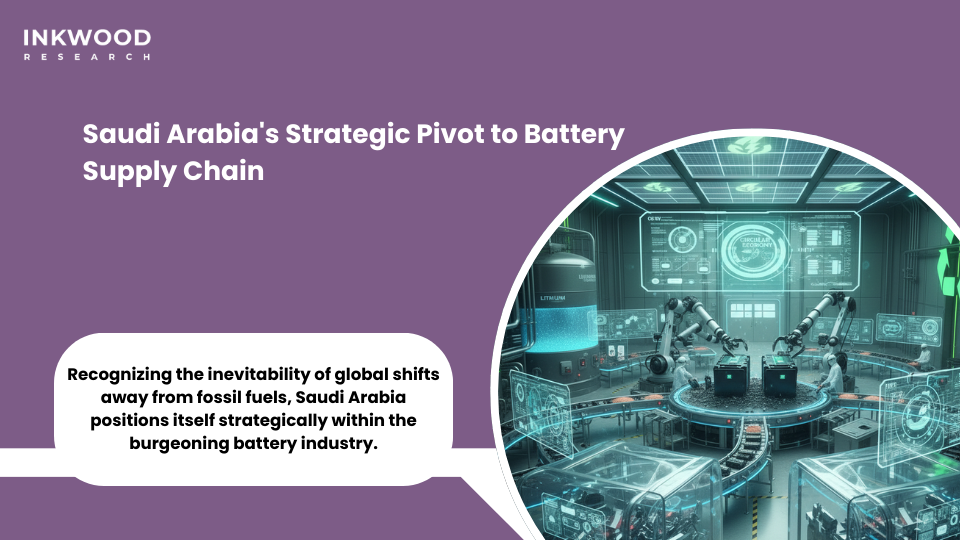
The Saudi Arabia battery recycling market emerges as a cornerstone of the kingdom’s ambitious economic diversification strategy. Recognizing the inevitability of global shifts away from fossil fuels, Saudi Arabia positions itself strategically within the burgeoning battery industry. This transition represents more than simple hedging against oil market volatility. Rather, it constitutes a comprehensive transformation leveraging existing industrial capabilities.
Together, developments across lithium processing, EV manufacturing, and recycling infrastructure set the stage for a “battery boom.” In fact, reports forecast a tenfold increase in global battery demand by 2030, primarily driven by rapidly expanding electric vehicle markets. This impending growth presents an array of economic opportunities that Saudi Arabia actively pursues.
Vision 2030 and Industrial Diversification
Saudi Arabia’s sovereign wealth fund, the Public Investment Fund (PIF), makes strategic investments in high-tech firms and partnerships with leading global battery manufacturers. Moreover, these investments create jobs, stimulate technological innovation, and usher in sustainable economic prosperity.
The kingdom’s Public Investment Fund created the Saudi Investment Recycling Company to improve recycling practices, including batteries and e-waste. This institutional framework demonstrates governmental commitment to developing circular economy infrastructure. Furthermore, it provides capital and strategic direction for nascent recycling sector development.
From Oil Wells to Power Cells
Battery manufacturing itself indicates a significant growth opportunity for the petrochemical industry, one of Saudi Arabia’s most developed non-oil sectors. The country ranks among the world’s largest producers of petrochemical products. Consequently, lithium-ion batteries require electrolytes, separators, and various chemical components that local petrochemical plants could produce.
By repurposing existing infrastructure, the kingdom capitalizes on established supply chains and technical expertise. This strategic advantage reduces capital requirements for battery chemical production. Additionally, it accelerates deployment timelines compared to building entirely new industrial capacity.
Lithium Processing Infrastructure Development
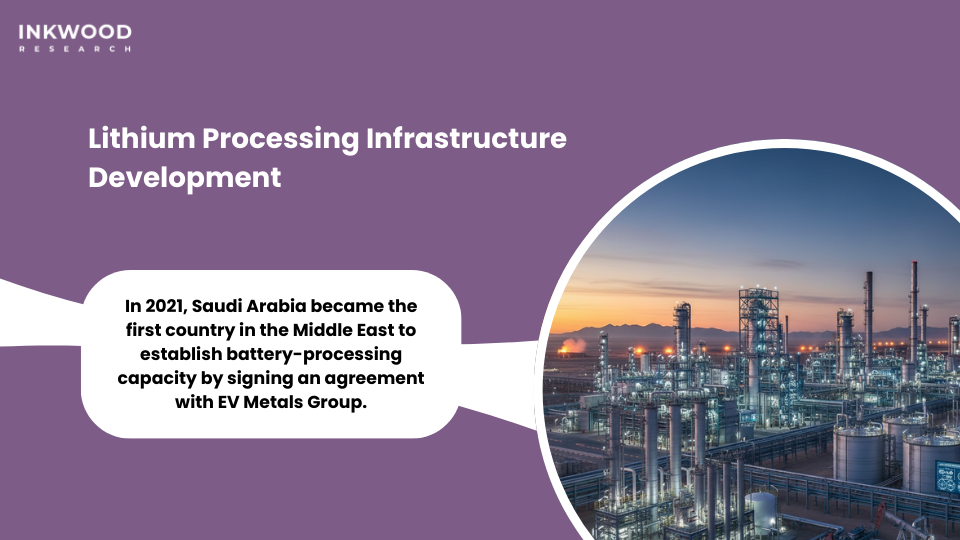
In 2021, Saudi Arabia became the first country in the Middle East to establish battery-processing capacity by signing an agreement with EV Metals Group. This groundbreaking partnership established a battery chemicals complex in Yanbu Industrial City. The facility processes lithium into battery-grade materials suitable for cathode and anode production.
Direct Lithium Extraction Innovation
Saudi Aramco and Abu Dhabi National Oil Company team up to extract lithium from oilfield brine, advancing Gulf states’ move into electric vehicle production. Direct Lithium Extraction (DLE) represents the latest method to extract lithium, involving multiple chemical processes to isolate lithium into saleable forms. Three main methods include adsorption, ion exchange, and solvent extraction.
Industry experts note the EV industry will likely depend on lithium for many years because cheaper battery technologies have yet to reach market maturity. Saudi Arabia’s oil wealth means it can afford to establish itself as an EV hub, utilizing whatever lithium it produces. Therefore, the kingdom develops integrated value chains from extraction through processing to manufacturing.
Battery-Grade Material Production
The lithium processing agreement positions Saudi Arabia strategically within global battery supply chains. Processing capacity transforms raw lithium into chemical compounds suitable for battery manufacturing. Specifically, facilities produce lithium carbonate and lithium hydroxide meeting international quality standards.
This processing capability reduces dependence on Asian suppliers, currently dominating battery chemical markets. Moreover, it creates regional supply security for emerging Middle Eastern EV manufacturers. Consequently, Saudi Arabia captures higher value-added activities within battery production ecosystems.
Critical Minerals Strategy
Saudi Arabia’s lithium vision extends beyond a single-commodity focus to a comprehensive critical minerals strategy. The kingdom explores opportunities in cobalt, nickel, and manganese processing alongside lithium development. These materials constitute essential battery components requiring secure, sustainable supply chains.
Partnerships with international mining companies provide access to mineral resources globally. Meanwhile, domestic processing infrastructure adds value to imported concentrates. This two-pronged approach diversifies revenue sources while building industrial capabilities.
EV Battery Recycling Market Dynamics
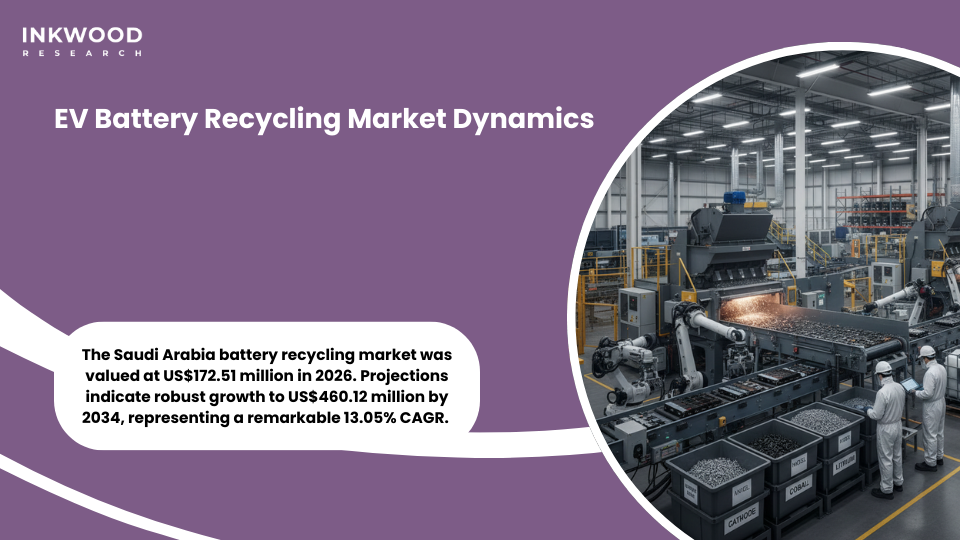
The Saudi Arabia battery recycling market was valued at US$172.51 million in 2026. Projections indicate robust growth to US$460.12 million by 2034, representing a remarkable 13.05% CAGR. This growth rate significantly exceeds global averages, reflecting the kingdom’s aggressive infrastructure development and policy support.
Market Drivers and Growth Catalysts
Saudi Arabia plays an essential role in the EV battery supply chain through its Lithium Processing Agreement and domestic manufacturing initiatives. In 2022, the Saudi EV brand Ceer was announced with the goals of producing 500,000 EVs by 2030. These efforts show the kingdom’s commitment to being a key player in the supply chain and lifecycle of EV batteries. This explosive growth reflects both increasing EV adoption and developing recycling infrastructure.
Governments in the region actively support growth through the construction of world-class facilities. The UAE produced its first commercial lithium-battery recycling plant at Automechanika Dubai 2024. This facility aims to process 5,000 tonnes of battery waste annually by the second quarter of 2027.
Supply and Demand Dynamics
Growing demand for lithium-ion batteries in electric vehicles and rising resource conservation through material recovery drive the Middle East market expansion. As EV adoption accelerates, end-of-life battery volumes increase proportionally. Therefore, recycling capacity must scale to match incoming waste streams.
Battery health diagnostic technologies remain crucial for determining optimal end-of-life pathways. Investment in research and development continues to improve these assessment methodologies. Subsequently, more batteries qualify for either second-life applications or efficient materials recovery.
Ceer Automotive: Domestic EV Manufacturing Vision
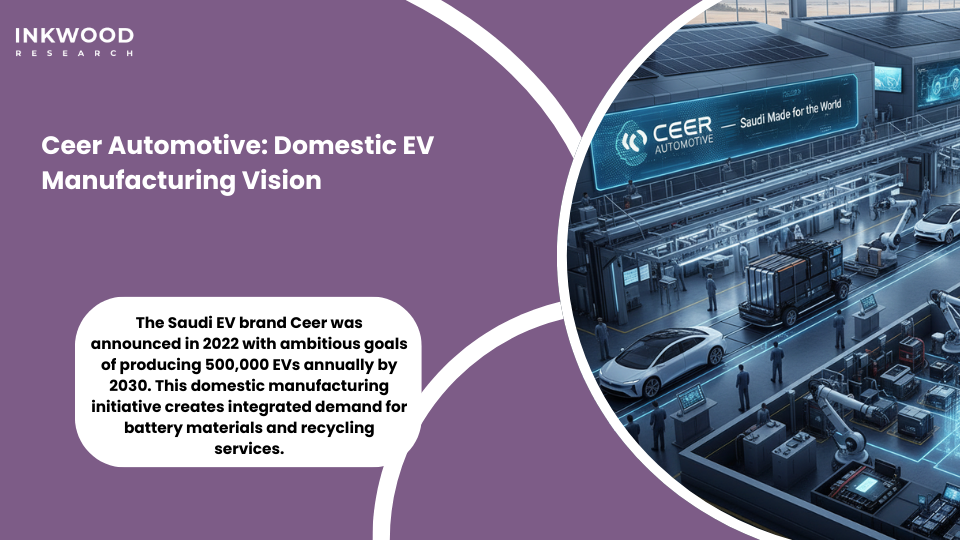
The Saudi EV brand Ceer was announced in 2022 with ambitious goals of producing 500,000 EVs annually by 2030. This domestic manufacturing initiative creates integrated demand for battery materials and recycling services. Moreover, it establishes Saudi Arabia as an automotive manufacturing hub within the Middle East region.
Vertical Integration Strategy
Ceer’s development follows a vertically integrated approach spanning battery sourcing, vehicle manufacturing, and end-of-life management. This comprehensive strategy ensures control over the entire value chain. Additionally, it creates opportunities for domestic suppliers across multiple industrial sectors.
The company partners with international automotive manufacturers and technology providers to access proven designs and production systems. Meanwhile, Saudi Arabia contributes capital, energy resources, and market access across Gulf Cooperation Council nations. Therefore, partnerships leverage complementary strengths.
Manufacturing Capacity Development
The Public Investment Fund is set to fund 500,000 EVs annually by 2030 through Ceer and related initiatives. This production volume requires substantial manufacturing infrastructure, including assembly plants, component suppliers, and logistics networks. Consequently, significant capital investments flow into industrial development projects.
Battery assembly facilities represent critical components of EV manufacturing ecosystems. Whether Saudi Arabia produces batteries domestically or imports completed packs affects recycling infrastructure requirements. Nevertheless, either approach generates end-of-life batteries requiring local processing capabilities.
Market Positioning
Saudi Arabia’s oil wealth allows it to establish itself as an EV hub, utilizing whatever lithium it produces domestically. The kingdom offers competitive energy costs, strategic geographic location, and growing regional markets. These advantages attract international automotive companies seeking Middle East manufacturing presence.
Moreover, Ceer targets both domestic Saudi consumers and export markets across the Gulf states. Regional EV adoption remains nascent but shows promising growth trajectories. Therefore, early manufacturing investments position Saudi Arabia advantageously for regional market leadership.
Recycling Technologies and Infrastructure Investments
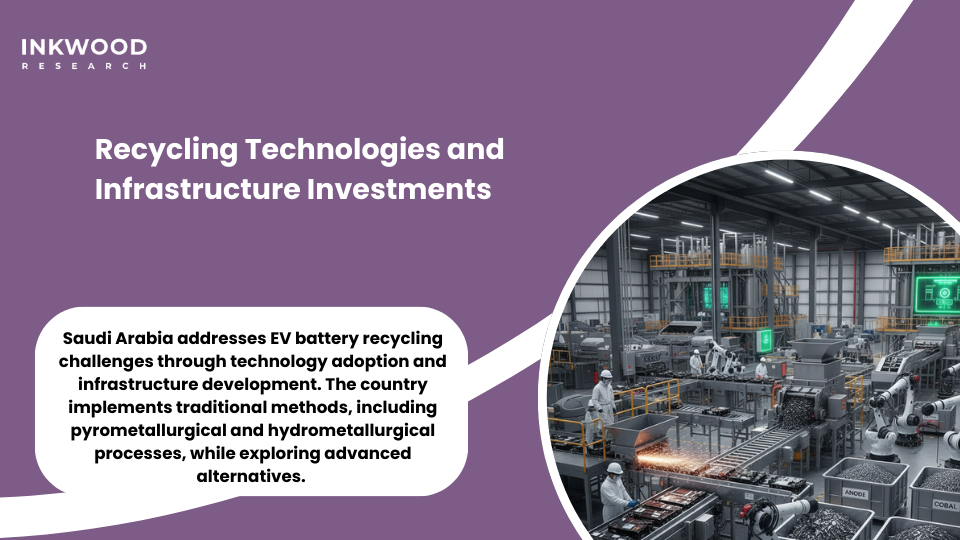
Saudi Arabia addresses EV battery recycling challenges through technology adoption and infrastructure development. The country implements traditional methods, including pyrometallurgical and hydrometallurgical processes, while exploring advanced alternatives. These investments establish a foundation for sustainable battery lifecycle management.
Pyrometallurgical Processing
Traditional pyrometallurgical methods involve high-temperature processing to extract valuable metals, including cobalt, nickel, and copper. These processes benefit from Saudi Arabia’s abundant energy supplies, making high-temperature operations economically viable. However, they also pose challenges regarding emissions and energy consumption.
Facilities must implement environmental controls to manage emissions from high-temperature processing. Additionally, pyrometallurgy typically recovers fewer material types than alternative methods. Nevertheless, the technology offers proven reliability for processing mixed battery streams.
Hydrometallurgical Advances
Hydrometallurgical processes utilize chemical solutions to extract metals, proving efficient and environmentally friendly when properly managed. These methods align with Saudi Arabia’s growing sustainability initiatives. Moreover, lower energy consumption compared to pyrometallurgy reduces operational costs.
Several companies investigate hydrometallurgical techniques in order to extract precious metals like lithium, cobalt, nickel, and manganese from worn-out batteries. Closed-loop supply chains assist circular economy objectives as reclaimed products feed back into battery manufacturing processes. Therefore, hydrometallurgy supports integrated recycling ecosystems.
Infrastructure Development Status
Currently, there is no concrete policy framework or systematic assessment addressing waste battery management in Saudi Arabia. This gap poses significant challenges for implementing sustainable solutions. However, the government recognizes these deficiencies and works toward comprehensive regulatory frameworks.
The study provides the first academic assessment of waste battery generation, policy initiatives, and management practices in Saudi Arabia. It aims to guide policymakers, government organizations, businesses, and academic researchers by offering management strategies and technology options. Subsequently, informed decisions accelerate infrastructure development.
Regional Comparison: Saudi Arabia vs. UAE Battery Initiatives
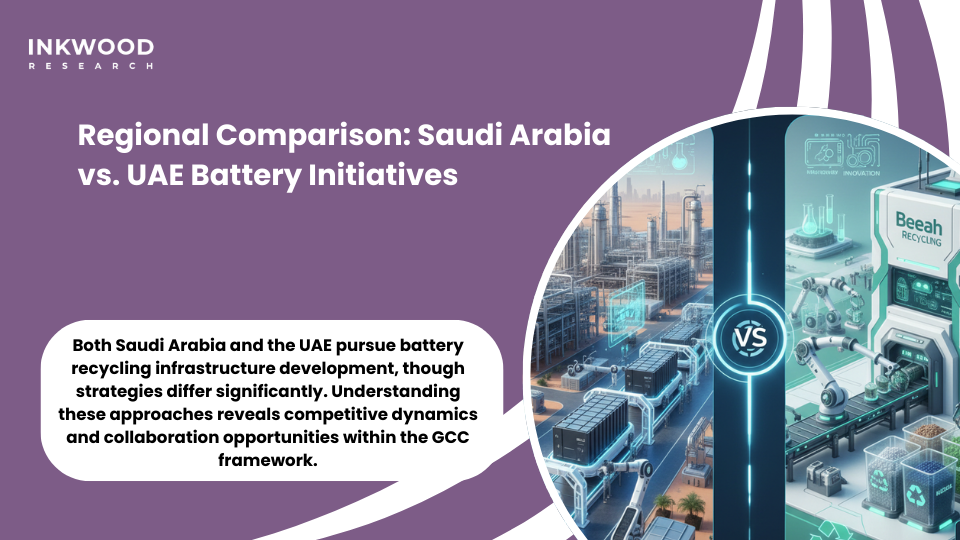
Both Saudi Arabia and the UAE pursue battery recycling infrastructure development, though strategies differ significantly. Understanding these approaches reveals competitive dynamics and collaboration opportunities within the GCC framework.
UAE’s Recycling Infrastructure
The UAE has taken significant steps toward establishing sustainable EV battery lifecycles through two main initiatives. The Beeah project, in collaboration with the Ministry of Energy and Infrastructure and the American University of Sharjah, plans to develop the first recycling plant for used EV batteries. This facility addresses regional recycling capacity gaps.
The second initiative involves Witthal Gulf Industries’ project partnering with Kezad Group to establish a lithium battery recycling plant. This facility will process 5,000 tons of battery waste annually. These efforts reduce greenhouse gas emissions and divert EV batteries from landfills, aligning with the UAE’s Net Zero by 2050 goal.
Comparative Market Analysis
Israel plays a pivotal role in the Middle East and Africa lithium-ion battery recycling markets, displaying robust dedication to advancing recycling processes. Through significant investment in research and development, Israel positions itself as an innovation leader. The country develops sustainable solutions for efficient reuse of lithium-ion battery materials.
Saudi Arabia focuses more heavily on upstream supply chain activities, including lithium processing and EV manufacturing. Conversely, the UAE emphasizes downstream recycling and waste management infrastructure. Therefore, complementary strategies create regional synergies rather than direct competition.
Collaboration Opportunities
The Middle East is increasing battery recycling job opportunities, and attractive compensation packages draw specialists from across the globe. This diverse talent drives sector growth and establishes the region as a battery recycling hotspot. Moreover, it supports circular economy goals and increases demand for experienced professionals.
Regional cooperation frameworks could accelerate infrastructure development while reducing costs. Shared research initiatives, technology transfer agreements, and coordinated policy development benefit all Gulf states. Additionally, unified approaches enhance competitiveness versus established Asian and European battery recycling hubs.
Challenges in Middle East Battery Recycling Development
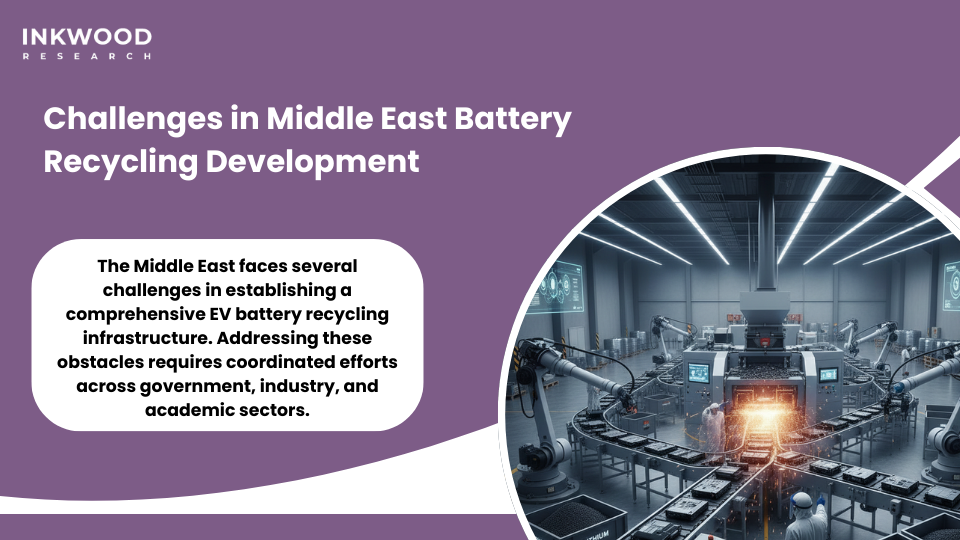
The Middle East faces several challenges in establishing a comprehensive EV battery recycling infrastructure. Addressing these obstacles requires coordinated efforts across government, industry, and academic sectors. Nevertheless, solutions emerge through technology adoption and policy development.
Technological Limitations
Some recycling methods require technologies and expertise still developing in the region. International technology providers must transfer knowledge and capabilities to local partners. This process takes time and requires sustained investment in workforce development and facility construction.
Moreover, diverse battery chemistries complicate standardization efforts. Different manufacturers use varying cathode materials, cell formats, and pack configurations. Therefore, recycling facilities must handle multiple battery types efficiently. Advanced sorting and processing technologies address this challenge.
Economic Feasibility Concerns
High costs of recycling processes discourage potential investors. Capital requirements for facility construction, equipment procurement, and technology licensing create significant barriers. Additionally, uncertain feedstock supplies in early market stages increase financial risks.
However, government incentives and subsidies can offset initial cost hurdles. The Saudi Investment Recycling Company provides a potential funding source for infrastructure projects. Furthermore, rising battery waste volumes improve long-term economic prospects.
Regulatory Framework Development
Policies and governance regulations remain in development and may lead to inconsistencies across the industry. Clear standards for battery collection, transportation, storage, and processing require establishment. Moreover, extended producer responsibility frameworks need definition and enforcement.
Jordan applies strict regulations on car battery disposal, ensuring all battery storage and collection sites are environmentally friendly. Similar frameworks could extend to lithium-ion batteries across the Gulf states. Therefore, regulatory harmonization supports regional market development.
Public Awareness Gaps
The public remains largely unaware of battery recycling importance. Consumer participation in collection programs depends on education and convenience. Marketing campaigns highlighting environmental and economic benefits can increase participation rates.
Additionally, automotive dealerships and service centers must implement a collection infrastructure. Training programs ensure proper handling of end-of-life batteries. Therefore, comprehensive awareness initiatives span multiple stakeholder groups.
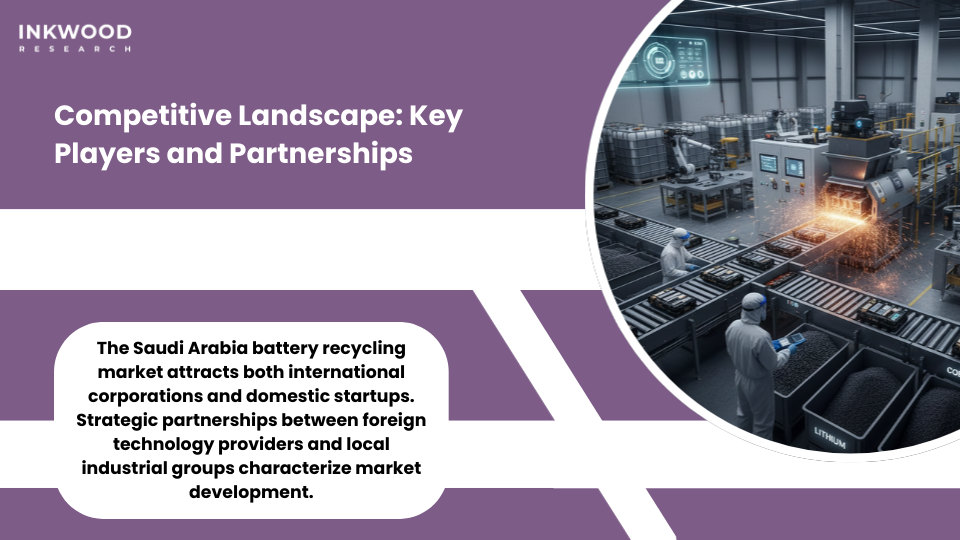
The Saudi Arabia battery recycling market attracts both international corporations and domestic startups. Strategic partnerships between foreign technology providers and local industrial groups characterize market development. These collaborations combine global expertise with regional resources.
International Technology Providers
ANDRITZ (Austria), Contemporary Amperex Technology Co., Limited (China), ECOBAT (U.K.), and GEM Co., Ltd. operate within the Middle East and Africa lithium-ion battery recycling markets. These established companies bring proven technologies and operational experience. Moreover, they provide technology licensing and facility development services.
CATL subsidiary companies explore regional opportunities given Saudi Arabia’s strategic importance within global battery supply chains. Partnerships with local entities facilitate market entry while navigating regulatory requirements. Therefore, joint ventures represent preferred investment structures.
Regional Players
Dubatt, based in Dubai, develops Middle East-specific recycling solutions. The company understands regional market dynamics, including climate considerations, logistics challenges, and regulatory environments. Local expertise proves valuable for adapting international technologies to regional conditions.
Saudi companies increasingly invest in battery recycling capabilities as market potential becomes apparent. These domestic players leverage existing industrial infrastructure and government connections. Additionally, they access favorable financing through national development programs.
Strategic Partnerships
In February 2023, CATL, Mercedes-Benz, and GEM signed an MOU to recycle cobalt, nickel, manganese, and lithium from Mercedes-Benz’s spent EV batteries. Materials will be repurposed into battery cathode materials. This partnership demonstrates international cooperation spanning automotive manufacturers, battery producers, and recycling specialists.
In March 2022, Retriev Technologies strengthened its lithium-ion battery recycling and logistics capabilities by acquiring Battery Solutions. This strategic move enhances the capacity to manage and recycle lithium-ion batteries effectively. Furthermore, it contributes to sustainable resource management, supporting green energy technologies.
Market Entry Strategies
Foreign companies typically partner with Saudi entities to navigate market complexities. These partnerships provide local market knowledge, regulatory expertise, and established business networks. Meanwhile, international partners contribute technology, capital, and operational know-how.
The PIF serves as a potential investment partner or customer for recycling infrastructure projects. Its involvement signals government support and reduces investment risks. Therefore, companies actively cultivate relationships with sovereign wealth fund representatives.
Policy Framework Supporting Battery Circular Economy
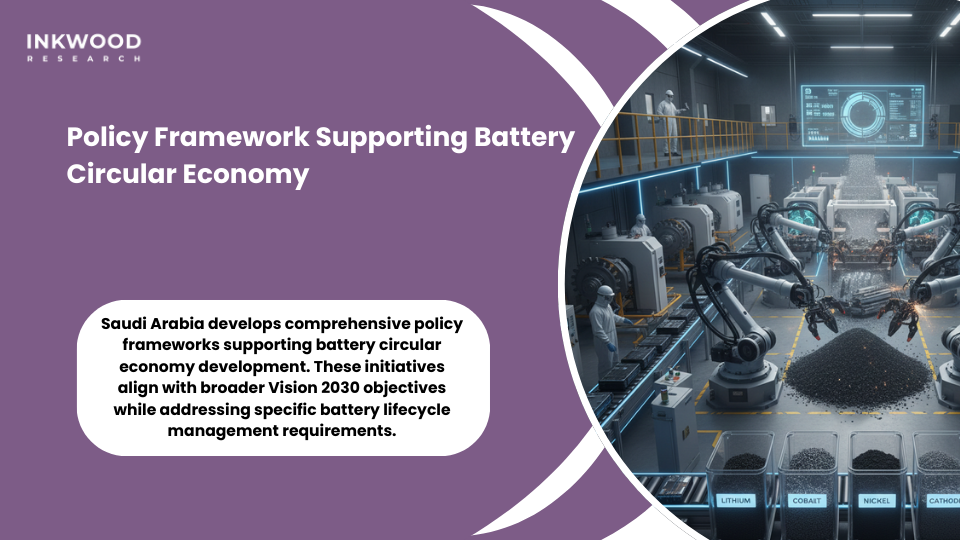
Saudi Arabia develops comprehensive policy frameworks supporting battery circular economy development. These initiatives align with broader Vision 2030 objectives while addressing specific battery lifecycle management requirements. Coordinated approaches across multiple government agencies ensure policy coherence.
Extended Producer Responsibility Development
Currently, there is no concrete policy framework or systematic assessment addressing waste battery management in Saudi Arabia. However, policymakers study international best practices, including the EU Battery Regulation and case studies from Switzerland’s INOBAT and Belgium’s BEBAT programs. These examples inform domestic regulation development.
Extended Producer Responsibility (EPR) programs make manufacturers responsible for end-of-life battery management. This approach incentivizes design-for-recycling while funding collection and processing infrastructure. Moreover, EPR aligns manufacturer interests with circular economy objectives.
Critical Minerals Security
Saudi Arabia recognizes battery materials as strategic resources requiring long-term supply security. Policies promote domestic processing capacity, reducing import dependence. Additionally, recycling infrastructure contributes to materials security by recovering valuable components from end-of-life batteries.
The kingdom explores international partnerships, securing access to upstream mineral resources. Meanwhile, domestic processing and recycling capabilities add value throughout battery lifecycles. Therefore, integrated strategies address both primary supply and secondary recovery.
Investment Incentives
Government incentives support battery recycling infrastructure development. Tax benefits, subsidized financing, and streamlined permitting processes reduce investment barriers. The Saudi Investment Recycling Company provides institutional support for qualifying projects.
Public-private partnerships leverage government resources alongside private sector efficiency. These structures share risks and rewards appropriately between partners. Moreover, they accelerate deployment timelines compared to purely governmental approaches.
Research and Development Support
Academic institutions receive funding to conduct battery recycling research addressing regional challenges. Universities collaborate with industry partners, testing technologies and training a skilled workforce. These programs build domestic expertise, reducing long-term technology dependence.
Several future research directions are suggested to foster interdisciplinary collaboration. Recommendations offer valuable guidance to academic researchers while supporting practical industry applications. Therefore, research initiatives bridge gaps between academic knowledge and commercial implementation.
Key Takeaways
- The Saudi Arabia battery recycling market demonstrates exceptional growth potential, projected to reach US$460.12 million by 2034 at a 13.05% CAGR. The kingdom became the first Middle Eastern nation to establish battery-processing capacity in 2021 through strategic partnerships with EV Metals Group. Additionally, Saudi Arabia develops domestic EV manufacturing targeting 500,000 vehicles annually by 2030 through the Ceer automotive brand.
- Lithium recovery capabilities position Saudi Arabia strategically within global battery supply chains. Direct lithium extraction from oilfield brine leverages existing petroleum industry expertise and infrastructure. Meanwhile, the battery chemicals complex in Yanbu Industrial City processes lithium into battery-grade materials suitable for manufacturing applications.
- Critical minerals recovery extends beyond lithium to a comprehensive strategy encompassing cobalt, nickel, and manganese processing. The Saudi Investment Recycling Company provides an institutional framework supporting infrastructure development. Moreover, government incentives and subsidies offset initial capital requirements for recycling facilities.
- Challenges persist, including technological limitations, economic feasibility concerns, regulatory framework development, and public awareness gaps. However, solutions emerge through international partnerships, technology transfer, and coordinated policy development. The study evaluating 49 global recycling companies provides a roadmap for Saudi implementation.
- Regional dynamics show complementary strategies between Saudi Arabia and the UAE. While Saudi Arabia focuses on upstream supply chain activities, the UAE emphasizes downstream recycling infrastructure. Therefore, Gulf Cooperation Council cooperation could accelerate regional battery circular economy development.
Conclusion:
Saudi Arabia’s transformation from an oil-dependent economy to battery industry participant represents strategic economic diversification. The kingdom leverages financial resources, industrial capabilities, and geographic advantages to establish positions across battery value chains. From lithium processing through EV manufacturing to recycling infrastructure, comprehensive strategies address multiple value chain segments.
The 13.05% CAGR for the battery recycling market significantly exceeds global averages, reflecting aggressive infrastructure development and policy support. Nevertheless, challenges remain, including technology gaps, regulatory uncertainties, and workforce development needs. Addressing these obstacles requires sustained commitment and international collaboration.
At Inkwood Research, we help organizations navigate Middle East battery industry opportunities through comprehensive market intelligence and strategic advisory services. Our experts analyze technology trends, regulatory developments, and competitive dynamics shaping Saudi Arabia’s battery recycling markets.
Contact our team to explore how Gulf region battery infrastructure development can enhance your supply chain strategies while supporting sustainability objectives and capturing high-growth market opportunities.
Frequently Asked Questions
What makes Saudi Arabia strategically important for battery recycling in the Middle East?
Saudi Arabia became the first Middle Eastern nation establishing battery-processing capacity in 2021, develops domestic EV manufacturing targeting 500,000 vehicles annually by 2030, and leverages petrochemical industry expertise for battery chemical production. These factors position the kingdom as a regional battery industry hub.
How does Saudi Arabia's battery recycling market growth compare to global averages?
Saudi Arabia’s battery recycling market grows at a 13.05% CAGR from 2026 to 2034, significantly exceeding the global average of 10.63%. This reflects aggressive infrastructure development, government policy support, and strategic focus on battery supply chain integration within Vision 2030 economic diversification objectives.
What are the main challenges facing battery recycling development in Saudi Arabia?
Key challenges include technological limitations requiring international expertise transfer, high capital costs discouraging investors, developing regulatory frameworks creating policy uncertainties, and limited public awareness affecting collection program participation. However, government support and international partnerships gradually address these obstacles.