Table of Contents
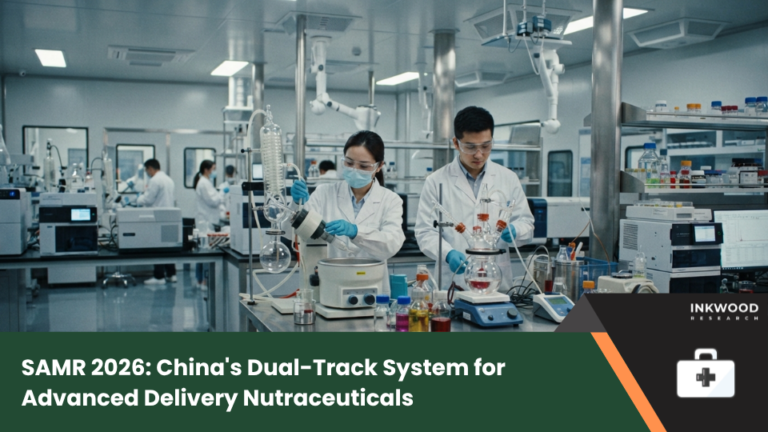
This analysis is brought to you by Inkwood Research, a leading market intelligence firm specializing in China’s regulatory landscape, the China advanced delivery nutraceuticals market, and Asia-Pacific food supplement compliance strategies. Our research team combines deep expertise in SAMR frameworks, health food registration pathways, and the evolving regulatory environment for advanced nutraceutical delivery technology in China. Through strategic partnerships with Chinese regulatory consultants, nutraceutical manufacturers, and trade bodies, we deliver actionable intelligence for enterprises navigating China’s nutraceutical sector.
TLDR
China’s State Administration for Market Regulation (SAMR) is implementing a pivotal dual-track regulatory framework in 2026 for advanced delivery nutraceuticals, separating registered health foods from general foods with functional claims. The China advanced delivery nutraceuticals market is projected to grow from US$15,625.32 million in 2026 to US$35,989.05 million by 2034 at a 10.99% CAGR. For global brands, understanding how this dual-track system governs nanoencapsulation, bioavailability claims, and novel nutraceutical carriers is essential to market entry and compliance success.
This blog is essential for nutraceutical executives and regulatory affairs professionals entering or operating in China. Furthermore, global brands developing advanced nutraceutical delivery systems, legal and compliance teams monitoring the China advanced delivery nutraceuticals market, and investors assessing regulatory risk in Asia-Pacific will benefit directly. R&D teams working on nanoencapsulation, liposomal delivery, and controlled release nutraceuticals for Chinese consumers will find the insights actionable and strategically timely.
What Is China’s SAMR 2026 Dual-Track System for Nutraceuticals?
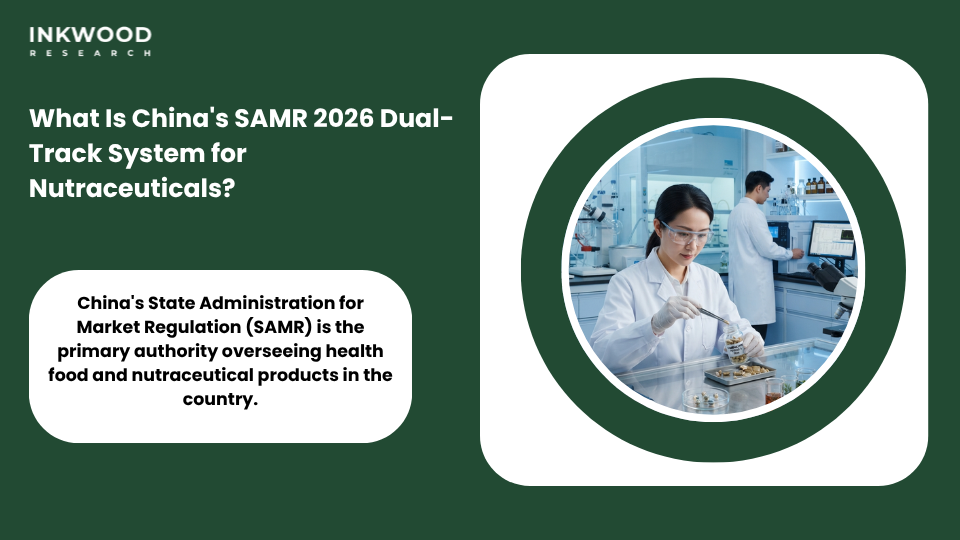
China’s State Administration for Market Regulation (SAMR) is the primary authority overseeing health food and nutraceutical products in the country. Its evolving dual-track framework distinguishes between two distinct product pathways, each with different evidence requirements, timelines, and claim boundaries that directly shape how the China advanced delivery nutraceuticals market operates.
Track One: Blue Hat Health Food Registration
The Blue Hat registration pathway (保健食品注册) applies to products making specific health function claims. Under this track, products undergo formal clinical evaluation and dossier review by SAMR. For companies in the advanced delivery nutraceuticals market, several important rules apply:
- Nanoencapsulation in nutraceuticals and liposomal nutraceutical delivery systems may require enhanced material safety documentation
- Approval timelines typically extend 24 to 36 months, making early strategic planning essential
- Bioavailability enhancement nutraceuticals that rely on novel delivery carriers face the most intensive regulatory scrutiny
- Clinical or preclinical data supporting efficacy claims must be generated before or during the dossier submission process
Track Two: General Food with Functional Claims
The second pathway allows certain foods with documented nutritional benefits to communicate functional attributes without full health food registration. This track is gaining significant relevance for the China advanced delivery nutraceuticals market because:
- It offers a faster commercialization route for functional nutraceuticals market growth products with well-established safety profiles
- Clean label delivery systems nutraceuticals with recognized ingredient safety are best positioned under this track
- SAMR has tightened substantiation requirements under Track Two to prevent unverified claims from proliferating
- Novel nutraceutical carriers market ingredients must still meet updated ingredient catalog requirements before proceeding
Furthermore, SAMR’s 2026 updates introduce mandatory disclosure requirements for certain ingredients involving nanotechnology in dietary supplements, adding a new layer of compliance planning for companies in the advanced nutraceutical delivery systems market size 2026 space.
How Does SAMR 2026 Affect the China Advanced Delivery Nutraceuticals Market?
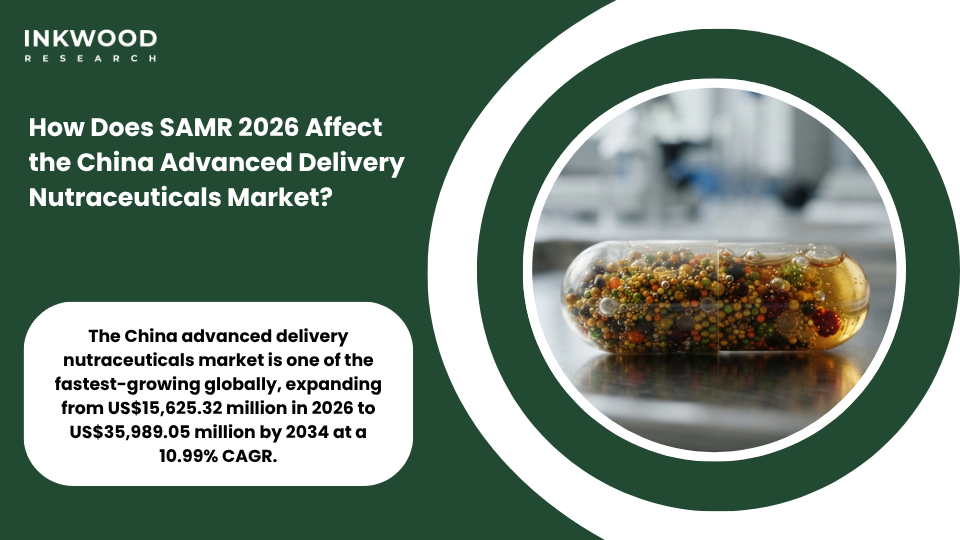
The China advanced delivery nutraceuticals market is one of the fastest-growing globally, expanding from US$15,625.32 million in 2026 to US$35,989.05 million by 2034 at a 10.99% CAGR. SAMR’s regulatory evolution has direct implications for product strategy, timelines, and competitive positioning.
Market Implications for Nanoencapsulation and Novel Carriers
Advanced delivery formats like solid lipid nanoparticles nutraceuticals, microencapsulation nutraceutical applications, and phytosome technology nutraceuticals occupy a genuinely complex regulatory space under SAMR’s updated framework. Specifically:
- Products relying on nanoencapsulation technology in nutraceuticals may require separate material safety assessments before review
- SAMR’s updated ingredient catalog determines whether novel carriers qualify for expedited or standard registration timelines
- Controlled release nutraceuticals market forecast models must now account for registration timeline variability under the dual-track system
- Pre-submission consultations with SAMR are increasingly recommended for any company bringing targeted nutraceutical delivery technologies to China
Bioavailability Claims Under Scrutiny
SAMR is focusing more closely on the substantiation behind bioavailability enhancement nutraceuticals. Under the 2026 framework, nutraceutical bioavailability enhancement technologies market trends are evolving in several important directions:
- Clinical or preclinical evidence supporting enhanced absorption claims is expected at the dossier stage for Track One submissions
- Advanced supplement absorption technologies lacking peer-reviewed validation face an elevated rejection risk under both tracks
- AI-generated bioavailability models, while useful internally, are not yet accepted as standalone regulatory evidence by SAMR
- Personalized nutraceutical delivery systems market insights must be backed by human-relevant data to support any health function claims
What Are the Compliance Challenges for Global Nutraceutical Companies?

Navigating SAMR’s framework presents a distinct set of challenges, particularly for international brands more familiar with FDA or EFSA standards. Understanding these pressure points in advance can meaningfully reduce market entry risk for the advanced delivery nutraceuticals market.
Documentation and Clinical Evidence Requirements
- Full ingredient traceability documentation is mandatory, covering origin, manufacturing process, and safety data for every component of advanced oral delivery systems nutraceuticals
- Innovative nutraceutical formulations involving new delivery carriers require China-specific safety data, even when equivalent evidence exists for other markets
- SAMR increasingly requests human clinical data rather than animal study extrapolations for personalized nutraceutical delivery systems market insights applications
- R&D teams must align nutraceutical R&D trends and investment opportunities planning with SAMR dossier requirements from the outset
Cross-Border E-Commerce and Labeling Rules
China’s cross-border e-commerce (CBEC) channel offers a faster market entry route but carries its own compliance obligations for the encapsulated nutraceuticals market:
- Products sold via CBEC must still comply with SAMR’s ingredient safety lists and catalog requirements
- Claims referencing bioavailability enhancement nutraceuticals require careful translation to avoid triggering Blue Hat registration obligations
- QR code traceability requirements on packaging apply to all functional nutraceuticals market growth products entering through CBEC channels
- Enforcement activity under SAMR has intensified, making pre-entry compliance audits a strategic necessity
Furthermore, brands targeting the China advanced delivery nutraceuticals market through digital channels should engage compliance specialists early to ensure that product descriptions and marketing materials do not inadvertently cross regulatory boundaries.
How Are Leading Companies Navigating the Dual-Track Framework?
Several major players in the advanced delivery nutraceuticals market are actively adapting their China strategies in response to SAMR’s evolving requirements. Their approaches offer instructive models for both domestic and international brands:
- By-Health Co., Ltd.: China’s largest domestic nutraceutical company is expanding its Blue Hat registered portfolio while developing general food functional products under Track Two, maximizing market coverage across both pathways.
- Amway China: Continues to leverage established Blue Hat registrations for core products while exploring Track Two for newer controlled release nutraceutical innovations, balancing speed with compliance robustness.
- Herbalife China: Has invested in reformulating certain products to meet SAMR’s updated ingredient standards, particularly around microencapsulation nutraceutical applications and clean label delivery systems.
- BASF and DSM-Firmenich: Are both working with Chinese manufacturing partners or through local approvals to develop compliant versions of their advanced nutraceutical ingredient portfolios, including delivery systems.
- Nestlé Health Science: Is navigating the dual-track system across its personalized nutrition product lines, investing in local clinical partnerships to build compliant evidence packages.
What Does the Future of China's Advanced Nutraceuticals Market Look Like?

The China advanced delivery nutraceuticals market will continue expanding significantly, underpinned by several structural trends that are independent of short-term regulatory complexity:
- Rising health awareness among China’s middle class is fueling demand for precision nutraceuticals market trends and science-backed products
- Government investment in preventive healthcare frameworks supports functional nutraceuticals market growth at the policy level
- SAMR’s ongoing regulatory refinement, while complex in the short term, ultimately creates a more credible and defensible market for compliant brands
- Growing adoption of smart nutraceutical delivery platforms and AI in nutraceutical formulation development within Chinese research institutions is accelerating innovation
- Domestic manufacturing capabilities for encapsulated nutraceuticals market ingredients are improving rapidly, reducing import dependence
Additionally, China’s national nutrition plan guidelines from the National Health Commission emphasize preventive nutrition approaches, creating a meaningful policy tailwind for evidence-based advanced nutraceutical delivery systems market size 2026 expansion. Brands that invest now in SAMR-compliant evidence packages and dual-track compliance infrastructure will consequently be best positioned to capture this growth.
Key Takeaways
- China advanced delivery nutraceuticals market grows from US$15,625.32 million in 2026 to US$35,989.05 million by 2034 at a 10.99% CAGR
- SAMR’s 2026 framework separates Blue Hat registered health foods from general food functional claims, requiring distinct strategies for each pathway
- Nanoencapsulation in nutraceuticals and other advanced delivery formats faces enhanced documentation and safety disclosure requirements
- Bioavailability enhancement nutraceuticals claims must be substantiated with clinical or preclinical data to satisfy SAMR’s 2026 standards
- By-Health, Amway China, Herbalife China, BASF, and DSM-Firmenich are all actively adapting to the dual-track framework with distinct approaches
- Pre-submission consultation with SAMR is essential for any company bringing novel nutraceutical carriers market products into the China advanced delivery nutraceuticals market
Conclusion:
China’s SAMR 2026 dual-track framework is meaningfully reshaping how global and domestic brands approach the China advanced delivery nutraceuticals market. Compliance complexity is real, but it is manageable for companies that invest in early regulatory planning and robust clinical evidence packages. The market’s 10.99% CAGR through 2034 represents a compelling opportunity, and navigating SAMR effectively is the key to capturing it.
Inkwood Research provides the regulatory intelligence, competitive analysis, and market insights needed to build a winning China strategy for your advanced delivery nutraceuticals market portfolio.
Connect with our team to explore how our analysis can support your entry or expansion in China’s nutraceutical sector.
Frequently Asked Questions
What is China's SAMR dual-track nutraceutical system?
SAMR’s dual-track system separates registered health foods (Blue Hat) from general foods with functional claims, each requiring distinct compliance strategies and evidence packages.
How large is the China advanced delivery nutraceuticals market in 2026?
China’s market is valued at US$15,625.32 million in 2026, growing to US$35,989.05 million by 2034 at a 10.99% CAGR, driven by health awareness and preventive nutrition demand.
What delivery technologies face the most SAMR scrutiny in 2026?
Nanoencapsulation, solid lipid nanoparticles, and novel nutraceutical carriers face the most intensive safety documentation requirements under SAMR’s updated 2026 framework.
Can global brands use cross-border e-commerce to avoid SAMR registration?
CBEC offers a faster entry route but still requires ingredient compliance and imposes strict labeling restrictions on bioavailability enhancement and health function claims.
How long does Blue Hat registration typically take in China?
Blue Hat registration typically takes 24 to 36 months, requiring early strategic planning, pre-submission consultation with SAMR, and comprehensive clinical evidence submission.
What role does AI play in SAMR compliance for nutraceuticals?
AI supports internal bioavailability modeling and formulation optimization, but is not currently accepted as standalone regulatory evidence by SAMR for advanced delivery nutraceuticals claims.