Table of Contents
This analysis is brought to you by Inkwood Research, a leading market intelligence firm specializing in European healthcare technology, artificial intelligence integration in medical diagnostics, and mobile imaging infrastructure development. Our research team combines extensive experience analyzing digital health transformation, government healthcare investments, and AI-driven diagnostic innovations across Poland, Central Europe, and the broader European Union. Based on our proprietary research methodologies and strategic partnerships with Polish healthcare institutions, medical technology providers, and European regulatory bodies, we deliver actionable insights that empower strategic decision-making for global enterprises navigating Poland’s healthcare modernization revolution.
TLDR
Poland’s mobile imaging services market stands poised for a remarkable transformation as government funding meets artificial intelligence innovation. The sector reached US$190.47 million in 2026 and projects growth to US$243.24 million by 2034, advancing at a steady 3.10% CAGR. Moreover, Poland’s National Reconstruction Plan allocates approximately USD 400 million by the end of 2026 specifically for AI-driven medical technologies. Furthermore, mobile diagnostic units are reshaping healthcare accessibility across urban centers and rural communities alike, creating unprecedented opportunities for diagnostic imaging providers.
Healthcare administrators, diagnostic imaging center operators, medical technology investors, and government healthcare officials will discover valuable strategic insights in this analysis. Additionally, radiologists exploring mobile service expansion, equipment manufacturers targeting Polish markets, and healthcare consultants advising European clients can leverage our research-backed recommendations. International investors evaluating Central European healthcare opportunities and policy makers designing diagnostic accessibility programs will also benefit from our comprehensive market intelligence on Poland’s evolving mobile imaging landscape.
Poland’s Healthcare Modernization Creates Mobile Imaging Momentum
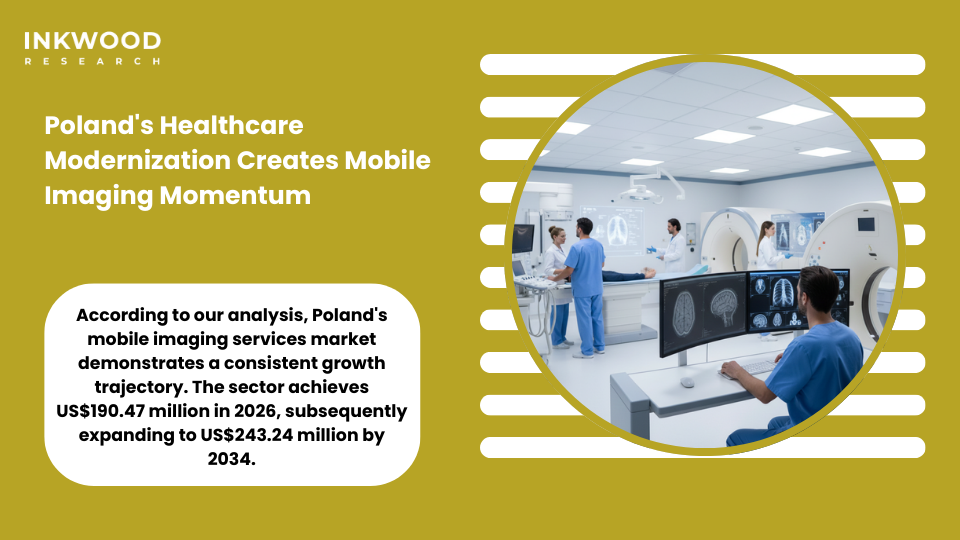
Poland’s diagnostic imaging sector experiences unprecedented transformation. The convergence of government investment and technological innovation creates fertile ground for the mobile imaging services market expansion. Healthcare facilities nationwide recognize that portable diagnostic solutions address accessibility challenges effectively.
However, what drives this remarkable shift? Poland’s aging population, coupled with chronic disease prevalence, demands innovative diagnostic delivery models. Consequently, hospitals and clinics increasingly adopt mobile solutions to reach underserved populations. Traditional fixed imaging centers often struggle to serve rural communities adequately.
Government Investment Catalyzes Market Growth
The Polish government demonstrates an unwavering commitment to healthcare modernization. Specifically, Poland’s National Reconstruction Plan and Cohesion Policy funds dedicate USD 400 million toward AI-enabled medical technologies by 2026. This substantial investment significantly impacts diagnostic imaging capabilities across the nation.
Meanwhile, healthcare institutions leverage these funds to procure advanced mobile imaging equipment. Mobile units equipped with cutting-edge digital radiography, computed tomography, and ultrasound capabilities are becoming increasingly common. These investments directly address Poland’s healthcare accessibility challenges.
Furthermore, government initiatives focus specifically on modernizing diagnostic services. Mobile imaging solutions align perfectly with national healthcare objectives by extending quality diagnostic capabilities beyond traditional hospital settings. Rural areas and underserved urban neighborhoods benefit tremendously from this strategic approach.
Market Valuation Reflects Steady Expansion
According to our analysis, Poland’s mobile imaging services market demonstrates a consistent growth trajectory. The sector achieves US$190.47 million in 2026, subsequently expanding to US$243.24 million by 2034. This represents a compound annual growth rate of 3.10% throughout the forecast period.
Nevertheless, what factors underpin this steady expansion? Several key drivers emerge from our research. First, chronic disease rates continue rising across Polish demographics. Second, healthcare providers increasingly recognize mobile imaging’s operational efficiency. Third, patient preference for accessible diagnostic services grows stronger.
Additionally, mobile imaging addresses Poland’s geographic healthcare disparities effectively. The technology brings hospital-grade diagnostic capabilities directly to patients’ communities. This convenience factor drives adoption among both healthcare providers and patients seeking quality diagnostic services.
How AI Funding Reshapes Diagnostic Imaging Infrastructure

Artificial intelligence integration fundamentally transforms Poland’s diagnostic imaging landscape. The million-dollar government allocation for AI-driven medical technologies creates ripple effects throughout the healthcare ecosystem. Mobile imaging services particularly benefit from these technological advancements.
AI Enhancement of Diagnostic Accuracy
Machine learning algorithms revolutionize how radiologists interpret medical images. AI-powered systems analyze X-rays, CT scans, and ultrasounds with remarkable precision. These technologies detect subtle abnormalities that might escape human observation initially.
Moreover, AI reduces diagnostic turnaround times substantially. Mobile imaging units equipped with AI interpretation software deliver preliminary results within minutes. Radiologists then review these AI-generated analyses, focusing their expertise on complex cases requiring human judgment.
However, implementing AI solutions requires significant infrastructure investment. Therefore, government funding becomes crucial for widespread AI adoption across Poland’s healthcare sector. Medical facilities use these funds to integrate AI platforms into existing mobile imaging workflows seamlessly.
Technology Partnerships Drive Innovation
Polish healthcare institutions increasingly collaborate with international technology providers. These partnerships accelerate AI implementation while ensuring compliance with European medical device regulations. Additionally, collaborations facilitate knowledge transfer and technical expertise development.
For instance, major medical imaging companies establish strategic relationships with Polish healthcare networks. GE Healthcare, Siemens Healthineers, and Koninklijke Philips NV actively support Poland’s diagnostic modernization efforts. These partnerships bring cutting-edge mobile imaging solutions to Polish markets.
Furthermore, local technology startups contribute innovative AI solutions tailored to Polish healthcare needs. These emerging companies develop specialized algorithms addressing specific diagnostic challenges prevalent in Central European populations. Their agility complements established manufacturers’ comprehensive product portfolios.
Regulatory Framework Supports Innovation
Poland operates within the European Union’s comprehensive medical device regulatory framework. The EU AI Act provides clear guidelines for AI implementation in healthcare settings. This regulatory clarity encourages investment while maintaining patient safety standards.
Meanwhile, Poland develops national strategies complementing EU regulations. The country’s AI Policy focuses on creating transparent algorithms for public administration and healthcare applications. This approach ensures AI-driven diagnostic tools meet rigorous safety and efficacy requirements.
Consequently, medical device manufacturers can confidently invest in the Polish markets. Clear regulatory pathways reduce uncertainty while accelerating time-to-market for innovative mobile imaging solutions. Healthcare providers benefit from this streamlined approval process through faster access to advanced technologies.
Mobile Imaging Technology Advances Across Service Lines
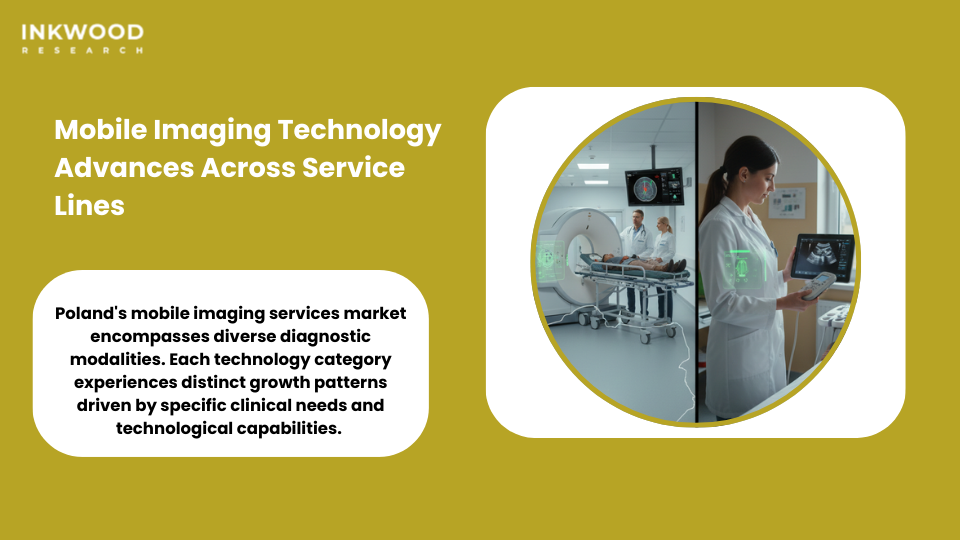
Poland’s mobile imaging services market encompasses diverse diagnostic modalities. Each technology category experiences distinct growth patterns driven by specific clinical needs and technological capabilities. Understanding these variations helps stakeholders make informed strategic decisions.
Mobile Radiography Leads Adoption Rates
Portable X-ray systems represent the most widely adopted mobile imaging technology. These units deliver high-quality diagnostic images while maintaining exceptional mobility and ease of operation. Digital radiography technology enhances image quality while significantly reducing radiation exposure significantly.
Plus, mobile radiography serves diverse healthcare settings effectively. Emergency departments utilize portable X-ray units for trauma assessment. Long-term care facilities employ mobile radiography for elderly patient monitoring. Home healthcare programs incorporate portable X-ray capabilities for homebound patients requiring regular diagnostic imaging.
Additionally, battery-powered portable X-ray systems enable true point-of-care diagnostics. These lightweight units operate independently from electrical infrastructure, extending diagnostic capabilities to remote locations. Polish manufacturers like StarNuke Technologies develop innovative portable solutions specifically designed for challenging environments.
Mobile Computed Tomography (CT) Gains Momentum
Mobile CT units bring advanced cross-sectional imaging to diverse healthcare environments. These sophisticated systems provide detailed anatomical visualization previously available only in fixed hospital settings. Mobile CT technology particularly benefits stroke diagnosis and emergency trauma assessment.
However, mobile CT implementation presents unique challenges. The technology requires substantial infrastructure support, including power supply and radiation shielding considerations. Therefore, adoption rates lag behind mobile radiography despite growing clinical demand.
Nevertheless, technological advancements continuously address these limitations. Newer mobile CT units feature improved energy efficiency and enhanced radiation safety features. Manufacturers develop compact designs that navigate hospital corridors and reach patient bedsides more easily.
Ultrasound Mobility Expands Applications
Mobile ultrasound technology demonstrates remarkable versatility across clinical specialties. These portable systems enable point-of-care imaging for cardiac, vascular, obstetric, and general diagnostic applications. Handheld ultrasound devices further enhance accessibility by fitting into clinicians’ pockets.
Moreover, ultrasound technology requires no ionizing radiation, making it ideal for frequent patient monitoring. This safety profile drives adoption in primary care settings and rural health clinics. Mobile ultrasound units serve as first-line diagnostic tools for diverse conditions.
Furthermore, AI integration enhances ultrasound imaging capabilities substantially. Automated measurement algorithms improve examination consistency while reducing operator dependency. These technological improvements democratize ultrasound access across healthcare settings with varying technical expertise levels.
Competitive Landscape: Major Players Driving Polish Market Growth
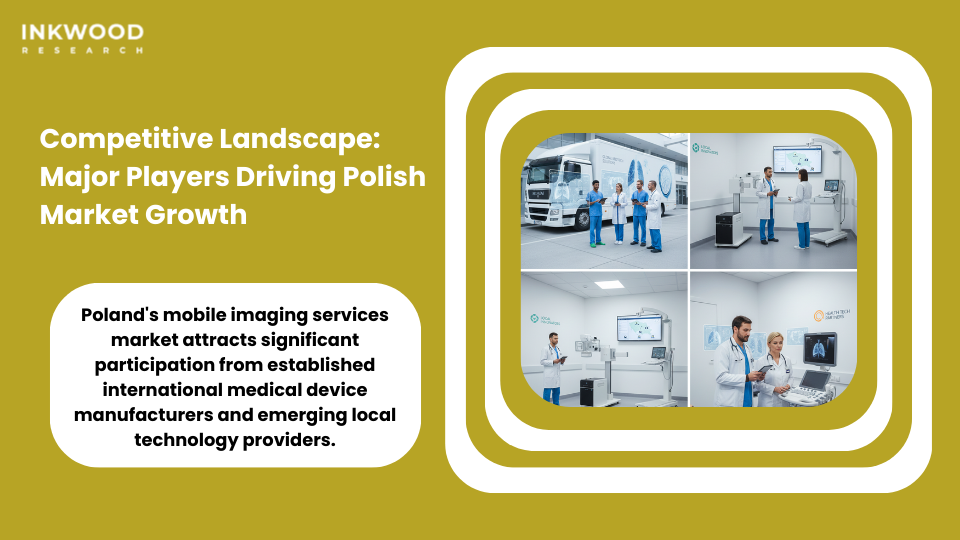
Poland’s mobile imaging services market attracts significant participation from established international medical device manufacturers and emerging local technology providers. This competitive dynamic fosters innovation while driving service quality improvements across the sector.
Global Leaders Establish Strong Market Presence
GE Healthcare maintains a substantial presence throughout Poland’s mobile imaging landscape. The company supplies advanced mobile radiography, computed tomography, and ultrasound systems to major Polish healthcare institutions. Further, GE Healthcare’s collaboration with Polish hospitals drives digital transformation through AI-powered imaging solutions and remote diagnostics capabilities.
Similarly, Siemens Healthineers delivers comprehensive mobile imaging portfolios to Polish markets. Their mobile C-arm systems and portable ultrasound devices serve interventional radiology and emergency medicine applications effectively. Additionally, Siemens emphasizes workflow optimization through integrated digital solutions that streamline diagnostic processes.
Koninklijke Philips NV focuses heavily on mobile diagnostic innovation across Central Europe. The company’s portable ultrasound systems and mobile radiography solutions gain traction among Polish healthcare providers. Philips emphasizes AI integration and cloud connectivity, enabling remote image interpretation and consultation capabilities.
Additionally, Canon Medical Systems expands its Polish market share through competitive pricing and reliable service networks. Their mobile X-ray and CT systems appeal to mid-sized hospitals seeking cost-effective diagnostic solutions without compromising image quality. Also, Canon’s established European service infrastructure ensures prompt technical support.
Emerging Polish Companies Contribute to Innovation
Local medical device manufacturers increasingly compete in Poland’s mobile imaging sector. Subsequently, these companies understand regional healthcare needs intimately and develop solutions addressing specific Polish market requirements. Their agility enables rapid response to evolving clinical demands.
Prognosys Medical Systems designs and manufactures high-end medical imaging technologies specifically for Polish and Central European markets. The company’s product range includes digital radiography systems, mobile C-arms, and teleradiology solutions. Prognosys emphasizes radiation safety and cost-effectiveness in product development.
Furthermore, startups like Brain Scan leverage artificial intelligence for pathology detection in CT and MRI images. Although primarily software-focused, these companies partner with mobile imaging service providers to enhance diagnostic capabilities. Their machine learning algorithms using 3D Convolutional Neural Networks improve detection accuracy significantly.
Service Providers Expand Geographic Coverage
Beyond equipment manufacturers, specialized mobile imaging service companies operate throughout Poland. These organizations own and operate mobile diagnostic units that travel to various healthcare facilities on scheduled routes. This business model enables smaller clinics and rural health centers to offer advanced imaging without capital equipment investments.
Moreover, these service providers often partner with equipment manufacturers for technology upgrades and maintenance support. Such collaborations ensure mobile units feature the latest diagnostic capabilities while maintaining optimal operational efficiency. Also, patients benefit from consistent service quality regardless of geographic location.
Latest Product Developments Transform Service Delivery
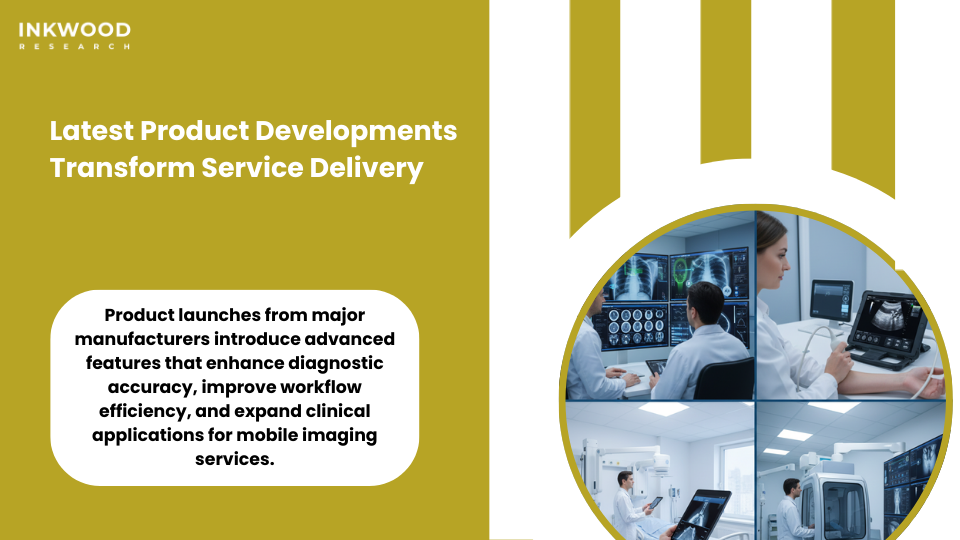
Recent technological innovations reshape Poland’s mobile imaging capabilities dramatically. Accordingly, product launches from major manufacturers introduce advanced features that enhance diagnostic accuracy, improve workflow efficiency, and expand clinical applications for mobile imaging services.
AI-Powered Diagnostic Enhancement
- Throughout 2024 and early 2025, artificial intelligence integration emerged as the dominant product development theme. GE Healthcare introduced updated AI algorithms for its mobile radiography systems that automatically detect and flag critical findings. These algorithms specifically target pneumothorax, pneumonia, and rib fractures—conditions requiring urgent clinical attention.
- Meanwhile, Siemens Healthineers launched enhanced AI capabilities for mobile ultrasound systems. Their new software provides automated cardiac measurements and ejection fraction calculations during point-of-care examinations. This automation reduces examination time while improving measurement consistency across different operators.
- Furthermore, Philips unveiled cloud-connected mobile imaging solutions enabling remote AI-assisted interpretation. Radiologists can review images from mobile units anywhere using secure web platforms. This connectivity particularly benefits rural healthcare facilities lacking on-site radiology expertise.
Portable Equipment Miniaturization
Equipment portability improvements represent another significant development trend. Manufacturers continue to reduce device weight and size while maintaining or improving imaging performance. These advancements enable true point-of-care diagnostics in previously inaccessible locations.
Canon Medical Systems released an ultra-lightweight mobile X-ray system specifically designed for intensive care and emergency department use. The unit features battery operation lasting entire shifts without recharging. Its compact design navigates crowded patient rooms effortlessly.
Additionally, handheld ultrasound devices from multiple manufacturers achieve smartphone-like portability. These pocket-sized systems connect wirelessly to tablets or smartphones for image display and storage. Primary care physicians increasingly adopt these devices for office-based diagnostic evaluations.
Radiation Dose Reduction Technologies
Patient safety remains paramount in mobile imaging product development. Consequently, manufacturers prioritize radiation dose reduction without compromising diagnostic image quality. Advanced detector technologies and intelligent exposure control systems achieve remarkable dose efficiency.
- Siemens Healthineers implemented sophisticated scatter reduction algorithms in its mobile C-arm systems. These technologies reduce radiation exposure for both patients and operating room staff during interventional procedures. The company reports dose reductions exceeding 30% compared to previous generation equipment.
- Similarly, GE Healthcare introduced tin filtration technology in mobile CT units. This innovation preferentially removes low-energy X-rays that contribute to patient dose without enhancing image quality. The technique substantially reduces radiation exposure while maintaining diagnostic efficacy.
Workflow Integration Solutions
Modern mobile imaging systems emphasize seamless integration with hospital information systems and picture archiving and communication systems. This connectivity eliminates manual data entry while ensuring images reach appropriate destinations automatically.
Philips developed universal connectivity solutions compatible with diverse hospital IT infrastructures. Their mobile units automatically retrieve patient demographics from electronic medical records and upload completed examinations to PACS without user intervention. This automation reduces errors while improving technologist efficiency.
Moreover, Canon implemented voice-controlled interfaces on mobile imaging systems. Technologists can initiate examinations, adjust technique parameters, and annotate images using voice commands. This hands-free operation proves particularly valuable during sterile procedures and infection control scenarios.
Key Takeaways
Poland’s mobile imaging services market presents compelling opportunities driven by government support and technological innovation. Strategic investors and healthcare providers should consider these critical insights:
- Government funding creates unprecedented opportunity. The USD 400 million allocation for AI-driven medical technologies directly supports mobile imaging infrastructure development. Healthcare organizations can leverage these funds to modernize diagnostic capabilities substantially.
- Market growth demonstrates consistency and reliability. The 3.10% CAGR from 2026 through 2034 reflects steady demand expansion rather than speculative growth. This stability attracts long-term investment while minimizing market volatility risks.
- AI integration differentiates competitive positioning. Mobile imaging providers incorporating artificial intelligence capabilities gain significant advantages in diagnostic accuracy and workflow efficiency. Early AI adopters will establish market leadership positions.
- Rural accessibility drives service expansion. Geographic healthcare disparities create substantial demand for mobile diagnostic solutions. Service providers addressing rural markets tap into underserved populations with genuine clinical needs.
- International partnerships accelerate market entry. Collaborations between Polish healthcare institutions and global technology leaders facilitate rapid capability development. These partnerships combine international expertise with local market knowledge effectively.
Conclusion:
Poland’s mobile imaging services market stands at a transformative crossroads where government investment meets technological innovation. The sector’s projected growth from US$190.47 million in 2026 to US$243.24 million by 2034 reflects fundamental shifts in healthcare delivery paradigms.
Artificial intelligence funding and regulatory support create favorable conditions for market participants. Healthcare providers can expand diagnostic accessibility while improving clinical outcomes through mobile imaging adoption. Meanwhile, equipment manufacturers and service operators find receptive markets hungry for innovation.
Stakeholders who recognize these opportunities early will shape Poland’s diagnostic imaging future. The convergence of policy support, technological advancement, and clinical need rarely aligns so favorably. Organizations prepared to invest strategically in Poland’s mobile imaging transformation will reap substantial rewards.
Ready to capitalize on Poland’s mobile imaging opportunities?
Contact Inkwood Research today for comprehensive market intelligence and strategic guidance tailored to your organization’s specific objectives in Central European healthcare markets.
Frequently Asked Questions
What government funding supports Poland's mobile imaging market growth?
Poland allocates approximately USD 400 million from its National Reconstruction Plan and Cohesion Policy funds specifically for AI-driven medical technologies by 2026. This substantial investment directly supports mobile imaging infrastructure development and modernization initiatives.
Which companies dominate Poland's mobile imaging services sector?
Major international players, including GE Healthcare, Siemens Healthineers, Koninklijke Philips NV, and Canon Medical Systems, maintain strong market presence. Additionally, Polish manufacturers like Prognosys Medical Systems contribute specialized solutions for regional healthcare needs.
How does AI enhance mobile imaging diagnostic capabilities?
Artificial intelligence algorithms automatically detect critical findings, reduce interpretation time, and improve diagnostic consistency. AI-powered systems analyze images for pneumonia, fractures, and other conditions while flagging urgent cases requiring immediate clinical attention.