Table of Contents
This analysis is brought to you by Inkwood Research, a leading market intelligence firm specializing in Asia-Pacific pharmaceutical regulatory ecosystems, geriatric healthcare innovation, and pharmaceutical additive manufacturing market development. Our research team combines deep expertise in PMDA regulatory pathways, India’s CDSCO pharmaceutical reform agenda, and precision drug delivery adoption across Japan and India. Through strategic partnerships with Asia-Pacific pharmaceutical manufacturers and healthcare policy analysts, we deliver actionable intelligence for enterprises navigating the Japan pharmaceutical 3D printing manufacturing market and India’s emerging pharmaceutical 3D printing landscape.
TLDR
Japan and India are approaching pharmaceutical 3D printing from opposite ends of the market spectrum. The Japan pharmaceutical 3D printing manufacturing market is projected to grow from US$29.34 million in 2026 to US$104.46 million by 2034, at a 17.20% CAGR, driven by geriatric care demands and PMDA’s evolving new modality frameworks. Meanwhile, the India pharmaceutical 3D printing manufacturing market is on track to expand from US$18.00 million in 2026 to US$88.13 million by 2034, at a 21.96% CAGR, the fastest national growth rate in the entire Asia-Pacific region, fueled by India’s low-cost manufacturing ambition and the CDSCO’s emerging regulatory roadmap.
This blog serves pharmaceutical manufacturers, geriatric healthcare specialists, and Asia-Pacific market entry strategists evaluating pharmaceutical 3D printing opportunities in Japan and India. Additionally, regulatory affairs professionals navigating PMDA and CDSCO frameworks, investors tracking the India and Japan pharmaceutical 3D printing manufacturing markets, and pharma startup founders exploring low-cost 3D drug production in India will find evidence-grounded insights here.
Why Are Japan and India Two of the Most Distinct 3D Pharma Markets in Asia-Pacific?
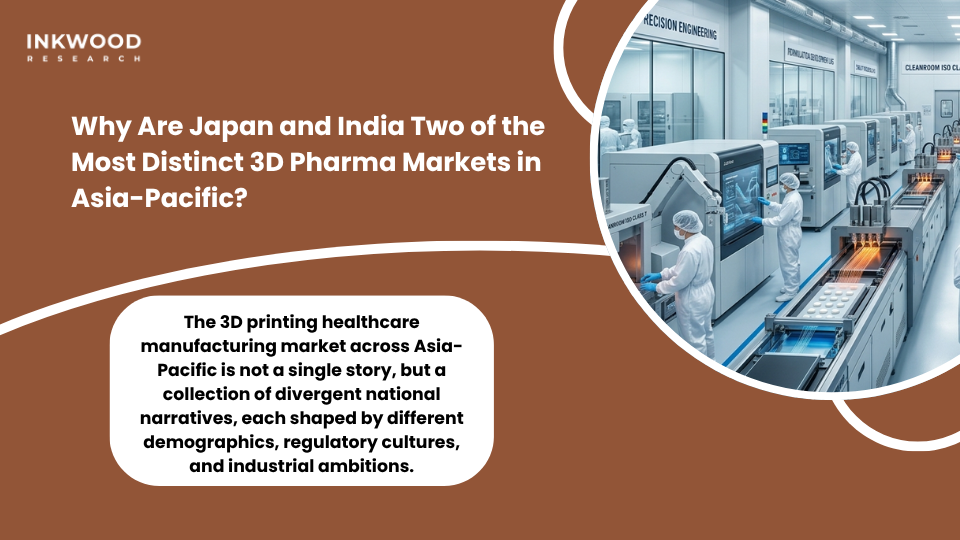
The 3D printing healthcare manufacturing market across Asia-Pacific is not a single story, but a collection of divergent national narratives, each shaped by different demographics, regulatory cultures, and industrial ambitions. Nowhere is that diversity more pronounced than in the contrast between Japan and India.
Japan is the world’s most rapidly aging society, operating within a sophisticated regulatory environment that prioritizes patient safety and clinical evidence.
India is a young, price-sensitive market that already manufactures pharmaceuticals for the world. Moreover, it is now beginning to ask whether pharmaceutical additive manufacturing can extend that cost leadership into the next generation of drug production.
Together, these two markets illustrate the two most important demand drivers for 3D printed medicines globally: geriatric personalized care at one end, and democratized access to advanced formulations at the other. Understanding both trajectories is essential for any company or investor with a serious interest in the Asia-Pacific pharma 3D printing manufacturing market.
How Large Is the Japan Pharmaceutical 3D Printing Manufacturing Market?
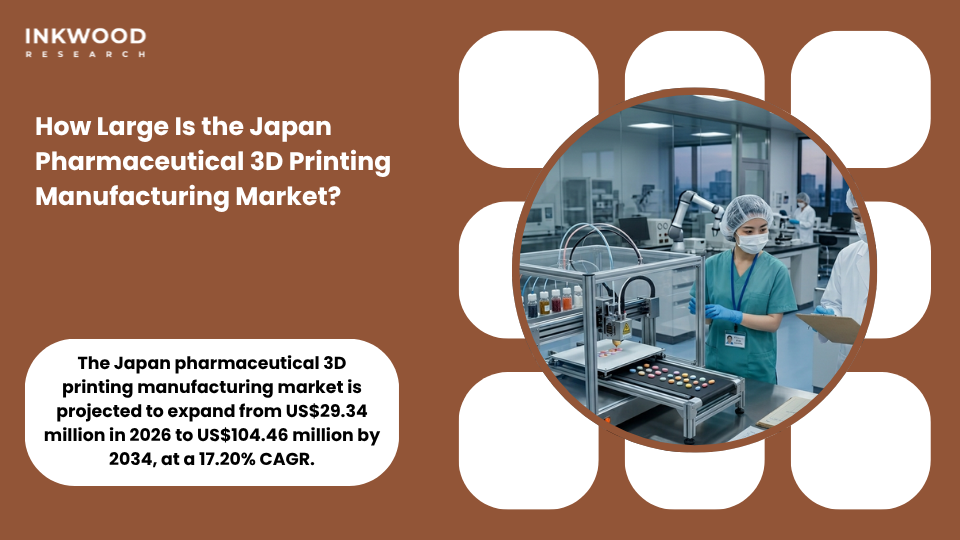
Japan’s pharmaceutical 3D printing landscape is growing with both scale and purpose. The Japan pharmaceutical 3D printing manufacturing market is projected to expand from US$29.34 million in 2026 to US$104.46 million by 2034, at a 17.20% CAGR. That trajectory reflects a healthcare system under genuine pressure from demographic change. Japan’s population is aging faster than any other major economy, and the pharmaceutical industry is looking for solutions that conventional manufacturing cannot provide.
The demand case for 3D printed oral dosage forms in Japan is particularly compelling in the geriatric context. Elderly patients frequently require customized doses, alternative tablet sizes for dysphagia management, and multi-drug combinations that reduce daily pill burden. Consequently, precision drug delivery through pharmaceutical 3D printing addresses a specific and growing clinical need that Japan’s aging population creates at scale, a need that conventional tablet manufacturing is structurally unable to meet.
How Is PMDA Developing New Modalities for 3D Printed Geriatric Medicine?
The Pharmaceuticals and Medical Devices Agency (PMDA) has been one of the most proactive regulatory bodies in Asia-Pacific in engaging with advanced pharmaceutical manufacturing technologies. PMDA’s new modality framework, originally developed to handle cell therapies, gene therapies, and regenerative medicine, has progressively expanded its scope to encompass novel manufacturing approaches, including pharmaceutical additive manufacturing. That expansion reflects a regulatory philosophy that distinguishes Japan’s approach: rather than waiting for commercial products to arrive and then building frameworks around them, PMDA develops guidance proactively.
For the Japan pharmaceutical 3D printing manufacturing market, this regulatory posture is genuinely enabling. Companies developing drug delivery systems 3D printing platforms for geriatric applications can engage with PMDA at the formative stages of development, reducing the regulatory uncertainty that often delays investment decisions. Furthermore, PMDA’s consultation system for advanced therapeutics provides a structured pathway for manufacturers to clarify product classification, quality requirements, and clinical data expectations for 3D printed medicines before committing to full development programs.
What Geriatric Applications Is Japan Prioritizing in 3D Drug Manufacturing?
- Dysphagia-friendly oral dosage forms: Quickly dissolving tablets and orodispersible films produced through 3D printing healthcare manufacturing, designed for patients who cannot safely swallow conventional tablets, a significant and underserved population in Japanese long-term care facilities.
- Polypharmacy management through multi-drug printing: Personalized combination tablets consolidating multiple APIs into a single daily dose for elderly patients on complex therapeutic regimens, improving adherence and reducing medication errors.
Weight-adjusted sustained-release formulations: Dose-flexible controlled release drug manufacturing for geriatric patients where standard commercial dosing creates either over-dosing or under-dosing risk due to age-related changes in renal and hepatic function.
Which Japanese Companies Are Advancing 3D Drug Manufacturing?
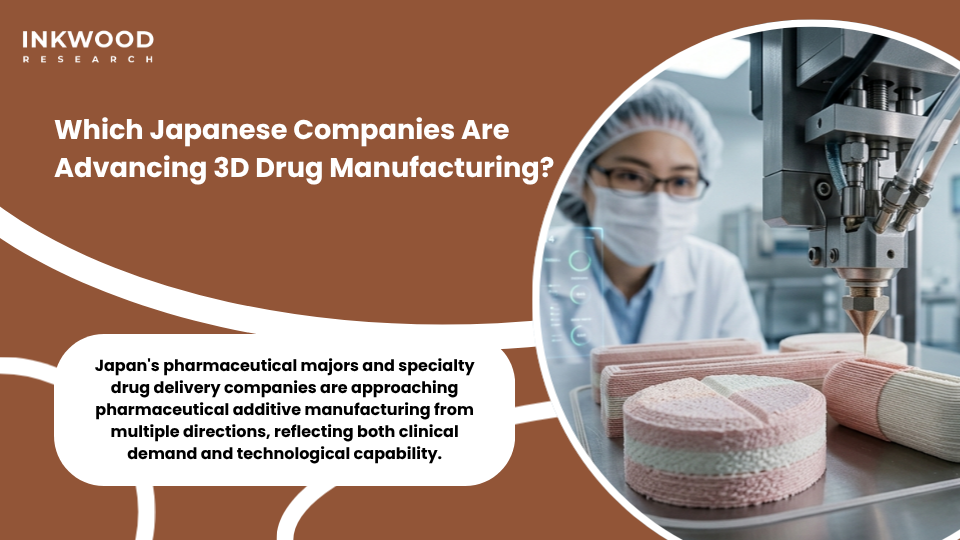
Japan’s pharmaceutical majors and specialty drug delivery companies are approaching pharmaceutical additive manufacturing from multiple directions, reflecting both clinical demand and technological capability.
- Daiichi Sankyo: One of Japan’s largest pharmaceutical companies, Daiichi Sankyo has invested in advanced drug delivery technology through its global R&D network, with growing interest in small-batch drug manufacturing and personalized dosage form development aligned with Japan’s geriatric care priorities.
- Takeda Pharmaceutical: Takeda has been a consistent investor in pharmaceutical manufacturing innovation, including digital manufacturing integration across its global production network. Its specialty care focus, oncology, rare diseases, and neuroscience, aligns with the high-value 3D printed medicines applications that are most compelling within the PMDA regulatory framework.
Shin-Etsu Chemical: Shin-Etsu Chemical produces pharmaceutical-grade hydroxypropyl methylcellulose (HPMC) and other excipient materials critical for drug delivery systems 3D printing, positioning it as an important materials enabler within the Japan pharmaceutical 3D printing manufacturing market.
How Large Is the India Pharmaceutical 3D Printing Manufacturing Market?
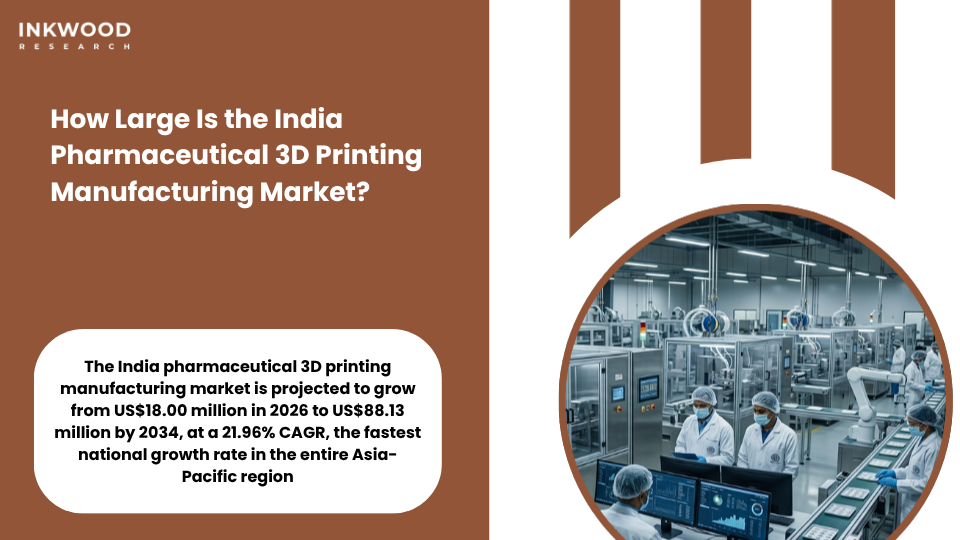
India’s pharmaceutical 3D printing trajectory is remarkable for both its pace and its strategic logic. The India pharmaceutical 3D printing manufacturing market is projected to grow from US$18.00 million in 2026 to US$88.13 million by 2034, at a 21.96% CAGR, the fastest national growth rate in the entire Asia-Pacific region, and significantly above the regional average of 18.46%. That exceptional growth rate reflects a pharmaceutical sector that is already one of the world’s most cost-competitive and is now beginning to build capability in advanced manufacturing modalities.
India currently supplies approximately 20% of global generic medicine exports by volume, according to the Indian Ministry of Chemicals and Fertilizers. Moreover, as the world’s third-largest pharmaceutical producer by volume, it supplies over 200 countries, including high-demand markets like the USA and UK, and produces 60% of global vaccines. This existing export infrastructure, combined with India’s established API manufacturing base, low production costs, and growing biotech talent pool, creates uniquely favorable conditions for decentralized drug manufacturing through pharmaceutical 3D printing. The question for India is not whether 3D drug manufacturing will grow; it is how quickly the regulatory and investment frameworks can support that growth.
What Is CDSCO’s 2026 Roadmap for India’s 3D Pharma Startups?
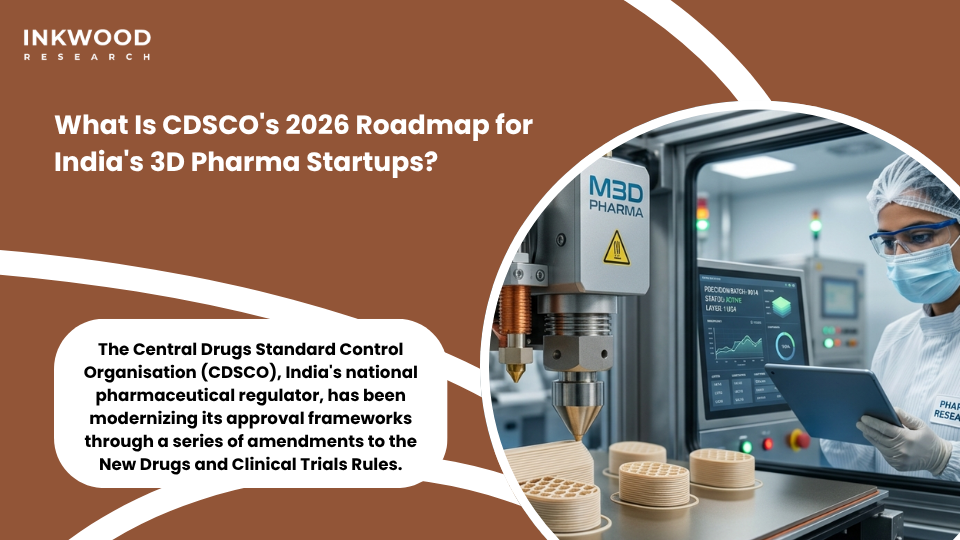
The Central Drugs Standard Control Organisation (CDSCO), India’s national pharmaceutical regulator, has been modernizing its approval frameworks through a series of amendments to the New Drugs and Clinical Trials Rules. For pharmaceutical 3D printing, the most consequential regulatory development is CDSCO’s evolving classification of novel drug delivery systems, which increasingly encompasses 3D printed oral dosage forms and advanced formulations under dedicated technical guidance.
India’s pharma startup ecosystem has been watching CDSCO’s regulatory evolution closely because classification clarity directly determines the development pathway and timeline for 3D printed medicines. Startups developing small-batch drug manufacturing platforms for hospital pharmacies, specialty clinics, or export-oriented contract manufacturing need to know whether their products will be classified as new drugs, reformulations, or medical devices, distinctions that have significant implications for development cost and speed to market. CDSCO’s emerging guidance on drug delivery systems 3D printing is progressively resolving these questions, though the framework remains a work in progress.
How Does India’s Generic Drug Heritage Enable Low-Cost 3D Drug Printing?
India’s competitive advantage in pharmaceutical manufacturing has always rested on cost efficiency at scale, and that heritage translates meaningfully into pharma supply chain transformation through 3D printing. Indian pharmaceutical manufacturers already operate at some of the world’s lowest API production costs, with established chemistry expertise, trained pharmaceutical engineering talent, and export-quality GMP facilities.
Integrating pharmaceutical additive manufacturing into that existing infrastructure, rather than building from scratch as markets without India’s pharmaceutical base must do, creates a cost structure for 3D printed drugs that global buyers will find highly competitive.
Furthermore, India’s pharmacy of the world positioning means its pharmaceutical manufacturers have existing commercial relationships with buyers in Africa, Southeast Asia, and Latin America, regions where decentralized drug manufacturing through 3D printing could deliver meaningful access improvements. That distribution network is a strategic asset that few other national pharmaceutical 3D printing markets can match.
Which Indian Companies Are Building the Low-Cost 3D Drug Printing Model?
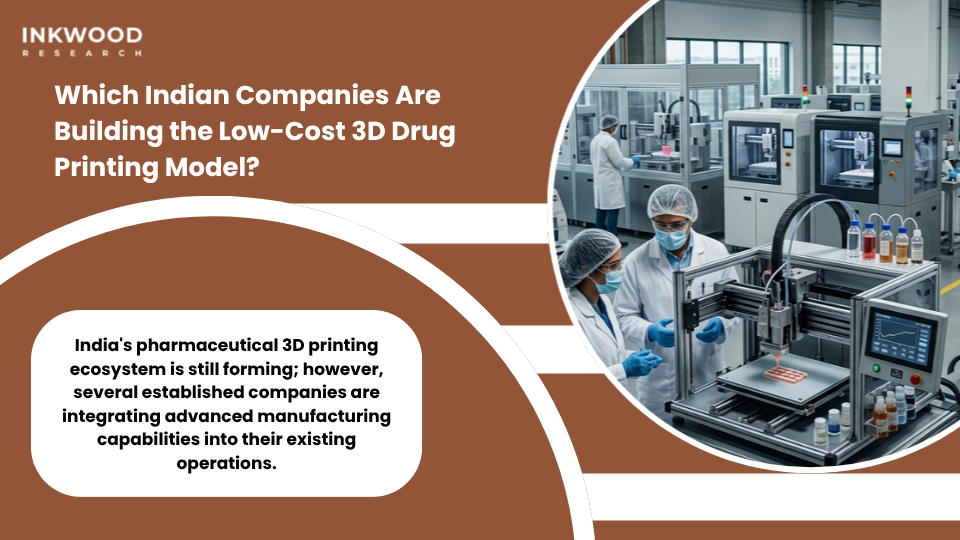
India’s pharmaceutical 3D printing ecosystem is still forming; however, several established companies are integrating advanced manufacturing capabilities into their existing operations. Conversely, a new generation of startups approaches the India pharmaceutical 3D printing manufacturing market from the ground up.
- Sun Pharmaceutical Industries: Sun Pharma, India’s largest pharmaceutical company, and commanding over 8% market share in India, has been investing in specialty and complex formulations as a strategic growth pillar. Its advanced formulation centers in Mumbai and Vadodara are developing 3D printing healthcare manufacturing capabilities for complex generics and specialty drug delivery applications.
- Cipla: Cipla has pursued pharmaceutical innovation through its Cipla Technology and Quality Solutions division, with a growing interest in advanced drug delivery systems. Its work on inhalation formulations and complex generics creates a natural adjacency to drug delivery systems 3D printing for respiratory and specialty therapeutic areas.
- Aurobindo Pharma: Aurobindo Pharma operates one of India’s largest pharmaceutical manufacturing networks, with 30+ manufacturing facilities and strong API-to-finished-dosage integration. That vertical integration positions Aurobindo well for pharmaceutical additive manufacturing at competitive cost structures that serve both domestic and international markets.
- Emerging biotech startups: A growing cluster of pharmaceutical technology startups in Hyderabad, Bengaluru, and Pune is developing point-of-care small-batch drug manufacturing platforms specifically designed for hospital pharmacies and specialty clinics, drawing on India’s established IT and engineering talent base to build software-hardware integrated 3D printed medicines production systems.
Key Takeaways
- The Japan pharmaceutical 3D printing manufacturing market grows from US$29.34 million in 2026 to US$104.46 million by 2034, at a 17.20% CAGR, driven by geriatric care demand for 3D printed oral dosage forms and PMDA’s proactive regulatory engagement.
- The India pharmaceutical 3D printing manufacturing market expands from US$18.00 million in 2026 to US$88.13 million by 2034, at a 21.96% CAGR, the fastest national growth rate in Asia-Pacific.
- Japan’s PMDA new modality framework is proactively enabling pharmaceutical additive manufacturing for dysphagia care, polypharmacy management, and personalized geriatric dosing.
- India’s 20% global generic medicine export share creates an existing infrastructure advantage for scaling 3D printed drugs at competitive costs for both domestic and international markets.
- CDSCO’s evolving classification frameworks for drug delivery systems 3D printing are progressively resolving the regulatory ambiguity that has limited Indian startup investment in pharmaceutical 3D printing.
- Japanese companies, including Daiichi Sankyo, Takeda, and Shin-Etsu Chemical, and Indian manufacturers, including Sun Pharma, Cipla, and Aurobindo, are each building pharmaceutical manufacturing innovation capabilities from different competitive starting points, but converging toward the same technology.
Conclusion
Japan and India represent the two most analytically interesting national markets within Asia-Pacific’s 3D printing healthcare manufacturing market, not because they are the largest, but because they illustrate the full range of what pharmaceutical 3D printing can accomplish. Japan is solving a precision care challenge: providing elderly patients with 3D printed medicines tailored to their actual physiological needs. India is solving an access challenge: extending the cost leadership that made it the pharmacy of the world into the next generation of advanced drug formulations.
Both trajectories matter, and both are accelerating. For pharmaceutical companies, investors, and market strategists operating across Asia-Pacific, understanding the Japan pharmaceutical 3D printing manufacturing market and the India pharmaceutical 3D printing manufacturing market on their own terms is essential to positioning effectively in the region.
Inkwood Research provides the market intelligence and regional depth needed to navigate both markets with confidence.
Connect with our team to explore how our analysis can support your Asia-Pacific pharmaceutical 3D printing strategy.
Frequently Asked Questions (FAQs)
The Japan market is valued at US$29.34 million in 2026, projected to reach US$104.46 million by 2034, growing at a 17.20% CAGR.
Dysphagia-friendly orodispersible tablets, polypharmacy multi-drug printed dosage forms, and weight-adjusted sustained-release formulations for elderly patients are Japan’s primary 3D printed medicine priorities.
The PMDA offers a proactive consultation system for novel manufacturing modalities, enabling early regulatory dialogue for pharmaceutical additive manufacturing developers before formal submissions.
At a 21.96% CAGR from 2026 to 2034, the India pharmaceutical 3D printing manufacturing market is the fastest-growing nationally in Asia-Pacific, supported by India’s generic medicine export infrastructure and CDSCO regulatory reforms.
The CDSCO is developing product classification guidance for novel drug delivery systems, including 3D printed oral dosage forms, within its ongoing New Drugs and Clinical Trials Rules amendments.
Sun Pharmaceutical Industries, Cipla, and Aurobindo Pharma are India’s leading established pharmaceutical companies, integrating pharmaceutical additive manufacturing alongside a growing cluster of specialty biotech startups.