Table of Contents
This analysis is brought to you by Inkwood Research, a leading market intelligence firm specializing in European medical technology markets, precision diagnostics innovations, and surgical technology ecosystems. Our research team combines deep expertise in analyzing Germany’s medical device regulatory landscape through BfArM frameworks, endoscopic optical imaging systems adoption, and intraoperative optical imaging devices integration across German healthcare institutions. Based on our proprietary methodologies and partnerships with European medical device manufacturers, we deliver strategic insights that enable informed decision-making.
TLDR
Germany’s healthcare system demonstrates exceptional sophistication in adopting optical imaging systems across the entire patient care continuum. The Germany optical imaging systems market is projected to grow from US$240.19 million in 2026 to US$538.90 million by 2034, achieving a 10.63% CAGR through strategic investments in diagnostic precision and surgical innovation. Furthermore, Germany’s regulatory excellence through the Federal Institute for Drugs and Medical Devices (BfArM) creates streamlined pathways for deploying 3D optical imaging platforms, multispectral optical imaging systems, and high-resolution optical imaging devices. Consequently, German hospitals lead Europe in integrating advanced imaging technologies that enhance both diagnostic accuracy and surgical outcomes.
Medical device manufacturers targeting Germany’s sophisticated healthcare market will gain critical insights into regulatory requirements and adoption patterns. Additionally, hospital administrators planning equipment investments, surgical department leaders evaluating intraoperative optical imaging technologies, and healthcare policy analysts studying Germany’s medical innovation ecosystem will benefit substantially. Moreover, international investors assessing European medical technology opportunities and regulatory consultants navigating BfArM approval processes can leverage these strategic perspectives for market entry planning.
Germany’s Medical Device Excellence Framework

Germany maintains one of Europe’s most advanced healthcare systems. It is characterized by comprehensive insurance coverage, substantial research funding, and rapid adoption of proven medical technologies. Therefore, the country serves as both a critical test market and a gateway for medical device manufacturers targeting European healthcare systems.
Why Germany Matters for Optical Imaging
German hospitals prioritize evidence-based technology adoption supported by rigorous clinical evaluation. Accordingly, the optical imaging equipment market growth depends on demonstrating clear patient benefits and economic value. Moreover, Germany’s strong emphasis on precision medicine aligns perfectly with optical imaging’s ability to provide detailed, real-time tissue characterization.
The Federal Institute for Drugs and Medical Devices (BfArM) oversees approximately 1,000 specialized personnel, including physicians, pharmacists, chemists, biologists, and engineers, working to ensure device safety and efficacy. According to official government sources, BfArM represents Germany’s largest drug approval authority in Europe, contributing expertise to European Medicines Agency scientific committees.
Regulatory Landscape and BfArM Requirements

Understanding Germany’s regulatory environment proves essential for the successful optical imaging systems commercialization.
BfArM’s Regulatory Authority
- The Federal Institute for Drugs and Medical Devices handles critical responsibilities, including medical device approval, clinical investigation authorization, and post-market surveillance. Importantly, BfArM’s tasks derive from the Medical Device Regulation (MDR) (EU) 2017/745, the Medical Device Law Implementation Act (MPDG), and related implementing ordinances.
- Medical devices must meet specific criteria before entering the German market. For instance, devices ranging from X-ray machines and cardiac pacemakers to optical aids require conformity assessment procedures demonstrating safety and performance. Furthermore, BfArM collects and assesses adverse event reports, taking necessary protective measures when safety concerns emerge.
Clinical Investigation Requirements
- German regulations mandate favorable ethics committee opinions and competent authority approval before conducting clinical investigations. The German Medical Devices Information and Database System (DMIDS) facilitates online submission and management of clinical investigation applications. Consequently, sponsors can efficiently navigate approval processes while maintaining regulatory compliance throughout study execution.
- According to BfArM’s clinical investigation guidance, Class III and IV devices require particularly rigorous evaluation through the conformity assessment process. Additionally, implantable devices and high-risk products must provide comprehensive clinical data demonstrating safety and performance under intended use conditions.
EU MDR Harmonization Benefits
Germany’s implementation of the EU Medical Device Regulation creates advantages for manufacturers seeking broad European market access. Since EUDAMED registration becomes mandatory for medical devices from May 28, 2026, German regulatory frameworks align with broader European requirements. Therefore, successful BfArM approval often facilitates commercialization across multiple EU member states.
Diagnostic Applications Across Medical Specialties

German healthcare institutions leverage optical imaging devices across diverse clinical applications, demonstrating the technology’s versatility and value.
Ophthalmology Leadership
German ophthalmology practices pioneered European adoption of advanced optical coherence tomography systems for retinal disease management. Major university hospitals and private practices utilize multimodal imaging platforms combining OCT, fundus photography, and fluorescence angiography. Consequently, German ophthalmologists can comprehensively assess various retinal pathologies during single patient visits.
Clinical research conducted at German institutions contributed significantly to establishing OCT’s diagnostic accuracy for glaucoma, macular degeneration, and diabetic retinopathy. Moreover, German ophthalmologists actively participate in international clinical trials evaluating novel imaging technologies and contrast agents.
Gastroenterology Innovations
Endoscopic optical imaging systems transformed German gastroenterology through enhanced mucosal visualization and early cancer detection capabilities. Confocal laser endomicroscopy, initially developed through German research collaborations, enables real-time histological assessment during endoscopic procedures. Subsequently, gastroenterologists can target biopsies more accurately and identify subtle lesions missed by conventional white-light endoscopy.
German hospitals implement advanced imaging technologies like narrow-band imaging, blue-light imaging, and fluorescence endoscopy for comprehensive gastrointestinal examination. These technologies improve polyp detection rates, characterize lesions without biopsy, and guide therapeutic interventions more precisely.
Dermatology Applications
Dermatology clinics across Germany employ confocal optical imaging systems for non-invasive skin cancer screening and treatment monitoring. Reflectance confocal microscopy provides cellular-resolution images without requiring tissue removal, enabling longitudinal monitoring of suspicious lesions. Furthermore, optical coherence tomography assists in assessing non-melanoma skin cancers and monitoring treatment responses.
German dermatologists integrate optical imaging with artificial intelligence algorithms for automated lesion classification and risk stratification. Consequently, screening programs can evaluate larger patient populations while maintaining high diagnostic sensitivity and specificity.
Surgical Integration and Intraoperative Imaging
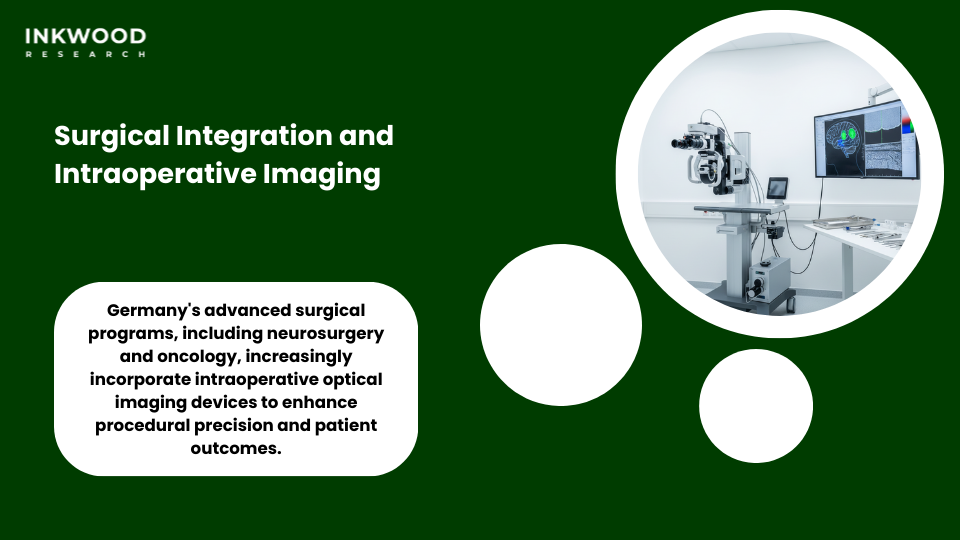
Germany’s advanced surgical programs, including neurosurgery and oncology, increasingly incorporate intraoperative optical imaging devices to enhance procedural precision and patient outcomes.
Neurosurgery Applications
- German neurosurgery departments utilize fluorescence-guided surgery for brain tumor resection with remarkable success. Specifically, 5-aminolevulinic acid (5-ALA) fluorescence imaging helps surgeons visualize malignant glioma margins during resection. Research conducted at German university hospitals demonstrated that fluorescence guidance significantly improves the extent of resection while minimizing damage to eloquent brain regions.
- Moreover, intraoperative OCT provides real-time visualization of tissue layers during delicate procedures. Neurosurgeons can verify complete tumor removal, assess surgical plane integrity, and identify residual disease without interrupting procedures for frozen section analysis. Therefore, operating times decrease while surgical completeness improves.
Oncologic Surgery Advancements
- 3D optical imaging platforms enable comprehensive tumor margin assessment during oncologic procedures across multiple anatomical sites. For instance, breast-conserving surgery benefits from near-infrared fluorescence imaging using indocyanine green to identify sentinel lymph nodes and assess tissue perfusion. Consequently, surgeons achieve higher rates of clear margins while preserving healthy tissue.
- German surgical oncology programs also investigate novel fluorescent tracers targeting specific tumor markers. These molecular imaging approaches may eventually enable real-time detection of microscopic disease beyond what surgeons can visualize through conventional magnification.
Cardiovascular Interventions
- Interventional cardiologists at major German centers use high-resolution optical imaging devices during coronary procedures. Intravascular OCT provides detailed coronary artery visualization enabling optimal stent selection, deployment verification, and complication detection. Additionally, optical imaging assesses plaque characteristics, helping determine appropriate treatment strategies.
- German cardiology research focuses on developing automated analysis algorithms that extract clinically relevant parameters from OCT images. Subsequently, these tools may facilitate faster, more consistent image interpretation across different operators and institutions.
Leading German Healthcare Institutions and Adoption
Several prominent German healthcare institutions drive optical imaging systems adoption through clinical research, technology evaluation, and innovative implementation.
University Hospitals Leading Innovation
- Charité – Universitätsmedizin Berlin operates one of Europe’s largest university hospitals with comprehensive optical imaging capabilities across multiple departments. Their ophthalmology, gastroenterology, and surgical services utilize state-of-the-art imaging technologies while conducting clinical research evaluating emerging systems.
- Similarly, Heidelberg University Hospital maintains international recognition for its contributions to confocal microscopy and OCT development.
Other leading institutions, including LMU Klinikum München, Universitätsklinikum Freiburg, and Universitätsklinikum Hamburg-Eppendorf, actively participate in multicenter trials assessing novel optical imaging applications. Consequently, German research significantly influences international clinical practice guidelines and technology standards.
Private Healthcare Sector
- Germany’s robust private healthcare sector rapidly adopts proven optical imaging technologies. Premium ophthalmology practices invest heavily in the latest diagnostic equipment, differentiating services through advanced technology availability.
- Meanwhile, specialized surgical centers deploy intraoperative imaging to enhance outcomes and attract referring physicians.
- Private clinics often provide early commercial experience for innovative imaging systems, generating real-world evidence that supports broader adoption across public healthcare facilities.
Competitive Dynamics and Market Leaders
The Germany optical imaging systems market features intense competition among global medical device leaders and specialized German manufacturers.
Carl Zeiss Meditec AG
Headquartered in Jena, Germany, Carl Zeiss Meditec represents a global powerhouse in medical optical technologies. The company’s comprehensive portfolio spans diagnostic ophthalmology, microsurgery, and ophthalmic lasers. Their CIRRUS, CLARUS, and PLEX Elite platforms dominate German ophthalmology practices through superior image quality, workflow efficiency, and clinical validation.
Zeiss continuously expands imaging capabilities through strategic acquisitions, internal R&D investments, and academic collaborations. Recent developments include AI-powered diagnostic algorithms, cloud-based image management, and integration with electronic health records.
Heidelberg Engineering GmbH
Also based in Germany, Heidelberg Engineering pioneered confocal scanning laser ophthalmoscopy technology through university spin-out origins. Their Spectralis platform combines multiple imaging modalities for comprehensive retinal assessment.
Moreover, Heidelberg’s focus on diagnostic software distinguishes its offerings through automated analysis tools and longitudinal progression tracking. The company maintains strong relationships with German ophthalmology departments, facilitating rapid technology translation from research concepts to commercial products.
Olympus Europa
Olympus maintains a significant presence in the German endoscopy market through advanced endoscopic optical imaging systems. Their narrow-band imaging technology enhances mucosal visualization during gastrointestinal procedures.
Additionally, Olympus develops specialized imaging modalities like blue-light imaging and texture and color enhancement imaging for improved polyp detection. German gastroenterology departments rely on Olympus equipment for routine procedures while collaborating on clinical research evaluating novel imaging approaches.
KARL STORZ SE & Co. KG
This German manufacturer delivers comprehensive surgical visualization solutions, including rigid and flexible endoscopes with advanced optical imaging capabilities. KARL STORZ’s IMAGE1 S platform provides high-resolution optical imaging across multiple surgical specialties. Furthermore, their focus on integrated operating room solutions aligns with German hospitals’ emphasis on comprehensive surgical ecosystems.
Leica Microsystems
Leica Microsystems, part of Danaher Corporation, supplies advanced microscopy solutions, including confocal and multiphoton systems for research and clinical applications. German pathology departments utilize Leica equipment for digital pathology and tissue imaging. Moreover, their surgical microscopes incorporate optical technologies enhancing neurosurgery and ophthalmology procedures.
Innovation Pipeline and Recent Developments
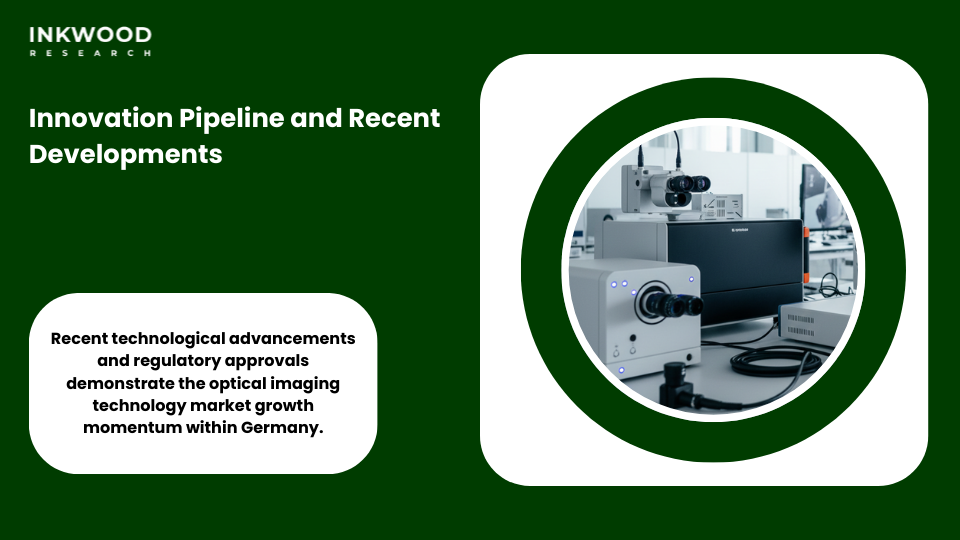
Recent technological advancements and regulatory approvals demonstrate the optical imaging technology market growth momentum within Germany.
AI-Enhanced Imaging Systems
German manufacturers increasingly integrate artificial intelligence capabilities into optical imaging platforms. For instance, automated retinal disease screening systems analyze OCT scans for diabetic macular edema, age-related macular degeneration, and glaucoma progression. Consequently, ophthalmologists can manage larger patient volumes while maintaining diagnostic accuracy.
Similarly, AI algorithms assess gastrointestinal endoscopy images in real-time, alerting clinicians to suspicious lesions and improving polyp detection rates. German regulatory authorities evaluate these AI-enabled devices through established frameworks, ensuring safety and performance before market entry.
Portable and Point-of-Care Devices
Development of portable optical imaging devices addresses healthcare accessibility challenges in rural areas and emergency settings. Handheld OCT systems enable bedside retinal examinations in hospital wards and nursing facilities. Meanwhile, portable endoscopy equipment facilitates procedures in ambulatory settings without requiring hospital admission.
German healthcare policy increasingly emphasizes outpatient care and decentralized service delivery. Therefore, portable optical imaging technologies align strategically with broader healthcare system transformation initiatives.
Molecular Imaging Advances
Research institutions across Germany investigate fluorescent probes targeting specific disease biomarkers for molecular optical imaging. For example, tumor-specific fluorescent tracers may improve surgical margin detection beyond what structural imaging alone can achieve. Additionally, fluorescent antibodies enable immune cell tracking during inflammatory conditions.
German regulatory experience with companion diagnostics facilitates clinical development of optical imaging agents paired with specific imaging devices. BfArM’s clinical trial approval processes accommodate innovative combination products while maintaining rigorous safety oversight.
Strategic Market Opportunities
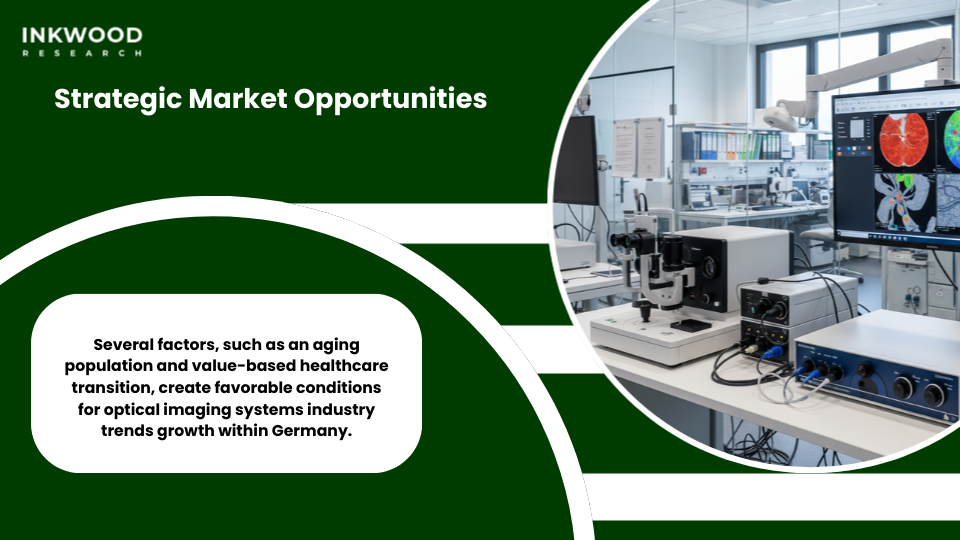
Several factors, such as an aging population and value-based healthcare transition, create favorable conditions for optical imaging systems industry trends growth within Germany.
Aging Population Demographics
Germany’s aging population drives increased demand for diagnostic services, particularly in ophthalmology, oncology, and cardiovascular medicine. Optical imaging technologies enable efficient, non-invasive screening and monitoring of age-related conditions. Therefore, healthcare systems must invest in diagnostic capacity expansion to meet growing demand.
Moreover, German insurance systems provide comprehensive coverage for proven diagnostic technologies, reducing financial barriers to adoption once clinical value is established.
Value-Based Healthcare Transition
German healthcare policy increasingly emphasizes value-based care models, rewarding quality outcomes rather than service volume. Optical imaging technologies support this transition through improved diagnostic accuracy, treatment guidance, and outcomes monitoring. Consequently, providers can demonstrate value through reduced complications, improved cure rates, and enhanced patient satisfaction.
Additionally, digital health initiatives, including electronic health records, telemedicine, and remote monitoring, create opportunities for integrating optical imaging data into comprehensive patient management platforms.
Research and Development Ecosystem
Germany’s strong medical research infrastructure facilitates technology development through university-industry collaborations. Federal and state governments provide substantial funding for medical device innovation, clinical trials, and commercialization support.
Therefore, companies can access resources, expertise, and patient populations necessary for developing and validating novel optical imaging applications. Furthermore, Germany’s central European location and EU membership enable efficient access to broader European markets once initial commercialization succeeds domestically.
Key Takeaways
Our analysis of Germany’s optical imaging systems market reveals several strategic insights:
- Robust Market Growth: Germany’s optical imaging market will expand from US$240.19 million in 2026 to US$538.90 million by 2034, representing a 10.63% CAGR driven by diagnostic advancement and surgical innovation integration.
- Regulatory Excellence: BfArM’s sophisticated regulatory framework ensures patient safety while facilitating innovation through clear approval pathways and EU harmonization.
- Clinical Integration: Successful adoption requires demonstrating clear clinical benefits, economic value, and seamless workflow integration within Germany’s evidence-based healthcare culture.
- Technology Diversity: Multiple optical imaging modalities serve distinct applications across ophthalmology, gastroenterology, dermatology, neurosurgery, and interventional cardiology.
- Innovation Leadership: German manufacturers like Carl Zeiss Meditec and Heidelberg Engineering maintain global leadership through continuous innovation, clinical validation, and strong academic partnerships.
Conclusion:
Germany’s optical imaging systems market exemplifies how sophisticated healthcare systems can strategically adopt advanced medical technologies to enhance patient care. The country’s regulatory excellence, research infrastructure, and clinical expertise create favorable conditions for continued market growth and innovation.
Healthcare providers increasingly recognize optical imaging as essential diagnostic and surgical infrastructure rather than optional advanced technology. Meanwhile, demographic trends, healthcare policy evolution, and technological advances converge to drive sustained demand growth across multiple clinical applications.
Organizations seeking success in Germany’s medical device market must understand that technological superiority alone proves insufficient. Rather, success requires comprehensive clinical validation, favorable health economics, regulatory compliance, and strategic partnerships with key opinion leaders and healthcare institutions.
Ready to navigate Germany’s optical imaging market landscape?
Inkwood Research delivers customized market intelligence, competitive analysis, and regulatory guidance, helping organizations identify opportunities, assess challenges, and optimize commercialization strategies. Contact our consulting team to discuss how our insights can support your strategic planning and market entry initiatives.
Frequently Asked Questions
What makes Germany's optical imaging market unique?
Germany combines sophisticated healthcare infrastructure, rigorous evidence-based adoption, comprehensive insurance coverage, and strong research capabilities. Additionally, BfArM provides clear regulatory pathways while German physicians actively participate in technology evaluation and clinical research.
How does BfArM approval affect market entry timelines?
BfArM review timelines vary by device classification and substantial equivalence status. However, the German Medical Devices Information and Database System (DMIDS) streamlines application processes through online submission, automated notifications, and standardized documentation requirements.
Which clinical specialties drive optical imaging adoption in Germany?
Ophthalmology leads adoption through widespread OCT utilization. However, gastroenterology, dermatology, neurosurgery, and interventional cardiology show rapid growth through advanced endoscopy, confocal microscopy, fluorescence-guided surgery, and intravascular imaging applications.