Table of Contents

This analysis is brought to you by Inkwood Research, a leading market intelligence firm specializing in European photonics innovation, artificial intelligence integration in medical imaging, and the Netherlands technology ecosystems. Our research team combines deep expertise in analyzing Dutch computer vision laboratories, optical imaging technology market growth, and AI-powered diagnostic platform development across Amsterdam, Delft, Utrecht, and Eindhoven research centers. Based on proprietary methodologies and partnerships with European photonics clusters, we deliver strategic insights enabling informed decision-making.
TLDR
The Netherlands emerges as Europe’s premier hub where artificial intelligence transforms optical imaging systems into intelligent vision platforms, revolutionizing healthcare, autonomous systems, and scientific research. The Netherlands optical imaging systems market demonstrates exceptional growth potential, projected to reach US$120.59 million by 2034 from US$45.30 million in 2026, achieving an impressive 13.02% CAGR. Furthermore, Dutch research institutions, including the University of Amsterdam, TU Delft, and Utrecht University, pioneer breakthrough technologies combining confocal optical imaging systems, multiphoton optical imaging, and hyperspectral optical imaging devices with sophisticated AI algorithms. Consequently, Netherlands-developed vision systems enable autonomous navigation, real-time surgical guidance, and early disease detection impossible through conventional optical imaging alone.
Technology investors evaluating European AI and photonics opportunities will gain critical insights into the Netherlands’ unique innovation ecosystem and commercial potential. Additionally, medical device companies exploring AI integration, autonomous systems developers requiring vision capabilities, and research institutions seeking collaboration partners will benefit substantially. Moreover, policymakers studying successful technology cluster development, computer vision engineers, and entrepreneurs developing 3D optical imaging platforms can leverage these perspectives for strategic planning and partnership identification.
Why the Netherlands Leads European AI-Optical Imaging Innovation

The Netherlands cultivates exceptional conditions for AI-optical imaging innovation through strategic government investment, world-class universities, and thriving startup ecosystems. Accordingly, the nation punches far above its weight in computer vision research and photonics commercialization. Moreover, Dutch researchers published over 26% of their AI work in planning and decision-making—the highest percentage globally according to Rathenau Institute analysis. This focus on practical applications aligns perfectly with optical imaging challenges requiring intelligent interpretation.
Integrated Photonics Excellence
The Netherlands established itself as a global photonics powerhouse through decades of strategic investment and cluster development. According to Welcome to NL, the Dutch photonics sector comprises nearly 300 companies contributing approximately €8.6 billion to the economy with 7% annual growth. Furthermore, the government recognizes photonics as a Key Enabling Technology, allocating approximately €1 billion annually through the High Tech Systems and Materials agenda.
The PhotonDelta ecosystem integrates design, fabrication, packaging, and application development, creating vertically integrated capabilities. Consequently, innovations transition rapidly from laboratory concepts to commercial products. Additionally, venture capital funding surged to €280 million in 2023, demonstrating substantial investor confidence in the Netherlands’ photonics opportunities.
Computer Vision Research Leadership
Dutch universities maintain exceptional computer vision research programs combining theoretical depth with practical applications. The University of Amsterdam’s VIS Lab studies computer vision, deep learning, and cognitive science, embedding three public-private AI labs. Similarly, TU Delft’s Computer Vision Lab operates on the threshold of signal processing and machine learning, focusing particularly on deep learning approaches.
These institutions collaborate extensively with industry partners, government agencies, and international research networks. For instance, partnerships with companies like Qualcomm and Bosch enable cutting-edge research on deep vision and automotive applications. Therefore, Dutch computer vision research maintains strong relevance to commercial needs while advancing fundamental understanding.
Amsterdam’s Computer Vision Research Powerhouses

Amsterdam concentrates exceptional talent and infrastructure, making it Europe’s leading AI research hub, particularly for vision systems.
University of Amsterdam Excellence
The University of Amsterdam’s Informatics Institute hosts multiple world-class research groups advancing optical imaging technology market growth through AI integration. The VIS Lab, led by prominent computer vision researchers, embeds four public-private AI labs, including the QUVA Lab with Qualcomm and the DELTA Lab with Bosch. These partnerships ensure research addresses real-world challenges while maintaining academic rigor.
Moreover, UvA researchers focus on representation learning, multimodal learning, and video understanding—critical capabilities for advanced optical imaging systems. For instance, teaching algorithms to interpret medical images requires understanding visual representations at multiple scales and contexts. Subsequently, UvA graduates and research outputs influence global computer vision development far beyond the Netherlands borders.
AI Lab for Imaging and Image-Guided Interventions
Utrecht University operates a specialized AI Lab for Imaging and Image-Guided Interventions, where researchers develop intelligent systems for medical imaging applications. According to lab director Nico van den Berg, “AI enables us to work faster and more accurately, reducing strain on patients as well as workload for healthcare staff.” This mission-driven approach ensures technologies deliver genuine clinical value rather than purely technical achievements.
The lab collaborates with hospitals, developing AI algorithms for various imaging modalities, including confocal optical imaging systems and advanced microscopy. For example, researchers work on automated polyp detection during endoscopy, early cancer identification in pathology images, and surgical guidance systems providing real-time tissue characterization. Therefore, Utrecht’s work directly impacts patient care through clinically validated innovations.
ELLIS Unit Amsterdam
The ELLIS Unit Amsterdam coordinates European Learning and Intelligent Systems research, focusing substantially on computer vision applications. Their research spans representation learning, multimodal learning, video understanding, and temporal machine learning—all essential for next-generation optical imaging systems. Furthermore, ELLIS facilitates international collaborations connecting Dutch researchers with leading AI scientists globally.
This network effect accelerates knowledge transfer and enables ambitious research projects requiring diverse expertise. For instance, developing AI-enhanced surgical guidance systems demands computer vision, medical expertise, robotics, and clinical validation capabilities. Consequently, ELLIS collaborations bring together complementary skillsets to advance complex challenges.
Delft and Eindhoven Technology Innovation

Beyond Amsterdam, Delft, and Eindhoven contribute substantially to the Netherlands optical imaging innovation through engineering excellence and industry partnerships.
TU Delft Signal Processing Leadership
TU Delft’s Computer Vision Lab excels in automatic visual data analysis spanning images, videos, and 3D/4D sensors. Their research operates at the intersection of signal processing and machine learning, particularly emphasizing deep learning approaches. Consequently, Delft researchers pioneer novel architectures that process high-dimensional optical imaging data efficiently.
For example, hyperspectral optical imaging devices generate massive datasets requiring sophisticated algorithms to extract meaningful information. Delft researchers develop specialized neural network architectures handling spectral dimensions while maintaining computational efficiency. Therefore, their work enables real-time hyperspectral imaging previously requiring extensive post-processing.
TNO Intelligent Imaging
TNO, Netherlands Organization for Applied Scientific Research, operates an exceptional Intelligent Imaging group with over 55 professionals pioneering computer vision applications. Their work spans defense, security, healthcare, and industrial sectors, developing AI-powered vision systems for autonomous platforms and decision support.
For instance, TNO develops automatic ship identification systems for the Royal Navy, vehicle detection for aerial surveillance, and autonomous inspection robots. These applications demand robust 3D optical imaging platforms combined with sophisticated AI interpretation handling varied lighting conditions, occlusions, and motion artifacts. Subsequently, TNO’s solutions demonstrate how AI transforms raw optical data into actionable intelligence.
Eindhoven High-Tech Campus
Eindhoven hosts a thriving high-tech campus where companies like ASML, Philips, and numerous startups collaborate on photonics and imaging technologies. This ecosystem fosters innovation through proximity, shared infrastructure, and talent circulation between organizations. Moreover, partnerships with Eindhoven University of Technology ensure access to cutting-edge research and graduate talent.
Several companies on the campus develop multispectral optical imaging systems for industrial inspection, biomedical applications, and agricultural monitoring. For instance, systems identifying plant diseases through spectral signatures or detecting manufacturing defects invisible to human inspectors. Therefore, Eindhoven exemplifies how the Netherlands’ integrated innovation ecosystems accelerate technology commercialization.
AI-Enhanced Optical Imaging Breakthroughs
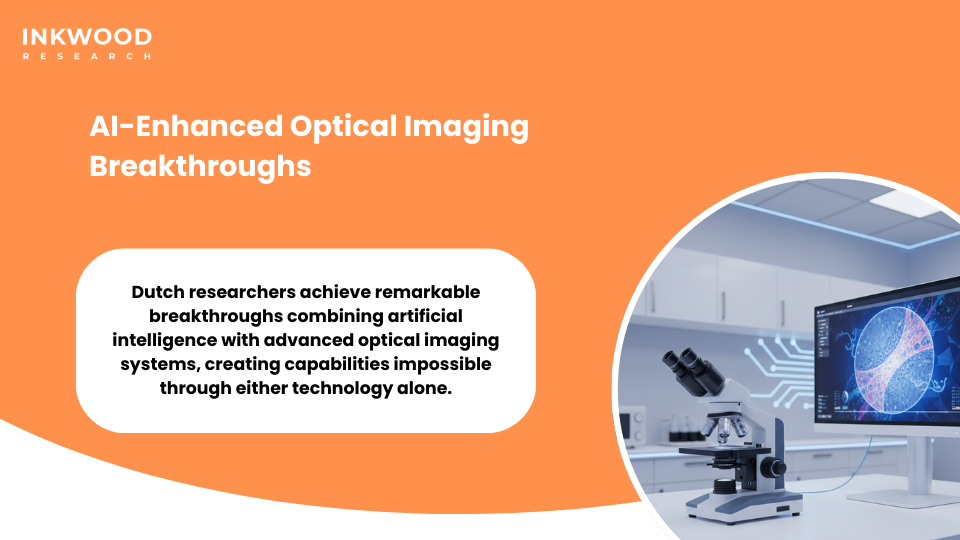
Dutch researchers achieve remarkable breakthroughs combining artificial intelligence with advanced optical imaging systems, creating capabilities impossible through either technology alone.
Real-Time Tissue Characterization
- Medical imaging increasingly incorporates AI, enabling real-time tissue classification during examinations and procedures. For example, endoscopic optical imaging systems enhanced with deep learning identify suspicious lesions during gastrointestinal procedures, alerting clinicians to areas requiring closer examination or biopsy. Moreover, algorithms trained on millions of images recognize subtle patterns human observers might miss.
- Utrecht University researchers develop AI systems that analyze confocal optical imaging data in real-time during surgical procedures. These systems provide surgeons with immediate feedback about tissue types, tumor margins, and critical structures. Consequently, surgical decision-making improves through augmented intelligence supplementing surgeons’ expertise rather than replacing judgment.
Autonomous Systems Vision
- Dutch expertise in autonomous systems heavily leverages AI-enhanced optical imaging for navigation, obstacle avoidance, and scene understanding. TNO develops vision systems enabling robots to operate in complex environments, including underwater inspection, prison ground monitoring, and battlefield reconnaissance. These applications require robust perception handling of varied lighting, weather conditions, and unexpected obstacles.
- For instance, high-resolution optical imaging devices capture detailed environmental information while AI algorithms extract semantic understanding—identifying pathways, obstacles, people, and vehicles. Furthermore, multi-sensor fusion combines optical imaging with radar, lidar, and other modalities, creating comprehensive situational awareness. Therefore, autonomous platforms make intelligent decisions even in challenging conditions.
Medical Diagnostics Automation
- AI transforms medical imaging workflows through automated screening, quantitative analysis, and predictive modeling. Dutch researchers develop algorithms detecting diabetic retinopathy in retinal images, identifying pulmonary nodules in chest imaging, and characterizing skin lesions from dermoscopy. These systems handle routine screening, freeing specialists for complex cases requiring expert interpretation.
- Moreover, AI enables quantitative biomarker extraction from multiphoton optical imaging and other advanced modalities. Algorithms measure cellular morphology, vascular patterns, and tissue organization, providing objective metrics tracking disease progression or treatment response. Subsequently, clinical trials leverage these biomarkers as surrogate endpoints, accelerating drug development.
Commercial Applications and Industry Adoption
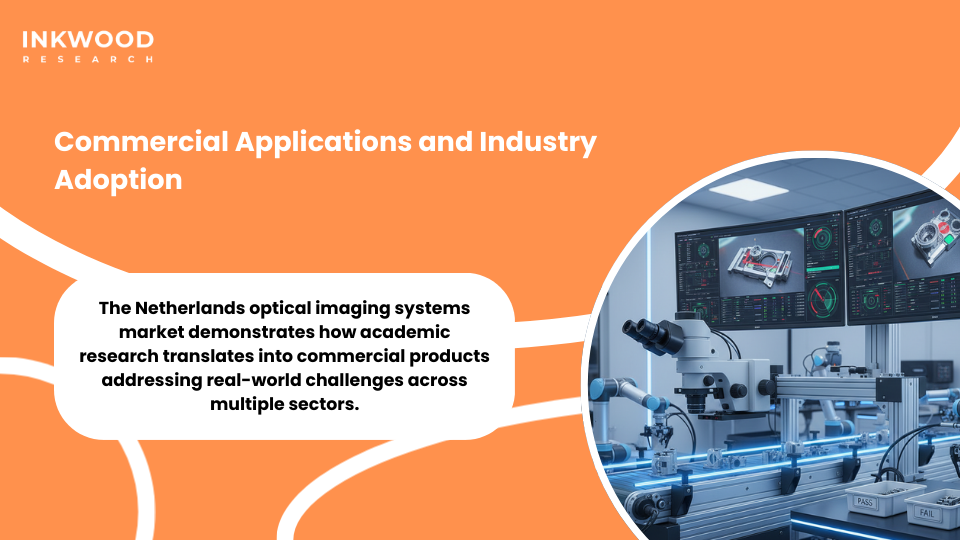
The Netherlands optical imaging systems market demonstrates how academic research translates into commercial products addressing real-world challenges across multiple sectors.
Healthcare Diagnostics
Dutch medical technology companies develop AI-enhanced diagnostic systems serving ophthalmology, pathology, radiology, and other specialties. For example, automated retinal screening systems deployed in primary care settings enable early diabetic retinopathy detection without requiring ophthalmologist expertise. Similarly, digital pathology platforms incorporating AI assist pathologists in cancer diagnosis and grading.
These solutions address healthcare workforce shortages while improving diagnostic consistency and accuracy. Moreover, the Netherlands’ strong healthcare system provides ideal testing grounds for validating technologies before international commercialization. Therefore, Dutch companies benefit from domestic market feedback, refining products for global deployment.
Agricultural Monitoring
Precision agriculture increasingly adopts optical imaging and AI for crop health monitoring, disease detection, and yield optimization. Dutch companies develop multispectral and hyperspectral imaging systems mounted on drones or ground vehicles, analyzing plant health at scale. Subsequently, farmers receive actionable insights enabling targeted interventions, reducing pesticide use while improving productivity.
For instance, hyperspectral optical imaging devices detect plant stress days before visible symptoms appear, allowing preventive treatment. AI algorithms trained on extensive agricultural datasets identify specific diseases, nutrient deficiencies, and pest infestations from spectral signatures. Therefore, precision agriculture exemplifies how the Netherlands’ strengths in imaging, AI, and agriculture converge, creating valuable innovations.
Industrial Quality Control
Manufacturing industries adopt AI-enhanced optical inspection systems, improving quality control while reducing costs. Systems inspect components at high speeds, identifying defects that human inspectors might miss. Moreover, deep learning algorithms continuously improve through exposure to production data, adapting to new defect types without explicit reprogramming.
The Netherlands’ high-tech manufacturing sector, including semiconductor equipment, precision mechanics, and food processing, extensively employs these technologies. For example, high-resolution optical imaging devices inspect microelectronics, identifying nanometer-scale defects affecting product performance. Subsequently, manufacturers maintain exceptional quality standards while increasing production throughput.
Government Support and Ecosystem Development
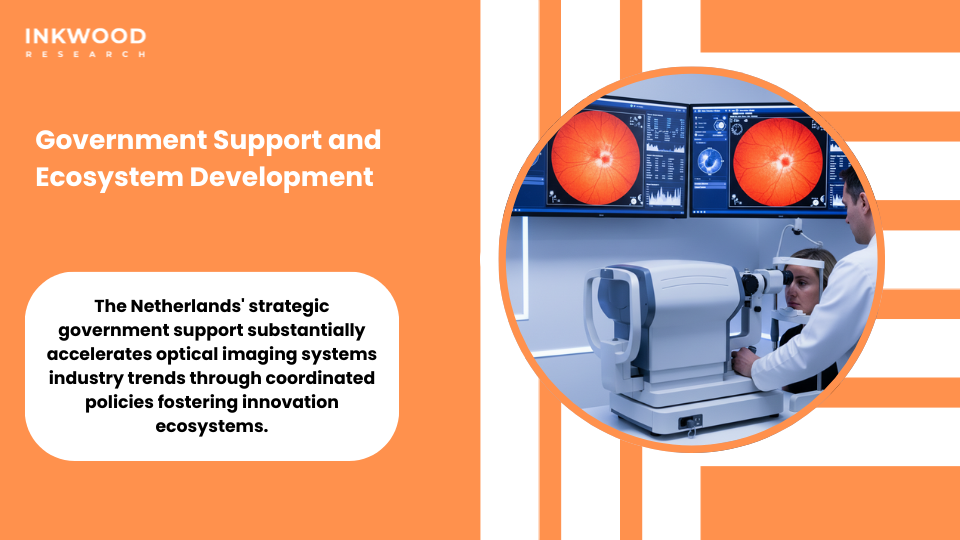
The Netherlands’ strategic government support substantially accelerates optical imaging systems industry trends through coordinated policies fostering innovation ecosystems.
Strategic Funding Programs
The Dutch government allocates significant funding annually to high-tech sectors, including photonics, through the High Tech Systems and Materials agenda. This substantial investment supports fundamental research, technology development, and commercialization activities across the innovation pipeline. Moreover, programs specifically target photonics as a Key Enabling Technology, driving economic growth and addressing societal challenges.
According to government strategic planning, the 2030 vision aims to position the Netherlands as a leading global photonics hub, targeting a 30% increase in photonics-related employment. Furthermore, the integrated photonics market aims to generate 4,000 full-time jobs and exceed €1 billion in revenue by 2026.
Public-Private Partnership Models
The Netherlands excels at creating effective public-private partnerships, accelerating technology translation. The Dutch Photonics Cluster brings together industry players, researchers, and government bodies, facilitating collaboration and accelerating development. Similarly, university-embedded industry labs like QUVA Lab and DELTA Lab enable companies to access cutting-edge research while providing researchers with real-world problem contexts.
These partnerships benefit all stakeholders—companies gain innovation capabilities, universities secure research funding and relevance, while society receives technologies addressing genuine needs. For instance, healthcare partnerships ensure AI medical imaging systems address actual clinical workflows rather than purely technical challenges. Therefore, the Netherlands’ collaborative culture substantially improves innovation efficiency.
International Collaboration Networks
Dutch institutions actively participate in European research programs, including Horizon Europe, ELLIS, and PhotonDelta initiatives. These networks enable ambitious projects requiring capabilities beyond individual organizations or nations. Moreover, international collaborations attract global talent and investment to the Netherlands while ensuring Dutch researchers remain at the innovation frontiers.
For example, coordinated European efforts in quantum photonics, neuromorphic computing, and AI ethics leverage complementary national strengths. The Netherlands contributes exceptional photonics manufacturing and AI research while collaborating with partners providing other capabilities. Subsequently, European ecosystem competitiveness improves through strategic collaboration.
Future Outlook and Strategic Opportunities
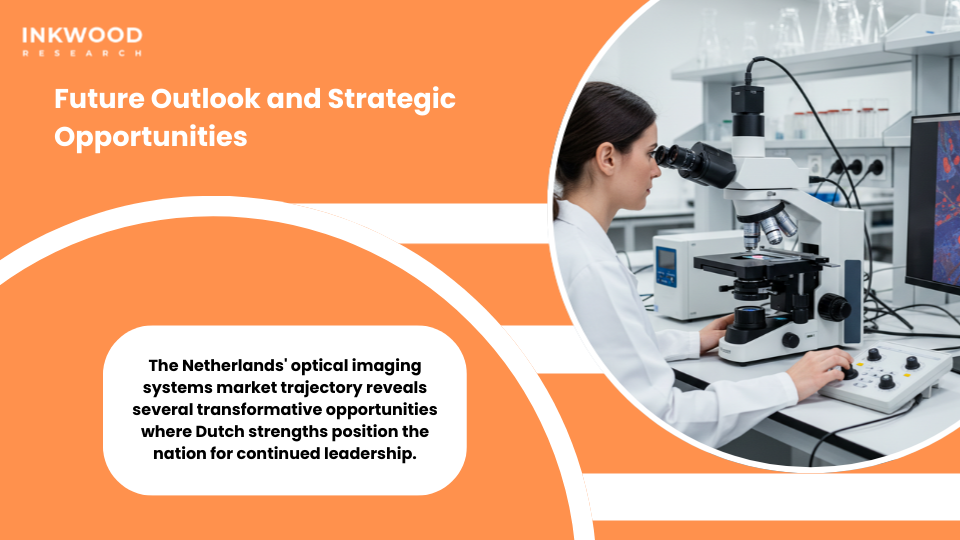
The Netherlands’ optical imaging systems market trajectory reveals several transformative opportunities where Dutch strengths position the nation for continued leadership.
Neuromorphic Vision Systems
Next-generation vision systems may adopt neuromorphic architectures mimicking biological visual processing. Dutch researchers investigate brain-inspired computing, potentially enabling dramatically more efficient image processing. For instance, neuromorphic chips process visual information using orders of magnitude less power than conventional approaches, critical for autonomous systems and edge computing applications.
Moreover, neuromorphic systems excel at temporal processing and event detection—capabilities valuable for optical imaging systems monitoring dynamic processes. Therefore, the Netherlands’ strengths in both photonics hardware and AI algorithms position it well for neuromorphic vision leadership.
Quantum-Enhanced Imaging
Quantum technologies promise revolutionary optical imaging capabilities through enhanced sensitivity, resolution, and security. Dutch quantum research institutes explore quantum-enhanced microscopy, quantum illumination, and quantum secure imaging communications. These technologies may enable molecular-resolution biological imaging, low-light vision systems, and unhackable secure imaging.
The Netherlands Quantum Initiative coordinates quantum research across universities and industry partners. Given the Netherlands’ photonics expertise and quantum research excellence, the nation could lead quantum optical imaging commercialization. However, substantial technical challenges remain before practical applications emerge.
Global Market Expansion
Dutch optical imaging companies increasingly pursue international markets, leveraging technology excellence and European market validation. Asia-Pacific markets present particularly attractive opportunities given the expanding healthcare infrastructure and manufacturing automation needs. Moreover, the Netherlands’ reputation for engineering quality and reliability facilitates market access.
However, successful global expansion requires navigating diverse regulatory frameworks, competitive landscapes, and customer requirements. Companies adopt varied strategies, including direct sales, distributor partnerships, and strategic acquisitions. Therefore, international growth demands substantial resources beyond technology development alone.
Key Takeaways
Our analysis of the Netherlands’ optical imaging equipment market overview reveals several strategic insights:
- Exceptional Growth Trajectory: The Netherlands optical imaging systems market will expand from US$45.30 million in 2026 to US$120.59 million by 2034, achieving a remarkable 13.02% CAGR—outpacing many larger markets through specialized excellence.
- AI Integration Leadership: Dutch research institutions lead globally in combining artificial intelligence with optical imaging, creating intelligent vision systems enabling autonomous operation, real-time diagnostics, and sophisticated scene understanding.
- Ecosystem Strength: The Netherlands’ integrated innovation ecosystem connecting universities, industry partners, government support, and international networks accelerates technology translation from laboratory discoveries to commercial products.
- Strategic Positioning: Focus on practical applications, high-value niches, and emerging technologies positions the Netherlands competitively despite its modest absolute market size compared to larger nations.
- Global Talent Attraction: The Netherlands’ quality of life, English language prevalence, and innovation culture attract international talent, enhancing domestic capabilities while facilitating global collaboration.
Conclusion:
The Netherlands exemplifies how strategic focus, ecosystem integration, and excellence in complementary fields create disproportionate innovation impact. Despite modest population and geography, Dutch contributions to AI-enhanced optical imaging systems rival much larger nations through concentrated expertise and collaborative culture.
Amsterdam, Delft, Utrecht, and Eindhoven host world-class research institutions pushing optical imaging and AI frontiers while maintaining strong industry connections, ensuring practical relevance. Moreover, government policies strategically support photonics and AI as Key Enabling Technologies through substantial funding, talent development, and infrastructure investment.
Future opportunities span neuromorphic vision, quantum-enhanced imaging, and global market expansion. Organizations seeking cutting-edge optical imaging AI capabilities should engage the Netherlands’ innovation ecosystem through research partnerships, talent recruitment, or commercial collaborations. However, success requires understanding Dutch collaborative culture, emphasizing partnership over transaction.
Ready to explore the Netherlands’ optical imaging opportunities?
Inkwood Research provides customized market intelligence, ecosystem mapping, and partnership facilitation, helping organizations navigate Dutch innovation landscapes. Our insights support strategic planning, technology scouting, and collaboration development. Contact our consulting team to discuss how the Netherlands’ AI-optical imaging excellence can advance your strategic objectives.
Frequently Asked Questions
What makes the Netherlands particularly strong in AI-optical imaging?
The Netherlands combines exceptional photonics infrastructure through the PhotonDelta ecosystem, world-class computer vision research at Amsterdam, Delft, and Utrecht universities, strategic government investment exceeding €1 billion annually, and a collaborative culture facilitating public-private partnerships. Additionally, English language prevalence and the quality of life attract international talent.
How do Dutch research institutions collaborate with industry?
Dutch universities embed industry-funded labs, enabling direct collaboration like QUVA Lab with Qualcomm and DELTA Lab with Bosch. Moreover, the PhotonDelta ecosystem facilitates partnerships through shared infrastructure and networking. Government incentives encourage university-industry collaboration, ensuring research addresses commercial needs.
Which applications show the strongest commercial potential?
Healthcare diagnostics, including AI-enhanced screening and surgical guidance, show immediate opportunities given aging demographics and workforce shortages. Additionally, agricultural monitoring leveraging the Netherlands’ farming expertise, autonomous systems vision, and industrial quality control demonstrate strong growth potential. Emerging quantum and neuromorphic technologies offer longer-term opportunities.