Table of Contents
This analysis is brought to you by Inkwood Research, a distinguished market intelligence firm specializing in autonomous systems infrastructure and advanced charging technology sectors. Our research team combines decades of experience analyzing UAV fleet operations, wireless power transmission technologies, and North American commercial drone deployment strategies across defense, logistics, and industrial applications. Based on our proprietary research methodologies and extensive partnerships with charging infrastructure developers, drone fleet operators, utility companies, agricultural technology providers, and regulatory bodies including the Federal Aviation Administration, we deliver actionable insights that empower strategic decision-making for enterprises navigating charging infrastructure investments, fleet optimization challenges, and the rapidly expanding North American UAV battery market ecosystem.
TLDR
The North American UAV battery market revolutionizes fleet operations through innovative charging infrastructure solutions. On-site systems provide fixed installations for permanent operations, achieving 98% uptime. Meanwhile, mobile charging units enable remote deployments across oil fields and agricultural zones. Additionally, swap-and-go systems reduce turnaround times to seconds rather than hours. Furthermore, wireless charging technologies eliminate physical connections while transferring data autonomously. The North American market reached $822.89 million in 2024, projecting growth to $2.09 billion by 2032 through advanced infrastructure investments supporting defense, commercial, and industrial applications.
Fleet operators managing multi-drone operations discover infrastructure optimization strategies. Similarly, logistics companies evaluating delivery drone investments gain a comparative analysis of charging solutions. Moreover, facility managers planning permanent installations can access technical specifications and ROI benchmarks. Defense procurement officers requiring mobile deployment capabilities find operational insights. Additionally, agricultural enterprises implementing precision monitoring systems benefit from infrastructure planning guidance throughout this comprehensive analysis.
North America UAV Battery Market Overview: Infrastructure Focus
Imagine a logistics company operating 50 delivery drones across urban corridors. Each drone completes 8-12 missions daily, requiring 3-4 battery charges. Traditional charging approaches create operational nightmares while drones sit idle for hours waiting for batteries. Consequently, fleet utilization plummets while operational costs skyrocket.
This scenario isn’t hypothetical—it’s reality for countless operators across North America. However, innovative charging infrastructure solutions transform these challenges into competitive advantages. According to our analysis, the North America UAV battery market reached $1052.36 million in 2025. Moreover, projections indicate growth to $2680.68 million by 2032, representing a 14.29% CAGR driven primarily by infrastructure investments.
So, what’s driving this infrastructure revolution? Three critical factors emerge from our analysis.
First, commercial drone deployments demand continuous operations without downtime. Second, remote applications require flexible charging solutions beyond fixed installations. Third, automated systems eliminate human intervention, reducing labor costs dramatically.
Subsequently, operators evaluate three primary approaches: on-site installations, mobile charging units, and swap-and-go systems. Each offers distinct advantages depending on operational requirements.
Market Size and Growth Dynamics
The North America UAV battery market demonstrates exceptional strength and momentum. Our regional analysis indicates North America captured 35.19% market share in 2025, with the broader battery market reaching $1052.36 million regionally.
Why does North America lead globally? Defense procurement programs invest billions annually in autonomous systems. The United States operates over 10,000 military UAVs requiring sophisticated power infrastructure. Additionally, FAA regulations supporting commercial drone operations create favorable conditions. Robust R&D ecosystems in technology hubs further accelerate innovation cycles dramatically.
Key Infrastructure Challenges in the UAV Battery Market
Operators face multiple infrastructure bottlenecks limiting deployment scale. Traditional manual charging approaches require human intervention for battery removal, connection, and monitoring. Consequently, labor costs accumulate rapidly. One operator managing 20 drones spends 2-3 hours daily on battery maintenance alone. Moreover, human error introduces safety risks and reduces reliability.
Charging time constraints limit operational tempo. Standard lithium-ion batteries require 1-2 hours for full charges. However, commercial applications demand much faster turnaround. Delivery drones completing 10+ daily missions need charging infrastructure supporting rapid cycling. Otherwise, fleet sizes must increase proportionally, raising capital costs significantly.
Remote operations present unique challenges. Agricultural monitoring across thousands of acres requires charging solutions far from permanent infrastructure. Similarly, infrastructure inspection along pipelines or power lines needs mobile capabilities. Nevertheless, traditional generator-based solutions prove inefficient and environmentally problematic. Therefore, innovative approaches addressing these constraints create competitive advantages.
On-Site Charging Infrastructure: Fixed Solutions for the North America UAV Battery Market

Wireless Charging Technology Advantages
Wireless charging infrastructure revolutionizes permanent installations. Companies like WiBotic pioneered autonomous charging pads, eliminating physical connection points. Their PowerPad technology supports drones from small commercial units to large industrial UAVs. Moreover, systems automatically transfer flight data, images, and video during charging cycles.
How does wireless charging work? Inductive power transmission delivers energy through the air without contact, and onsequently, mechanical wear disappears while reliability increases dramatically. The technology proves fully weatherproof, protecting electronics from dust, debris, rain, and insects. According to Commercial UAV News, WiBotic’s adaptive matching technology provides power levels necessary for varied aircraft sizes.
Programmable voltage and current extend battery lifespans significantly. Systems optimize charging profiles based on battery health, temperature, and usage patterns. Subsequently, operators reduce costly battery replacements while maximizing performance. Additionally, seamless data transfer enables real-time fleet management without human intervention. Flight plans upload automatically while sensor data downloads to industrial computers inside charging pads.
Fixed Installation Applications
- Permanent installations excel in specific operational scenarios. Energy and utilitiessectors deploy charging stations across infrastructure networks. Utility operators need daily inspection data—not annual surveys. Permanently deployed UAVs with multiple PowerPad stations along transmission lines reduce inspection costs while dramatically increasing frequency.
- Warehouse operationsbenefit tremendously from fixed installations. Indoor inventory management drones require frequent recharging between missions. Rooftop or interior-mounted charging pads enable completely autonomous operations. Drones complete inventory cycles, return to charging stations automatically, and resume operations without human oversight. Consequently, operational efficiency increases while labor costs decrease.
- Smart city applicationsleverage permanent infrastructure strategically. Security monitoring drones patrol urban corridors using networked charging stations. Emergency response drones stationed at fire departments remain ready through continuous wireless charging. Moreover, delivery hubs in dense urban areas establish charging infrastructure supporting high-volume operations throughout business districts.
Cost-Benefit Analysis for On-Site Systems
Initial capital investments require careful evaluation. According to reports, wireless charging stations range from $5,000-$25,000, depending on capacity and features. However, operational savings accumulate rapidly. Elimination of manual battery handling reduces labor costs by 70-80% annually.
How quickly do investments pay off? Fleet operators report 18-24 month payback periods typically. Larger fleets achieve faster returns through economies of scale. Additionally, improved battery longevity through optimized charging reduces replacement frequency by 30-40%. These factors combine to create compelling economic justifications.
Hidden benefits enhance value propositions further. Autonomous operations enable 24/7 fleet availability without shift workers. Data integration improves fleet management through real-time analytics. Safety improvements from eliminating manual handling reduce insurance premiums. Consequently, the total cost of ownership decreases substantially compared to traditional approaches.
Mobile Charging Units: Flexible Solutions for the North America UAV Battery Market

Portable Charging System Architectures
Mobile charging infrastructure addresses remote operation requirements. Portable units mount in trucks, trailers, or temporary structures. Subsequently, operators establish charging capabilities wherever missions demand. This flexibility proves essential for applications spanning vast geographic areas without permanent infrastructure.
What technologies enable mobile deployments? Compact wireless charging pads integrate with portable power supplies. Systems operate on generator power, vehicle batteries, or renewable sources. According to industry analysis, weather-resistant designs withstand extreme conditions across North American climates. Moreover, rapid deployment capabilities enable setup within minutes rather than hours.
Solar-powered mobile stations offer sustainable alternatives. Heisha Technology develops solutions combining photovoltaic panels with battery storage. These systems operate completely off-grid, ideal for agricultural applications across remote farmland. Additionally, solar charging aligns with sustainability mandates while eliminating fuel costs associated with generator-based approaches.
Industry Applications for Mobile Infrastructure
- Oil and gas operations leverage mobile charging extensively. Texas and California oil fields span hundreds of square miles, requiring regular pipeline inspections. Mobile charging units are positioned strategically across networks, creating “drone highways” servicing multiple UAVs. According to WiBotic representatives, this approach enables cost-effective inspections across dense piping networks.
- Agricultural monitoring demands mobile flexibility. Crop health assessments cover thousands of acres throughout growing seasons. Farmers deploy mobile charging stations at field edges, enabling extended survey missions. Subsequently, single drones complete tasks requiring multiple aircraft under traditional approaches. Moreover, seasonal operations avoid permanent infrastructure investments, generating poor ROI.
- Disaster responseoperations require rapid deployment capabilities. Emergency management agencies transport mobile charging units to incident sites. Search and rescue drones operate continuously through rotating battery cycles. Additionally, infrastructure damage assessment missions maintain operational tempo throughout response phases. Mobile solutions prove essential where permanent infrastructure suffers destruction.
Comparative Economics: Mobile vs. Fixed
Mobile solutions offer lower initial investments. Portable charging units cost $3,000-$15,000, typically, substantially less than permanent installations. However, operational costs remain higher through generator fuel consumption and transportation requirements. Consequently, mobile approaches suit operations requiring geographic flexibility or seasonal deployments.
When does mobile infrastructure make sense? Applications spanning large areas without concentrated operations benefit significantly. Agricultural surveys, infrastructure inspection, and emergency response represent ideal use cases. Conversely, operations concentrated in fixed locations justify permanent installation investments through superior long-term economics.
Hybrid approaches optimize many deployments. Organizations establish permanent stations at operation centers while maintaining mobile units for remote requirements. This strategy balances capital efficiency with operational flexibility. Moreover, mobile units provide redundancy, ensuring continued operations during permanent infrastructure maintenance or failures.
Swap-and-Go Battery Systems: Rapid Turnaround for the North America UAV Battery Market
Automated Battery Swapping Technology
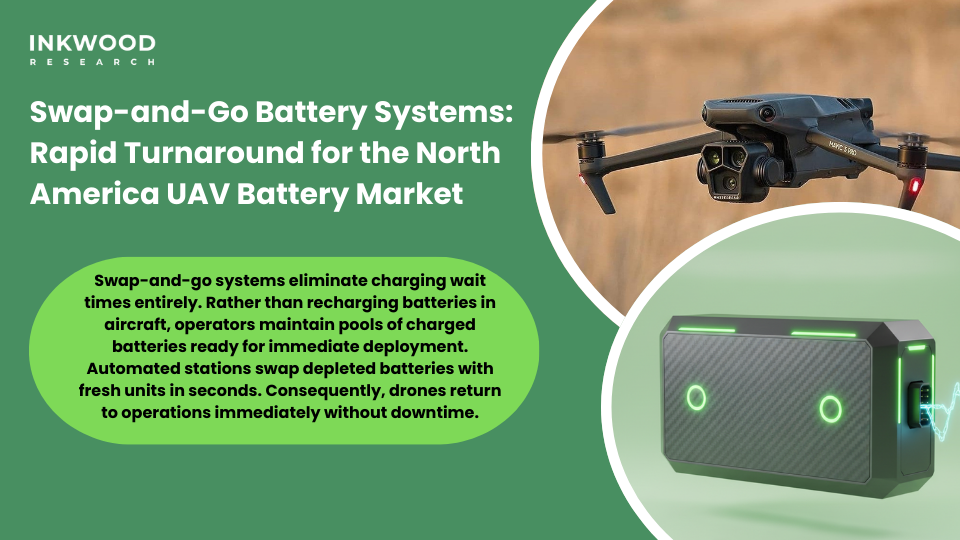
Swap-and-go systems eliminate charging wait times entirely. Rather than recharging batteries in aircraft, operators maintain pools of charged batteries ready for immediate deployment. Automated stations swap depleted batteries with fresh units in seconds. Consequently, drones return to operations immediately without downtime.
How do automated systems work? Robotic mechanisms remove discharged batteries and install charged replacements autonomously. According to industry analysis, swappable batteries improve last-mile logistics efficiency dramatically. Delivery drones operate longer hours with minimal interruption, enhancing operational capacity while reducing fleet maintenance costs.
Battery pool management requires sophisticated software. Systems track individual battery health, charge cycles, and performance degradation. Subsequently, operators retire batteries reaching end-of-life thresholds before failures occur. Additionally, predictive analytics optimize charging schedules across battery pools, ensuring adequate fresh batteries always remain available.
Operational Advantages of Swap Systems
Swap-and-go infrastructure maximizes fleet utilization. Traditional charging creates idle periods, consuming 30-50% of operational windows. However, battery swapping reduces turnaround to under 60 seconds typically. Consequently, single drones complete 2-3x more daily missions. For delivery operators, this translates to proportional revenue increases without fleet expansion.
Flexibility represents another significant advantage. Operators maintain battery pools matching mission requirements. High-demand periods draw from expanded pools without aircraft additions. Subsequently, capital efficiency improves through right-sizing fleet investments. Moreover, battery leasing models captured approximately 8% of total market revenue in 2024, enabling OPEX rather than CAPEX approaches.
Safety improves through centralized battery management. Rather than individual operators handling batteries with varying care levels, automated systems ensure consistent treatment. Temperature monitoring, charge rate optimization, and health tracking occur automatically. Therefore, battery failures decrease while lifespans extend through professional management protocols.
Infrastructure Requirements and Costs
Swap-and-go systems require substantial initial investments. Automated swapping stations cost $30,000-$100,000, depending on capacity and sophistication. Additionally, battery pools represent significant capital—each aircraft requires 3-5 batteries in rotation typically. Consequently, total system costs exceed wireless charging alternatives substantially.
Nevertheless, high-intensity operations justify investments. Delivery services completing 50+ daily missions per aircraft achieve rapid payback through revenue generation. Similarly, time-sensitive applications where downtime creates opportunity costs benefit from continuous availability. Research indicates delivery operators recoup swap-and-go investments within 12-18 months through increased throughput.
Centralized vs. distributed architectures affect economics significantly. Hub-and-spoke models concentrate on swapping infrastructure at central facilities. Drones return to hubs between missions for rapid battery changes. Conversely, distributed networks position swap stations throughout operational areas. This approach reduces flight distances but increases infrastructure investments proportionally.
Market Adoption Trends
Swap-and-go adoption accelerates in specific sectors, with logistics and delivery representing primary adopters. Companies like Amazon and UPS evaluate swappable battery infrastructure for drone delivery networks. Moreover, modular pack architectures featured in 18% of new releases during 2024, supporting easier maintenance for large-scale fleets.
Asian markets lead adoption curves currently. However, North American deployments expand rapidly. Defense applications explore swap-and-go for tactical operations requiring sustained presence. Commercial operators recognize throughput advantages justifying premium investments. Consequently, market projections indicate accelerating adoption through 2030.
Competitive Landscape: Charging Infrastructure Leaders in the North America UAV Battery Market
Market Leaders and Technology Innovators
- Skysense pioneered modular charging pad development. Their robust solutions support a wide range of commercial drone models. Emphasis on reliability and integration ease creates competitive advantages. Moreover, systems accommodate various aircraft weights and power requirements through adaptive technology.
- WiBotic specializes in wireless charging and power optimization. Based in Seattle, the company developed the PowerPad and PowerPad Pro platforms. According to Automated Warehouse, PowerPad Pro integrates seamlessly into existing hangars and storage facilities. Furthermore, advanced fleet management capabilities and multi-platform interoperability distinguish their offerings.
- H3 Dynamics focuses on hybrid charging technologies and autonomous mobile stations. Their solutions cater to mission-critical deployments requiring guaranteed availability. Additionally, partnerships with aerospace manufacturers integrate charging infrastructure directly into aircraft platforms. This vertical integration creates ecosystem advantages that competitors struggle to match.
- Heisha Technology offers diverse portfolios spanning battery swap systems and solar-powered stations. Their solutions target both commercial and governmental end-users. Moreover, emphasis on renewable energy integration aligns with sustainability mandates, gaining prominence across North America.
- Drone Volt provides turnkey solutions combining drone manufacturing with charging infrastructure. This integrated approach simplifies procurement for organizations seeking complete systems. Moreover, focus on public safety applications creates niche dominance in emergency services and law enforcement sectors.
Strategic Partnerships and Market Positioning
WiBotic announced BlueHalo as the first PowerPad Pro partner in 2024. BlueHalo’s Intense Eye V2 and E900 models now feature integrated wireless charging and data offload. According to Mary Clum, BlueHalo’s Corporate EVP, growing demand for permanently deployed, remotely controlled UAVs drives partnership value. PowerPad Pro provides a single, reliable tool integrating autonomous capabilities into platforms.
Valmont Industries partnered with WiBotic, enhancing drone inspection capabilities. For the first time, their charging platforms work with any UAVs they deploy. Remote flight plan uploads and automated sensor downloads enable inspections at any location. This flexibility proves crucial for infrastructure monitoring across distributed assets.
Cross-sector collaborations accelerate innovation.
- In June 2024, FlyingBasket partnered with Molicel, developing batteries for FB3 cargo drones. This integration enhanced flight range by 9% while supporting 100 kg payloads.
- Similarly, in April 2024,Avy integrated Tulip’s smart batteries, achieving 80-100% longer flight times.
Emerging Players and Disruptive Technologies
Startups challenge established players through specialized solutions. PowerUp develops innovative battery swap stations and scalable infrastructure for commercial fleets. Their modular approach allows incremental capacity expansion, matching fleet growth organically.
DroneDock focuses on automated swapping stations, enabling rapid turnaround. Their technology targets high-frequency operations where minimizing downtime creates competitive advantages. Moreover, integration with fleet management software provides comprehensive operational visibility.
SkyX Systems develops autonomous docking and charging platforms. Their solutions enable truly autonomous operations from takeoff through landing and recharging. This end-to-end automation reduces operational complexity while improving reliability significantly.
Industry Applications: Real-World Infrastructure Deployments in North America UAV Battery Market
Logistics and Delivery Operations
Major logistics companies revolutionize last-mile delivery through drone infrastructure. Amazon Prime Air evaluates multiple charging solutions across pilot programs. Their operational requirements demand rapid turnaround, supporting 100+ daily deliveries per hub. Consequently, swap-and-go systems prove most effective for high-volume urban operations.
UPS Flight Forward implements hybrid infrastructure strategies. Hub facilities feature automated swapping stations, maximizing throughput. However, suburban delivery zones utilize wireless charging pads at strategic locations. This approach balances capital efficiency with operational flexibility across diverse geographic requirements.
Further, delivery applications represent the fastest-growing segments as swappable batteries improve efficiency dramatically, allowing drones to operate for longer hours. Moreover, infrastructure investments enable business models previously impossible under traditional battery constraints.
Agricultural Technology Applications
Precision agriculture operators deploy mobile charging infrastructure across vast farmlands. John Deere integrates drone technology with equipment fleets for comprehensive field monitoring. Solar-powered mobile stations are positioned at field edges during growing seasons. Subsequently, drones complete multi-hour survey missions without returning to base facilities.
Crop health monitoring requires sustained presence throughout critical growth phases. Traditional approaches necessitate multiple drones or frequent manual battery changes. However, strategically positioned mobile charging enables a single aircraft to cover thousands of acres efficiently. Farmers report 60-70% cost reductions compared to multi-drone alternatives.
Seasonal operations favor mobile solutions economically. Permanent infrastructure generates poor ROI for applications concentrated in 4-6 month windows. Conversely, mobile units deploy during active seasons and then redeploy to different operations. This flexibility maximizes capital utilization across agricultural enterprises.
Defense and Public Safety
Military applications demand robust, field-deployable charging infrastructure. Defense contractors develop ruggedized systems that withstand combat environments. Mobile charging units are transported via military vehicles, establishing capabilities wherever operations require.
Border Patrol utilizes permanent wireless charging stations along monitoring corridors. UAVs patrol sectors autonomously, returning to charging stations between missions. This approach maintains continuous surveillance without human intervention. Moreover, integration with command systems provides real-time operational awareness.
Fire departments install permanent charging infrastructure at stations. Emergency response drones remain ready through continuous wireless charging. When alarms sound, drones launch immediately with fully charged batteries. Subsequently, incident commanders receive aerial intelligence within minutes rather than waiting for helicopter deployments.
Infrastructure Inspection and Monitoring
Utility companies revolutionize infrastructure monitoring through permanent charging networks. Electric transmission line corridors feature charging stations at strategic intervals. Inspection drones patrol sections autonomously, documenting equipment conditions and identifying developing issues.
Pipeline operators deploy similar approaches across vast networks. Charging infrastructure along rights-of-way enables continuous monitoring missions. According to operator reports, drone inspections occur 10x more frequently than traditional methods. Moreover, early problem detection prevents catastrophic failures, saving millions in remediation costs.
Bridge and highway departments establish permanent monitoring installations. Drones conduct structural inspections on predetermined schedules without human pilots. Wireless charging enables truly autonomous operations, while data offload provides engineering teams instant access to inspection results. Consequently, maintenance decisions occur proactively rather than reactively.
Key Takeaways: North America UAV Battery Market Infrastructure Insights
On-Site Solutions :
Wireless charging eliminates physical connections while automating data transfer. Fixed installations excel for permanent operations, achieving 98% uptime through autonomous systems.- Mobile Flexibility : Portable charging units enable remote operations across oil fields, agricultural zones, and disaster sites. Solar-powered options provide sustainable off-grid capabilities.
Swap-and-Go Efficiency :
Automated battery swapping reduces turnaround to seconds rather than hours. High-intensity operations achieve 2-3x throughput improvements, justifying premium investments.Technology Leaders :
WiBotic, Skysense, H3 Dynamics, and Heisha Technology dominate through specialized solutions. Strategic partnerships accelerate innovation across integrated ecosystems.
Conclusion: Optimizing Infrastructure for the North America UAV Battery Market
Charging infrastructure fundamentally determines UAV fleet operational efficiency. Organizations selecting appropriate solutions gain decisive competitive advantages. On-site wireless systems excel for permanent installations requiring autonomous operations. Mobile units provide flexibility for remote deployments and seasonal applications. Meanwhile, swap-and-go systems maximize throughput for high-intensity operations, justifying premium investments.
What’s the bottom line? Since no single infrastructure approach suits all applications, successful deployments must match solutions to specific operational requirements. Delivery operations benefit from swap-and-go throughput. Agricultural monitoring leverages mobile flexibility. Utility infrastructure inspection utilizes permanent wireless networks. Moreover, hybrid strategies combining multiple approaches often optimize complex operational environments.
Looking forward, the North America UAV battery market trajectory appears exceptionally strong. Defense modernization programs continue to invest billions in autonomous systems. Commercial applications expand across logistics, agriculture, and infrastructure sectors. Consequently, charging infrastructure markets grow faster than overall battery markets, reflecting operational bottleneck solutions creating disproportionate value.
Technology evolution accelerates continuously. Wireless charging efficiency improves while costs decline. Battery swap automation advances through AI-powered robotics. Solar-powered mobile solutions become increasingly viable. Therefore, organizations investing in infrastructure today position themselves advantageously for tomorrow’s opportunities.
Ready to evaluate charging infrastructure solutions for your UAV operations?
Contact Inkwood Research for comprehensive analysis and strategic guidance. Our expert team provides tailored recommendations based on your specific operational requirements, helping you navigate the complex landscape of charging infrastructure options and maximize your North America UAV battery market investments.
Frequently Asked Questions
What charging infrastructure solution works best for delivery drone operations?
Swap-and-go systems prove most effective for high-volume delivery operations. Automated battery swapping reduces turnaround to under 60 seconds, enabling individual drones to complete 2-3x more daily missions. Subsequently, fleet utilization increases dramatically while capital investments decrease. Moreover, centralized battery management improves safety and extends battery lifespans through professional handling. Logistics companies report 12-18 month payback periods through increased throughput and revenue generation.
How do mobile charging units compare economically to permanent installations?
Mobile solutions cost $3,000-$15,000 typically versus $5,000-$25,000 for permanent wireless installations. However, operational costs remain higher through generator fuel and transportation requirements. Mobile infrastructure suits applications requiring geographic flexibility or seasonal deployments. Conversely, concentrated operations in fixed locations justify permanent installations through superior long-term economics. Hybrid approaches combining both often optimize complex operational environments, balancing capital efficiency with flexibility.
Which companies lead charging infrastructure innovation in North America?
WiBotic dominates wireless charging through PowerPad platforms, integrating seamlessly with varied UAV types. Skysense provides robust, modular solutions emphasizing reliability and ease of integration. H3 Dynamics specializes in hybrid technologies and autonomous mobile stations for mission-critical deployments. Heisha Technology offers diverse portfolios spanning battery swap systems and solar-powered solutions. Additionally, emerging players like PowerUp, DroneDock, and SkyX Systems challenge established leaders through specialized innovations.