Table of Contents
TLDR
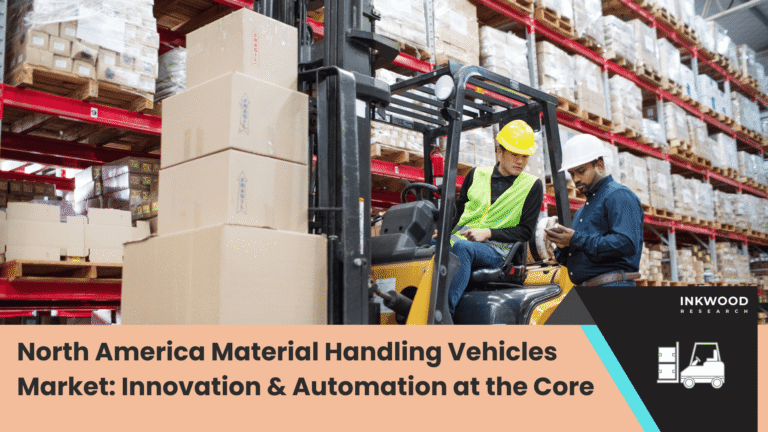
The North America material handling vehicles market commands regional leadership through advanced automation infrastructure and aggressive technology adoption. Valued at $10.66 billion in 2025, projections indicate growth to $15.14 billion by 2032 at a 5.14% CAGR. Labor shortages, stringent safety regulations, and environmental mandates accelerate investments in autonomous forklifts, electric fleets, and smart warehouse systems. The United States dominates through massive e-commerce networks while Canada leverages manufacturing strength and unique cold-climate expertise for specialized applications across diverse industries.
North American logistics managers, distribution center directors, and operations executives discover region-specific insights addressing local challenges. Procurement teams evaluating equipment investments benefit from competitive intelligence and regulatory guidance. Manufacturing plant managers, third-party logistics providers, and cold storage operators gain strategic perspectives. Furthermore, investors analyzing industrial automation opportunities access detailed regional market dynamics and growth projections.
North America’s Material Handling Leadership Position
The North America material handling vehicles market establishes global benchmarks for automation sophistication and technology integration. According to our research, the material handling vehicles market encompasses the United States and Canadian operations, representing the world’s most advanced logistics infrastructure. These material handling vehicles serve critical functions across manufacturing, third-party logistics, and rapidly expanding e-commerce warehouse automation sectors regionally.
Regional leadership stems from several converging advantages. Warehouse automation solutions adoption rates exceed global averages significantly. Furthermore, extensive capital availability enables aggressive equipment modernization cycles. Technology partnerships between equipment manufacturers and end-users accelerate innovation deployment.
Market Valuation and Growth Projections
Our analysis reveals that the North America material handling vehicles market reached $10.66 billion in 2025. Forecasts project expansion to $15.14 billion by 2032, progressing at 5.14% CAGR. This growth trajectory reflects sustained investments in distribution center automation and fleet modernization programs.
Major retailers operate hundreds of distribution facilities requiring thousands of material handling vehicles annually. Amazon alone operates over 300 fulfillment centers across North America, each requiring sophisticated equipment fleets. Consequently, replacement cycles and capacity expansions drive consistent demand regardless of economic conditions.
Technology Adoption Leadership
North American companies pioneer emerging technologies before global proliferation. Autonomous vehicle deployments reached commercial scale years ahead of other regions. Similarly, lithium-ion battery adoption accelerated faster than in European or Asian markets despite higher initial costs.
This innovation culture stems from competitive pressures and customer expectations. Consumers demand rapid delivery, forcing logistics providers to maximize operational efficiency. Equipment downtime or inefficiencies directly impact service levels and profitability. Therefore, companies invest aggressively in proven technologies delivering measurable performance improvements.
Labor Crisis Accelerates Automation Adoption
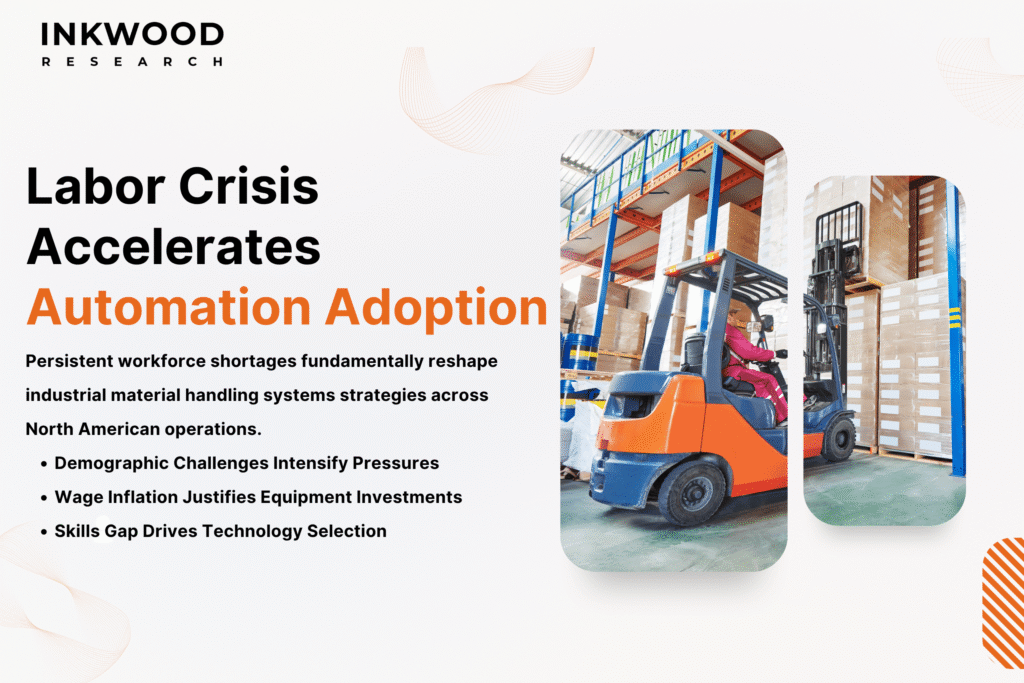
Persistent workforce shortages fundamentally reshape industrial material handling systems strategies across North American operations. Warehouse worker turnover exceeds 40% annually in many markets, creating constant recruitment and training burdens. Wages increased 25-30% over recent years as companies compete for limited labor pools.
These dynamics make automated guided vehicles (AGVs) increasingly attractive from purely economic perspectives. Autonomous systems operate continuously without breaks, sick days, or turnover disruptions. Initial capital investments deliver returns within 18-24 months through labor cost avoidance and productivity gains.
Demographic Challenges Intensify Pressures
Baby Boomer retirements remove experienced warehouse workers from available talent pools. Meanwhile, younger generations prefer technology-focused careers over physical warehouse positions. Immigration policy uncertainties further constrain labor supply across border states and regions.
Consequently, businesses cannot rely on traditional staffing models for capacity planning. Instead, automation provides consistent, scalable capabilities independent of external labor markets. Warehouse robots market solutions complement remaining human workers rather than replacing entire workforces.
Wage Inflation Justifies Equipment Investments
Average warehouse wages in major metros like Los Angeles, New York, and Chicago now exceed $18-20 per hour. Benefits, training costs, and management overhead add 30-40% to direct wage expenses. Therefore, total annual costs per warehouse worker approach $50,000-60,000.
In contrast, autonomous forklifts deliver equivalent productivity at total annual costs under $30,000, including financing, maintenance, and energy. This cost differential expands as wage inflation continues while equipment costs stabilize through manufacturing scale efficiencies.
Skills Gap Drives Technology Selection
Traditional forklift operators possess mechanical aptitude but limited technology expertise. Modern smart warehouse technologies require different skill sets, emphasizing system supervision rather than manual operation. Retraining existing workforces presents significant challenges and costs.
Alternatively, newer autonomous systems feature intuitive interfaces requiring minimal training. Supervisors monitor multiple vehicles simultaneously through centralized dashboards. Consequently, businesses maintain productivity with smaller, higher-skilled workforces rather than large pools of equipment operators.
Regulatory Environment Shapes Equipment Selection
OSHA (Occupational Safety and Health Administration) establishes comprehensive safety standards governing material handling equipment operations across the United States workplaces. These regulations mandate operator training, equipment inspections, and workplace protocols protecting employee safety. Non-compliance results in substantial fines and potential facility shutdowns.
Forklift-related incidents cause approximately 85 fatalities and 34,000 serious injuries annually across American workplaces. Therefore, OSHA scrutinizes material handling operations intensively. Companies invest heavily in safety technologies, training programs, and compliance documentation to avoid regulatory penalties and liability exposure.
- Safety Technology Requirements
Modern industrial trucks and lifts incorporate advanced safety features exceeding minimum regulatory standards. Collision avoidance systems using radar, cameras, and LiDAR sensors prevent accidents by detecting obstacles and personnel. Speed governors limit maximum velocities based on load weights and travel conditions.
Operator presence systems ensure equipment stops immediately when operators leave control positions. Load capacity indicators prevent overloading situations, causing tip-overs or structural failures. Furthermore, stability control systems monitor load distribution, adjusting handling characteristics to maintain safe operations.
- Training and Certification Mandates
OSHA requires comprehensive operator training, including classroom instruction, practical evaluation, and ongoing refresher courses. Employers must maintain detailed training records demonstrating compliance with federal standards. Additionally, workplace-specific training addresses unique hazards and operational procedures at individual facilities.
These requirements create administrative burdens and ongoing costs for manual equipment operations. Conversely, autonomous systems eliminate operator certification requirements while maintaining superior safety records. Consequently, automation reduces regulatory compliance complexity alongside operational costs.
- Environmental Regulations Drive Electrification
California’s Advanced Clean Trucks regulation mandates zero-emission vehicle adoption timelines for commercial fleets. Other states adopt similar standards following California’s environmental leadership. These regulations accelerate electric material handling equipment transitions regardless of economic considerations.
Indoor air quality standards further restrict internal combustion engine usage within enclosed facilities. Warehouses serving food distribution, pharmaceutical, or clean manufacturing applications cannot tolerate combustion emissions. Therefore, electric powertrains become mandatory rather than optional for many applications.
Electric Vehicle Mandates Transform Regional Fleets
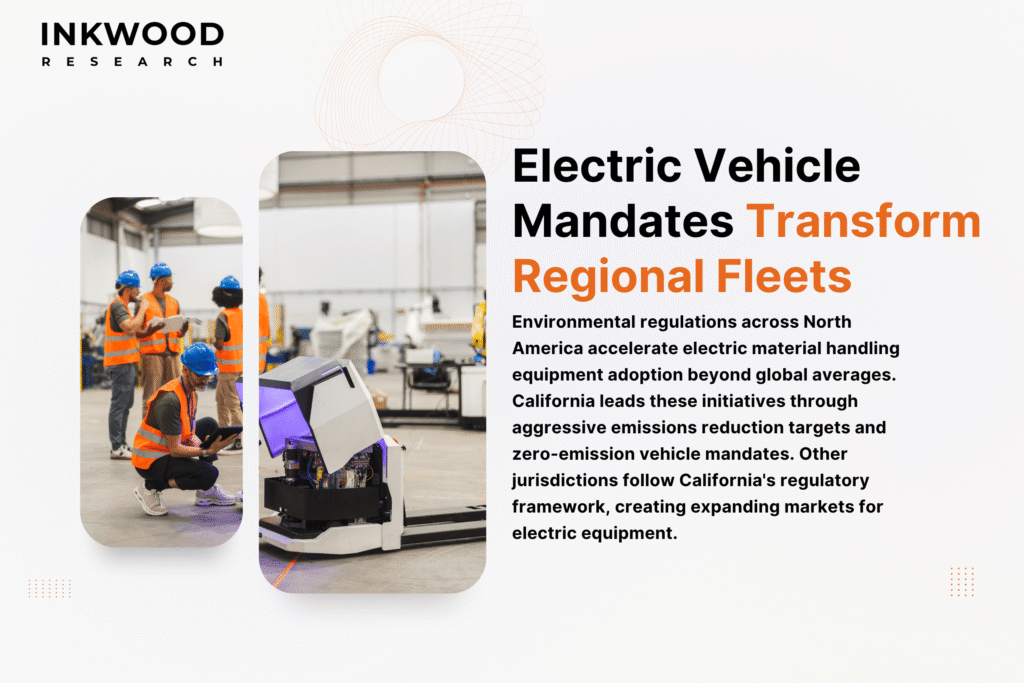
Environmental regulations across North America accelerate electric material handling equipment adoption beyond global averages. California leads these initiatives through aggressive emissions reduction targets and zero-emission vehicle mandates. Other jurisdictions follow California’s regulatory framework, creating expanding markets for electric equipment.
California’s Regulatory Leadership
California Air Resources Board (CARB) implements strict emissions standards affecting industrial equipment throughout the state. The Advanced Clean Trucks regulation requires manufacturers to sell increasing percentages of zero-emission vehicles annually. By 2035, all new forklift sales in California must be zero-emission.
These mandates transform forklifts market dynamics as manufacturers accelerate electric product development. Companies operating California facilities must plan transitions years in advance due to equipment lifecycle durations. Consequently, national fleet strategies incorporate California requirements even for out-of-state operations.
Federal Incentives Support Transitions
The Infrastructure Investment and Jobs Act allocates substantial funding for clean energy infrastructure, including charging systems. Federal tax credits reduce electric vehicle purchase costs by thousands of dollars per unit. Additionally, accelerated depreciation schedules improve project economics from accounting perspectives.
State-level incentive programs supplement federal support in markets like New York, Massachusetts, and Washington. Combined incentives offset 20-30% of incremental electric equipment costs compared to conventional alternatives. Therefore, total cost of ownership calculations increasingly favor electric solutions across applications.
Lithium-Ion Battery Advantages
Modern lithium-ion batteries deliver superior performance across multiple dimensions compared to lead-acid predecessors. Charging efficiency exceeds 95% versus 80% for lead-acid technology, reducing energy costs significantly. Opportunity charging during breaks maintains equipment availability without dedicated charging periods.
Battery lifespan extends 3-5 years longer than lead-acid alternatives, reducing replacement frequency and costs. Maintenance requirements virtually disappear as lithium-ion systems require no watering, equalization charging, or terminal cleaning. Furthermore, consistent voltage delivery throughout discharge cycles maintains equipment performance regardless of charge state.
Infrastructure Development Challenges
Large electric fleets require substantial electrical service upgrades at many facilities. Transformer capacity, panel boards, and distribution systems may need replacement to support charging loads. These infrastructure investments add project costs and complexity beyond equipment purchases.
Battery swapping systems offer alternatives for operations requiring continuous equipment availability. Quick-swap stations enable battery changes in minutes rather than hours of charging time. Nevertheless, battery inventory requirements and swap infrastructure investments create financial burdens for many operations.
United States Market Dynamics and Opportunities
The United States dominates the North America material handling vehicles market share through extensive e-commerce infrastructure and advanced manufacturing capabilities. Amazon, Walmart, Target, and numerous regional retailers operate massive distribution networks requiring sophisticated material handling solutions throughout the country.
- E-Commerce Infrastructure Drives Demand
According to U.S. Census Bureau data, e-commerce maintains robust growth trajectories across consumer segments. Online sales now represent over 15% of total retail activity, continuing upward trends despite economic uncertainties. This expansion directly correlates with distribution center construction and equipment procurement.
Major metropolitan areas feature dozens of fulfillment centers supporting same-day or next-day delivery promises. Each facility requires 50-200 material handling vehicles, depending on size and throughput requirements. Additionally, technological obsolescence drives replacement cycles as older equipment lacks modern connectivity and automation capabilities.
- Manufacturing Resurgence Creates Opportunities
Nearshoring initiatives bring manufacturing capacity back to North America from overseas locations. Automotive, aerospace, electronics, and consumer goods sectors invest billions in new domestic production facilities. Each manufacturing plant requires comprehensive material transport vehicles supporting production workflows.
The Infrastructure Investment and Jobs Act funds transportation and logistics infrastructure improvements nationwide. These investments enhance supply chain efficiency while creating demand for modern material handling equipment. Furthermore, advanced manufacturing techniques require sophisticated equipment capabilities beyond traditional forklift functions.
- Cold Storage Expansion Accelerates
Grocery delivery services and meal kit companies drive explosive cold storage facility growth. Temperature-controlled warehouses require specialized equipment operating reliably in freezing environments. Electric systems offer advantages over internal combustion alternatives that struggle in extreme cold.
Food safety regulations mandate stringent cleanliness standards prohibiting combustion emissions in food handling areas. Therefore, electric warehouse vehicles become mandatory for these applications. Market growth exceeds 8-10% annually as grocery e-commerce penetration increases across demographics.
- Third-Party Logistics Consolidation
3PL providers consolidate market share as companies outsource distribution activities to specialists. DHL, XPO Logistics, and regional providers operate hundreds of facilities requiring standardized equipment fleets. Fleet management sophistication and buying power influence equipment selection and technology adoption patterns.
These providers invest aggressively in automation technologies, demonstrating competitive advantages to prospective clients. ROI requirements drive equipment decisions as 3PL margins remain thin despite revenue growth. Consequently, operational efficiency improvements directly impact profitability and competitive positioning.
Canada’s Unique Market Characteristics
Canada’s material handling vehicles market benefits from robust manufacturing sectors, natural resource industries, and growing e-commerce penetration across provinces. The country’s vast geography creates unique logistics challenges requiring efficient industrial material handling systems across distribution networks.
Geographic Challenges Shape Requirements
Canadian operations span enormous distances between population centers, creating distinct logistics requirements. Distribution networks must serve markets from Vancouver to Halifax across 5,500 kilometers. Consequently, regional warehouses require substantial equipment inventories supporting service level objectives.
Winter conditions lasting 5-6 months annually necessitate specialized equipment tolerating extreme temperatures. Cold storage operations overlap with outdoor loading dock exposures, requiring equipment functioning reliably in -30°C conditions. Therefore, Canadian specifications often exceed southern climate requirements significantly.
Manufacturing Sector Strength
Ontario and Quebec concentrate Canadian manufacturing activity, particularly automotive and aerospace industries. These sectors demand heavy-duty material handling equipment supporting production workflows. Load capacities, durability requirements, and operational intensity exceed typical warehouse applications.
Trade relationships with the United States integrate Canadian operations into North American supply chains seamlessly. Cross-border logistics require equipment compatibility with American facilities and regulatory standards. Additionally, bilingual documentation and training materials support French-speaking Quebec operations.
Natural Resource Industry Applications
Forestry, mining, and energy sectors utilize specialized material handling equipment for harsh industrial environments. Heavy-duty forklifts transport materials in sawmills, warehouses, and processing facilities. Equipment must withstand dust, moisture, and temperature extremes while maintaining reliability.
These industries prioritize equipment durability and serviceability over technological sophistication. Maintenance capabilities in remote locations influence purchase decisions significantly. Therefore, simpler, more robust equipment often outperforms advanced alternatives lacking adequate service support.
Cold Storage Expertise Leadership
Canadian companies develop specialized expertise in cold storage operations given climate requirements. Food processing, pharmaceutical distribution, and cold chain logistics represent substantial market segments. Equipment specifications address freezer operations, condensation management, and battery performance in extreme cold.
This expertise positions Canadian operations as innovation centers for cold storage technologies. Equipment manufacturers test and refine cold-weather capabilities through Canadian partnerships. Subsequently, these innovations serve global cold storage markets beyond North American applications
Regional Competitive Strategies and Market Leaders
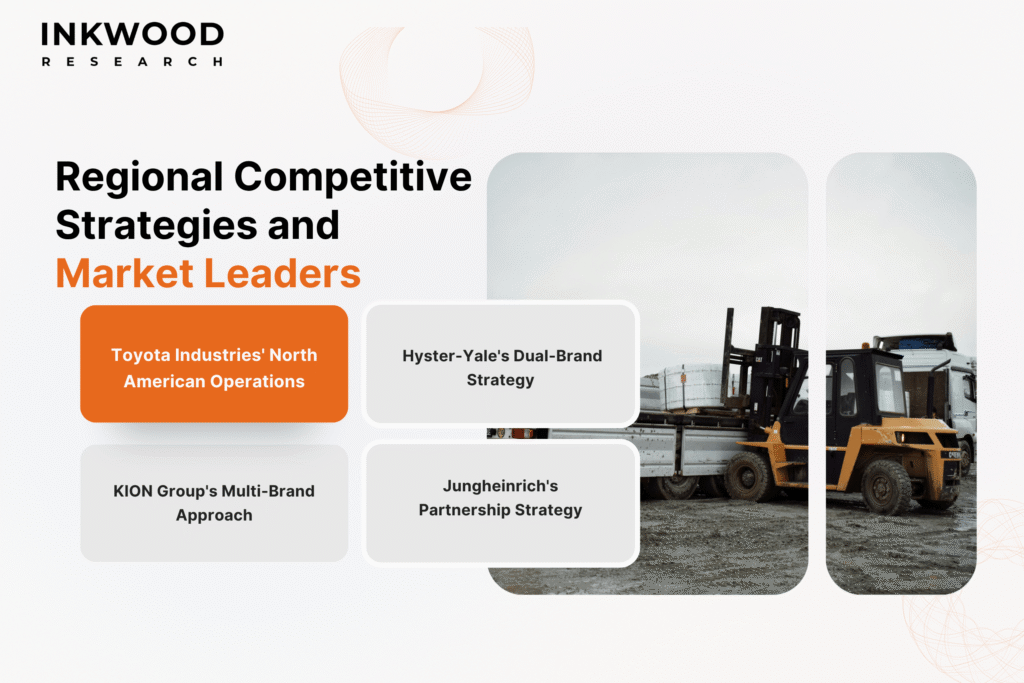
Crown Equipment Corporation maintains a strong North American presence through American manufacturing and direct sales models. Based in New Bremen, Ohio, Crown operates extensive service networks providing rapid response times across the region. The company’s 2024 revenue reached $5.29 billion, demonstrating continued market strength.
Crown’s direct sales approach eliminates distributor markups while ensuring consistent customer experiences. Factory-trained technicians provide superior service quality compared to third-party maintenance providers. Additionally, flexible financing programs enable equipment access without prohibitive capital expenditures for customers.
- Toyota Industries’ North American Operations
Toyota Industries Corporation dominates regional markets through the Toyota and Raymond brands, serving complementary segments. Toyota Material Handling focuses on traditional forklift applications across diverse industries. Conversely, Raymond specializes in narrow-aisle warehouse equipment for distribution center applications.
The companies’ combined manufacturing footprint includes multiple North American facilities. Toyota’s $100 million Columbus, Indiana, expansion demonstrates ongoing regional commitment. Additionally, the joint Energy Solutions Manufacturing Center produces lithium-ion batteries supporting electric vehicle leadership.
- Hyster-Yale’s Dual-Brand Strategy
Hyster-Yale Materials Handling Inc operates globally through Hyster and Yale brands, addressing different market segments. Hyster emphasizes rugged applications for harsh industrial environments. Meanwhile, Yale targets warehouse and distribution center applications with an operator comfort focus.
In February 2024, Yale launched lithium-ion forklifts specifically designed for retail and warehouse applications. The ERP32-40UXTL three-wheeled and ERP30-70UXL four-wheeled models offer enhanced maneuverability for tight spaces. These innovations demonstrate brand-specific product development addressing distinct customer requirements.
- KION Group’s Multi-Brand Approach
KION Group AG serves North American markets primarily through the Linde Material Handling brand. German engineering heritage positions Linde as a premium equipment provider, emphasizing quality and performance. The company targets customers, prioritizing total cost of ownership over initial purchase prices.
KION’s partnership with Microsoft Azure develops cloud-based fleet management solutions announced in July 2024. This collaboration enables real-time monitoring and predictive maintenance across global operations. Furthermore, advanced analytics optimize equipment utilization and operational efficiency for enterprise customers.
- Jungheinrich’s Partnership Strategy
Jungheinrich AG distributes products through a partnership with Mitsubishi Logisnext Americas Group across North American markets. This arrangement leverages Mitsubishi’s established distribution network and service infrastructure. The joint venture Rocrich AGV Solutions launched in 2023 delivers autonomous lift trucks and automation solutions.
This partnership model enables rapid market expansion without massive infrastructure investments. Shared service networks reduce costs while maintaining customer support quality. Additionally, combined R&D resources accelerate autonomous vehicle development and deployment.
Innovation Hubs: Recent Product Launches and Developments
North American manufacturers lead global innovation through substantial R&D investments and customer collaboration. Proximity to end-users enables rapid feedback integration into product development cycles. Consequently, regional innovations often precede global product launches by 12-24 months.
- Autonomous Vehicle Commercial Deployments
Crown Equipment Corporation acquired a leading AGV technology company in January 2024, strengthening autonomous capabilities. This acquisition accelerates next-generation smart warehouse technologies development for distribution applications. Crown’s integration approach combines proprietary forklift expertise with advanced autonomous navigation systems.
The company’s Proximity Assist System represents semi-autonomous innovation bridging manual and fully autonomous operations. LiDAR sensing provides operators with corrective action opportunities before collisions occur. This approach addresses liability concerns while improving safety metrics substantially.
- Battery Technology Breakthroughs
Toyota and Raymond’s joint Energy Solutions Manufacturing Center commenced operations in late 2023. The Broome County, New York facility produces lithium-ion batteries and thin plate pure lead batteries. This vertical integration strategy reduces supply chain risks while controlling battery quality and specifications.
Battery swapping infrastructure development accelerates across high-intensity applications. Quick-swap stations enable battery changes in under five minutes, maintaining continuous operations during peak periods. Consequently, businesses eliminate productivity losses from traditional charging downtime.
- IoT and Fleet Management Platforms
KION’s collaboration with Microsoft Azure creates cloud-based fleet management, transforming equipment from isolated tools into networked business systems. Real-time data collection enables predictive maintenance, utilization optimization, and performance benchmarking. Additionally, remote diagnostics reduce service response times and repair costs.
Crown’s proprietary InfoLink system provides wireless fleet management across equipment populations. Managers access utilization metrics, operator behavior data, and maintenance alerts through web-based dashboards. These insights identify training opportunities, rightsizing fleets, and operational improvements invisible through traditional management approaches.
- Operator Assistance Technologies
Advanced safety systems transform equipment into active accident prevention platforms. Multi-sensor collision avoidance using radar, cameras, and ultrasonic sensors detects obstacles from all directions. Furthermore, AI algorithms distinguish between stationary objects, moving equipment, and pedestrians, adjusting responses appropriately.
Operator monitoring systems track behavior patterns, identifying risky practices requiring intervention. Excessive speed, harsh braking, and improper load handling trigger alerts and training requirements. Consequently, safety culture improvements occur through data-driven coaching rather than reactive discipline.
- Hydrogen Fuel Cell Pilots
While lithium-ion dominates mainstream adoption, hydrogen fuel cell pilots demonstrate viability for specific applications. Heavy-duty equipment requiring extended runtime without recharging benefits from fuel cell capabilities. Amazon, Walmart, and major 3PL providers test hydrogen-powered forklifts in high-intensity distribution centers.
Infrastructure challenges remain significant as hydrogen production, storage, and fueling systems require substantial investments. However, government incentives for clean energy support pilot program economics. Therefore, hydrogen may serve niche applications where battery limitations prove problematic.
Ownership Models Reshape Equipment Access
Traditional equipment purchases increasingly compete with alternative ownership models addressing different business priorities. Leasing, renting, and used equipment markets expand as companies optimize capital deployment strategies. These alternatives enable technology access without massive upfront investments.
Leasing Programs Gain Popularity
Operating leases convert capital expenditures into predictable monthly expenses, improving cash flow management. Lessors assume residual value risks as technology evolves and equipment depreciation accelerates. Additionally, lease agreements often include maintenance services, reducing operational burdens.
Tax advantages vary by jurisdiction and business structure, but generally favor leasing over purchasing. Lease payments typically qualify as fully deductible operating expenses. Conversely, owned equipment requires depreciation over extended periods, reducing immediate tax benefits.
Short-Term Rental Flexibility
Seasonal demand fluctuations create temporary capacity requirements unsuitable for permanent fleet expansions. Rental programs provide surge capacity during peak periods without idle equipment during slow seasons. Retailers particularly leverage rental solutions for holiday season requirements.
Project-based applications also favor rental approaches over purchasing. Construction, facility expansions, and special events require equipment temporarily. Rental economics outperform ownership when utilization periods span weeks or months rather than years.
Used Equipment Market Growth
Technological advancement accelerates equipment obsolescence even when the mechanical condition remains excellent. Three-to-five-year-old equipment offers substantial value for budget-conscious buyers accepting older technology. Used equipment costs 40-60% less than comparable new alternatives.
Certified refurbishment programs provide quality assurance and warranty coverage, bridging new and used markets. Manufacturers recondition returned lease equipment to like-new specifications. Subsequently, these units serve small businesses and secondary applications at accessible price points.
Flexible Ownership Transitions
Lease-to-own programs enable businesses to convert rental or lease arrangements into ownership positions. This flexibility accommodates evolving requirements as companies scale operations. Additionally, trial periods reduce technology adoption risks before permanent commitments.
Equipment-as-a-Service models bundle equipment, maintenance, and management into comprehensive subscription packages. These arrangements appeal to companies preferring outsourced equipment management. Service providers optimize fleet utilization across multiple customers while assuming operational responsibilities.
Key Takeaways
- North America commands global material handling innovation leadership through advanced automation adoption, substantial R&D investments, and sophisticated logistics infrastructure supporting e-commerce and manufacturing excellence.
- Persistent workforce shortages, 40%+ annual turnover rates, and wage inflation accelerate autonomous vehicle adoption as businesses prioritize operational consistency over traditional staffing models.
- OSHA safety standards, California emissions mandates, and environmental regulations shape equipment selection toward electric powertrains, advanced safety systems, and zero-emission technologies.
- The North America material handling vehicles market expands from $10.66 billion (2025) to $15.14 billion (2032), driven by e-commerce infrastructure, manufacturing resurgence, and cold storage facility expansion.
- California’s zero-emission mandates, federal incentives, and lithium-ion battery advantages accelerate regional electric equipment adoption beyond global averages across applications.
- Crown Equipment, Toyota Industries, Hyster-Yale, KION Group, and Jungheinrich employ distinct strategies, including direct sales, multi-brand portfolios, and strategic partnerships addressing diverse customer segments.
- North American manufacturers pioneer autonomous systems, lithium-ion batteries, IoT fleet management, and advanced safety technologies, subsequently deployed globally.
Conclusion
The North America material handling vehicles market exemplifies innovation leadership, transforming global logistics operations. Regional advantages, including advanced infrastructure, technology adoption culture, and competitive intensity, accelerate the development and deployment of cutting-edge solutions.
Labor market challenges create unprecedented opportunities for automation technologies addressing persistent workforce constraints. Simultaneously, regulatory environments push equipment electrification and safety enhancements beyond global norms. These dynamics position North America as a testing ground for technologies eventually serving worldwide markets.
Successful equipment strategies require understanding regional nuances, including regulatory requirements, ownership preferences, and application-specific performance demands. Businesses partnering with experienced suppliers and leveraging flexible ownership models maximize returns while minimizing implementation risks.
Inkwood Research delivers comprehensive North American market intelligence supporting strategic equipment decisions.
Our regional experts provide insights into competitive dynamics, technology trends, and regulatory developments impacting your operations.
Ready to modernize your material handling fleet? Contact our specialists for customized analysis addressing your specific regional requirements and growth objectives.