Table of Contents
This analysis is brought to you by Inkwood Research, a premier market intelligence firm specializing in North American energy storage and grid modernization sectors. Our research team combines extensive experience analyzing flow battery deployments, utility-scale energy storage projects, and regulatory frameworks across the United States and Canada. Based on our proprietary research methodologies and deep partnerships with U.S. Department of Energy programs, national laboratories, and leading utilities, we deliver actionable insights that empower strategic decision-making for enterprises navigating North America’s clean energy transition and long-duration storage market opportunities.
TLDR
North America’s flow battery market stands at $172.20 million in 2025, poised for dramatic expansion to $610.55 million by 2032 with a robust CAGR of 19.82%. This comprehensive analysis explores how vanadium redox flow batteries and advanced energy storage solutions are revolutionizing grid resilience across the U.S. and Canada. Discover why major utilities, policymakers, and energy developers are betting big on long-duration energy storage solutions to address renewable integration challenges and strengthen grid stability in an electrified future.
Energy sector executives, utility operators, renewable developers, and infrastructure investors will discover actionable insights throughout this analysis. Policy strategists and grid planners seeking to understand flow battery technology deployment will find comprehensive coverage of market drivers, regulatory frameworks, and competitive dynamics. Clean energy advocates, battery manufacturers, and strategic consultants focused on grid-scale batteries and sustainable energy storage will gain valuable intelligence on North America’s energy transition landscape.
The North America Energy Storage Revolution: Why Flow Batteries Matter Now
Power grids across North America, including the United States and Canada face an unprecedented challenge. As renewable capacity surges and extreme weather events multiply, utilities scramble to maintain stable electricity delivery. Meanwhile, data centers consume exponentially more energy, electric vehicles strain distribution networks, and aging infrastructure buckles under modern demands. However, a proven yet previously overlooked technology now emerges as the solution.
The North America flow battery market reached a valuation of $172.20 million in 2025, according to our analysis. Moreover, projections indicate this market will soar to $610.55 million by 2032, representing a compelling CAGR of 19.82% during the forecast period. This remarkable flow battery market growth reflects fundamental shifts in how North American utilities approach grid-scale batteries and long-duration energy storage solutions.
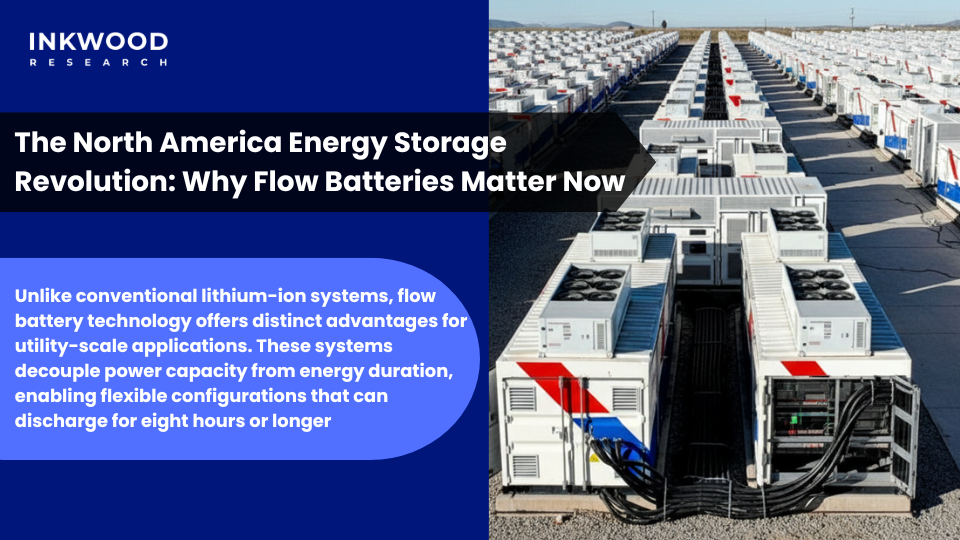
Unlike conventional lithium-ion systems, flow battery technology offers distinct advantages for utility-scale applications. These systems decouple power capacity from energy duration, enabling flexible configurations that can discharge for eight hours or longer. Furthermore, vanadium redox flow batteries demonstrate exceptional safety profiles, with non-flammable electrolytes that eliminate thermal runaway risks. The technology also boasts operational lifespans exceeding 20 years with minimal degradation, making vanadium flow batteries ideal for infrastructure-grade deployments.
Policy Frameworks Driving Flow Battery Adoption
Federal Initiatives Transforming Energy Storage Economics
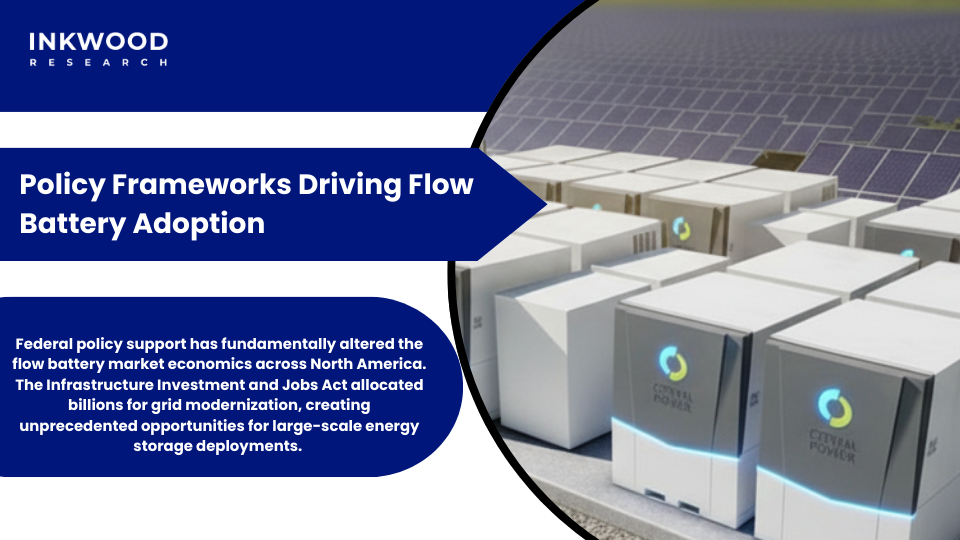
Federal policy support has fundamentally altered the flow battery market economics across North America. The Infrastructure Investment and Jobs Act allocated billions for grid modernization, creating unprecedented opportunities for large-scale energy storage deployments. Subsequently, the Inflation Reduction Act introduced investment tax credits covering up to 30% of project costs for qualifying energy storage solutions.
Additionally, the U.S. Department of Energy’s Long Duration Storage Shot targets reducing storage costs to $0.05 per kilowatt-hour by 2030. This ambitious goal accelerates flow battery technology innovations and commercial viability. Research funding through DOE programs supports breakthrough developments in redox flow batteries and manufacturing scale-up initiatives. Consequently, project developers now view flow battery deployment as economically competitive with traditional peaker plants.
Regional Programs Accelerating Market Development
State-level programs complement federal initiatives by creating immediate demand for grid energy storage solutions. California’s Self-Generation Incentive Program provides substantial rebates for long-duration storage projects. Meanwhile, New York’s ambitious clean energy targets require utilities to procure gigawatt-scale storage capacity by 2030. These mandates specifically favor industrial energy storage systems capable of multi-hour discharge durations.
Canadian provinces have launched parallel initiatives supporting sustainable energy storage deployment. Ontario’s energy plan emphasizes grid reliability through diverse storage technologies. British Columbia’s CleanBC program funds innovative storage pilots demonstrating flow battery efficiency in remote communities. Alberta’s electricity market reforms create revenue opportunities for flexible renewable energy storage systems that can participate in ancillary services markets.
Technology Breakthroughs Reshaping Market Dynamics
Vanadium Chemistry Advancements
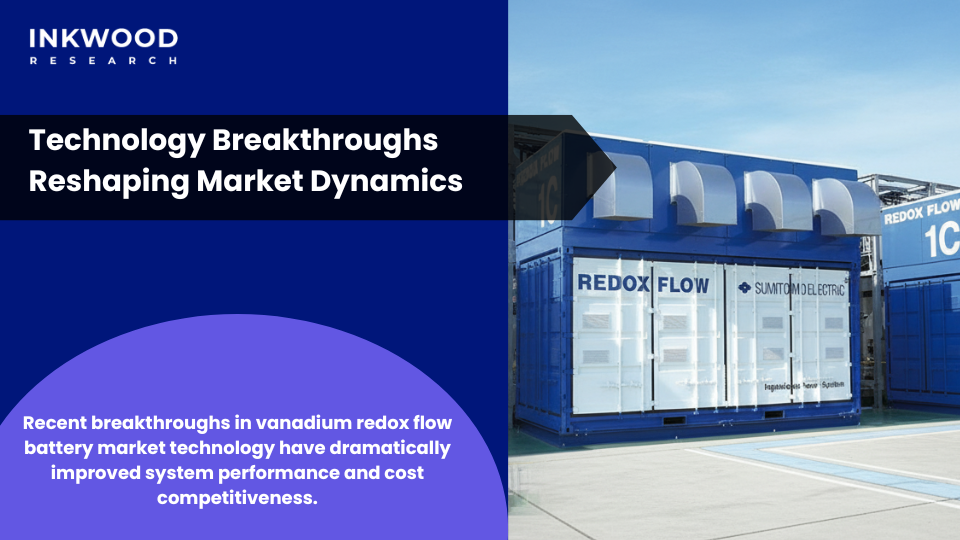
Recent breakthroughs in vanadium redox flow battery market technology have dramatically improved system performance and cost competitiveness. Sumitomo Electric Industries unveiled a revolutionary VRFB in March 2025 featuring a 30-year operational lifespan. This advancement incorporates newly developed long-life materials that enhance durability while reducing maintenance requirements. Moreover, the system achieves 15% higher energy density compared to previous generations, shrinking physical footprints and lowering installation costs by approximately 30%.
These flow battery technological advancements address critical barriers that previously limited commercial adoption. Enhanced energy density means utilities can store more electricity in smaller spaces, reducing land acquisition costs. Furthermore, extended lifespans improve project economics by spreading capital investments across decades of reliable operation. The combination of these factors positions vanadium flow batteries as increasingly attractive alternatives to lithium-ion systems for duration-sensitive applications.
Manufacturing Scale and Cost Reduction
Manufacturing innovations continue driving flow battery cost reduction strategies across North America. ESS Inc., a leading iron flow battery manufacturer, announced plans in 2025 to achieve 750 MWh of annual production capacity through fully automated manufacturing lines. This represents a significant scale-up from previous production levels. Similarly, the formation of Storion Energy in February 2025 established the first vertically integrated supply chain for vanadium flow battery components in North America.
Storion Energy emerged from a joint venture between Stryten Energy and Largo Clean Energy, combining U.S. manufacturing expertise with access to the Western Hemisphere’s only vanadium mine. This partnership addresses a critical supply chain vulnerability that previously forced North American developers to rely on imported electrolytes. Consequently, domestic production capabilities reduce costs while enhancing energy security for flow battery market participants.
Major Players and Strategic Developments

Sumitomo Electric’s North American Expansion
Sumitomo Electric Industries has dramatically expanded its flow battery deployment footprint across North America during 2024-2025. The company operates a 2 MW/8 MWh pilot project at San Diego Gas & Electric that has achieved 99% uptime while participating in California’s wholesale electricity markets. This demonstration project validates vanadium redox flow batteries for grid-scale applications requiring daily cycling and long-duration discharge.
Furthermore, Sumitomo announced plans in February 2023 to expand manufacturing capabilities specifically targeting the U.S. market. The company holds over 387 core patents related to flow battery technology, providing substantial intellectual property advantages. Their modular system design allows configurations ranging from six-hour to ten-hour durations, addressing diverse utility requirements. These strategic moves position Sumitomo as a dominant player in the North American flow battery market throughout the forecast period.
ESS Inc and Iron Flow Innovation
ESS Inc. has pioneered iron-based flow battery commercialization trends that challenge vanadium’s market dominance. The Oregon-based company’s technology utilizes abundant, low-cost iron in water-based electrolytes, dramatically reducing material expenses. Unlike vanadium systems, iron flow batteries avoid supply chain constraints associated with critical minerals. This approach resonates strongly with utilities seeking cost-effective long-duration energy storage solutions.
During 2025, ESS announced strategic global partnerships with other flow battery manufacturers to accelerate utility-scale deployment. The company’s Energy Warehouse product delivers 50 kW to 3 MW of power capacity with four to twelve hours of duration. Additionally, ESS systems feature non-toxic, non-flammable chemistry that eliminates fire suppression requirements. This safety profile, combined with a 25-year design life, makes iron flow technology particularly attractive for installations near populated areas.
Grid Resilience and Renewable Integration Challenges
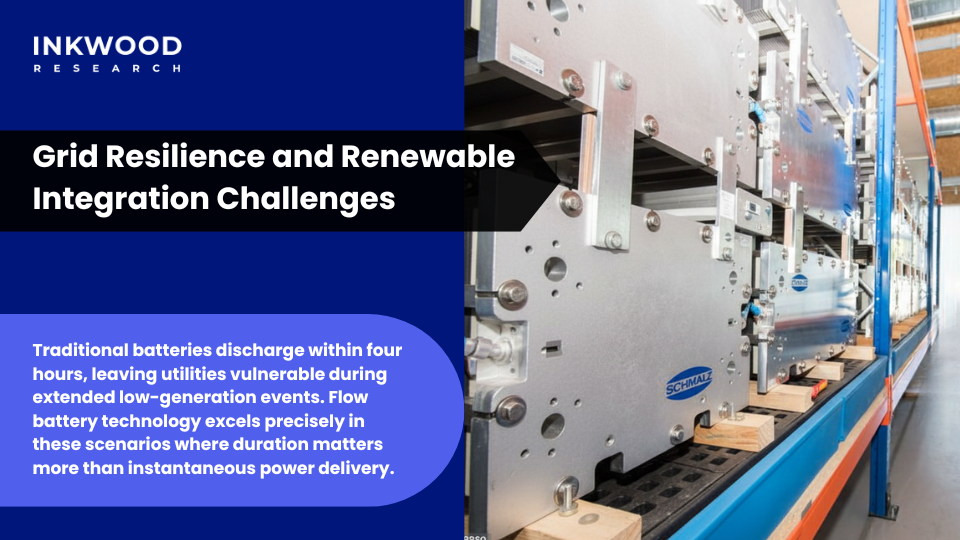
North American grids struggle with renewable intermittency as solar and wind capacity rapidly expand. Wind generation can drop precipitously during calm weather periods, while solar production ceases entirely after sunset. Traditional batteries discharge within four hours, leaving utilities vulnerable during extended low-generation events. Flow battery technology excels precisely in these scenarios where duration matters more than instantaneous power delivery.
Texas experienced this challenge acutely during Winter Storm Uri in February 2021, when frozen wind turbines and gas infrastructure left millions without power. Subsequently, grid operators recognized that renewable energy storage systems must provide multi-day backup capability. Flow batteries address this requirement through scalable tank designs that extend discharge duration economically. Utilities can size power capacity for typical conditions while oversizing energy capacity for extreme weather resilience.
Microgrid Applications in Remote Communities
Remote and indigenous communities across Canada face unique energy challenges that industrial energy storage systems can solve effectively. Diesel generators currently provide electricity to hundreds of isolated settlements, imposing high costs and environmental impacts. However, renewable microgrids incorporating grid-scale batteries offer cleaner alternatives. Flow batteries prove particularly suitable for these applications due to their ability to handle harsh environmental conditions and minimal maintenance requirements.
Projects in northern territories demonstrate flow battery adoption trends in challenging climates. These systems operate reliably at temperature extremes while providing multi-day backup during periods of low solar or wind generation. Moreover, the long operational lifespan reduces the need for frequent component replacement in locations with difficult logistics. Consequently, provincial and federal programs increasingly specify long-duration storage in microgrid tenders, creating targeted demand for flow battery market participants.
Competitive Landscape: Leading Companies and Market Positioning
Invinity Energy Systems’ Project Portfolio
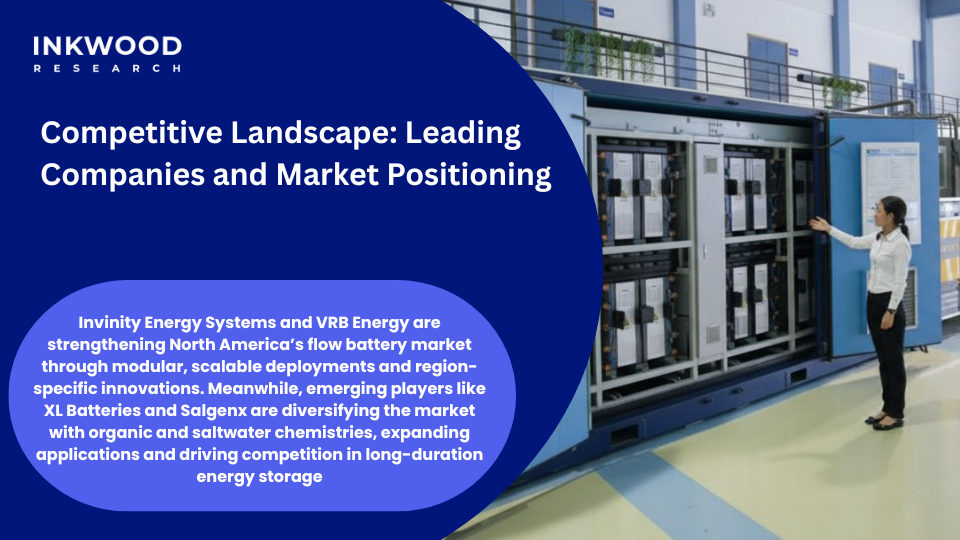
Invinity Energy Systems has established a strong presence through high-profile flow battery deployment projects across North America. In February 2025, the company announced the deployment of its VS3 next-generation system in a commercial Solar Plus Storage project in California. This installation showcases improved efficiency and scalability compared to previous product generations. Invinity’s modular approach allows customers to configure systems from 30 kWh to multi-MWh capacities, addressing both commercial and utility requirements.
The UK-based company’s strategy emphasizes standardized products that reduce engineering costs and accelerate installation timelines. Their systems ship as pre-integrated modules requiring minimal onsite assembly, contrasting with bespoke engineering projects common among Chinese manufacturers. This productization strategy resonates with North American developers seeking predictable costs and schedules. Furthermore, Invinity offers “Energy Storage as a Service” contracts that eliminate upfront capital requirements, expanding their addressable market beyond traditional utility procurements.
VRB Energy and Canadian Market Leadership
VRB Energy, headquartered in Canada, leverages domestic advantages in the North America flow battery market. The company’s technology utilizes proprietary stack designs that improve power density while reducing system costs. VRB Energy has delivered projects across multiple Canadian provinces, demonstrating vanadium flow battery performance in diverse climate conditions. Their experience in cold-weather applications provides competitive differentiation for northern installations.
Strategic partnerships enhance VRB Energy’s market position significantly. Collaborations with engineering firms and utilities create project pipelines while building industry confidence in flow battery technology. The company’s focus on Canadian content appeals to provincial programs prioritizing local economic development. Additionally, VRB Energy participates actively in industry associations and standards development, positioning itself as a thought leader in sustainable energy storage evolution.
Emerging Players and Technology Diversification
New entrants continue challenging established flow battery manufacturers with alternative chemistries and innovative business models. XL Batteries commissioned the first grid-scale organic flow battery in Houston during April 2025, partnering with Stolthaven Terminals. This project marks the commercial debut of patented water-based battery technology, emphasizing safety advantages over traditional chemistries. Similarly, Salgenx introduced a saltwater redox flow battery in December 2024, targeting cost-sensitive grid applications.
These alternative approaches expand the flow battery market by addressing different use cases and customer preferences. Organic and saltwater chemistries avoid critical mineral dependencies that constrain vanadium and iron technologies. Furthermore, diverse technology options accelerate overall market growth by providing solutions for applications where incumbent technologies face limitations. Consequently, utilities benefit from increased competition, driving performance improvements and cost reductions across all energy storage solutions.
Investment Trends and Commercial Opportunities
Venture Capital and Strategic Financing
Investment in flow battery commercialization trends has accelerated dramatically across North America during 2024-2025. ESS Inc. raised $250 million through a SPAC listing, providing capital for manufacturing expansion and project development. Form Energy, while focusing on iron-air batteries, secured investments from Breakthrough Energy and other prominent climate funds, validating long-duration storage concepts more broadly. This influx of capital supports the rapid scaling required to achieve cost targets and commercial viability.
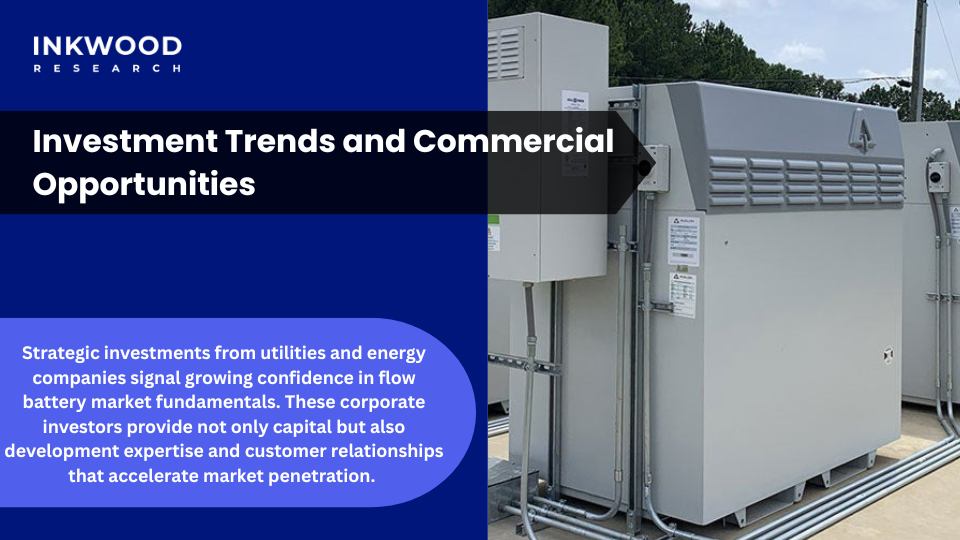
Strategic investments from utilities and energy companies signal growing confidence in flow battery market fundamentals. These corporate investors provide not only capital but also development expertise and customer relationships that accelerate market penetration. Additionally, project finance structures increasingly accommodate flow battery technology as operational track records demonstrate reliability. Favorable debt terms improve project economics, enabling developers to offer competitive pricing against conventional generation resources.
Data Center and Industrial Opportunities
Data centers represent an emerging application driving flow battery deployment across North America. These facilities require uninterruptible power supplies with substantial capacity to protect against grid outages. Traditional diesel generators face increasing environmental restrictions and operational costs. However, large-scale energy storage systems powered by renewables offer cleaner alternatives while reducing long-term expenses. Flow batteries excel in this application due to their fire safety characteristics and ability to provide backup power for extended periods.
Industrial facilities with critical processes similarly benefit from industrial energy storage systems, providing resilience against grid disturbances. Manufacturing plants, cold storage facilities, and water treatment operations cannot tolerate power interruptions. Flow battery installations enable these customers to maintain operations during utility outages while participating in demand response programs that generate revenue. Furthermore, pairing storage with onsite solar reduces electricity costs and enhances sustainability credentials important to corporate stakeholders.
Key Takeaways
- The North America flow battery market demonstrates compelling growth trajectories driven by converging policy, technology, and economic factors. Federal and state programs create substantial financial incentives while renewable mandates generate immediate demand for long-duration energy storage solutions. Technology breakthroughs by companies like Sumitomo Electric have dramatically improved system performance while reducing costs by approximately 30% compared to previous generations.
- Major manufacturers, including Sumitomo Electric Industries, ESS Inc., Invinity Energy Systems, and VRB Energy, are establishing manufacturing capacity and project pipelines across the region. The formation of Storion Energy represents a transformative development in creating vertically integrated North American supply chains for vanadium redox flow batteries. These strategic initiatives address supply vulnerabilities while positioning domestic manufacturers to capture growing market opportunities.
- Grid resilience challenges and renewable integration requirements drive utility adoption of flow battery technology for applications where duration exceeds lithium-ion capabilities. Remote microgrids, utility firming, and industrial backup power represent high-growth segments where sustainable energy storage economics favor flow chemistry. Data centers and AI facilities present emerging opportunities as these energy-intensive operations seek reliable, long-duration backup solutions.
- Investment activity confirms strong market confidence, with hundreds of millions flowing into flow battery manufacturers during 2024-2025. The combination of improved economics, proven technology, and supportive policies creates favorable conditions for sustained flow battery market growth throughout the forecast period to 2032. Stakeholders across the energy value chain should closely monitor developments in this rapidly evolving sector.
Conclusion: Positioning for North America’s Storage Future
North America stands at an energy storage inflection point. As the flow battery market expands from $172.20 million in 2025 toward $610.55 million by 2032, strategic positioning becomes critical for market participants. Utilities must evaluate how long-duration energy storage solutions fit within broader grid modernization strategies. Developers should assess partnership opportunities with established flow battery manufacturers to secure technology access and project support.
Policymakers face decisions about incentive structures that accelerate deployment while ensuring grid reliability benefits. The combination of federal support through the Infrastructure Investment and Jobs Act alongside state-level mandates creates unprecedented momentum. However, sustained growth requires continued policy commitment and regulatory frameworks that recognize flow battery technology value propositions. Our analysis indicates that jurisdictions prioritizing long-duration storage will achieve renewable targets faster while maintaining superior grid resilience.
For investors and strategic acquirers, the North America flow battery market presents compelling opportunities across the value chain. Manufacturing scale-up, supply chain integration, and project development all require substantial capital deployment. Companies that successfully navigate technology selection, partnership structures, and market positioning will capture outsized returns as sustainable energy storage transitions from niche applications to mainstream grid infrastructure. The next phase of North America’s energy transition depends fundamentally on technologies like flow batteries that enable reliable, clean electricity delivery at scale.
Frequently Asked Questions
What makes flow batteries better than lithium-ion for grid-scale storage?
Flow batteries excel in applications requiring discharge durations exceeding four hours, where their cost advantage becomes pronounced. Unlike lithium-ion systems, vanadium redox flow batteries decouple power and energy capacity, allowing utilities to economically extend discharge duration by simply adding larger electrolyte tanks
How do government policies support flow battery deployment in North America?
Federal programs like the Infrastructure Investment and Jobs Act and the Inflation Reduction Act provide substantial financial support through investment tax credits covering up to 30% of project costs. The Department of Energy’s Long Duration Storage Shot program funds research targeting $0.05 per kilowatt-hour storage costs by 2030. Additionally, state-level mandates in California, New York, and other jurisdictions require utilities to procure gigawatt-scale energy storage solutions, creating immediate market demand.
Which companies lead the North America flow battery market?
Sumitomo Electric Industries dominates with advanced vanadium flow battery technology featuring 30-year lifespans and 30% cost reductions. ESS Inc. leads iron flow innovation with plans for 750 MWh annual production capacity. Invinity Energy Systems provides modular VRFB solutions with successful California deployments. VRB Energy maintains a strong Canadian presence with cold-climate expertise. Storion Energy, formed in February 2025 through Stryten Energy and Largo Clean Energy’s partnership, creates the first vertically integrated North American supply chain.