Table of Contents

This analysis is brought to you by Inkwood Research, a leading market intelligence firm specializing in automotive electrification technologies, battery safety validation systems, and regulatory compliance frameworks. Based on our extensive research partnerships with automotive OEMs, battery manufacturers, testing certification bodies, and government safety agencies across North America, Europe, and Asia-Pacific, we deliver strategic insights empowering decision-makers navigating the battery testing equipment market transformation and automotive industry electrification.
TLDR
Automotive battery testing has become mission-critical as electric vehicles transform global transportation. The battery testing equipment market delivers sophisticated validation platforms ensuring battery packs meet stringent safety standards. From thermal runaway prevention to crash-test compliance, comprehensive testing protocols protect consumers while enabling manufacturer confidence. According to our analysis, the North America battery testing equipment market grows at a 4.65% CAGR through 2032, driven by electrification mandates and regulatory requirements. Moreover, advanced testing infrastructure separates reliable products from potentially hazardous failures.
Automotive engineers developing electric powertrains, quality assurance managers overseeing battery production, regulatory compliance specialists, and testing laboratory operators will gain valuable insights. Further, original equipment manufacturers evaluating validation infrastructure, battery cell suppliers ensuring product quality, and safety certification professionals navigating the market will discover actionable implementation strategies for comprehensive automotive battery testing programs.
The Automotive Battery Testing Imperative

Electric vehicle adoption accelerates worldwide, fundamentally transforming automotive safety requirements. Battery systems now represent the single most critical component determining vehicle reliability, driving range, and occupant protection. Consequently, comprehensive testing protocols have evolved into non-negotiable prerequisites for market entry.
The Stakes Have Never Been Higher
A single battery failure can trigger catastrophic consequences. Thermal runaway events generate temperatures exceeding 800°C within seconds, potentially igniting adjacent cells in cascade reactions. According to our research, automotive manufacturers now allocate 15-20% of electric vehicle development budgets toward battery validation programs. Consequently, this investment reflects recognition that inadequate testing creates existential business risks through recalls, litigation, and brand damage.
Market Growth Driven by Electrification
The North America battery testing equipment market reached $156.77 million in 2025, progressing toward $215.54 million by 2032 at a 4.65% CAGR. Automotive applications constitute the fastest-growing end-user segment as manufacturers transition entire product portfolios to electric propulsion. Furthermore, a new model introduction requires extensive testing infrastructure supporting design validation, manufacturing quality control, and regulatory certification.
Why Traditional Testing Falls Short
Conventional automotive testing evolved around internal combustion powertrains. However, battery systems introduce entirely different failure modes requiring specialized evaluation methodologies. In this regard, electrochemical instability, thermal management challenges, and high-voltage safety considerations demand equipment capabilities far beyond traditional mechanical testing. As a result, this fundamental shift drives sustained innovation within the battery testing equipment market.
Safety Validation and Abuse Testing Protocols

Automotive battery systems must demonstrate resilience against extreme abuse conditions that conventional vehicles never encounter. Accordingly, comprehensive safety validation separates production-ready designs from laboratory curiosities.
Thermal Runaway Prevention
Thermal runaway represents the most severe battery failure mode. Single-cell overheating can propagate throughout entire battery packs, generating toxic fumes and igniting flammable materials. Furthermore, testing protocols therefore include nail penetration, external heating, and overcharge scenarios that intentionally trigger cell failure. Accordingly, engineers monitor temperature propagation rates, determining whether adjacent cells ignite within critical time windows.
According to industry standards, including IEC 62660-2, thermal abuse testing subjects batteries to temperatures exceeding 130°C while monitoring voltage stability and physical deformation. In this regard, equipment within the battery testing equipment market increasingly incorporates blast chambers containing thermal runaway events while capturing high-speed video documenting failure progression.
Mechanical Abuse Validation
Vehicle collisions subject battery packs to extreme mechanical forces. Crush testing applies specified loads simulating impact scenarios, ensuring electrical isolation is maintained even when enclosures deform. Similarly, drop tests validate packaging integrity during handling and transportation. On the other hand, vibration testing replicates years of road stress within hours, identifying fatigue failure mechanisms before field deployment.
The SAE J2464 standard defines comprehensive abuse testing requirements for electric vehicle battery systems. Accordingly, testing facilities throughout the North America battery testing equipment market have invested heavily in equipment supporting these protocols. These include, hydraulic crush fixtures and electrodynamic shakers capable of generating multi-axis vibration profiles.
Electrical Abuse Scenarios
Short-circuit testing evaluates battery response when terminals accidentally connect through low-resistance paths. Overcharge protocols push cells beyond voltage limits, assessing battery management system protection algorithms. Moreover, forced discharge drives batteries into voltage reversal, simulating controller malfunctions. These intentional abuse conditions reveal design weaknesses before they manifest as field failures.
Modern testing platforms integrate real-time monitoring, capturing voltage, current, temperature, and pressure data at millisecond intervals. As a result, this comprehensive data collection enables forensic analysis to understand failure mechanisms and validate protective systems.
Navigating the Regulatory Compliance Landscape
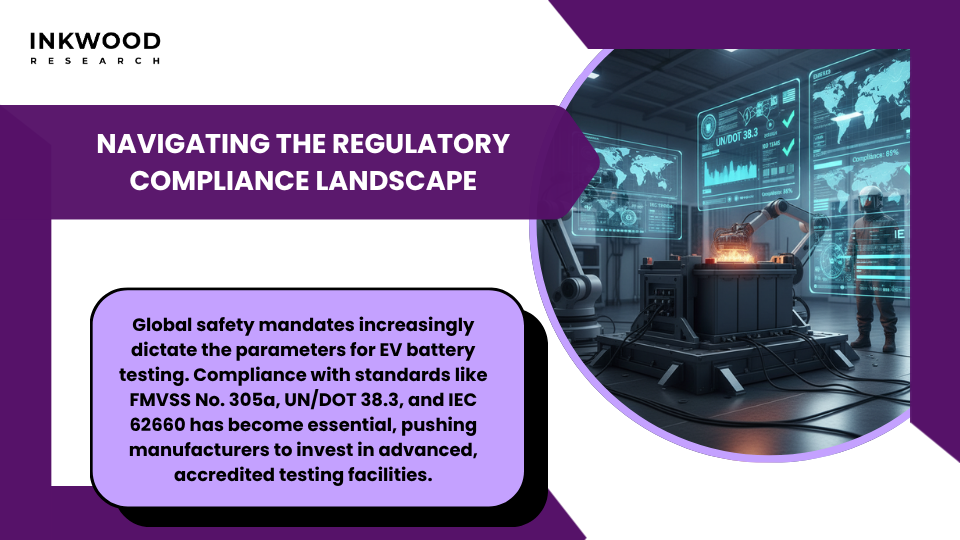
Government agencies worldwide have established comprehensive regulatory frameworks governing automotive battery safety. Accordingly, understanding these requirements proves essential for market access.
North American Regulatory Requirements
The Federal Motor Vehicle Safety Standard (FMVSS) No. 305a, effective February 2025, establishes comprehensive performance requirements for electric vehicle propulsion batteries. Furthermore, this regulation mandates rigorous testing for battery retention during crashes, electrical isolation integrity, thermal runaway prevention, and post-crash safety compliance.
Testing laboratories throughout the North America battery testing equipment market have expanded capabilities to perform one-hour fire observation protocols and thermal runaway simulations required under these regulations. According to our analysis, the North American market reached $156.77 million in 2025, growing toward $215.54 million by 2032, driven substantially by FMVSS compliance investments.
International Standards Harmonization
Multiple international standards govern automotive battery testing, including UN/DOT 38.3 for transportation safety, ISO 12405 series for electrically propelled vehicles, and IEC 62660 for lithium-ion traction batteries. Also, organizations like UL Solutions provide third-party certification services, ensuring compliance across jurisdictions.
However, slight variations between regional requirements complicate global product launches. Hence, manufacturers often adopt testing protocols exceeding minimum standards, ensuring products meet requirements across all target markets simultaneously.
Performance Testing Across Operating Conditions

Beyond safety validation, automotive batteries must demonstrate consistent performance across diverse environmental conditions and duty cycles. Comprehensive characterization ensures customer satisfaction and warranty cost management.
Cold-Weather Performance Validation
Battery capacity and power capability decline significantly at low temperatures. Lithium-ion systems can lose 40% performance at -20°C compared to room temperature operation. Testing protocols, therefore, include cold-crank simulations validating vehicle start capability in sub-zero conditions.
Canadian facilities within the North America battery testing equipment market particularly emphasize cold-weather testing, given harsh winter climates. Moreover, environmental chambers maintaining -40°C enable validation across extreme operating ranges. Manufacturers developing vehicles for northern markets often conduct extended winter testing campaigns in locations like Alaska and Scandinavia, complementing laboratory evaluations with real-world field data.
High-Temperature Endurance Testing
Elevated temperatures accelerate battery degradation while potentially triggering safety issues. For instance, desert climates subject vehicles to sustained 50°C+ ambient temperatures, stressing thermal management systems. Endurance testing at elevated temperatures validates cooling system adequacy and predicts warranty performance across vehicle lifetimes.
Testing facilities throughout the battery testing equipment market now incorporate thermal chambers capable of precisely maintaining high temperatures for weeks or months. Moreover, accelerated aging protocols expose batteries to temperature cycling between extremes, compressing years of degradation into months of testing time.
Fast-Charging Capability Assessment
Consumer expectations demand charging times approaching conventional refueling experiences. Modern electric vehicles support charging rates exceeding 250 kilowatts, replenishing 80% capacity within 20-30 minutes. However, such aggressive charging generates substantial heat and stress electrochemical interfaces.
Testing protocols validate fast-charging capability across battery life, ensuring performance remains acceptable after thousands of cycles. Manufacturers must balance charging speed against longevity, with testing data informing these trade-offs. Equipment supporting these evaluations includes high-power bidirectional power supplies and precision thermal monitoring systems capturing hotspot formation during charging events.
Testing Infrastructure and Equipment Requirements
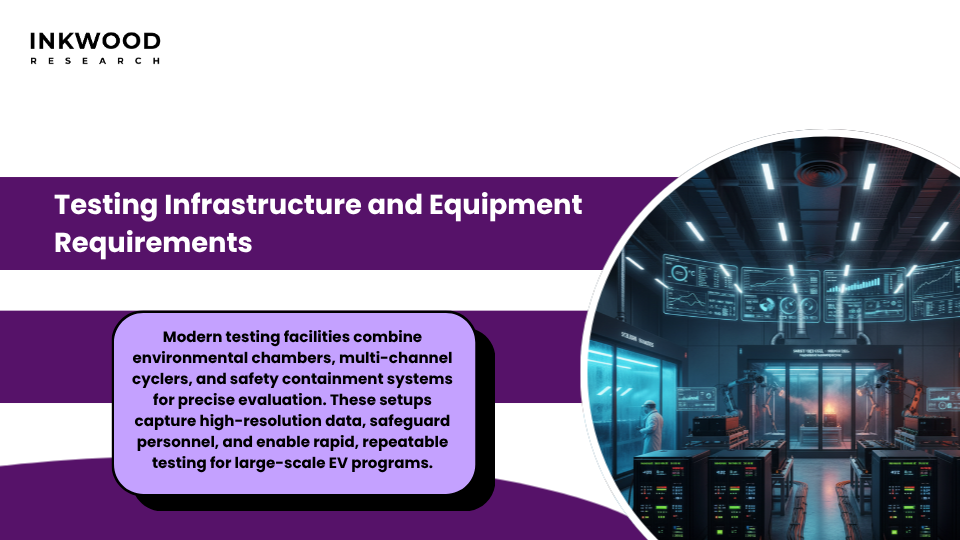
Comprehensive automotive battery validation demands sophisticated facilities equipped with specialized instrumentation. Understanding infrastructure requirements helps organizations plan testing capability expansion.
Multi-Channel Cycler Systems
Battery testing fundamentally requires precise control of charge-discharge cycles while monitoring electrical parameters. Multi-channel cyclers provide independent control of dozens or hundreds of test channels simultaneously. Further, regenerative designs recover discharge energy, reducing facility power consumption by 40-60%.
Systems from industry leaders, including Arbin Instruments, Chroma Systems Solutions, and BioLogic, offer voltage ranges from millivolts to 1,500 volts, supporting applications from individual cell characterization through complete pack validation. Accordingly, measurement resolution down to 100 parts per million enables detection of subtle degradation signatures critical for lifetime prediction.
Environmental Chamber Integration
Temperature profoundly influences battery behavior, necessitating climate-controlled testing environments. Walk-in chambers accommodate complete vehicle battery packs, maintaining precise temperatures from -40°C to +85°C. In this regard, thermal shock capabilities enable rapid temperature transitions simulating extreme environmental changes.
According to our research, environmental chamber procurement represents 25-30% of total testing facility capital expenditure. Leading suppliers like ESPEC and Cincinnati Sub-Zero provide chambers specifically designed for battery testing, incorporating safety systems that manage thermal runaway events.
Safety Containment Systems
Abuse testing intentionally triggers battery failures requiring robust containment. Blast chambers isolate thermal runaway events while enabling observation through reinforced viewing windows. Furthermore, exhaust systems evacuate toxic fumes generated during cell failure, protecting personnel and facility infrastructure.
Fire suppression systems specifically designed for lithium-ion batteries employ specialized extinguishing agents addressing unique combustion characteristics. These safety systems have become mandatory within the battery testing equipment market, with regulatory agencies increasingly scrutinizing laboratory safety protocols.
Data Acquisition and Analysis Systems
Modern testing generates terabytes of data requiring sophisticated management infrastructure. High-speed data acquisition systems capture voltage, current, temperature, and pressure measurements at millisecond intervals across hundreds of channels simultaneously. Accordingly, centralized databases aggregate results, enabling statistical analysis and trend identification.
Software platforms from testing equipment manufacturers provide visualization tools helping engineers interpret complex datasets. Additionally, automated reporting functionality generates documentation supporting regulatory certification submissions, streamlining compliance workflows.
Industry Leaders and Competitive Dynamics

The battery testing equipment market features established instrumentation specialists serving automotive applications. Understanding competitive positioning helps procurement teams evaluate supplier capabilities.
- Arbin Instruments Global Presence
Headquartered in College Station, Texas, Arbin Instruments maintains global operations with offices across China, Germany, India, Korea, Vietnam, and Taiwan. The company’s 65,000-square-foot manufacturing facility produces high-precision test equipment ranging from micro-ampere applications to megawatt-scale systems. Arbin’s Regenerative Battery Tester (RBT) series provides voltage capabilities up to 1,500 volts with current ranges exceeding 1,000 amperes, specifically addressing electric vehicle pack testing requirements.
- Chroma Systems Solutions Integration
Chroma Systems Solutions offers comprehensive battery testing platforms supporting automotive applications from cell characterization through pack validation. Modular architectures enable capacity expansion matching production growth without wholesale system replacement. Further, integration with battery management system emulators allows comprehensive functional testing, validating control algorithms.
- Midtronics Diagnostic Innovation
Midtronics pioneered conductance-based battery testing, enabling rapid health assessment without full discharge cycles. This technology dominates automotive service centers where technicians evaluate battery condition within seconds. Additionally, cloud connectivity aggregates fleet-wide battery health data, supporting predictive maintenance programs that prevent unexpected failures.
- Megger Field Testing Solutions
Megger Group Limited emphasizes portable testing instruments enabling field deployment. Rugged designs withstand harsh industrial environments while maintaining measurement accuracy. Moreover, battery conductance testers provide rapid State of Health screening for large battery banks in telecommunications and utility applications, complementing laboratory validation equipment.
- BioLogic Research Systems
BioLogic specializes in high-precision electrochemical test equipment serving research applications. The 2024 launch of the BCS-900 added 10A/6V modules optimized for fundamental battery research while maintaining scalability toward production testing. Also, real-time electrochemical impedance spectroscopy capabilities enable continuous degradation monitoring throughout charge-discharge cycles.
Key Takeaways
- Automotive battery testing has become mission-critical as electric vehicles transform global transportation safety requirements
- FMVSS No. 305a in North America and the EU Battery Regulation in Europe drive comprehensive testing infrastructure investments
- Thermal runaway prevention, mechanical abuse validation, and electrical safety testing represent critical safety protocols
- Production testing, including formation, grading, and end-of-line validation, ensures manufacturing quality consistency
- Environmental chambers, multi-channel cyclers, and safety containment systems constitute core testing infrastructure requirements
- Industry leaders, including Arbin Instruments, Chroma Systems, UL Solutions, and DEKRA, continuously expand testing capabilities
- Recent laboratory expansions in Germany and Georgia demonstrate sustained investment responding to automotive electrification
Conclusion
Automotive battery testing represents a non-negotiable prerequisite for electric vehicle market success. As manufacturers transition entire product portfolios to electric propulsion, comprehensive validation protocols ensure safety, reliability, and regulatory compliance. The battery testing equipment market responds with increasingly sophisticated platforms balancing laboratory precision against automotive production throughput demands.
Organizations developing electric vehicles must invest in testing infrastructure that matches their application requirements and target market regulations. Whether validating new battery pack designs or ensuring manufacturing quality consistency, comprehensive testing separates successful products from potential failures. Essentially, technology providers continue innovating, delivering systems that accelerate time-to-market while ensuring thorough safety evaluation.
Inkwood Research provides strategic intelligence supporting decision-making throughout the automotive battery ecosystem. Our analysis helps manufacturers, testing laboratories, and certification bodies understand regulatory evolution, competitive dynamics, and technology trends.
Contact our team to discuss how customized research deliverables can inform your automotive battery testing strategy and equipment procurement decisions.
Frequently Asked Questions
What are the most critical automotive battery safety tests?
Thermal runaway testing, mechanical crush validation, and electrical abuse scenarios represent the most critical safety evaluations. These protocols intentionally trigger failure conditions, ensuring battery systems maintain electrical isolation and prevent fire propagation even under extreme circumstances that vehicles may encounter during crashes or malfunctions.
How long does comprehensive automotive battery testing take?
Complete battery pack validation typically requires 6-12 months, including safety testing, performance characterization across temperatures, and accelerated lifetime studies. Production testing occurs within hours for each battery pack, validating quality before shipping to vehicle assembly plants. Development programs may extend 18-24 months when including iterative design improvements.
What testing standards apply to automotive batteries globally?
Major standards include FMVSS No. 305a (North America), EU Battery Regulation (Europe), UN/DOT 38.3 (transportation), ISO 12405 series (electric vehicles), IEC 62660 (lithium-ion batteries), and SAE J2464 (abuse testing). Manufacturers typically design products exceeding minimum requirements to ensure compliance across all target markets simultaneously.