Table of Contents
This analysis is brought to you by Inkwood Research, a leading market intelligence firm specializing in European energy transformation, port infrastructure development, and industrial decarbonization strategies. Our research team combines extensive experience analyzing electrolyzer deployment, renewable energy integration, and hydrogen value chain development across the Netherlands and broader European markets. Based on our proprietary research methodologies and strategic partnerships with energy producers, port authorities, and technology developers, we deliver actionable insights that empower strategic decision-making for enterprises navigating Europe’s green hydrogen revolution.
TLDR
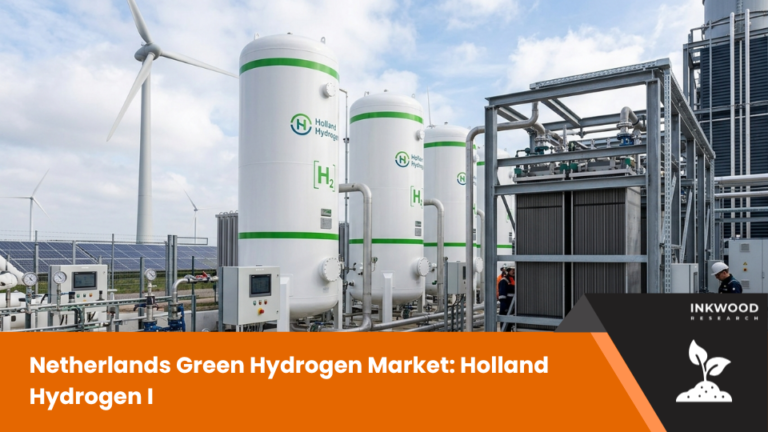
The Netherlands green hydrogen market grows from US$602.62 million in 2026 to US$11,986.78 million by 2034 at 45.32% CAGR. Holland Hydrogen I represents Europe’s largest renewable source hydrogen facility, utilizing 200MW alkaline electrolysis powered by wind energy, green hydrogen from offshore installations. Shell’s project integrates renewable energy integration through grid injection green hydrogen systems while supplying industrial green hydrogen to Rotterdam’s Energy and Chemicals Park. This pioneering deployment establishes infrastructure blueprints for hydrogen energy across European port complexes through innovative PEM electrolysis applications.
Port authorities developing hydrogen infrastructure, energy companies planning electrolyzer projects, European manufacturers seeking decarbonization pathways, technology providers supplying hydrogen systems, infrastructure investors evaluating port modernization opportunities, policy makers designing hydrogen frameworks, and shipping companies exploring clean fuel alternatives will gain critical insights into how strategic port-based hydrogen facilities transform industrial operations while establishing foundations for continental hydrogen networks through integrated renewable power sources.
Netherlands Green Hydrogen Market Analysis
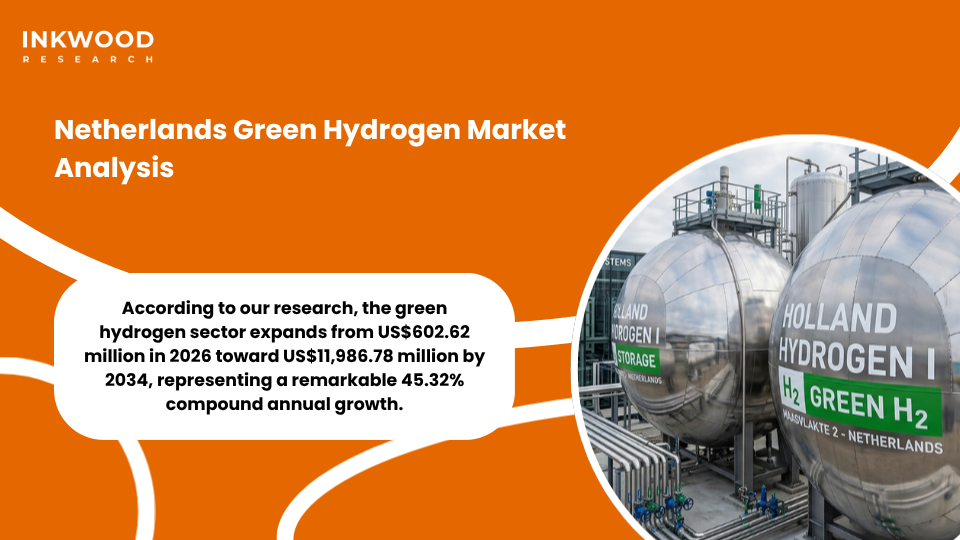
The Netherlands green hydrogen market experiences transformative momentum as strategic infrastructure projects establish foundations for large-scale clean fuel production. According to our research, the green hydrogen sector expands from US$602.62 million in 2026 toward US$11,986.78 million by 2034, representing a remarkable 45.32% compound annual growth. This acceleration reflects how renewable energy abundance combines with advanced alkaline electrolysis technologies, driving hydrogen energy adoption across industrial sectors.
Moreover, projects like Holland Hydrogen I demonstrate how renewable source integration enables industrial green hydrogen production at unprecedented scales. Meanwhile, wind energy green hydrogen initiatives combine with grid injection green hydrogen systems through sophisticated renewable energy integration strategies, connecting offshore wind farms directly to production facilities.
Holland Hydrogen I emerges as Europe’s most significant port-based hydrogen facility, establishing blueprints for continental infrastructure development. Shell’s 200-megawatt electrolyzer on Rotterdam’s Tweede Maasvlakte demonstrates how strategic location advantages combine with existing industrial infrastructure. Furthermore, the project’s integration with dedicated pipeline systems and offshore wind installations creates comprehensive value chains supporting both immediate decarbonization objectives and long-term export ambitions.
Port authorities worldwide observe Rotterdam’s hydrogen hub development as coastal facilities become focal points for clean energy transformation. These locations offer unique advantages connecting renewable power generation, industrial consumption, and international shipping routes. Consequently, hydrogen infrastructure in port environments addresses multiple market segments simultaneously while building foundations for intercontinental trade networks.
Understanding the Netherlands Green Hydrogen Market Landscape
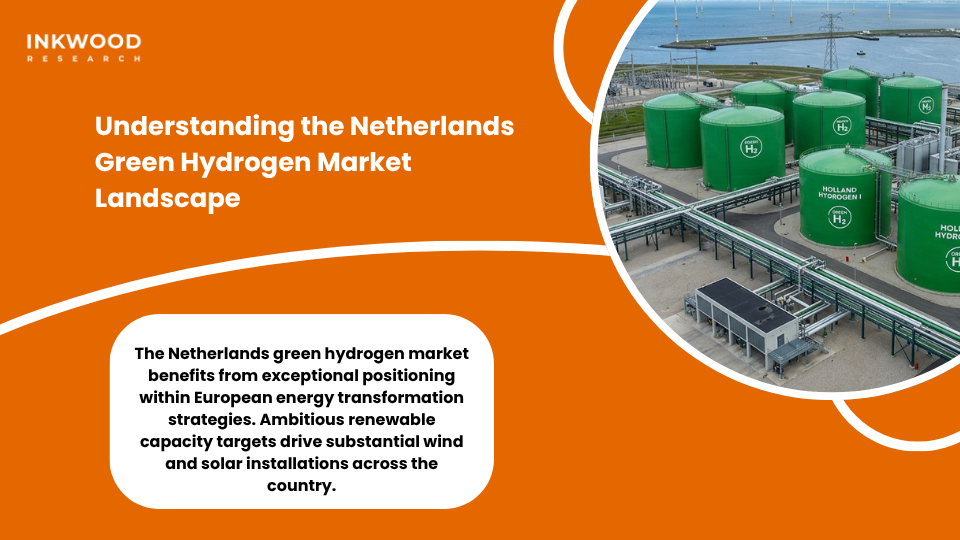
The Netherlands green hydrogen market benefits from exceptional positioning within European energy transformation strategies. Ambitious renewable capacity targets drive substantial wind and solar installations across the country. Additionally, established industrial clusters create immediate demand for clean hydrogen alternatives to current grey hydrogen consumption. Port infrastructure provides natural connection points between production, domestic utilization, and international markets.
Policy Frameworks Supporting Market Development
Dutch government initiatives establish supportive environments encouraging private sector investments in hydrogen infrastructure. Regulatory frameworks address technical standards, safety protocols, and certification requirements essential for commercial operations. Moreover, financial mechanisms reduce early-stage risks through grants and loan guarantees supporting pioneering projects. These policies recognize hydrogen’s strategic importance in achieving national climate commitments while maintaining industrial competitiveness.
Based on our analysis, the Netherlands positions itself as a European hydrogen hub connecting North Sea wind resources with continental industrial consumers. Strategic location advantages enable both domestic consumption and transit functions for hydrogen imports from regions with exceptional renewable resources. Consequently, infrastructure investments serve multiple purposes, supporting internal decarbonization while capturing transit revenues from international hydrogen trade.
Industrial Demand Creating Market Pull
Heavy industries concentrated around Dutch port facilities consume enormous hydrogen volumes for refining, chemical synthesis, and steel production. Currently, most hydrogen comes from natural gas reforming with significant carbon emissions. Transitioning these applications to green hydrogen eliminates operational footprints while maintaining production capabilities. This existing demand provides immediate markets for new production capacity as facilities come online.
Chemical clusters in Rotterdam particularly benefit from hydrogen infrastructure proximity. These facilities require high-purity hydrogen as a chemical feedstock rather than just an energy carrier. Furthermore, existing pipeline networks connecting industrial sites enable efficient distribution, minimizing transportation costs. Such infrastructure advantages accelerate hydrogen adoption by reducing capital requirements for individual facility connections.
Holland Hydrogen I: Project Scale and Technical Specifications
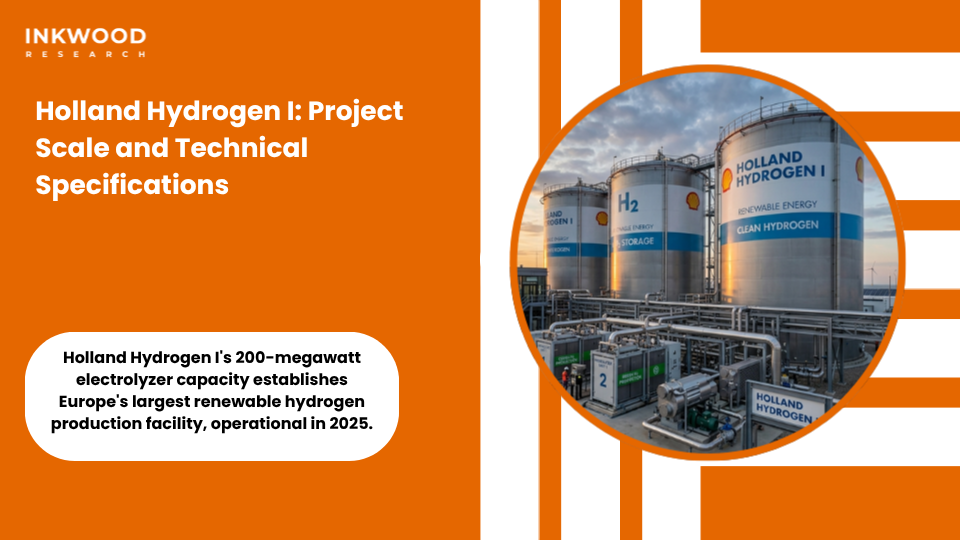
Holland Hydrogen I’s 200-megawatt electrolyzer capacity establishes Europe’s largest renewable hydrogen production facility, operational in 2025. Shell’s final investment decision in July 2022 launched construction on Tweede Maasvlakte, strategically positioned within Rotterdam’s port complex. The facility produces up to 60,000 kilograms of renewable hydrogen daily, equivalent to approximately 21,900 tonnes annually at full capacity utilization.
Project scale reflects confidence in both technical capabilities and market demand, supporting commercial viability. Shell, through subsidiaries Shell Nederland and Shell Overseas Investments, committed substantial capital toward this pioneering deployment. Moreover, the facility’s design incorporates reusable construction materials wherever feasible, while outer walls integrate solar panels to supplement power requirements. These sustainability considerations extend beyond hydrogen production itself toward comprehensive facility operations.
Construction Timeline and Operational Milestones
Construction activities commenced in 2022 following the final investment decision approval. Further, engineering, procurement, and construction phases proceeded through 2023 and 2024, with commissioning scheduled for 2025. This timeline demonstrates rapid deployment from concept through operational status, reflecting project readiness and regulatory framework efficiency. Additionally, lessons learned inform subsequent facilities both within the Netherlands and across Europe.
The facility occupies a two-hectare site, with the main production hall housing electrolyzer modules and supporting equipment. Location on Maasvlakte provides excellent access to both renewable power sources and hydrogen distribution infrastructure. Furthermore, proximity to Shell’s existing Energy and Chemicals Park minimizes pipeline distances, reducing capital costs while improving operational efficiency through integrated management.
Alkaline Electrolysis Technology and Offshore Wind Integration
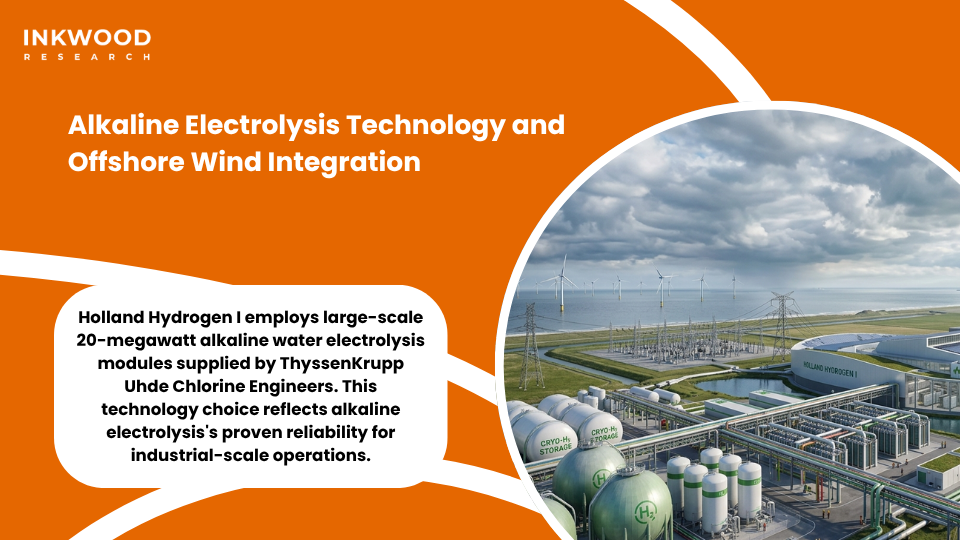
Holland Hydrogen I employs large-scale 20-megawatt alkaline water electrolysis modules supplied by ThyssenKrupp Uhde Chlorine Engineers. This technology choice reflects alkaline electrolysis’s proven reliability for industrial-scale operations. The systems utilize liquid electrolyte solutions, enabling high current densities and robust performance characteristics. Moreover, alkaline technology offers lower capital costs compared to PEM alternatives for steady-state applications.
Renewable power supply comes from the Hollandse Kust (Noord) offshore wind farm, partly owned by Shell. This 759-megawatt installation became operational in 2023, providing sufficient clean electricity for hydrogen production. The direct connection between wind generation and electrolyzer operations demonstrates renewable energy integration at scale. Consequently, hydrogen production maintains fully renewable credentials throughout its lifecycle, qualifying for premium market segments.
Operational Flexibility and Grid Services
According to our findings, electrolyzer systems can modulate operations responding to variable wind conditions. This flexibility provides valuable grid services, absorbing excess renewable generation during high-output periods. Additionally, reducing loads during supply constraints helps maintain system stability. Such capabilities become increasingly important as wind penetration increases across European power networks.
Grid connection arrangements with TenneT ensure reliable high-voltage access supporting facility operations. Initial connection utilizes the Maasvlakte 380-kilovolt substation, with permanent infrastructure through the new Amaliahaven substation to be completed by the end of 2026. These arrangements demonstrate coordination between hydrogen developers and transmission operators essential for successful project deployment.
HyTransPort Pipeline Infrastructure Connecting Production to Demand
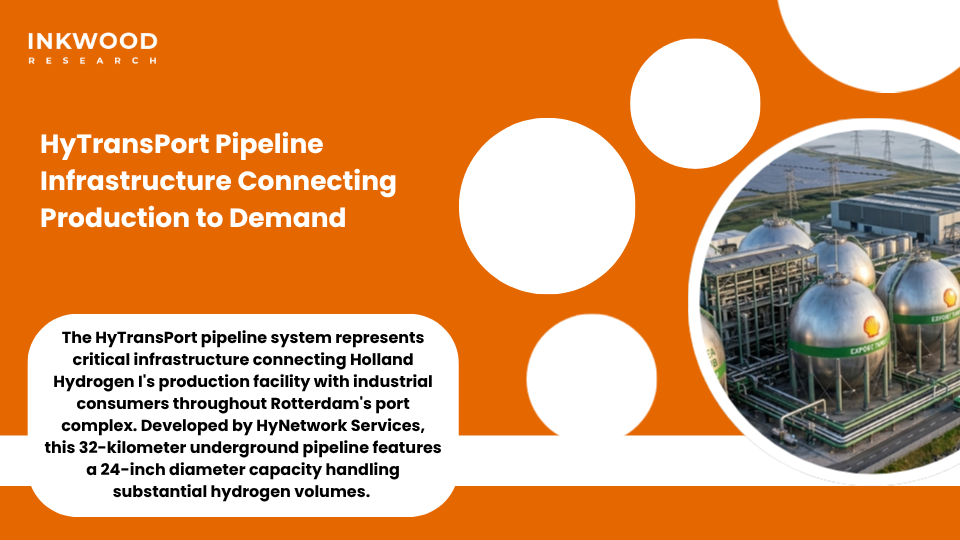
The HyTransPort pipeline system represents critical infrastructure connecting Holland Hydrogen I’s production facility with industrial consumers throughout Rotterdam’s port complex. Developed by HyNetwork Services, a Gasunie subsidiary, in collaboration with the Port of Rotterdam Authority, this 32-kilometer underground pipeline features a 24-inch diameter capacity handling substantial hydrogen volumes. Operational by 2025, the system includes five planned branch-off points for future connections, expanding network reach.
Pipeline infrastructure dramatically reduces hydrogen transportation costs compared to trucking or other distribution methods. Dedicated systems enable continuous flow, supporting steady industrial consumption patterns. Moreover, underground installation minimizes surface disruption while providing enhanced safety characteristics. These advantages make pipeline networks essential for large-scale hydrogen economies supporting industrial clusters.
Network Expansion and Future Connections
HyTransPort forms part of the broader Dutch hydrogen infrastructure development, connecting multiple production sources and consumption points. Future expansions will link the Port of Rotterdam network with national systems, enabling hydrogen flow across regions. Additionally, international connections under development will facilitate cross-border trade with neighboring countries. This integrated approach maximizes infrastructure utilization while supporting diverse market segments.
Based on our research, pipeline capacity exceeds current Holland Hydrogen I production volumes, accommodating additional sources as they come online. This forward-looking design prevents infrastructure bottlenecks, constraining market growth. Furthermore, standardized connection points enable new producers joining the network with minimal additional capital investment. Such planning demonstrates a sophisticated understanding of hydrogen economy development requirements.
Industrial Applications at Shell's Energy and Chemicals Park
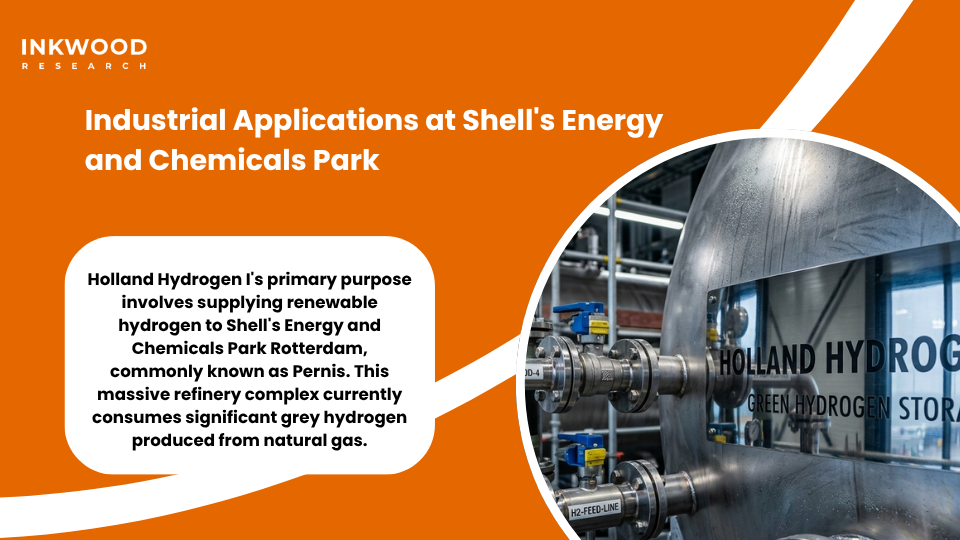
Holland Hydrogen I’s primary purpose involves supplying renewable hydrogen to Shell’s Energy and Chemicals Park Rotterdam, commonly known as Pernis. This massive refinery complex currently consumes significant grey hydrogen produced from natural gas. Replacing fossil-derived hydrogen with renewable alternatives directly reduces facility carbon emissions while maintaining production capabilities. Such transitions demonstrate practical pathways for refining sector decarbonization.
Refinery applications require substantial hydrogen volumes for hydrocracking and desulfurization processes, upgrading crude oil into transportation fuels. These established processes work identically whether using grey or green hydrogen molecules. Consequently, technical risks remain minimal during fuel switching. Furthermore, existing pipeline connections facilitate integration without extensive facility modifications or operational disruptions.
Emissions Reduction Benefits
According to our analysis, partial replacement of grey hydrogen at Pernis yields substantial emissions reductions from petrol, diesel, and jet fuel production. While end products remain identical, manufacturing processes become cleaner through renewable hydrogen utilization. This approach enables incremental decarbonization without waiting for complete facility transformation or end-product substitution. Moreover, progress occurs immediately as Holland Hydrogen I reaches operational status.
Additional applications beyond refining include potential supply to heavy-duty transportation as hydrogen vehicle markets develop. Refueling infrastructure expansion creates opportunities for surplus production supporting commercial trucking fleets. These mobility applications complement industrial uses, maximizing hydrogen facility utilization while serving multiple decarbonization pathways simultaneously across different economic sectors.
Port of Rotterdam's Strategic Hydrogen Hub Vision
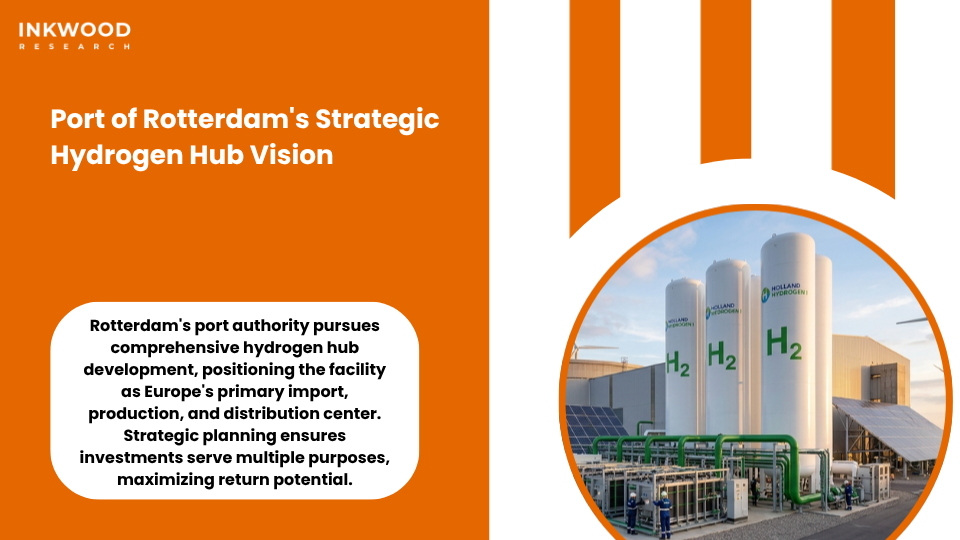
Rotterdam’s port authority pursues comprehensive hydrogen hub development, positioning the facility as Europe’s primary import, production, and distribution center. This strategy recognizes that domestic production alone cannot satisfy projected European hydrogen demand. Therefore, infrastructure must accommodate both local production and substantial import volumes from regions with exceptional renewable resources. Strategic planning ensures investments serve multiple purposes, maximizing return potential.
Port locations offer unique advantages for hydrogen hub functions, combining maritime access, industrial concentrations, and existing energy infrastructure. Rotterdam’s established position as Europe’s largest port provides natural foundations for hydrogen trade networks. Moreover, relationships with shipping companies, terminal operators, and industrial consumers enable rapid market development as hydrogen volumes increase.
Import Terminal and Storage Development
Planned import terminals will handle green ammonia as a hydrogen carrier, with conversion facilities reconverting ammonia to hydrogen for distribution. This approach addresses long-distance transport challenges by leveraging existing ammonia shipping infrastructure. Additionally, storage facilities under development enable supply buffering, smoothing out seasonal variations and supply disruptions. Such infrastructure creates resilient hydrogen supply chains supporting reliable industrial operations.
Based on our findings, Rotterdam’s hydrogen hub strategy attracts complementary investments across the value chain. Equipment suppliers, service providers, and technology developers establish operations near major facilities. This clustering effect accelerates innovation while reducing costs through local supply chain development. Consequently, hub approaches prove more effective than isolated projects for building comprehensive hydrogen economies.
Grid Connection and Renewable Energy Integration Strategies
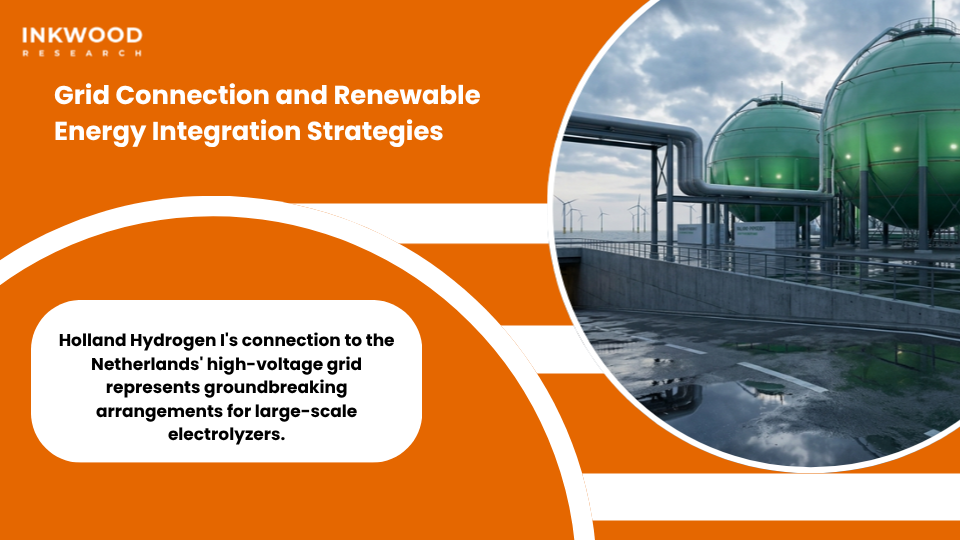
Holland Hydrogen I’s connection to the Netherlands’ high-voltage grid represents groundbreaking arrangements for large-scale electrolyzers. TenneT, the Dutch transmission system operator, worked closely with Shell to develop connection solutions accommodating substantial power demands. Initial temporary connection through the Maasvlakte 380-kilovolt substation enables operations pending permanent infrastructure completion. This innovative approach prevents project delays while long-term solutions progress.
The new Amaliahaven substation under construction specifically addresses hydrogen facility requirements alongside other industrial developments on Maasvlakte. Completion by the end of 2026 provides permanent, complete grid access supporting full-capacity operations. These infrastructure investments demonstrate transmission operators recognizing hydrogen’s importance in energy system transformation. Moreover, coordinated planning ensures grid capabilities match hydrogen development ambitions.
Balancing Renewable Variability
According to our analysis, electrolyzer flexibility provides system services for managing renewable generation variability. When wind output exceeds immediate demand, increased electrolyzer loading absorbs surplus electricity, preventing curtailment. Conversely, during supply constraints, reduced hydrogen production releases power for other uses. These capabilities enhance grid reliability while maximizing renewable energy utilization, addressing fundamental challenges of high-renewable power systems.
Future developments may include hydrogen storage systems enabling longer-duration energy management beyond hourly balancing. Salt cavern storage provides cost-effective options for seasonal energy shifting, addressing annual patterns in renewable generation and demand. This combination of flexible production and substantial storage creates comprehensive solutions for fully renewable energy systems supporting both the electricity and hydrogen sectors simultaneously.
Key Takeaways
- The Netherlands green hydrogen market expands at 45.32% annually, reaching US$11,986.78 million by 2034 as strategic infrastructure enables large-scale production.
- Holland Hydrogen I establishes Europe’s largest renewable hydrogen facility with 200-megawatt capacity, producing 60,000 kilograms daily. Alkaline electrolysis technology supplied by ThyssenKrupp Uhde Chlorine Engineers provides proven reliability for industrial operations.
- Offshore wind integration through Hollandse Kust (Noord) delivers fully renewable power, qualifying for premium market credentials. The HyTransPort pipeline connects production with Shell’s Energy and Chemicals Park Rotterdam, replacing grey hydrogen in refining operations.
- Port of Rotterdam’s hydrogen hub strategy positions the facility as Europe’s primary import, production, and distribution center.
- Grid connection arrangements with TenneT demonstrate transmission operator cooperation essential for electrolyzer deployment. Future developments include import terminals, storage facilities, and network expansions supporting comprehensive hydrogen economies.
- These integrated approaches prove more effective than isolated projects for building resilient hydrogen supply chains serving multiple industrial sectors simultaneously.
Conclusion
According to our research, Holland Hydrogen I represents a defining moment for European hydrogen infrastructure development. Shell’s commitment demonstrates private sector confidence in hydrogen’s commercial viability when supported by appropriate policy frameworks. The project’s scale and integration with existing industrial operations prove that renewable hydrogen can serve demanding applications while reducing emissions substantially.
Strategic port locations emerge as natural hydrogen hubs combining production, import, storage, and distribution functions. Rotterdam’s coordinated approach to building comprehensive infrastructure attracts complementary investments across value chains. These clustering effects accelerate innovation while reducing costs through local supply chain development, creating sustainable competitive advantages.
Success at Holland Hydrogen I will catalyze additional facilities both within the Netherlands and across Europe. Lessons learned inform subsequent projects, while established infrastructure reduces barriers for new market entrants. Ultimately, this pioneering deployment establishes templates for hydrogen economy development that other regions can adapt to their specific circumstances and resource endowments.
Frequently Asked Questions
What makes Holland Hydrogen I Europe’s most significant hydrogen project?
Holland Hydrogen I is Europe’s largest renewable hydrogen facility at 200 megawatts, integrating offshore wind power, dedicated pipeline infrastructure, and industrial supply within the Port of Rotterdam energy hub
How does alkaline electrolysis differ from PEM technology for large scale hydrogen production?
Alkaline electrolysis uses liquid electrolytes with lower capital costs and proven durability for baseload industrial hydrogen, while PEM electrolysis offers faster response to variable renewable energy but typically involves higher equipment investment
Why are port locations advantageous for hydrogen hub development in Europe?
Port based hydrogen hubs such as Port of Rotterdam benefit from maritime trade access, proximity to refineries and chemical clusters, existing pipelines, storage infrastructure, and space for integrated renewable hydrogen production
Who is developing Holland Hydrogen I in the Netherlands?
Holland Hydrogen I is developed by Shell as part of its European energy transition strategy, supplying renewable hydrogen to decarbonize refining and industrial operations
What industries will use hydrogen from Holland Hydrogen I?
Renewable hydrogen from Holland Hydrogen I will primarily serve refinery operations, chemical manufacturing, and industrial decarbonization in the Rotterdam cluster, replacing grey hydrogen derived from natural gas
How does offshore wind integration support Holland Hydrogen I operations?
Electricity from offshore wind farms in the Dutch North Sea directly powers electrolysis units, ensuring low carbon hydrogen production aligned with European renewable energy and climate neutrality targets