Table of Contents

This analysis is brought to you by Inkwood Research, a leading market intelligence firm specializing in North American automotive supply chains, nearshoring strategies, and battery technology ecosystems. Our research team combines extensive experience analyzing Mexico’s manufacturing capabilities, USMCA trade provisions, cross-border logistics optimization, and automotive investment trends. Based on our proprietary research methodologies and strategic partnerships with Mexican government agencies, automotive manufacturers, industry associations, and logistics providers, we deliver actionable insights that empower strategic decision-making for global enterprises navigating Mexico’s battery technology development and nearshoring opportunities in sustainable transportation transformation.
TLDR
Mexico’s graphene battery sector benefits from unique nearshoring advantages within North America’s automotive transformation. The Mexico graphene battery market growth centers on USMCA trade provisions, geographic proximity to U.S. markets, and substantial manufacturing investments. BMW committed 800 million euros ($843 million) for battery assembly in San Luis Potosí, while Ford invested $273 million in its Irapuato Electric Powertrain Center for EV battery market components. Strategic lithium reserves and automotive manufacturing expertise position Mexico as a critical North American battery technology hub supporting sustainable transportation evolution.
Automotive supply chain executives evaluating nearshoring opportunities, manufacturing strategists considering Mexican facility investments, policy analysts studying North American trade dynamics, and procurement directors optimizing lithium-ion batteries sourcing will gain critical insights. Investment analysts assessing Latin American manufacturing, logistics coordinators planning cross-border operations, and sustainability directors implementing regional energy storage solutions will discover actionable intelligence for strategic decision-making in Mexico’s evolving automotive industry ecosystem.
Geographic Advantages and USMCA Benefits
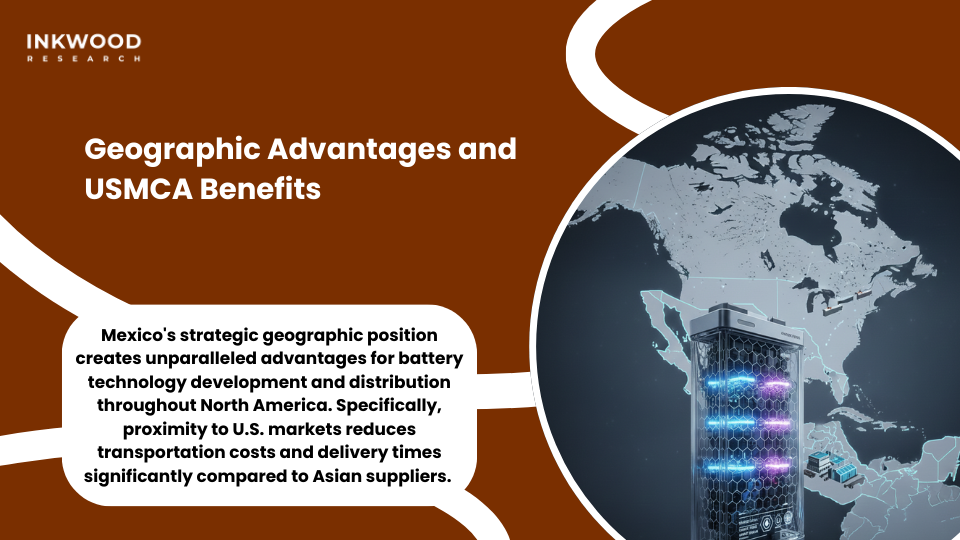
Mexico’s strategic geographic position creates unparalleled advantages for battery technology development and distribution throughout North America. Specifically, proximity to U.S. markets reduces transportation costs and delivery times significantly compared to Asian suppliers. Moreover, USMCA provisions eliminate tariffs on qualifying products, enhancing price competitiveness. Consequently, manufacturers leverage Mexico’s position to serve North American demand efficiently.
USMCA Trade Provisions Impact
The United States-Mexico-Canada Agreement (USMCA) influences automakers and battery suppliers to localize lithium-ion battery production within North America. Additionally, regional content requirements incentivize manufacturers to establish Mexican operations meeting qualification standards. These provisions reduce regulatory compliance complexity compared to imports from other regions. Furthermore, duty-free exports to the U.S. and Canada make Mexico a great choice for companies wanting to expand EV manufacturing while keeping costs low. Therefore, trade agreements benefits accelerate investment decisions substantially.
Logistics and Transportation Advantages
Mexico’s border states connect directly to major U.S. automotive manufacturing centers through efficient rail and highway networks. Specifically, shipping times from Mexican facilities to U.S. distribution centers are measured in days rather than weeks. Moreover, established customs procedures facilitate rapid cross-border movement of components and finished products. Additionally, shared time zones enable real-time coordination between Mexican facilities and U.S. headquarters. Consequently, companies achieve supply chain responsiveness impossible with distant suppliers.
Major Automotive Investments Driving Battery Demand
Global automotive manufacturers commit billions to Mexican facilities, creating substantial demand for advanced battery technology and driving the Mexico graphene battery market expansion. In May 2024, BMW Group began building a battery manufacturing facility next to its San Luis Potosí plant to support production of its Neue Klasse electric vehicles starting in 2027. Moreover, established automotive expertise enables rapid technology integration and production scaling. These investments demonstrate confidence in Mexico’s long-term manufacturing competitiveness.
BMW’s San Luis Potosí Battery Center
BMW is investing 800 million euros ($843 million) in expanding the Mexican production site, with 500 million euros dedicated specifically to constructing a high-voltage battery assembly center. Specifically, the future high-voltage battery assembly covering an area of more than 80,000 square metres is key to integrating the Neue Klasse at the production site. Additionally, BMW says this is the region’s first lithium battery plant, with pre-series battery production beginning by the end of 2025. Furthermore, the plant opened in 2019 and employs around 3,700 workers producing BMW 3 Series, 2 Series Coupe, and M2 models. Therefore, BMW’s investment establishes Mexico as a critical battery production hub.
Ford’s Electric Powertrain Investment
Ford announced a planned investment of US$273 million in its Irapuato Electric Powertrain Center (IEPC) in Guanajuato, which manufactures motors and transaxles for the first 100% mass-produced electric vehicle, completely made in Mexico. Moreover, the plant previously produced transmissions for gasoline-powered vehicles but switched to producing the primary drive units for the Mustang Mach-E, including the electric motor and transaxle. Additionally, the Mach-E is exported to about 40 countries in Europe and the Americas, as well as Australia. Consequently, Ford’s Mexican operations demonstrate scalable EV component manufacturing capabilities.
General Motors’ Battery Component Production
General Motors is committed to invest $1 billion in the Ramos Arizpe Manufacturing Complex in Coahuila, Mexico, to support its commitment to all-electric car production by 2035. Specifically, by the second half of 2021, the site produced batteries and electrical components, including the Ultium Drive propulsion system that powers GM’s electric vehicles. Moreover, GM’s purchasing volume in Mexico reached USD 2.5 billion, demonstrating deep supply chain integration. Additionally, in 2024, companies like Ford, General Motors, BMW Group, Audi, Giant Motors, and Toyota produced more than 200,000 EVs in Mexico. Therefore, GM’s investments strengthen Mexico’s EV production ecosystem significantly.
Tesla Gigafactory Uncertainty
Tesla officially announced Gigafactory Mexico in March 2023, planning approximately US$10 billion investment near Monterrey. However, Tesla has placed construction on hold until after the 2024 United States presidential election due to concerns about potential tariffs on cars made in Mexico.
Lithium Resources and Nationalization Strategy
Mexico’s lithium resources represent strategic assets for future battery supply chain development, though commercial exploitation remains underdeveloped compared to Latin American peers. According to the U.S. Geological Survey’s 2025 Mineral Commodity Summaries, Mexico ranks ninth globally in lithium reserves with 1.7 million metric tons, primarily in clay-based deposits that require advanced extraction technologies for economic viability. The majority of these reserves are concentrated in the state of Sonora, where over 80 known deposits span the “Lithium Valley” region, offering proximity to North American manufacturing hubs under the USMCA framework.
Moreover, Mexico ranks 11th globally in copper mine production, reaching approximately 700,000 metric tons in 2023, which supports broader battery component manufacturing through applications in cathodes, wiring, and conductive foils. Additionally, Mexico is among the top three suppliers to the United States for several of the 60 critical minerals identified in the final 2025 List of Critical Minerals, including fluorspar, strontium, and silver, among others, vital for battery electrolytes and structural components. Consequently, Mexico possesses valuable raw material resources for battery production, positioning it as a key nearshoring partner despite challenges like regulatory nationalization and water constraints.
Lithium Nationalization Policy
In April 2022, Mexico approved legislation to ban private lithium mining and processing activities and reserve such activity for the state. Furthermore, President López Obrador established 234,855 hectares in Sonora as a mining reserve zone under the control of the Energy Ministry, where the vast majority of known lithium resources are located. Additionally, President Claudia Sheinbaum announced that Minister of Energy Luz Elena González is working on new strategies to expand LitioMx’s role, integrating the company into broader development frameworks. Moreover, Mexico holds an estimated 1.7 million tonnes of lithium reserves. Therefore, government control shapes lithium development strategies.
Opportunities in Value Chain Stages
Although opportunities for international companies to mine lithium in Mexico remain closed, there are still lithium-related opportunities at other stages of the battery supply chain, such as refinement and battery cell manufacturing. Specifically, in July 2024, Mexico and Buenos Aires signed a cooperation agreement to advance the lithium value chain technology. Moreover, projects in Sonora and other northern states are exploring lithium extraction and processing, aiming to establish a vertically integrated supply chain. Additionally, in June 2024, ErgoSolar announced a USD 10 million investment to establish Mexico’s first lithium and sodium battery factory, likely in Puebla or Jalisco. Consequently, downstream opportunities remain accessible to private sector participants.
Manufacturing Infrastructure and Industrial Clusters

Mexico’s established automotive manufacturing infrastructure provides a robust foundation for battery technology integration and lithium-ion batteries production expansion. The Central-Bajío region of Mexico is a major automobile manufacturing hub, with Guanajuato leading the way with the highest annual production capacity, with over 800,000 light vehicles. Moreover, the Bajío region is referenced as the 3rd most important automotive cluster in North America, representing nearly 50% of all vehicle production capacity in the country. Additionally, experienced workforce availability enables rapid technology adoption and production scaling. Therefore, existing infrastructure accelerates battery manufacturing integration.
Key Industrial Regions
Tier-1 and Tier-2 suppliers are setting up operations in key industrial corridors such as Nuevo León and Guanajuato, often in proximity to major OEMs. Specifically, traditional hubs such as Guanajuato, Coahuila, Queretaro, San Luis Potosi, and Nuevo Leon remain central, while Durango and Puebla are emerging as new Tier 2 and Tier 3 centers. Moreover, Saltillo in Coahuila hosts General Motors divisions and Daimler Chrysler plants, creating a deep automotive expertise concentration. Additionally, there are more than 170 providers (Tier 1&2) of electromobility and electrification components in Mexico, ranging from batteries to electric drivetrains. Consequently, clustered suppliers enable efficient just-in-time manufacturing operations.
Supporting Infrastructure Development
Government investments in roads, railways, and utilities support expanding manufacturing operations throughout industrial regions. Furthermore, BMW’s San Luis Potosí plant sources only green power, which it generates itself at a more than 70,000 m² solar power installation on the plant grounds. Meanwhile, private sector investments complement public infrastructure spending, creating comprehensive industrial ecosystems. Additionally, special economic zones offer tax incentives and regulatory streamlining for battery technology manufacturers. Therefore, coordinated infrastructure development facilitates rapid manufacturing expansion.
Supply Chain Localization Initiatives
Supply chain localization driven by USMCA and nearshoring is influencing automakers and battery suppliers to localize lithium-ion battery production within North America. Specifically, nearshoring strategies aim to mitigate risks associated with long supply chains and global disruptions, while meeting regional content requirements for EV incentives. Moreover, direct foreign investment in electromobility reached US$606.4 million across 18 projects by Q3 2025. Additionally, Asian manufacturers establish Mexican facilities to access North American markets while avoiding trade barriers. Consequently, supply chain regionalization accelerates significantly.
Asian Manufacturer Expansion
Key investments include Giant Motors (JAC) in Hidalgo with US$160.6 million for EV assembly and testing facilities, and Seojin Mobility (South Korea) in Nuevo Leon with US$160 million for motor components. Furthermore, several Chinese suppliers have recently established a presence in Mexico, taking advantage of the country’s strategic location. Meanwhile, there are more than 43 providers (Tier 3) of materials for the EV industry in Mexico. Therefore, Asian companies leverage Mexico for North American market access.
Component Manufacturing Growth
Battery component suppliers expand Mexican operations to serve automotive assembly facilities efficiently. Additionally, there are more than 170 providers of electromobility and electrification components across nine technical subcategories, including battery systems, powertrain components, and thermal management. Furthermore, BMW works with over 100 Mexican suppliers, with 85 currently delivering parts to the San Luis Potosí plant. Consequently, comprehensive supplier ecosystems emerge around major assembly facilities.
Challenges and Strategic Considerations
Despite significant advantages, Mexico’s battery technology development faces obstacles requiring strategic mitigation by manufacturers and policymakers. Reported cases of extortion rose by 28% year-on-year nationwide during the first half of 2022, with manufacturing hubs Guanajuato and Nuevo León reporting the greatest increase. Moreover, the states of Mexico and Puebla account for roughly 50% of all incidents of road cargo theft. Additionally, energy availability concerns affect power-intensive battery manufacturing operations. Consequently, companies implement comprehensive risk management strategies.
Security and Logistics Risks
Although criminal hotspots are likely to vary during the next decade in response to security force deployments, national levels of criminal activity are likely to remain elevated. Furthermore, companies establish secure transportation corridors and partner with specialized logistics providers experienced in high-value cargo management. Meanwhile, insurance costs reflect elevated risk profiles compared to other manufacturing regions. Therefore, security considerations influence facility location and operational planning decisions.
Energy and Infrastructure Constraints
Some companies are steering away from Mexico because of energy scarcity, referring not only to the intensive power requirements of operations such as data centres but also the need for gas in operating heavy industry. Additionally, Mexico has become increasingly reliant on piping gas from the U.S. in recent years, particularly to fuel manufacturing associated with nearshoring. Furthermore, electricity grid capacity limitations affect some industrial regions. Consequently, manufacturers invest in on-site power generation and energy efficiency measures.
Conclusion:
Mexico’s battery technology sector represents a strategic convergence of geographic advantages, trade policy benefits, and manufacturing expertise. Unlike distant Asian suppliers, Mexican facilities offer proximity, USMCA compliance, and established automotive integration—characteristics increasingly valued by manufacturers seeking supply chain resilience.
Strategic investments by BMW, Ford, and General Motors demonstrate confidence in Mexico’s long-term competitiveness despite political and security challenges. Moreover, workforce development initiatives and industrial cluster maturation create sustainable foundations for technology advancement. As electric vehicle production accelerates and battery demand expands, Mexico’s nearshoring advantages will likely establish the country as North America’s critical battery manufacturing hub.
Partner with Inkwood Research to navigate Mexico’s battery technology landscape. Our customized market intelligence and strategic consulting services provide the insights you need for informed decision-making in this dynamic nearshoring opportunity.
Frequently Asked Questions
What are Mexico's primary advantages for battery manufacturing?
Geographic proximity to U.S. markets reduces logistics costs and delivery times dramatically. Moreover, USMCA provisions enable duty-free exports to the U.S. and Canada, making Mexico an attractive choice for expanding EV manufacturing. Additionally, established automotive infrastructure and a skilled workforce enable rapid production scaling.
How do lithium nationalization policies affect battery manufacturers?
April 2022 legislation reserves lithium mining for state-owned entities, but opportunities remain at other value chain stages. Furthermore, refinement and battery cell manufacturing remain accessible to private companies. Additionally, Mexico holds an estimated 1.7 million tonnes of lithium reserves that may eventually support domestic battery production.
What challenges should manufacturers consider when investing in Mexico?
Security concerns, including extortion and cargo theft, affect manufacturing hubs, requiring comprehensive risk management. Moreover, energy scarcity concerns affect power-intensive operations. Additionally, judicial reforms have affected investment decision-making, though nearshoring incentives remain compelling for North American market access.