Table of Contents
This analysis is brought to you by Inkwood Research, a leading market intelligence firm specializing in Japanese advanced manufacturing systems, automotive technology development, and East Asian battery innovation ecosystems. Our research team combines extensive experience analyzing Toyota Production System methodologies, Japanese materials science leadership, government-industry collaboration frameworks, and solid-state battery patent landscapes. Based on our proprietary research methodologies and strategic partnerships with Japanese automakers, battery materials suppliers, research institutions, and METI policy advisors, we deliver actionable insights that empower strategic decision-making for global enterprises navigating Japan’s solid-state battery industrialization and technological leadership strategies.
TLDR
Japan leverages decades of materials science expertise and manufacturing precision, pursuing solid-state battery leadership. Toyota targets 2027-2028 mass production through partnerships with Idemitsu and Sumitomo, while Nissan advances sulfide-based systems for 2028-2029 commercialization. Government support through METI coordinates industry efforts, providing financial backing and research infrastructure. Japan’s systematic approach prioritizes reliability and quality over speed, potentially delivering superior long-term competitive advantages despite later market entry than Chinese competitors.
This blog aims to serve automotive industry analysts, battery technology investors, materials science researchers, supply chain strategists, Japanese market specialists, and corporate development professionals seeking detailed insights into Japan’s solid-state battery production strategies, technology partnerships, government support programs, and implications for global automotive competitiveness.
Japan’s Methodical Approach to Battery Innovation
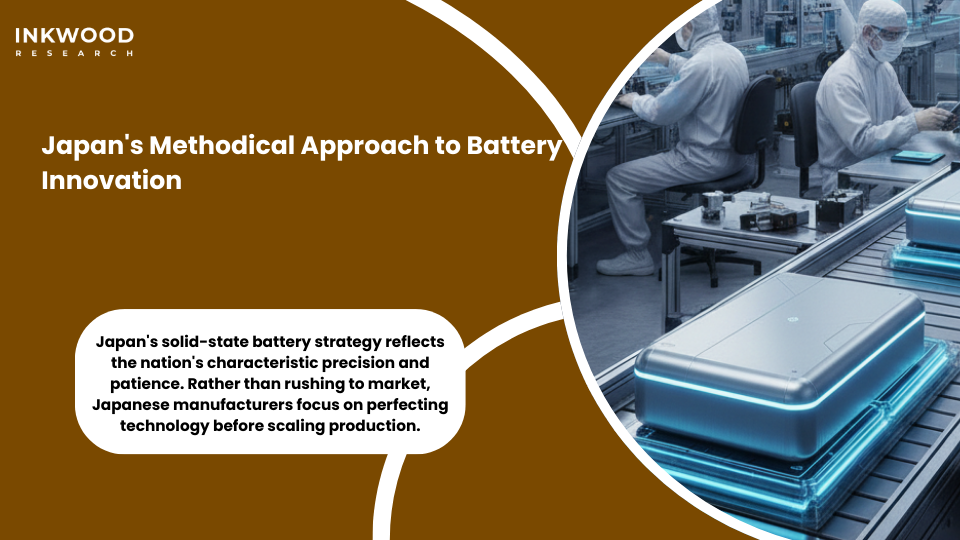
Japan’s solid-state battery strategy reflects the nation’s characteristic precision and patience. Rather than rushing to market, Japanese manufacturers focus on perfecting technology before scaling production. This measured approach contrasts sharply with aggressive Chinese commercialization timelines. However, Japan’s extensive materials science expertise and manufacturing excellence potentially deliver superior long-term results.
The Japan solid-state battery market reached US$176.01 million in 2026. Projections indicate growth to US$2,406.85 million by 2034, representing 38.67% CAGR. Consequently, Japan positions itself as a premium technology provider rather than a volume producer initially.
Toyota holds 1,331 global patents related to solid-state batteries, ranking first worldwide. Panasonic holds 272 patents, ranking second globally. This intellectual property dominance reflects decades of sustained R&D investments. Moreover, patent portfolios provide competitive moats protecting Japanese innovations.
METI’s Coordinating Role
Japan’s Ministry of Economy, Trade, and Industry validated Toyota’s solid-state battery production plans targeting a 2026 startup. Government support includes financial subsidies, research infrastructure, and coordination among industry participants. Additionally, METI facilitates collaboration between competing companies, advancing shared technology development goals.
Government programs reduce individual company risks while accelerating overall industry progress. Research institutions receive funding for fundamental materials science investigations. Furthermore, standardization efforts ensure interoperability across different manufacturers’ systems.
This coordinated approach mirrors Japan’s historical success in semiconductors, consumer electronics, and hybrid vehicle technologies. Consequently, industry observers expect similar methodical execution delivering commercially viable solid-state batteries.
Toyota’s Ambitious Production Timeline
Toyota announced solid-state battery production beginning in 2026 with gradual implementation. Mass production starts around 2030 following careful scaling and validation. Initially, limited volumes support hybrid vehicle applications before expanding to full battery-electric vehicles.
Keiji Kaita, president of Toyota’s Carbon Neutral Advanced Engineering Development Center, confirmed the company remains “sticking to the schedule” for 2027-2028 solid-state battery-powered EVs. These batteries promise high power, compact size, long range, and extended lifespan. Moreover, Toyota targets 10-minute charging times from 10% to 80% state of charge.
Sulfide Electrolyte Focus
Toyota’s solid-state strategy focuses on sulfide electrolyte routes promising 450-500 Wh/kg energy density. This represents more than double the current ternary lithium battery capabilities. Additionally, sulfide systems offer superior ionic conductivity, enabling fast-charging performance.
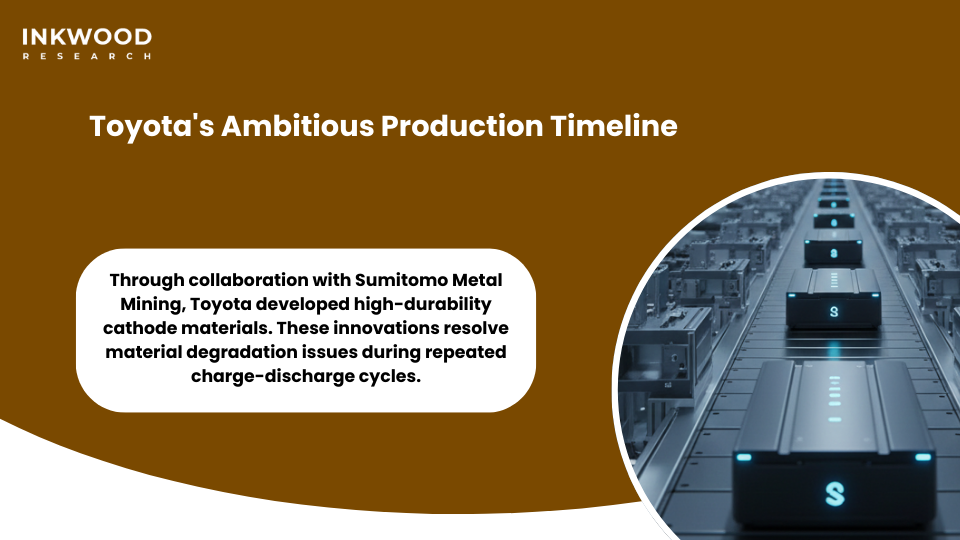
Through collaboration with Sumitomo Metal Mining, Toyota developed high-durability cathode materials. These innovations resolve material degradation issues during repeated charge-discharge cycles. Consequently, battery lifespan exceeds 15 years with capacity retention over 90% after 2,000 cycles.
However, sulfide electrolytes present manufacturing challenges. Sulfides demonstrate extreme sensitivity to moisture and atmospheric oxygen, requiring expensive dry-room production environments. Despite these difficulties, Toyota believes sulfide systems offer optimal performance characteristics, justifying manufacturing complexity.
Strategic Partnerships Ensuring Success
Toyota and Sumitomo Metal Mining entered joint development agreements for mass-producing cathode materials. These materials specifically target all-solid-state batteries for battery electric vehicles. Moreover, Sumitomo’s mining expertise ensures reliable raw material supplies.
Idemitsu Kosan invests ¥21.3 billion (US$142 million) in building lithium sulfide plants. These facilities, slated for 2027-2028 mass production, supply Toyota as the first customer. Additionally, METI provides financial backing to support this critical supply chain development.
Through Prime Planet Energy & Solutions’ partnership with Panasonic, Toyota secures battery manufacturing expertise. This joint venture combines Toyota’s automotive knowledge with Panasonic’s battery production capabilities. Consequently, Toyota leverages complementary strengths across the value chain.
Nissan’s Parallel Development Efforts
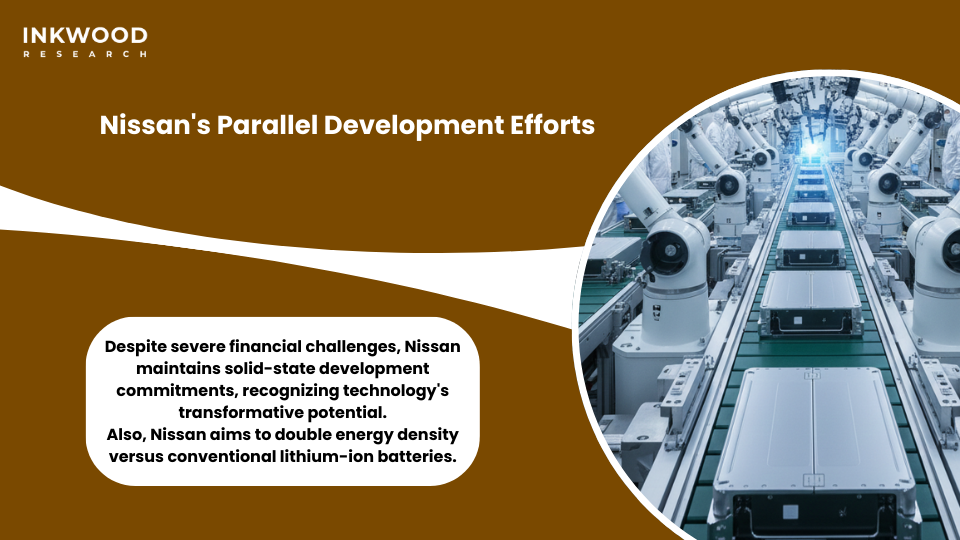
Nissan successfully developed all-solid-state batteries targeting trial production by 2025. Mass production of electric vehicles powered by solid-state batteries follows in 2028-2029. Despite severe financial challenges, Nissan maintains solid-state development commitments, recognizing technology’s transformative potential.
Also, Nissan aims to double energy density versus conventional lithium-ion batteries. Cost reduction targets reach US$75 per kWh by 2028. These ambitious goals require substantial technological breakthroughs and manufacturing innovations.
Sulfur-Based Electrolyte Innovation
Nissan’s all-solid-state cells use sulfur-based electrolytes with potential sulfur-manganese cathodes. This approach potentially eliminates cobalt entirely, reducing material costs and ethical concerns. Furthermore, sulfur abundance makes supply chains more resilient than cobalt-dependent systems.
Nissan executives indicated commercialization by fiscal year 2028 end. However, technical challenges remain substantial. Sulfur cathodes historically demonstrate capacity fading and voltage degradation over cycling. Therefore, Nissan’s durability solutions represent significant innovations if successful.
Overcoming Financial Constraints
Nissan’s profits tanked recently, with sales falling dramatically. Nevertheless, the company refuses to abandon solid-state battery development, recognizing technology’s critical importance. Management believes solid-state batteries provide essential competitive differentiation for future EV markets.
Financial pressures force Nissan to prioritize development efficiency over rapid timelines. The company focuses resources on the highest-impact innovations rather than broad exploration. Consequently, Nissan’s approach appears more targeted than Toyota’s comprehensive strategy.
Strategic partnerships might provide financial relief while advancing technology development. Potential collaborations with materials suppliers, equipment manufacturers, or even competitors could share costs. However, Nissan has not announced major partnerships comparable to Toyota’s extensive network.
Japan's Materials Science Advantages

Japan’s world-leading materials science capabilities provide fundamental competitive advantages. Decades of ceramic processing, chemical engineering, and nanotechnology research translate directly to solid-state battery development. Moreover, close university-industry collaboration accelerates innovation cycles.
Lithium Sulfide Production Capabilities
Idemitsu Kosan builds large-scale lithium sulfide facilities specifically supporting solid-state battery production. This represents Japan’s first major lithium sulfide manufacturing investment. Additionally, production methods leverage Idemitsu’s extensive chemical processing expertise from petrochemical operations.
Lithium sulfide proves critical for sulfide electrolyte manufacturing. Current global production capacity remains limited, creating supply bottlenecks. Therefore, Japan’s domestic production capabilities provide strategic advantages as solid-state batteries scale commercially.
Furthermore, controlling lithium sulfide production protects intellectual property regarding processing methods. Competing manufacturers must either develop independent capabilities or license Japanese technology. Consequently, Japan captures value across multiple supply chain segments.
Advanced Cathode Material Engineering
Sumitomo Metal Mining develops specialized cathode materials optimized for solid-state configurations. These materials address unique challenges, including solid-solid interfaces and volume changes during cycling. Moreover, proprietary compositions provide performance differentiation versus conventional cathodes.
Japan’s cathode materials industry already supplies global battery manufacturers extensively. Solid-state specific materials represent natural extensions of existing capabilities. Additionally, established customer relationships facilitate rapid market adoption once technology matures.
Research institutions contribute fundamental understanding of cathode electrochemistry, crystal structures, and degradation mechanisms. This scientific foundation enables systematic optimization rather than trial-and-error development. Consequently, Japanese materials demonstrate superior performance consistency and reliability.
Ceramic Processing Expertise
Oxide-based solid electrolytes require advanced ceramic processing techniques. Japan’s ceramics industry developed through the decades, serving electronics, automotive, and industrial applications. Consequently, expertise transfers readily to battery manufacturing requirements.
LLZO garnet electrolytes demonstrate wide electrochemical stability windows. However, achieving proper densification without excessive grain boundary resistance challenges manufacturers. Japanese companies employ sophisticated sintering processes and compositional modifications to optimize performance.
Additionally, Japan leads in thin-film deposition technologies applicable to oxide electrolyte manufacturing. Vapor deposition, sputtering, and sol-gel processes enable precise control over electrolyte layer properties. These capabilities prove increasingly valuable as solid-state batteries advance toward commercialization.
Manufacturing Excellence and Quality Control
Japan’s legendary manufacturing quality provides crucial advantages in solid-state battery production. The Toyota Production System’s emphasis on continuous improvement and zero-defect manufacturing directly applies to battery manufacturing challenges. Moreover, Japanese culture’s attention to detail ensures consistent product quality.
Precision Assembly Requirements
Solid-state batteries demand extraordinary manufacturing precision. Ceramic separators cannot tolerate mechanical damage during assembly. Furthermore, achieving uniform electrode-electrolyte contact requires careful pressure control and surface preparation. Therefore, Japanese manufacturers’ precision engineering capabilities prove essential.
Automated assembly systems must handle fragile ceramic components reliably. Vision systems inspect each layer, detecting microscopic defects before proceeding. Additionally, environmental controls maintain consistent temperature and humidity throughout production processes.
Japanese equipment manufacturers develop specialized machinery for solid-state battery production. These systems incorporate lessons from semiconductor and display panel manufacturing. Consequently, Japan potentially achieves superior manufacturing yields compared to competitors.
Validation Testing Protocols
Toyota promises 40-year battery lifespans if solid-state technology delivers as expected. However, validating such extreme durability requires comprehensive testing protocols. Japanese manufacturers employ accelerated aging tests, abuse simulations, and long-term cycling studies, ensuring reliability.
Testing rigor potentially delays commercialization versus competitors rushing to market. Nevertheless, Japanese companies believe that quality reputation justifies patience. Additionally, warranty liabilities from premature failures would overwhelm savings from faster market entry.
Automotive customers particularly value the Japanese reliability reputation. European and American automakers historically prefer Japanese components for critical applications. Therefore, Toyota and Nissan’s cautious approach potentially wins major contracts despite a later market arrival.
Government Support and Industrial Policy
METI coordinates Japan’s solid-state battery development through strategic funding and policy frameworks. Government support also reduces individual company risks while accelerating collective progress. Moreover, public research institutions receive substantial funding to advance fundamental science.
Financial Incentives and Subsidies
Government programs provide tax incentives, low-interest loans, and direct grants supporting solid-state battery development. METI backed Idemitsu’s lithium sulfide plant construction financially. These subsidies reduce capital barriers, enabling aggressive investment timelines.
Production facility construction receives preferential treatment through accelerated permitting and infrastructure support. Additionally, workforce training programs ensure adequate skilled labor availability. Consequently, manufacturers overcome multiple obstacles simultaneously.
Export promotion programs assist Japanese battery manufacturers in entering global markets. Trade missions, market research, and diplomatic support facilitate international partnerships. Therefore, government involvement extends beyond domestic market development alone.
Research Infrastructure Development
Public research institutions operate shared facilities enabling collaborative research. Universities receive funding for materials science, electrochemistry, and manufacturing process investigations. Additionally, industry researchers access specialized equipment and expertise through these partnerships.
METI coordinates pre-competitive research, avoiding duplication of efforts. Standardization committees develop common testing protocols and performance metrics. Furthermore, intellectual property frameworks encourage knowledge sharing while protecting commercial interests.
This collaborative approach accelerates overall industry progress compared to purely competitive dynamics. Companies benefit from shared fundamental research while competing on proprietary applications. Consequently, Japan’s collective capabilities potentially exceed individual company efforts.
Comparing Japanese and Global Strategies

Japan’s methodical approach contrasts sharply with competitors’ strategies. Chinese manufacturers prioritize rapid scaling and cost reduction. Korean companies pursue aggressive commercialization timelines. Meanwhile, American startups focus on breakthrough technologies. Each approach reflects distinct national strengths and market priorities.
Timeline Trade-offs
Chinese manufacturers target earlier production dates, potentially achieving first-mover advantages. However, quality concerns and durability questions surround rushed developments. Conversely, Japan’s patient approach potentially delivers superior long-term products.
Toyota’s 2027-2028 timeline allows extensive validation testing before full-scale production. This contrasts with Chinese competitors launching products with limited real-world validation. Nevertheless, delayed market entry risks ceding market share permanently.
First-mover advantages include customer relationship development and production learning curves. Additionally, early entrants establish supply chains and manufacturing ecosystems. Therefore, Japan’s later timing potentially creates permanent competitive disadvantages despite superior technology.
Technology Pathway Differences
Japanese manufacturers predominantly pursue sulfide electrolyte systems. Sulfides offer high ionic conductivity comparable to liquid electrolytes. However, manufacturing challenges and moisture sensitivity create substantial obstacles.
Chinese companies explore diverse approaches, including oxide, polymer, and hybrid systems. This broader exploration potentially identifies superior alternatives to sulfide routes. Moreover, multiple pathways reduce technology risks if specific approaches fail.
Korea similarly pursues varied strategies across different manufacturers. Samsung favors prismatic oxide cells while SK partners on sulfide systems. Therefore, the Korean industry hedges technology risks through portfolio diversification.
Japanese manufacturers target premium automotive segments initially before expanding to mass markets. This approach aligns with Japan’s historical positioning in high-quality, reliable products. Moreover, premium pricing justifies higher initial production costs during technology maturation.
Automotive Integration Plans
Toyota aims to sell 3.5 million EVs annually by 2030 across 30 different model lines. Solid-state batteries initially equip premium Lexus models before expanding across broader lineups. Additionally, hybrid vehicles may receive solid-state batteries earlier than full battery-electric vehicles.
Nissan similarly targets premium segments initially. Cost reductions progress systematically through manufacturing improvements and scale economies. Eventually, solid-state batteries will transition to mainstream vehicles as economics improve.
Consumer Electronics Opportunities
Smaller-scale solid-state batteries offer near-term commercialization opportunities. Wearable devices, medical implants, and IoT applications provide markets accepting premium pricing. Additionally, production volumes remain manageable during manufacturing learning curves.
Murata Manufacturing began mass production of earphones and wearables. Cell capacities reaching 25 mAh at 3.8 volts suit small mobile devices. However, automotive applications require 100 times greater capacity.
Consumer electronics success demonstrates technology viability while generating revenue. These markets also provide manufacturing experience before automotive scaling. Consequently, consumer applications serve as intermediate steps toward full commercialization.
Key Takeaways
- Japan pursues solid-state battery leadership through characteristic precision and patience. Toyota and Nissan target 2027-2029 mass production following extensive validation. Government support through METI coordinates industry efforts, providing financial backing and research infrastructure.
- Materials science advantages, including lithium sulfide production, advanced cathode engineering, and ceramic processing expertise, provide competitive advantages. Manufacturing excellence and quality control potentially deliver superior long-term products despite later market entry.
- However, delayed commercialization risks ceding market share to faster-moving Chinese and Korean competitors. First-mover advantages, including customer relationships and production learning curves, favor early entrants. Nevertheless, Japan bets quality reputation ultimately wins premium automotive customers.
- The 2027-2028 timeframe proves critical as Japanese manufacturers launch production. Technology performance, manufacturing yields, and market reception determine whether Japan’s patient approach succeeds. Success requires executing flawlessly while competitors struggle with rushed development consequences.
Conclusion:
Japan stakes its automotive competitiveness on solid-state battery technology perfected through systematic development. The approach reflects cultural values prioritizing quality and reliability over speed. Moreover, decades of materials science leadership and manufacturing excellence provide strong foundations.
Nevertheless, substantial uncertainties remain regarding market timing and competitive dynamics. Chinese manufacturers’ aggressive scaling and Korean companies’ coordinated strategies present formidable challenges. Additionally, conventional lithium-ion batteries continue improving, potentially extending technology transitions.
The next three years determine whether Japan’s methodical approach succeeds or falters. Toyota and Nissan must execute production launches flawlessly while demonstrating clear performance advantages. Organizations monitoring this transformation should track Japanese manufacturers’ milestone achievements carefully.
Partner with Inkwood Research for a comprehensive Japan solid-state battery market analysis. Our intelligence services provide detailed technology assessments, partnership evaluations, and strategic recommendations supporting investment decisions in Japanese battery innovations.
Contact our team today to discuss your specific research requirements.
Frequently Asked Questions
When will Toyota begin solid-state battery production?
Toyota targets 2026 for initial solid-state battery production startup with gradual scaling through 2027-2028. Mass production begins around 2030 following careful validation and manufacturing optimization. Initial applications focus on hybrid vehicles before expanding to full battery-electric vehicles, achieving 620-750 mile ranges.
What advantages does Japan have in solid-state batteries?
Japan holds 1,331 Toyota patents and 272 Panasonic patents, representing global leadership in intellectual property. Additionally, decades of materials science expertise, ceramic processing capabilities, and manufacturing precision provide fundamental competitive advantages. Government coordination through METI accelerates development while reducing individual company risks.
How does Japan's approach differ from Chinese competitors?
Japanese manufacturers prioritize quality and reliability over rapid commercialization, targeting 2027-2029 production versus China’s 2026 timelines. Japan focuses predominantly on sulfide electrolyte systems while China explores diverse technological approaches. Additionally, Japanese companies target premium automotive segments initially versus China’s volume-focused strategy.