Table of Contents
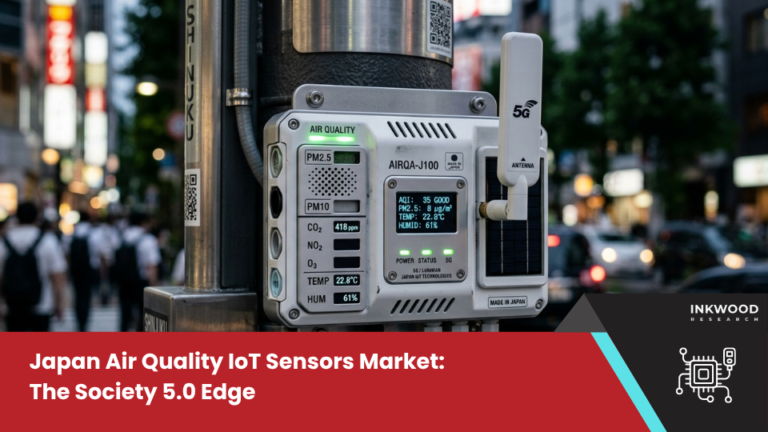
This analysis is brought to you by Inkwood Research, a leading market intelligence firm specializing in Asia-Pacific smart city technologies, IoT environmental monitoring systems, and urban sensor ecosystems. Our research team combines extensive experience analyzing Japan’s precision sensing infrastructure, Society 5.0 policy frameworks, and air quality monitoring networks across major urban centers. Through strategic partnerships with Japanese technology providers, municipal planners, and environmental agencies, we deliver actionable intelligence for businesses navigating the Japan air quality IoT sensors market.
TLDR
Japan is weaving air quality IoT sensors directly into the fabric of everyday city life. Guided by the Society 5.0 framework, the Japan air quality IoT sensors market is set to grow from US$100.19 million in 2026 to US$356.91 million by 2034, at a CAGR of 17.21%. This remarkable expansion reflects more than technology adoption; it signals a national commitment to making smart air quality sensors as fundamental to urban infrastructure as public transit or broadband connectivity.
This blog is essential reading for smart city planners, IoT infrastructure developers, and environmental technology investors evaluating Japan’s urban sensing landscape. Additionally, government policy analysts, sensor technology manufacturers, enterprise decision-makers assessing Society 5.0-aligned investments, and sustainability strategists navigating Japan’s air quality monitoring sensors market will find targeted, evidence-based insights to support informed technology and market entry decisions.
What Is Society 5.0 and How Does It Integrate Air Quality Monitoring?
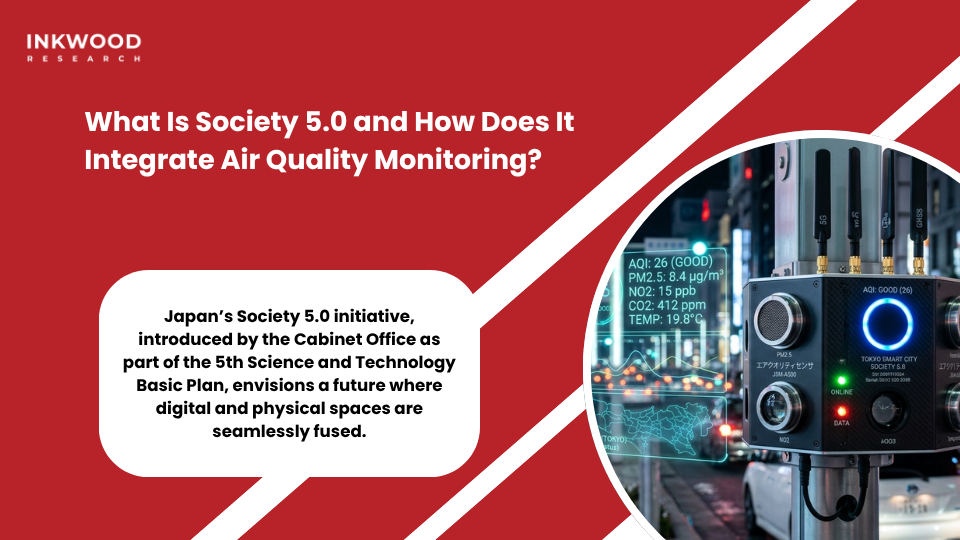
To understand where Japan’s air quality IoT sensors market is heading, it helps to understand where the country is coming from. Japan’s Society 5.0 initiative, introduced by the Cabinet Office as part of the 5th Science and Technology Basic Plan, envisions a future where digital and physical spaces are seamlessly fused. Unlike a purely technology-driven agenda, Society 5.0 is fundamentally about human well-being, and clean air is inseparable from that goal.
Within this framework, IoT environmental sensors are not viewed as standalone monitoring tools. Instead, they become part of a living urban intelligence system. Moreover, the Society 5.0 vision explicitly calls for data from sensing networks to be integrated with AI and cloud platforms, enabling cities to respond to environmental changes in real time rather than react after the fact.
Why Air Quality Fits the Society 5.0 Model
Air quality sits at an especially compelling intersection of technology, health, and policy. Japan already has one of the world’s most developed national monitoring networks, overseen by the Ministry of the Environment. Consequently, the infrastructure groundwork is well established; what Society 5.0 adds is the intelligence layer that transforms raw sensor data into actionable urban insights.
This shift from measurement to management defines the next phase of Japan’s IoT air quality monitoring market. Additionally, Japanese citizens consistently rank air quality and environmental health among their top urban concerns. This cultural emphasis on clean, healthy living environments creates grassroots demand that reinforces government-led investment in air pollution monitoring sensors at scale.
How Does Japan’s Urban Density Make IoT Air Sensing Essential?
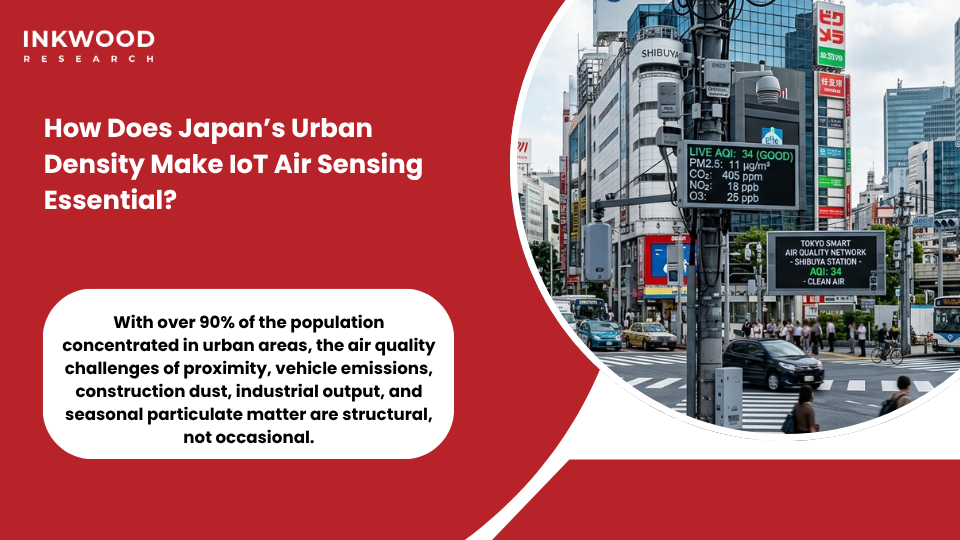
Japan’s geography makes the case for smart air quality sensors almost self-evident. With over 90% of the population concentrated in urban areas, and cities like Tokyo among the most densely populated on earth, the air quality challenges of proximity, vehicle emissions, construction dust, industrial output, and seasonal particulate matter are structural, not occasional.
Furthermore, Japan’s aging population amplifies the stakes considerably. Older residents face disproportionate health risks from poor air quality, particularly from fine particulate matter (PM2.5) and ground-level ozone. As a result, municipal governments are under increasing pressure to provide real-time, granular data that residents can act on, not just annual averages published in government reports.
The Indoor Dimension of Air Quality in Japan
Crucially, the indoor air quality sensors market is gaining significant momentum alongside outdoor monitoring. Japanese residential design, characterized by relatively compact, well-insulated homes, can trap pollutants when ventilation is inadequate. Similarly, commercial buildings, schools, and public spaces face growing scrutiny around indoor air quality standards.
Consequently, demand for indoor air quality monitoring systems is rising sharply, not just from corporations managing workplace wellness, but from individual households investing in personal environmental monitoring devices. This dual demand, outdoor and indoor, is one of the most important structural drivers behind Japan’s air quality IoT sensors market growth trajectory.
How Are Smart Air Quality Sensors Being Woven Into Everyday Life?
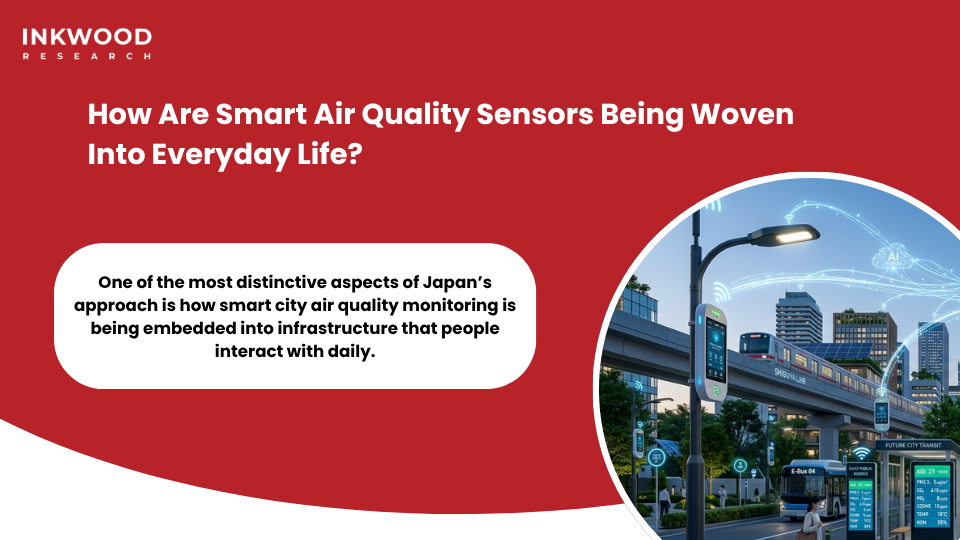
One of the most distinctive aspects of Japan’s approach is how smart city air quality monitoring is being embedded into infrastructure that people interact with daily. Rather than relying solely on large, expensive monitoring stations, Japanese municipalities are deploying low-cost air quality sensors across transit networks, public parks, shopping districts, and residential zones. This distributed model generates far denser data coverage than traditional approaches allow.
Moreover, integration with existing smart city platforms means that real-time air quality monitoring IoT data flows directly into city dashboards, public information displays, and mobile applications accessible to every resident. Several municipalities are already linking sensor data with weather platforms and traffic management systems, enabling predictive air quality forecasts rather than purely reactive reporting.
AI and Cloud: The Intelligence Behind the Sensors
The sensors themselves are only part of the story. What makes Japan’s model genuinely powerful is the AI-powered air quality monitoring systems layer that processes incoming data. Machine learning models trained on years of historical monitoring data can identify pollution sources, predict peak exposure windows, and recommend proactive responses, all without human intervention. Furthermore, cloud-connected air quality monitoring systems enable seamless aggregation of data across an entire city, making it possible to identify micro-pollution hotspots that point-based monitoring would entirely miss.
Japanese technology companies, including Panasonic, Hitachi, NEC, and Fujitsu, have all integrated environmental sensing capabilities into their smart city platforms. These firms are deploying IoT environmental sensors as part of broader urban intelligence suites, a distinction that reflects Japan’s system-level approach to Society 5.0 implementation.
Which Japanese Cities Are Leading Smart Air Sensing Integration?
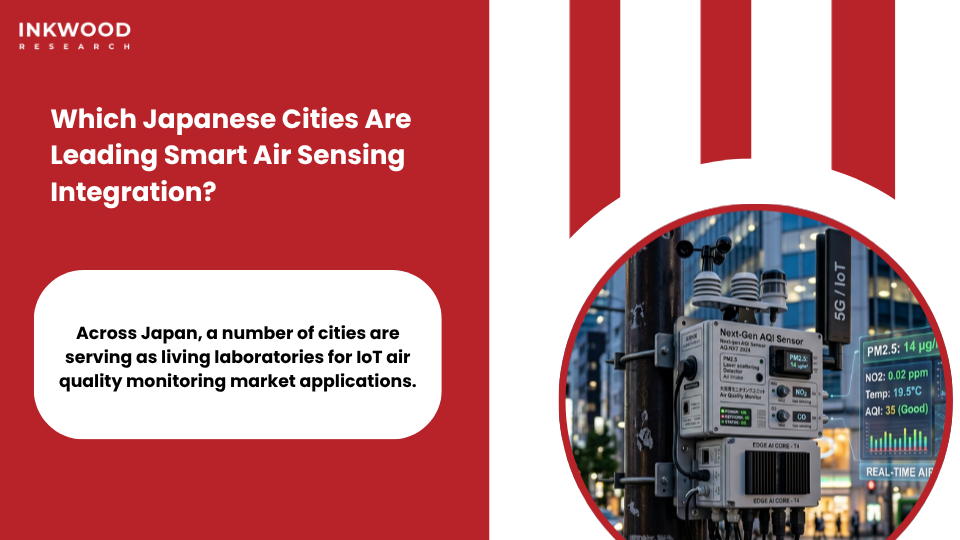
Across Japan, a number of cities are serving as living laboratories for IoT air quality monitoring market applications. Tokyo’s metropolitan government has invested in expanding its network of environmental monitoring points as part of its Zero Emission Tokyo strategy. The initiative connects air quality data streams with emissions reduction programs, creating a feedback loop between measurement and policy action.
Meanwhile, Osaka has incorporated air quality detection sensors into its smart city roadmap, with a focus on integrating sensing data with public health systems. Kitakyushu, long recognized as a leader in environmental technology, is piloting next-generation wireless air quality sensors across industrial and residential zones, generating comparative data that informs both regulatory enforcement and public awareness.
Additionally, Japan’s Digital Garden City Nation initiative, promoted by the Cabinet Secretariat, is extending smart city infrastructure, including environmental sensing, beyond major urban centers into smaller regional cities and rural towns. Consequently, the geographic footprint of Japan’s air quality monitoring sensors market is expanding well beyond traditional metropolitan hubs.
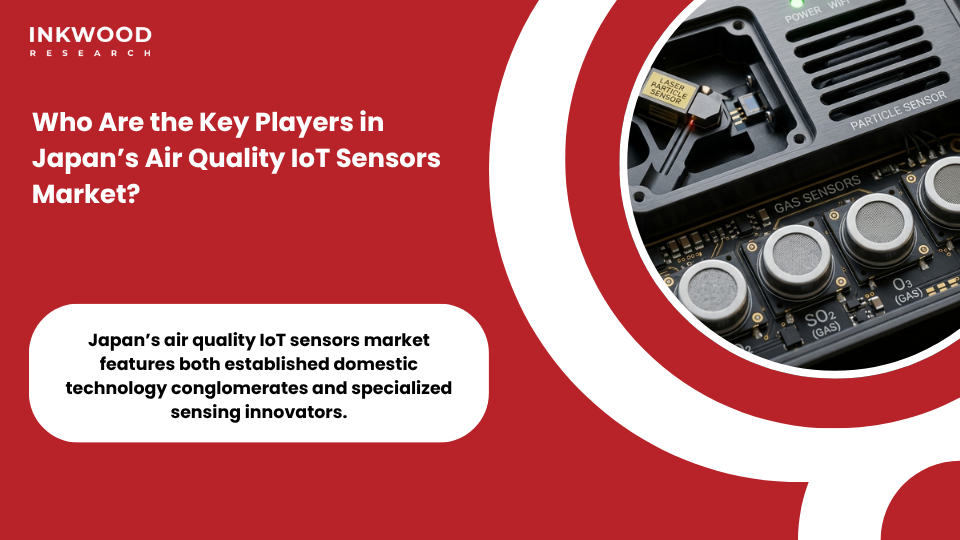
Japan’s air quality IoT sensors market features both established domestic technology conglomerates and specialized sensing innovators. Understanding each player’s positioning helps clarify where the competitive dynamics are moving.
- Panasonic has integrated indoor air quality monitoring systems into its Smart Town solutions, deploying sensor networks in residential and commercial developments. The company’s environment sensing portfolio covers CO₂, PM2.5, VOC, and humidity, a comprehensive stack aligned with Society 5.0’s whole-of-environment monitoring goals.
- Hitachi brings its Lumada IoT platform to bear on urban air quality monitoring, integrating sensor data with analytics and digital twin capabilities. Their approach positions air quality as one input within a broader city intelligence architecture.
- NEC focuses on AI-driven analysis of IoT air pollution monitoring systems, combining sensor networks with predictive modeling to serve municipal clients. Their smart city solutions are deployed across several Japanese prefectures.
- Fujitsu contributes cloud infrastructure and data management capabilities, enabling cities to aggregate and analyze real-time IoT monitoring platforms at scale.
- Honeywell and Siemens, both operating significant presences in Japan, bring global expertise in industrial air quality sensors market applications, particularly relevant for Japan’s manufacturing zones, where emission compliance monitoring is a regulatory requirement.
The emerging segment of low-cost air quality sensors is also drawing attention from startups and specialized sensor manufacturers, driven by demand from local governments seeking to expand coverage without proportional cost increases.
Key Takeaways
- The Japan air quality IoT sensors market is projected to grow from US$100.19 million in 2026 to US$356.91 million by 2034, at a 17.21% CAGR, reflecting strong structural demand.
- Society 5.0 positions smart air quality sensors not as environmental add-ons, but as core urban infrastructure integrated with AI, cloud, and city-wide data platforms.
- Japan’s high urban density and aging population create sustained demand for both outdoor and indoor air quality monitoring solutions.
- Major players, including Panasonic, Hitachi, NEC, and Fujitsu, are embedding IoT environmental sensors into broader smart city platforms rather than standalone products.
- Government initiatives, including Zero Emission Tokyo and the Digital Garden City Nation strategy, are accelerating smart city air quality monitoring deployment beyond major metropolitan areas.
- The low-cost air quality sensors market segment is emerging as a democratizing force, enabling municipal governments to achieve denser urban coverage at manageable investment levels.
Conclusion:
Japan’s approach to air quality IoT sensors is distinctly its own, shaped by a Society 5.0 philosophy that insists technology must serve human well-being, not merely demonstrate capability. As the Japan air quality IoT sensors market grows toward US$356.91 million by 2034, the opportunity extends beyond hardware sales. Furthermore, it encompasses platforms, analytics, integration services, and the long-term business of helping cities breathe better. For enterprises seeking to participate in this market, understanding Society 5.0’s system-level logic is as important as understanding sensor specifications.
Inkwood Research provides the market intelligence and strategic analysis needed to navigate Japan’s evolving IoT air quality monitoring market with confidence.
Connect with our team to explore how our insights can support your positioning in Japan’s smart environmental sensing landscape.
Frequently Asked Questions
What is the Japan air quality IoT sensors market size?
The market is valued at US$100.19 million in 2026, growing to US$356.91 million by 2034 at a 17.21% CAGR.
How does Society 5.0 drive demand for smart air quality sensors?
Society 5.0 integrates IoT environmental sensors into city infrastructure, connecting air quality data with AI platforms for real-time urban management.
Which companies lead Japan’s air quality IoT sensors market?
Panasonic, Hitachi, NEC, and Fujitsu are major domestic players, alongside global firms like Honeywell and Siemens operating in Japan.
What role does indoor air quality monitoring play in Japan?
Compact Japanese homes and public buildings drive strong demand for indoor air quality sensors measuring PM2.5, CO₂, and volatile organic compounds.
How does Japan’s government support IoT air quality monitoring?
Initiatives like Zero Emission Tokyo and the Digital Garden City Nation strategy fund smart environmental sensing networks across urban and regional areas.
What are low-cost air quality sensors used for in Japanese cities?
They enable dense urban coverage across transit networks, parks, and residential zones, supplementing traditional monitoring stations at lower deployment costs.