Table of Contents
This analysis is brought to you by Inkwood Research, a leading market intelligence firm specializing in competitive strategy, industry benchmarking methodologies, and business performance analytics. Our research team brings extensive experience in competitor analysis frameworks, market positioning strategies, and strategic intelligence tools across manufacturing, technology, consumer goods, and services sectors. Through rigorous research methodologies and industry partnerships, we deliver actionable competitive intelligence that helps business owners make smarter, faster strategic decisions.
TLDR
Knowing where your business stands relative to competitors is no longer optional; it is a strategic necessity. Industry benchmarking and competitive intelligence give business owners the tools to measure performance objectively, identify gaps, and act on them before competitors do. This guide breaks down exactly how to approach competitive analysis, which frameworks matter most, what KPIs to track, and how to turn competitive data into a clear, execution-ready strategy for 2026 and beyond.
This guide is directly relevant for business owners, founders, and operations leaders building or refining their competitive strategy. Additionally, strategy consultants, marketing directors, product managers, and investors conducting market competition analysis will find practical frameworks and execution-ready tools here. Whether you are benchmarking a startup against industry standards or conducting a full competitor analysis for an established enterprise, this guide delivers actionable clarity.
What Is Industry Benchmarking and Why Does It Matter for Your Business?

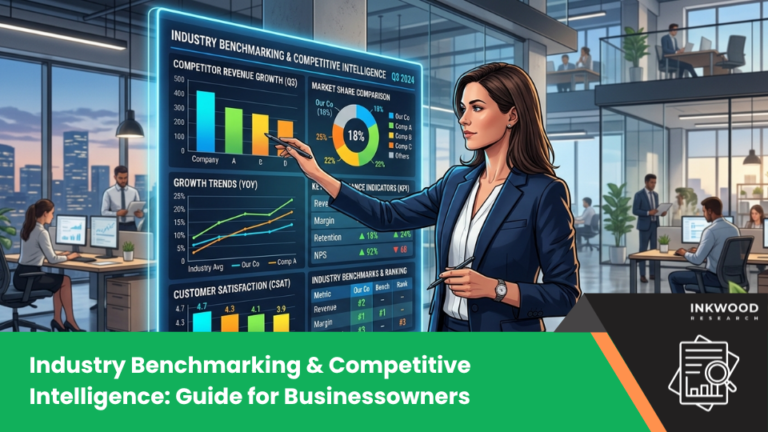
Industry benchmarking is the process of comparing your business’s performance, processes, and strategies against established industry standards or direct competitors. Simply put, it answers one foundational question: how are we doing relative to everyone else? Moreover, the answer to that question shapes everything from pricing and product development to operational efficiency and market positioning strategies.
Without benchmarking, business decisions rest on internal assumptions, and internal assumptions, however well-intentioned, rarely tell the full story. Competitive intelligence extends this further by gathering, analysing, and applying information about competitors, market conditions, and industry performance metrics in ways that inform proactive strategy rather than reactive response.
Types of Industry Benchmarking
Understanding which type of benchmarking applies to your situation is the first practical step forward:
- Performance benchmarking: Compares financial and operational KPIs against industry peers to reveal gaps in efficiency or profitability
- Process benchmarking: Evaluates internal workflows against best-in-class industry standards to identify operational improvements
- Strategic benchmarking: Assesses broader competitive positioning and growth strategy relative to market leaders
- Competitive benchmarking: Directly measures your performance against named competitors across multiple dimensions
Each type serves a different strategic purpose. However, the most effective business benchmarking strategies typically combine performance and competitive benchmarking, giving you both a quantitative foundation and a contextual competitive picture that neither approach alone provides.
How Do You Build a Competitive Intelligence Framework?

A competitive intelligence framework is a structured approach to gathering, organising, and applying information about your competitive environment. Unlike ad hoc competitor research, a framework ensures that intelligence gathering is systematic, ongoing, and tied directly to strategic decision-making. According to the U.S. Small Business Administration, businesses that invest in structured competitive and risk intelligence are better positioned to anticipate market changes and protect their strategic assets over time.
Step-by-Step Competitive Intelligence Framework
Building an effective framework follows a clear, repeatable sequence:
- Step 1 – Define your intelligence objectives: What decisions will this intelligence inform? Pricing, product development, market entry, or operational improvements?
- Step 2 – Identify your key competitors: Direct competitors, indirect competitors, and emerging disruptors; all three categories matter for a complete picture.
- Step 3 – Determine your intelligence sources: Public filings, industry publications, customer interviews, job listings, patent databases, and official regulatory records.
- Step 4 – Establish a collection cadence: Intelligence has a shelf life. Weekly or monthly collection cycles ensure your data remains current and actionable.
- Step 5 – Analyse and interpret: Raw data is not intelligence. Analysis converts information into insight that can drive decisions.
- Step 6 – Distribute and act: Intelligence only has value when the right people receive it at the right time and act on it decisively.
Porter’s Five Forces and SWOT in Competitive Context
Two analytical frameworks remain consistently useful for strategic competitive analysis across industries:
- Porter’s Five Forces: Evaluates competitive intensity, supplier and buyer power, threat of substitutes, and barriers to entry, providing a structural view of your competitive landscape.
- SWOT Analysis: Maps internal strengths and weaknesses against external opportunities and threats, grounding competitive strategy in honest self-assessment.
Neither framework replaces deep competitor analysis, but both provide strong analytical scaffolding. Furthermore, used together, they give business owners a layered view of competitive dynamics that single-framework approaches consistently miss.
A regional logistics company wanted to expand into three new markets but lacked clarity on competitive intensity, pricing norms, and market share distribution. Inkwood Research conducted a full competitive intelligence engagement, mapping seven key competitors across each market and analysing their pricing structures, service capabilities, and customer acquisition strategies.
The result was a market entry prioritisation framework that ranked the three markets by competitive risk and revenue opportunity. The client entered two markets within 12 months, avoiding the third where margin compression made entry economically unviable. Intelligence, not assumption, drove the decision.
What KPIs and Metrics Should You Track for Business Benchmarking?

Benchmarking without the right metrics produces noise rather than clarity. The key is selecting benchmarking KPIs and metrics that are both measurable and strategically relevant to your specific industry and competitive position. Consequently, KPI selection should always follow an objective definition, not precede it.
Core Benchmarking KPIs by Category –
Financial performance metrics:
- Revenue growth rate relative to industry average and direct competitors
- Gross margin and EBITDA margin benchmarked against sector norms
- Customer acquisition cost (CAC) compared to industry benchmarks
- Revenue per employee as a proxy for operational leverage
Operational efficiency metrics:
- Order fulfilment time versus industry standard delivery expectations
- Defect or error rates relative to quality benchmarks in your sector
- Employee productivity metrics benchmarked against peer organisations
Market performance metrics:
- Net Promoter Score (NPS) tracked against industry norms over time
- Customer retention rate compared to direct competitors
- Digital performance indicators: website traffic, conversion rates, search visibility
Industry Performance Metrics That Matter Most
Across industries, the highest-value benchmarks consistently involve customer experience, pricing competitiveness, and speed-to-market. Moreover, tracking these industry performance metrics over time, rather than at a single snapshot in time, reveals trend lines that static analyses miss entirely. Consequently, benchmarking becomes more valuable the more consistently it is practised.
What Are the Best Tools for Competitive Intelligence Analysis?

The right competitive intelligence tools depend on your budget, team size, and the depth of intelligence you need. Generally, tools fall into three practical categories, and the most effective competitive analysis guides recommend combining all three rather than relying on any single approach.
Free and Publicly Available Intelligence Sources
- S. Patent and Trademark Office (USPTO): Patent filings reveal competitors’ R&D focus and future product direction
- SEC EDGAR: Public company financial filings for competitor revenue and investment data
- S. Census Bureau: Industry economic data for sector-level benchmarking context
- Government procurement databases and regulatory filings for contract and compliance intelligence
Digital and Primary Intelligence Methods
Digital intelligence tools for ongoing competitive monitoring include:
- Web analytics platforms for tracking competitor content strategy and traffic trends
- Social listening tools for monitoring competitor messaging and audience sentiment shifts
- Job posting analysis, hiring patterns consistently reveal where competitors are investing strategically
Primary research methods go deeper still:
- Customer interviews and win/loss analysis to understand competitive switching behaviour
- Direct competitive product testing and mystery shopping
- Industry conference intelligence and ecosystem networking
Furthermore, data intelligence tools work best when combined with expert interpretation. Automated tools excel at surface-level monitoring, price changes, new product launches, and content updates, while primary research uncovers the strategic motivations behind competitor actions that tools alone cannot detect.
How Do You Track Competitors and Strengthen Your Market Position?

Effective competitor tracking is not a one-time exercise; it is an ongoing discipline. The most successful businesses treat market competition analysis as a continuous process, updating their competitive picture as new information becomes available. According to the U.S. Bureau of Labor Statistics Occupational Outlook, structured analytical roles focused on market and competitive intelligence are among the fastest-growing in the business and financial sector, reflecting how central this capability has become to modern business strategy.
Market Positioning Strategies Informed by Competitive Intelligence
Competitive intelligence directly shapes how you position your business in the market. Here are the four most actionable positioning strategies that competitive intelligence for business owners unlocks:
- Differentiation positioning: Identify gaps in competitor offerings and position your product or service to fill them decisively
- Cost leadership: Benchmark your cost structure against competitors to identify pricing advantages and margin opportunities
- Niche specialisation: Use competitive analysis to find underserved segments where competitive intensity is lower, and loyalty is higher
- Innovation positioning: Monitor competitor R&D and patent activity to anticipate where the market is heading before others move
Moreover, market positioning strategies are most durable when grounded in real competitive data rather than internal assumptions. That is precisely where competitive intelligence for business owners delivers its highest long-term return on investment.
Key Takeaways
- Industry benchmarking reveals where your business stands relative to peers, and where the performance gaps lie that are costing you a competitive position.
- A structured competitive intelligence framework ensures intelligence is systematic, ongoing, and decision-ready rather than reactive and ad hoc.
- The best competitor analysis combines Porter’s Five Forces, SWOT analysis, and primary research for a layered, reliable strategic view.
- Benchmarking KPIs should span financial, operational, and market performance dimensions, tracked consistently over time for maximum strategic value.
- Competitive intelligence tools work best when paired with expert human interpretation and primary research.
- Market positioning strategies are most effective and durable when grounded in real competitive data, not internal assumptions.
- Continuous competitor tracking, not one-time analysis, delivers the most sustainable strategic advantage over time.
Conclusion
Industry benchmarking and competitive intelligence are not luxuries for large enterprises; they are practical necessities for any business owner serious about growth. Understanding your competitive position, tracking the right metrics, and acting on structured intelligence are what separate businesses that lead their markets from those that follow reactively.
Inkwood Research delivers the competitive intelligence and benchmarking analysis that empowers business owners to make faster, more confident, and better-informed strategic decisions.
Connect with our team to explore how our insights can support your competitive analysis and business benchmarking strategies going forward.
Frequently Asked Questions (FAQs)
It is comparing your business performance and strategies against competitors or industry standards to objectively identify strengths, gaps, and growth opportunities.
Define your strategic objectives first, then identify competitors, intelligence sources, and a regular collection and analysis cadence to keep insights current.
Revenue growth, customer acquisition cost, retention rate, and NPS are each measured against direct industry peers for meaningful, decision-ready comparison.
USPTO patent filings, SEC EDGAR financial reports, and U.S. Census Bureau economic data provide reliable, publicly available competitive intelligence at no cost.
Establish monthly digital and pricing reviews, with deeper strategic competitive analyses conducted quarterly or annually for the most strategic value.
It reveals competitor gaps and underserved segments, allowing you to position your business where competitive pressure is lowest, and customer opportunity is highest.