Table of Contents
This analysis is brought to you by Inkwood Research, a leading market intelligence firm specializing in Asia-Pacific pharmaceutical manufacturing policy, China’s biomedical innovation programs, and pharmaceutical additive manufacturing ecosystems. Our research team combines expertise in China’s Five-Year industrial planning cycles, NMPA regulatory pathways, and digital pharma manufacturing strategy across domestic and export-oriented production. Through strategic partnerships with Chinese pharmaceutical innovators and Asia-Pacific policy analysts, we deliver intelligence for enterprises navigating the fast-evolving China pharmaceutical 3D printing manufacturing market.
TLDR
China’s 15th Five-Year Plan is setting the stage for the country’s most deliberate push yet into industrialized pharmaceutical manufacturing. The China pharmaceutical 3D printing manufacturing market is projected to grow from US$48.67 million in 2026 to US$193.81 million by 2034, at an 18.85% CAGR, within the broader Asia-Pacific pharmaceutical 3D printing manufacturing market expanding from US$136.25 million to US$528.40 million over the same period. State investment in advanced manufacturing, NMPA regulatory evolution, and homegrown companies like Triastek are converging to make China a global force in pharmaceutical additive manufacturing.
This blog is essential reading for pharmaceutical executives, policy strategists, and investors tracking China’s biomedical industrial ambitions. Additionally, market entry professionals planning operations in the China pharmaceutical 3D printing manufacturing market, regulatory affairs teams working within the NMPA framework, and R&D leaders evaluating Chinese pharmaceutical additive manufacturing partnerships will find targeted, verified intelligence here.
What Is China’s 15th Five-Year Plan and Why Does It Matter for Pharmaceutical 3D Printing?
China’s Five-Year Plans have long been the country’s most consequential industrial policy instrument, channeling state investment toward sectors identified as strategic priorities. The forthcoming 15th Five-Year Plan, covering the period from 2026 to 2030, is expected to build significantly on the 14th Five-Year Plan’s biopharmaceutical priorities, which already designated advanced pharmaceutical manufacturing as a national development focus. For the China pharmaceutical 3D printing manufacturing market, planning continuity is not just a policy background; it is the structural engine driving capital allocation, regulatory reform, and industrial investment.
China’s approach to industrializing pharmaceutical manufacturing has always been methodical and state-coordinated. The pharmaceutical additive manufacturing market in China is consequently developing differently from its counterparts in the US or Europe, where commercial demand and private capital drive the timeline. In China, government blueprints define the investment horizon, set the regulatory agenda, and create guaranteed demand pathways through national hospital procurement systems. Consequently, companies entering the China pharmaceutical 3D printing manufacturing market are not betting purely on commercial market dynamics; they are aligning with a planned industrial trajectory.
How Did the 14th Plan Lay the Groundwork for 3D Drug Manufacturing?
The 14th Five-Year Plan explicitly prioritized innovation in biopharmaceuticals and high-end medical devices, directing funding toward advanced drug delivery systems, precision formulation technology, and digital manufacturing integration. That investment created the research infrastructure, university labs, state-backed innovation centers, and pilot manufacturing facilities that the 15th Plan will now scale into commercial production.
Furthermore, the 14th Plan’s emphasis on domestic pharmaceutical self-sufficiency introduced a policy imperative for 3D printing drug manufacturing market development: China wants to produce its most advanced medicines domestically, and pharmaceutical 3D printing is increasingly central to that ambition.
How Large Is the China Pharmaceutical 3D Printing Manufacturing Market?
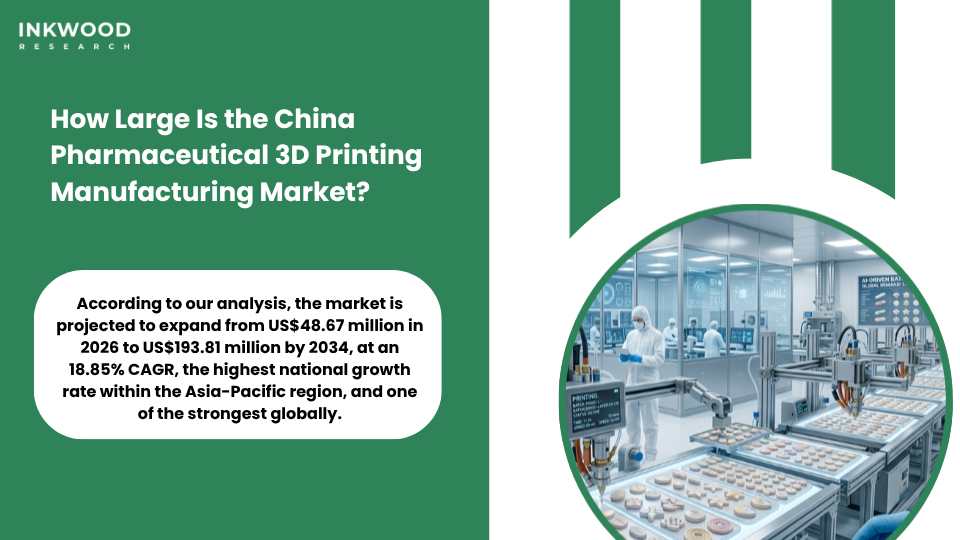
The scale of opportunity within the China pharmaceutical 3D printing manufacturing market is substantial and growing quickly. According to our analysis, the market is projected to expand from US$48.67 million in 2026 to US$193.81 million by 2034, at an 18.85% CAGR, the highest national growth rate within the Asia-Pacific region, and one of the strongest globally. Notably, this growth sits within a broader Asia-Pacific pharmaceutical 3D printing manufacturing market expanding from US$136.25 million in 2026 to US$528.40 million by 2034, with China accounting for a leading share of that regional expansion.
What makes China’s trajectory particularly distinctive is the demand structure. Unlike markets where growth is driven primarily by private hospital procurement or insurance reimbursement, China’s pharma 3D printing manufacturing market benefits from coordinated national hospital demand, centralized drug procurement programs, and government-funded clinical trial pipelines. These mechanisms compress the commercialization timeline for 3D printed drugs in ways that are genuinely difficult to replicate in more decentralized healthcare systems.
What Manufacturing Applications Is China Prioritizing?
Within the China pharmaceutical 3D printing manufacturing market, three application areas are drawing the most consistent investment and policy attention:
- Controlled-release oral dosage forms: Complex release-architecture tablets that improve patient compliance in chronic disease treatment, particularly for cardiovascular, diabetes, and oncology applications, where China carries an enormous disease burden.
- Pediatric and geriatric personalized dosing: Dose-flexible formulations produced through pharmaceutical additive manufacturing to address the clinical gaps in China’s aging population, where standard commercial dosing often fails older patients with complex comorbidities.
- Clinical trial manufacturing: Small-batch 3D printing in pharmaceutical R&D enables faster iteration on drug candidates during clinical development, a capability that China’s state-backed CRO and CDO sectors are beginning to integrate actively.
How Is China’s NMPA Evolving to Support 3D Printed Drug Manufacturing?
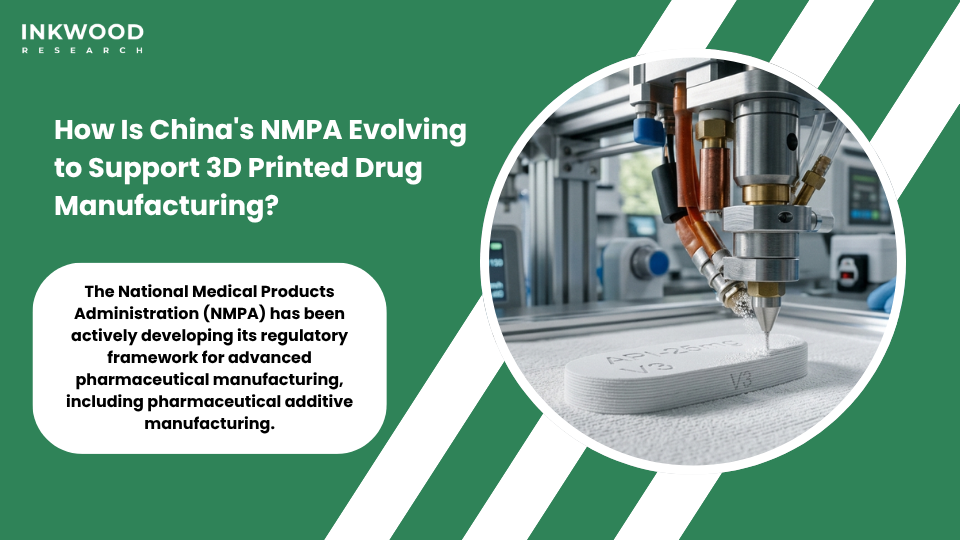
The National Medical Products Administration (NMPA) has been actively developing its regulatory framework for advanced pharmaceutical manufacturing, including pharmaceutical additive manufacturing. The NMPA’s technical guidelines for novel drug delivery systems have progressively expanded their scope to address digital fabrication processes, drawing on international precedents, particularly the FDA’s engagement with 3D printed drugs, while adapting them to China’s domestic regulatory culture.
For companies operating in the China pharmaceutical 3D printing manufacturing market, this regulatory evolution matters enormously. The NMPA has established an expedited review pathway for innovative drugs and novel manufacturing technologies under its priority review and approval system, which applies to 3D printed oral dosage forms with clear clinical advantages over existing approved alternatives. That pathway reduces the time and capital required to move from IND acceptance to commercial approval, which directly accelerates the pharmaceutical 3D printing market in China.
What Are the Key Regulatory Milestones Chinese Companies Are Targeting?
- Good Manufacturing Practice (GMP) compliance for additive manufacturing: Chinese manufacturers are working to establish GMP protocols specific to 3D printing drug manufacturing, as current GMP frameworks were designed for conventional tablet production.
- IND applications for complex formulations: Multiple Chinese pharma companies are pursuing IND filings for controlled release drug manufacturing candidates developed through 3D printing platforms, targeting both domestic NMPA and parallel FDA filings.
- Pharmacopoeial standards: The Chinese Pharmacopoeia Commission is developing analytical standards for 3D-printed drug products, which will provide the quality benchmarks manufacturers need for commercial-scale regulatory submission.
Which Chinese Companies Are Driving Pharmaceutical Additive Manufacturing?
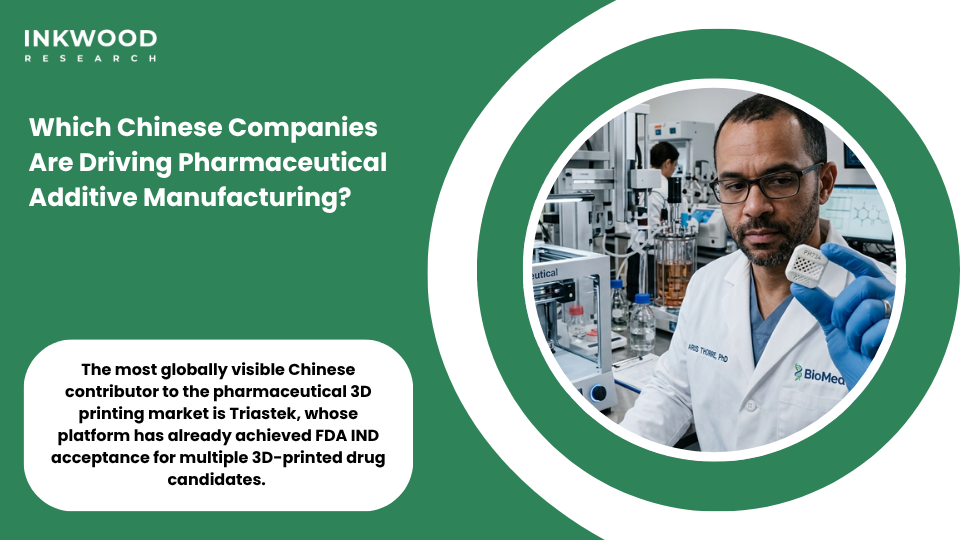
The most globally visible Chinese contributor to the pharmaceutical 3D printing market is Triastek, whose platform has already achieved FDA IND acceptance for multiple 3D-printed drug candidates. What makes Triastek particularly interesting is that it operates simultaneously within the NMPA and FDA frameworks, developing 3D printed drugs for both Chinese domestic use and US market entry. That dual-regulatory ambition reflects a confidence in the company’s melt extrusion platform that few other pharmaceutical additive manufacturing companies globally can match.
Beyond Triastek, a wider ecosystem of Chinese pharmaceutical manufacturers is integrating digital pharma manufacturing capabilities into existing production lines. State-owned pharmaceutical enterprises and private CRO platforms are both investing in pharmaceutical manufacturing innovation through 3D printing, often with partial state funding channeled through regional pharmaceutical innovation parks in Shanghai, Suzhou, and Chengdu. Furthermore, contract drug manufacturers with existing export relationships are exploring on-demand medicine production through 3D printing as a differentiation strategy for their global client base.
How Is China Positioning 3D Printed Drugs Within Its Biomedical Export Strategy?
China’s Made in China 2025 initiative and its successors have consistently identified advanced medical products as a key component of China’s industrial export ambition. Within that framework, pharmaceutical 3D printing offers a compelling export proposition: the ability to produce highly differentiated, personalized drug products at competitive costs that conventional manufacturing cannot replicate.
The China pharmaceutical 3D printing manufacturing market is consequently developing export readiness alongside domestic production capability. Companies pursuing dual FDA and NMPA regulatory approvals, like Triastek, are building the compliance infrastructure needed to supply international markets, particularly in Asia-Pacific economies, where demand for 3D printed oral dosage forms is growing rapidly. Additionally, China’s belt-and-road pharmaceutical partnerships create distribution relationships in Southeast Asian, African, and Middle Eastern markets that could accelerate international adoption of Chinese-manufactured 3D printed drugs at scale.
Key Takeaways
- The China pharmaceutical 3D printing manufacturing market grows from US$48.67 million in 2026 to US$193.81 million by 2034, at an 18.85% CAGR, the highest national rate in Asia-Pacific.
- China’s 15th Five-Year Plan is extending state investment in advanced pharmaceutical manufacturing, creating structural demand for pharmaceutical additive manufacturing at an industrial scale.
- The Asia-Pacific pharmaceutical 3D printing manufacturing market, expanding from US$136.25 million to US$528.40 million by 2034, positions China at the regional center of gravity for pharmaceutical manufacturing innovation.
- The NMPA’s expedited review pathway for innovative drug delivery systems is directly supporting the commercialization timeline for 3D printed drugs in China.
- Triastek’s dual FDA and NMPA regulatory strategy exemplifies how leading Chinese companies are building platforms for both domestic and export pharmaceutical additive manufacturing market capture.
- China’s biomedical export ambition, embedded in Made in China 2025 and its successors, creates an international demand pipeline for Chinese-manufactured 3D printed oral dosage forms beyond domestic consumption.
Conclusion:
China’s transition from pharmaceutical manufacturer to pharmaceutical innovator is well underway, and pharmaceutical 3D printing is a central part of that story. The China pharmaceutical 3D printing manufacturing market is not growing organically from consumer demand alone; it is growing from the intersection of state industrial policy, regulatory reform, and genuinely strong commercial innovation from companies like Triastek. Together, these forces are creating a market trajectory that the global pharmaceutical industry cannot afford to overlook.
Inkwood Research provides the market intelligence and strategic analysis needed to navigate the evolving China pharmaceutical 3D printing manufacturing market.
Connect with our team to explore how our insights can support your Asia-Pacific strategy.
Frequently Asked Questions
What is the China pharmaceutical 3D printing manufacturing market size?
The market stands at US$48.67 million in 2026, projected to reach US$193.81 million by 2034, at an 18.85% CAGR.
How does China's 15th Five-Year Plan support pharmaceutical 3D printing?
The 15th Plan extends the 14th Plan biomedical priorities, directing state investment into advanced drug manufacturing, R&D infrastructure, and domestic pharmaceutical self-sufficiency programs.
Which Chinese company leads pharmaceutical additive manufacturing globally?
Triastek is China’s most globally recognized pharmaceutical 3D printing company, holding FDA IND acceptances for multiple 3D-printed drug candidates using melt extrusion technology.
How is the NMPA regulating 3D printed drug manufacturing in China?
The NMPA operates a priority review pathway for novel drug delivery systems and is developing GMP standards and pharmacopoeial benchmarks for 3D-printed pharmaceutical products.
What applications does China prioritize in 3D printing drug manufacturing?
Controlled release oral dosage forms, pediatric and geriatric personalized dosing, and clinical trial small-batch manufacturing are China’s primary pharmaceutical 3D printing application priorities.
How does China position 3D printed drugs within its export strategy?
China’s Made in China 2025 framework positions advanced pharmaceutical manufacturing, including 3D printed drugs, as a key export category for the Asia-Pacific and emerging markets.