Table of Contents
This analysis is brought to you by Inkwood Research, a leading market intelligence firm specializing in Indian renewable energy policy, circular economy development, and emerging market waste management systems. Our research team combines extensive experience analyzing solar deployment patterns, regulatory frameworks, and infrastructure challenges across India’s diverse regions. Based on our proprietary research methodologies and strategic partnerships with Indian solar manufacturers, government agencies, and environmental organizations, we deliver actionable insights that empower strategic decision-making for enterprises navigating India’s solar panel recycling market evolution and policy transformation.
TLDR
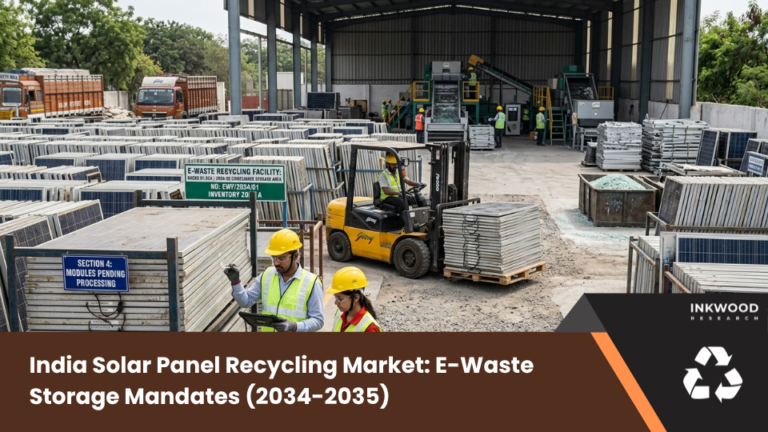
India tackles solar panel recycling through pragmatic interim solutions while building long-term infrastructure. The market reached US$16.50 million in 2026 and projects growth to US$77.98 million by 2034. E-Waste Management Rules 2022 mandate storage until 2034-2035, giving manufacturers time to develop collection systems. Meanwhile, CPCB drafts comprehensive guidelines for safe handling. This measured approach balances rapid solar deployment with responsible waste management as infrastructure matures.
Solar manufacturers navigating Indian compliance requirements, waste management companies exploring emerging opportunities, policy makers designing extended producer responsibility frameworks, renewable energy developers planning lifecycle strategies, and environmental consultants advising clients on Indian regulations will discover comprehensive insights into storage mandates, CPCB guidelines, infrastructure development challenges, and strategic approaches shaping India’s photovoltaic waste management landscape.
India’s Solar Panel Recycling Challenge: E-Waste Storage Mandates Until Infrastructure Matures

India confronts a unique challenge as solar deployment accelerates faster than recycling infrastructure development. The nation installed 132.85 GW of solar capacity as of November 2025, yet lacks comprehensive facilities for managing end-of-life panels. Rather than allowing this gap to create an environmental crisis, policymakers chose pragmatic interim solutions that acknowledge reality while building toward sustainable systems.
The approach reflects India’s characteristic balancing act between ambitious renewable energy targets and practical implementation constraints. Solar installations must continue expanding to meet climate commitments and energy access goals. Simultaneously, proper waste management cannot wait indefinitely. Therefore, storage mandates buy time for infrastructure development while preventing improper disposal.
This strategy differs markedly from Western approaches, where regulations followed infrastructure development. India builds both concurrently under compressed timelines. Consequently, the nation pioneers models that other rapidly developing solar markets may emulate. Moreover, it demonstrates how emerging economies adapt international best practices to local circumstances.
India Solar Panel Recycling Market Develops Under Storage Framework
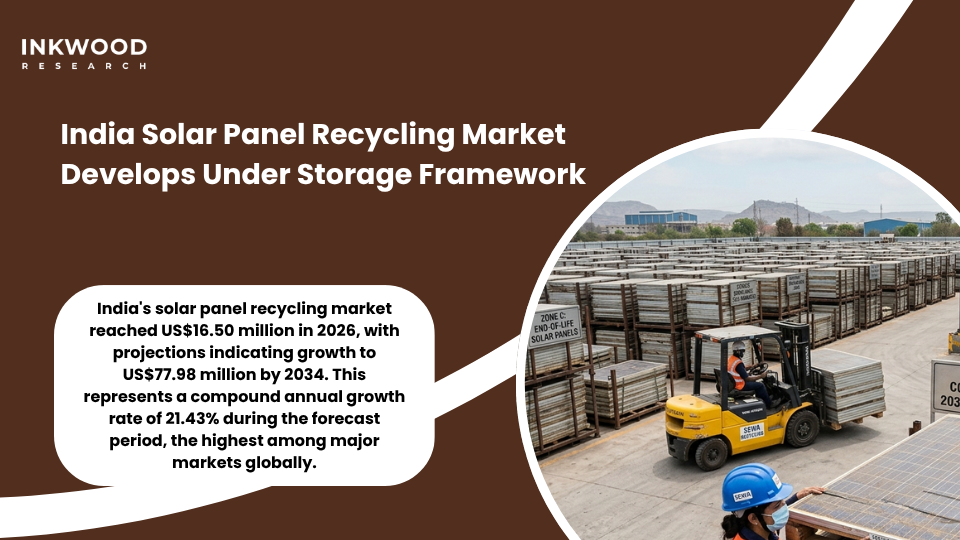
India’s solar panel recycling market reached US$16.50 million in 2026, with projections indicating growth to US$77.98 million by 2034. This represents a compound annual growth rate of 21.43% during the forecast period, the highest among major markets globally. Growth reflects both increasing waste volumes and evolving infrastructure capabilities.
The E-Waste Management Rules 2022 brought solar photovoltaic modules under the national electronic waste frameworks. These rules classify solar panels as CEEW 14 category e-waste, subjecting manufacturers to extended producer responsibility obligations. However, recognizing infrastructure gaps, regulations mandate storage rather than immediate recycling.
Further, manufacturers must store solar waste generated until the financial year 2034-2035 according to Central Pollution Control Board guidelines. This unprecedented requirement acknowledges that recycling facilities need years to develop. Meanwhile, producers maintain accountability through registration requirements and annual reporting obligations. The approach prevents both illegal disposal and unrealistic compliance expectations.
Waste Volume Projections Drive Policy Urgency
India’s installed solar capacity already generated approximately 100 kilotonnes of waste by 2024, according to CEEW research. Projections indicate cumulative waste could rise to 340 kt by 2030 and potentially 19,000 kt by 2050, according to Council on Energy, Environment and Water (CEEW) research. These volumes dwarf current processing capabilities, underscoring infrastructure development urgency.
Aligning with this, five states account for 67% of projected waste volumes. Rajasthan, Gujarat, Karnataka, Tamil Nadu, and Andhra Pradesh host eight of India’s ten largest solar parks. These regions prioritize infrastructure development given their disproportionate waste generation. Furthermore, they offer attractive locations for recycling facilities near major solar installations.
Regional concentration creates both challenges and opportunities. Concentrated waste streams enable economically viable facility operations. However, dependence on a few states creates vulnerability if infrastructure development lags. Therefore, national coordination ensures distributed capacity emerges across regions over time.
CPCB Guidelines Establish Safety Standards for Storage Period
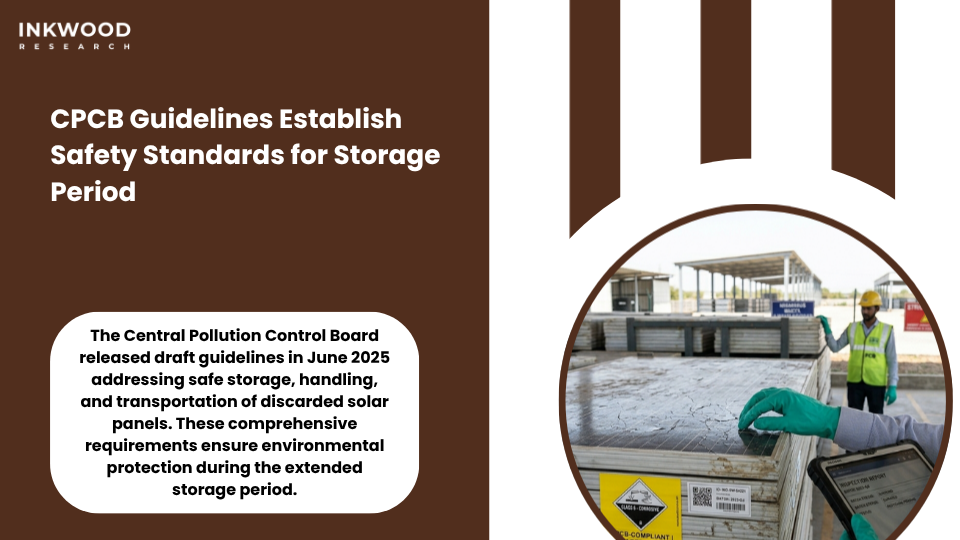
The Central Pollution Control Board released draft guidelines in June 2025 addressing safe storage, handling, and transportation of discarded solar panels. These comprehensive requirements ensure environmental protection during the extended storage period. Moreover, they establish foundations for eventual recycling operations.
Additionally, guidelines recognize that solar panels contain hazardous materials, including lead, cadmium, arsenic, antimony, selenium, copper, silver, gallium, tellurium, and tin. Improper storage risks soil and water contamination through material leaching. Uncontrolled burning releases toxic fumes, compromising air quality. Therefore, detailed protocols govern storage facility design and operational procedures.
Manufacturers must establish collection mechanisms from individual and bulk consumers. Take-back programs prevent panels from entering informal waste streams where unsafe handling occurs. Additionally, detailed inventory systems track stored volumes and locations. This data informs infrastructure planning while ensuring accountability throughout storage periods.
Extended Producer Responsibility Creates Manufacturer Accountability
Unlike other electronic waste categories with immediate recycling targets, solar panels receive a temporary exemption from EPR collection and recycling requirements. However, manufacturers still face substantial obligations to ensure responsible interim management. Registration mandates create traceability while annual reporting maintains transparency.
Moreover, producers must publicize collection point details and take-back program availability. This information enables consumers to properly dispose of panels rather than discarding them through general waste streams. Furthermore, manufacturers bear costs for establishing collection infrastructure and maintaining storage facilities meeting CPCB standards.
The framework anticipates transitioning from storage to recycling obligations once the infrastructure matures. Post-2035, EPR targets will likely mandate specific collection and material recovery rates. Subsequently, this phased approach gives industry time to develop capabilities while maintaining accountability throughout the transition period.
Infrastructure Development Progresses Through Pilot Projects

India develops recycling infrastructure through pilot facilities, testing different approaches before large-scale deployment. These projects generate operational experience informing policy refinement. Additionally, they build domestic capabilities, reducing dependence on imported technologies and expertise.
Further, several initiatives demonstrate progress despite overall infrastructure limitations. Gujarat Energy Development Agency initiated research studying material recovery methods and implementation roadmaps. Multiple startups explore innovative processing techniques adapted to Indian market conditions. Meanwhile, informal sector operators currently handle significant volumes, though without proper environmental controls.
Government support proves essential for catalyzing private sector investment. Viability gap funding could boost recycling project development by offsetting initial losses until scale economies emerge. Accordingly, research and development grants support technology adaptation while infrastructure subsidies reduce capital requirements. These incentives accelerate capability building during the critical transition period.
Academic Research Advances Material Recovery Technologies
Indian research institutions develop recycling technologies suited to local circumstances. MIT World Peace University created scalable processes recovering 95% of silicon and 85% of silver from retired panels. These innovations demonstrate domestic capabilities while reducing technology import dependence.
Moreover, the method involves sophisticated chemical and mechanical steps, separating panel components. Aluminum frames and glass undergo initial removal, followed by treatments dissolving and purifying silicon and silver. Residual materials convert into construction products, achieving zero-waste objectives. Consequently, Such approaches address both environmental and economic sustainability.
Knowledge transfer from research to commercial operations requires bridging gaps between laboratory and industrial scales. Pilot facilities prove concepts while identifying commercialization challenges. Subsequently, manufacturing partnerships enable technology deployment across multiple recycling centers. This ecosystem approach accelerates capability development beyond what individual entities achieve independently.
Circular Economy Vision Guides Long-Term Strategy

India views solar panel recycling as an essential element of the broader circular economy transformation. This perspective extends beyond waste management to comprehensive resource efficiency throughout product lifecycles. Moreover, recovered materials reduce virgin resource consumption while creating employment opportunities across collection, transportation, and processing operations.
Economic analysis reveals substantial value in recycled materials. Silicon, silver, copper, aluminum, and glass extraction from waste panels provides domestic material sources. This reduces import dependence while supporting self-reliant manufacturing ecosystems. Furthermore, recycling creates distributed economic opportunities across regions rather than concentrating benefits in mining areas.
The transition from linear to circular approaches requires systemic changes across multiple stakeholders. Manufacturers must design panels considering recyclability. Recyclers need specifications for recovered material quality. Policymakers establish frameworks incentivizing circular practices. Collectively, these elements create ecosystems where materials circulate repeatedly rather than following take-make-dispose patterns.
Public-Private Collaboration Accelerates Capability Development
Government agencies and private companies collaborate in developing recycling infrastructure through complementary strengths. The public sector provides regulatory frameworks, research funding, and infrastructure subsidies. Also, private enterprises bring technological innovation, operational expertise, and commercial discipline.
Partnerships reduce risks for private investors uncertain about long-term market viability. Government commitments signal policy stability, encouraging capital allocation. Additionally, public procurement preferences favor companies demonstrating circular economy practices. These mechanisms collectively de-risk investments, accelerating facility development.
International collaboration supplements domestic capabilities during initial phases. Technology transfer agreements provide proven processing methods adapted to Indian conditions. Training programs build workforce skills essential for operating sophisticated recycling facilities. However, emphasis remains on developing indigenous capabilities, ensuring long-term self-sufficiency.
Environmental Justice Considerations Shape Policy Development
Solar panel waste management intersects with environmental justice concerns, requiring careful policy attention. Informal sector workers currently handle significant recycling volumes without proper safety equipment or environmental controls. Moreover, these vulnerable populations face health risks from hazardous material exposure while receiving minimal economic benefits.
Formal recycling infrastructure development must address informal sector livelihoods disrupted by transitions. Skill development programs enable workers to join formal operations with proper safety protections. Additionally, fair compensation ensures economic benefits reach communities bearing environmental burdens. These considerations prevent recycling progress from exacerbating existing inequalities.
The geographic distribution of recycling facilities also raises justice questions. Concentrating facilities near waste generation sources reduces transportation emissions and costs. However, this locates processing operations in regions already hosting significant industrial activity. Therefore, stringent environmental controls and community consultation processes prove essential for maintaining public trust.
Key Takeaways
- India’s solar panel recycling market demonstrates pragmatic policymaking, acknowledging infrastructure development timelines.
- Storage mandates until 2034-2035 prevent improper disposal while giving the industry time to build capabilities.
- CPCB guidelines establish safety standards ensuring environmental protection during extended storage periods.
- Projected waste volumes reaching 19,000 kilotonnes by 2050 create urgency around infrastructure development.
- Five states account for 67% of waste, suggesting regional concentration strategies. Pilot projects build operational experience while research institutions develop technologies suited to Indian conditions.
- Circular economy vision guides long-term strategy connecting recycling with resource efficiency and economic development. Public-private partnerships accelerate capability building by combining regulatory frameworks with commercial innovation.
- Environmental justice considerations ensure transition benefits vulnerable populations rather than exacerbating existing inequalities.
- Extended producer responsibility obligations create manufacturer accountability throughout storage periods. Post-2035 transition to recycling targets will leverage infrastructure developed during the interim phase. This phased approach balances ambitious deployment targets with responsible lifecycle management.
Conclusion: Pragmatic Pathways to Circular Economy
India’s approach to solar panel recycling reflects the nation’s characteristic pragmatism, adapting international best practices to local realities. Storage mandates acknowledge that infrastructure development requires time while preventing improper disposal through a regulatory vacuum. This interim framework maintains environmental protection during the transition period.
The strategy demonstrates how emerging economies can pursue ambitious renewable energy deployment without sacrificing environmental responsibility. Rather than choosing between rapid solar growth and proper waste management, India pursues both through phased implementation. Storage provides breathing room for building capabilities matching deployment scale.
Future success depends on translating policy frameworks into operational infrastructure. Government support through subsidies, research funding, and regulatory clarity proves essential. Private sector innovation and investment supply technological solutions and processing capacity. Together, these elements create ecosystems enabling India’s circular economy transition.
Ready to navigate India’s evolving solar panel recycling landscape?
Inkwood Research provides comprehensive market intelligence and regulatory guidance for companies operating in India. Contact our expert team for actionable insights supporting successful market engagement.
Frequently Asked Questions
Why does India mandate solar panel storage until 2035 instead of immediate recycling?
India requires temporary storage of end-of-life solar panels until 2035 to prevent improper disposal while allowing time to develop large-scale recycling infrastructure and collection systems.
What materials can be recovered from solar panels in India?
Solar panels contain recoverable materials including silicon, silver, copper, aluminum, and glass that can be reused in manufacturing through advanced recycling technologies.
How will India’s solar panel recycling regulations evolve after 2035?
After 2035, extended producer responsibility rules are expected to mandate specific collection targets and material recovery rates for solar panel recycling.
Why is solar panel recycling becoming important in India’s renewable energy sector?
India’s rapidly expanding solar capacity will generate large volumes of photovoltaic waste in the coming decades, increasing the need for structured recycling systems.
What challenges affect solar panel recycling development in India?
Key challenges include limited recycling infrastructure, high processing costs, and the need for organized collection networks across the country.
How does solar panel recycling support India’s circular economy goals?
Recycling helps recover valuable raw materials from photovoltaic panels, reducing resource dependence and supporting sustainable growth in India’s renewable energy industry.