Table of Contents

This analysis is brought to you by Inkwood Research, a leading market intelligence firm specializing in South Asian renewable energy policy frameworks, distributed solar adoption patterns, and residential photovoltaic systems deployment. Our research team combines extensive experience analyzing India’s clean energy transition, government subsidy programs, and solar technology market dynamics. Based on our proprietary research methodologies and strategic partnerships with Indian solar installers, equipment distributors, and policy research organizations, we deliver actionable insights that empower strategic decision-making for businesses navigating India’s rapidly expanding rooftop solar ecosystem and emerging solar microinverter market opportunities.
TLDR
India’s rooftop solar revolution transforms the nation’s energy landscape as ambitious government schemes drive unprecedented residential adoption of photovoltaic systems. The India solar microinverter market reached US$223.14 million in 2026, projecting remarkable growth to US$1,180.19 million by 2034 at a 23.15% CAGR. The PM Surya Ghar initiative targets 10 million household installations by 2027, already achieving 2.4 million systems installed with 7 gigawatts of capacity while disbursing substantial subsidies. Meanwhile, India added 37.9 gigawatts of solar capacity in 2025, including 7.9 gigawatts of rooftop installations that create sustained demand for solar microinverters optimized for distributed generation applications where panel-level optimization delivers significant advantages over traditional string inverter configurations in diverse rooftop environments.
Solar equipment manufacturers targeting the Indian market will gain critical insights into residential adoption drivers and product requirements for diverse customer segments. International investors evaluating renewable energy opportunities in South Asia can leverage our analysis of policy frameworks and market growth trajectories. Installation contractors expanding into India’s rooftop solar sector need a practical understanding of how solar microinverters address common challenges, including complex roof geometries and inconsistent grid conditions. Energy consultants advising developers on distributed generation strategies must comprehend how government subsidies and net metering policies influence technology selections and system economics across India’s varied regional markets.
Government Schemes Accelerating India Solar Microinverter Adoption
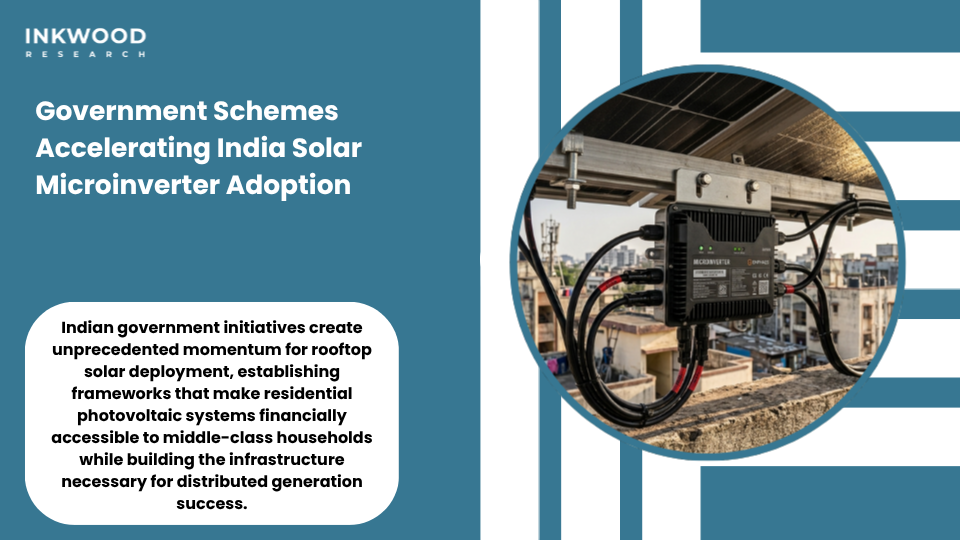
Indian government initiatives create unprecedented momentum for rooftop solar deployment, establishing frameworks that make residential photovoltaic systems financially accessible to middle-class households while building the infrastructure necessary for distributed generation success.
Accordingly, the PM Surya Ghar Muft Bijli Yojana represents the centerpiece of this effort, offering substantial subsidies that can cover up to 60% of system costs for smaller installations. In turn, this effectively removes the primary barrier that historically prevented widespread residential solar adoption across India’s diverse economic landscape.
As per India’s Ministry of New and Renewable Energy, approximately 2.4 million households have adopted rooftop solar through this program as of December 2025, installing 7 gigawatts of clean energy capacity while the government disburses over 13,000 crore rupees in subsidies. These dramatically improve project economics and make solar competitive with grid electricity without requiring homeowners to calculate complex lifetime savings scenarios.
Further, such schemes don’t simply provide financial support—they create comprehensive ecosystems. These include streamlined approval processes, standardized technical requirements, and financing mechanisms that collectively reduce friction throughout the customer journey from initial interest to operational systems generating electricity on rooftops across urban and rural India.
Subsidy Structures Favoring India Solar Microinverter Installations
The tiered subsidy approach rewards homeowners who choose smaller system sizes that government planners believe optimize grid integration while maximizing the number of households served with available program funding. Systems up to 3 kilowatts receive higher per-watt subsidies compared to larger installations, creating financial incentives that align with typical residential consumption patterns while encouraging distributed deployment across numerous rooftops rather than concentrating capacity in fewer large installations.
Moreover, the subsidy application process integrates directly with system registration, enabling homeowners to receive financial benefits relatively quickly after installation completion and grid connection approval.
This streamlined approach contrasts with earlier programs where complex documentation requirements and delayed subsidy disbursement created cash flow challenges for installers and uncertainty for homeowners. These improvements reflect the government learning from previous initiative shortcomings and demonstrate a commitment to making residential solar genuinely accessible rather than merely theoretically available.
Bank Financing Integration for Solar Microinverter Systems
Public sector banks approve thousands of rooftop solar loans monthly, providing homeowners with financing options that spread costs across multiple years while maintaining attractive interest rates supported by government guarantees and special lending programs. These financing mechanisms prove particularly important in India’s market, where upfront cash purchases remain challenging for many households despite improved system economics through subsidies, enabling broader market penetration by addressing the payment timing mismatch between installation costs and electricity savings that accumulate gradually over system lifetimes.
Furthermore, standardized loan products emerge as banks gain experience with solar financing, reducing documentation requirements and approval times while building institutional confidence in solar installations as reliable assets backing loans that carry minimal default risk because electricity savings materially improve household finances.
This maturing financing ecosystem creates positive reinforcement loops where increased bank comfort with solar loans leads to better terms and easier approvals, which in turn drives higher installation volumes that generate more performance data confirming solar’s financial reliability and justifying continued expansion of specialized lending programs that recognize photovoltaic systems as distinct from general home improvements requiring different risk assessment and collateral evaluation approaches.
Residential Market Transformation Through Rooftop Solar
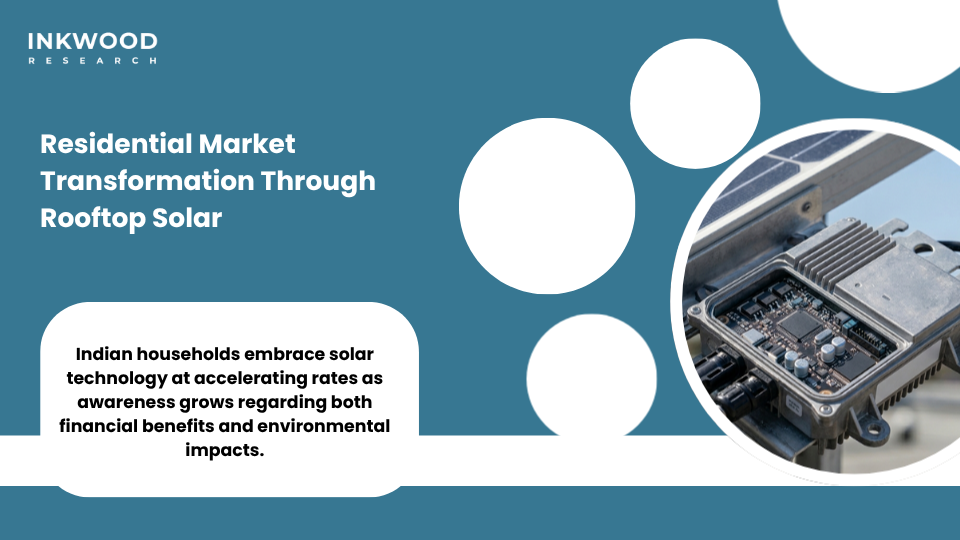
Indian households embrace solar technology at accelerating rates as awareness grows regarding both financial benefits and environmental impacts. This creates market dynamics where early adopters influence neighbors and community networks spread information about program availability and installation experiences. Moreover, urban areas see particularly strong uptake as middle-class homeowners seek energy independence amid rising electricity costs and increasingly frequent power quality issues that affect sensitive electronics and reduce the quality of life.
Meanwhile, solar microinverters appeal to Indian residential customers because panel-level monitoring capabilities resonate in a market where homeowners actively engage with technology and appreciate visibility into system performance through smartphone applications that provide real-time production data and historical trends. This monitoring enthusiasm reflects broader patterns in Indian consumer technology adoption, where smartphone penetration enables digital service engagement and creates expectations for connected products that provide data and control through mobile interfaces.
Such preferences are addressed by solar microinverter manufacturers through developing localized monitoring platforms with vernacular language support and features optimized for Indian user behaviors. This includes competitive comparisons with neighbors and gamification elements that encourage energy conservation alongside production optimization.
Urban Installation Challenges in India Solar Microinverter Market
Indian urban rooftops present unique installation challenges, including water tanks, television antennas, and multiple building protrusions that create shading patterns throughout the day, conditions where solar microinverters deliver clear performance advantages over string inverter configurations that suffer disproportionately from partial shading.
Additionally, many urban buildings feature complex roof geometries with multiple orientations and tilt angles that make optimizing string inverter array layouts difficult or impossible. Conversely, microinverter systems accommodate these irregular configurations naturally through panel-level optimization that extracts maximum energy regardless of individual panel orientations. The population density of Indian cities also means that neighboring structures create shading that varies seasonally as sun angles change, dynamic conditions where string inverter systems lose efficiency across entire strings, while microinverter architectures isolate shading impacts to affected panels.
As a result, these technical advantages translate directly into higher energy production in real-world urban environments, making solar microinverters increasingly attractive to installers. Also, they recognize that superior performance justifies modestly higher equipment costs through improved customer satisfaction and reduced service calls to address underperformance complaints that commonly afflict string inverter installations in challenging urban environments.
Commercial Rooftop Opportunities for Solar Microinverter Deployment
Indian commercial buildings are increasingly installing rooftop solar as businesses recognize electricity cost reduction opportunities. On the other hand, corporate sustainability commitments influence technology investment decisions across sectors, from information technology to manufacturing. Commercial rooftops often feature HVAC equipment, skylights, and other obstructions that create complex shading scenarios where solar microinverters optimize production more effectively than traditional inverters.
Likewise, the larger system sizes typical of commercial installations benefit from the scalability advantages that microinverter architectures provide through simple capacity expansion without requiring inverter replacements or system redesigns. Moreover, commercial customers particularly value the detailed monitoring capabilities that solar microinverters provide, enabling facility managers to verify system performance against financial models and quickly identify underperforming equipment requiring attention.
Further, the commercial segment also drives innovation in solar microinverter features. These include advanced grid support functions and integration with building energy management systems. These developments benefit residential applications through technology improvements that eventually trickle down to consumer products after proving effectiveness in demanding commercial environments where performance requirements exceed residential application needs.
Technical Advantages for India’s Diverse Installation Environments
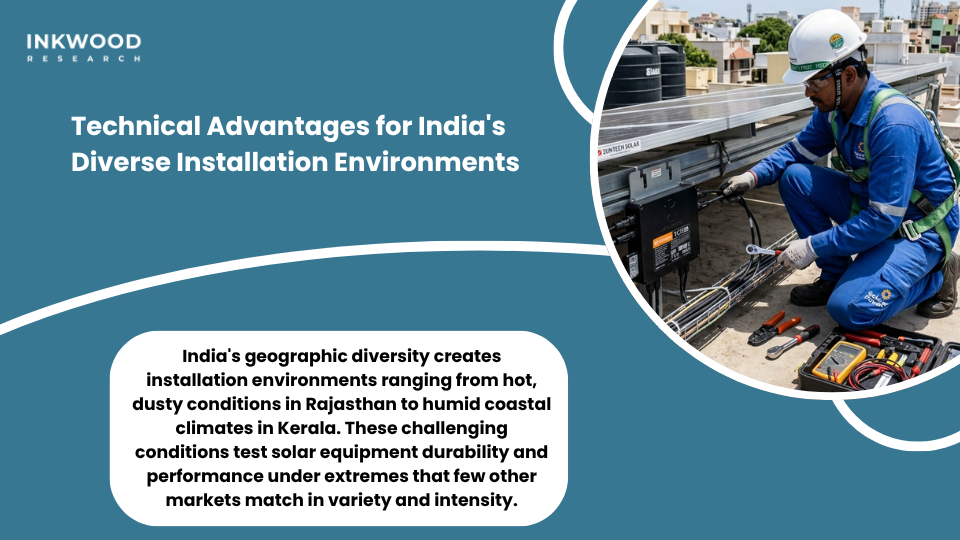
India’s geographic diversity creates installation environments ranging from hot, dusty conditions in Rajasthan to humid coastal climates in Kerala. These challenging conditions test solar equipment durability and performance under extremes that few other markets match in variety and intensity. Accordingly, solar microinverters must withstand temperature swings, monsoon humidity, and dust accumulation that affects both thermal management and component longevity. These requirements, in turn, drive manufacturers to develop ruggedized products with enhanced environmental protection and thermal designs optimized for sustained operation under high ambient temperatures.
Furthermore, India’s grid conditions vary significantly by region and even within cities, with voltage fluctuations and frequency instability. However, these create technical challenges that solar microinverters must accommodate through wide operating ranges and sophisticated grid support functions. In turn, they can also maintain stable output despite unstable input conditions from both solar panels experiencing rapidly changing irradiance under passing clouds and grid connections exhibiting voltage variations that would trip less sophisticated equipment.
These demanding operating conditions actually benefit the India solar microinverter market long-term because products proven reliable in Indian installations gain credibility for export markets. Whereas, less extreme conditions make performance validation straightforward, enabling Indian-market-tested equipment to command premium positioning in international markets based on demonstrated resilience under challenging operating environments.
Dust and Soiling Impacts on India Solar Microinverter Performance
Dust accumulation represents a persistent challenge across much of India, particularly in northern regions where agricultural activity and construction generate airborne particles that settle on solar panels and reduce light transmission. While this degradation affects all photovoltaic installations, it impacts string inverter systems more severely because dust-induced performance variations across panels create mismatch losses throughout entire strings.
However, solar microinverters mitigate these impacts through panel-level optimization that prevents cleaner panels from being constrained by dirtier neighbors. As a result, they maintain higher overall system output between cleaning cycles compared to string configurations where the dirtiest panel determines performance for entire series-connected groups. Moreover, detailed panel-level monitoring that microinverter systems provide enables identification of soiling impacts through performance comparisons across arrays.
In turn, this allows operators to schedule cleaning interventions based on actual production losses rather than arbitrary time intervals that may clean panels too frequently or not frequently enough, depending on local dust conditions. This data-driven maintenance approach optimizes cleaning costs against production losses, proving particularly valuable in India, where manual roof access for cleaning creates safety concerns and labor costs.
Agricultural and Rural Solar Microinverter Applications
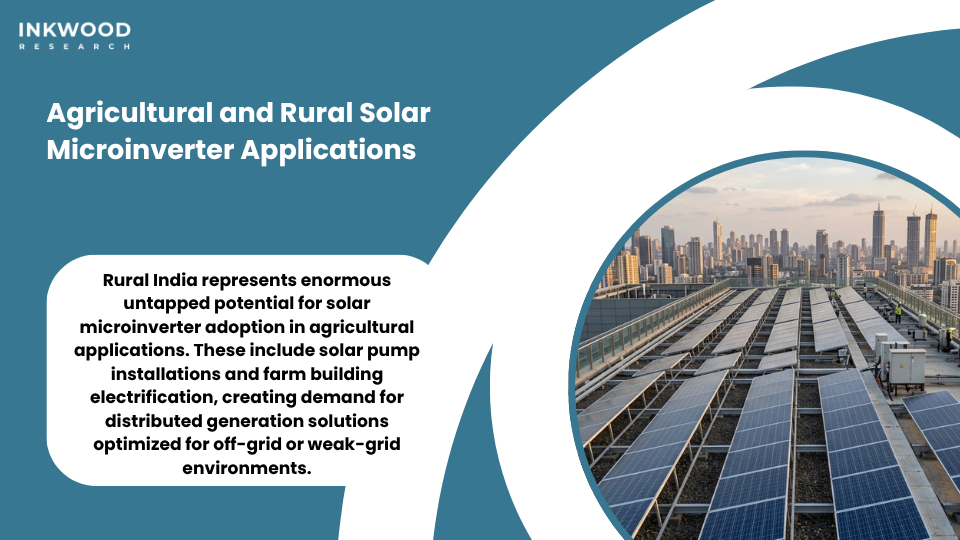
Rural India represents enormous untapped potential for solar microinverter adoption in agricultural applications. These include solar pump installations and farm building electrification, creating demand for distributed generation solutions optimized for off-grid or weak-grid environments. The PM-KUSUM scheme specifically targets agricultural solar deployment through subsidizing pump installations and encouraging farmers to generate solar electricity on unused land.
As a result, this creates market opportunities for solar microinverters designed for agricultural applications, where reliability under minimal maintenance proves critical given remote locations and limited technical support availability in rural areas. Furthermore, rural electrification through solar microgrids increasingly incorporates microinverter technology for residential connections. These configurations are where panel-level optimization accommodates the varied and expanding nature of village electrical systems that grow organically as household incomes improve and electrical appliance ownership increases.
Plus, they also require flexible solar configurations that can scale incrementally rather than requiring complete system redesigns. In this regard, capacity needs to expand beyond initial installation sizes planned when microgrids first deploy, before usage patterns fully establish themselves in communities transitioning from limited electricity access to 24-hour availability, enabling modern appliances and improved quality of life.
Solar Pump Modernization in India Solar Microinverter Market
Agricultural pump solarization programs help farmers reduce diesel costs and improve irrigation reliability. Additionally, they also support government goals for reducing fossil fuel consumption and air pollution from diesel generators that historically powered rural pumps, absent grid connectivity. In this regard, solar microinverters adapt well to pump applications because distributed architectures accommodate the space constraints common in agricultural settings where panels are installed on multiple surfaces.
These include pump sheds, residential rooftops, and ground-mounted frames, configurations that would prove challenging with centralized string inverters requiring all panels connect in specific series/parallel combinations. Additionally, panel-level monitoring enables farmers to track system performance remotely through mobile applications. This is a valuable capability in rural contexts where farm owners may not visit fields daily but still need assurance that irrigation systems function correctly, particularly during critical growing seasons when pump failures could devastate crops and annual incomes.
Furthermore, the agricultural market also drives the development of ruggedized products. This is mainly because farming environments expose equipment to dust, moisture, and temperature extremes that exceed residential installation conditions. As a result, this pushes manufacturers to improve component quality and enclosure designs in ways that benefit all market segments through products designed for worst-case conditions rather than idealized residential installations.
Grid Integration and Battery Energy Storage Considerations
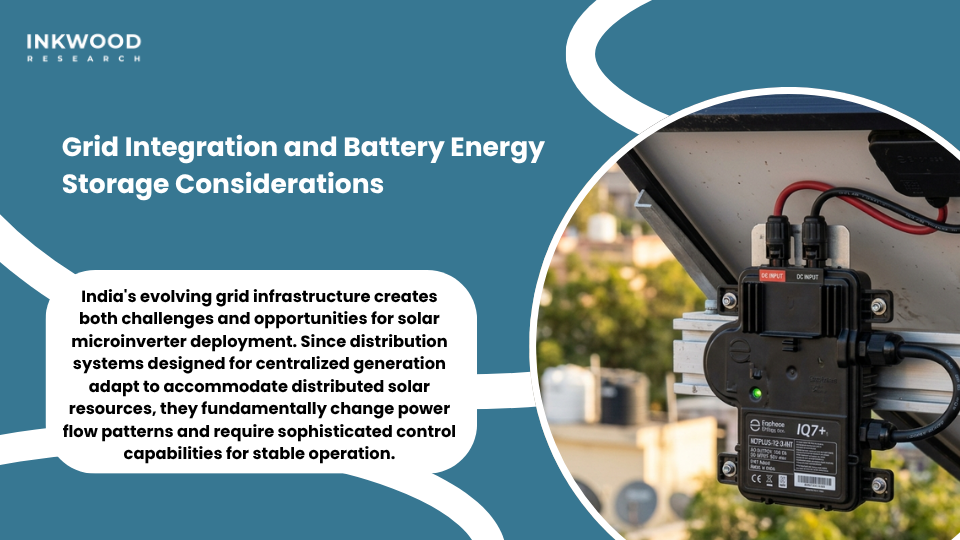
India’s evolving grid infrastructure creates both challenges and opportunities for solar microinverter deployment. Since distribution systems designed for centralized generation adapt to accommodate distributed solar resources, they fundamentally change power flow patterns and require sophisticated control capabilities for stable operation. Aligning with this, solar microinverters increasingly incorporate advanced grid support functions, including voltage regulation, frequency response, and reactive power provision.
These capabilities help distribution utilities manage solar integration while improving overall grid stability in ways that benefit all connected customers beyond just solar system owners. Moreover, battery energy storage integration grows rapidly as Indian customers recognize the value in backup power during grid outages, while utilities experiment with aggregating distributed battery systems into virtual power plants. Also, they provide grid services, including peak demand management and renewable energy smoothing.
These storage applications favor microinverter architectures because AC-coupled batteries integrate seamlessly with existing microinverter installations without requiring equipment replacement or complex retrofit procedures. Moreover, they complicate adding storage to string inverter systems designed without storage integration in mind, creating upgrade pathways where residential customers initially install solar-only systems.
Subsequently, they can also add batteries as needs evolve or costs decline. This flexibility proves valuable in markets like India, where customer budgets constrain initial system specifications. Accordingly, future expansion remains likely as incomes grow and storage technology costs continue falling, making backup power economically attractive.
Net Metering Policies Affecting India Solar Microinverter Economics
State-level net metering regulations create varying economic frameworks for solar installations across India. Accordingly, some states offer favorable terms where surplus generation receives credits at retail electricity rates. Meanwhile, others provide compensation at wholesale rates that materially reduce system economics and extend payback periods for residential installations.
These policy variations influence technology selection because net metering generosity affects the value of maximizing solar production through advanced technologies like solar microinverters versus simply achieving acceptable performance with lower-cost equipment that may underperform microinverter systems but still generate positive returns under favorable regulatory regimes.
Furthermore, net metering policies continue evolving as solar penetration increases and utilities grapple with the revenue implications of customer-sited generation. While this reduces electricity sales when distribution costs remain fixed or increase, it also creates uncertainty that affects long-term investment decisions. Moreover, it also makes monitoring system performance through detailed microinverter data streams valuable for documenting actual generation and ensuring proper crediting for exported electricity.
The monitoring capabilities become particularly important when disputes arise regarding system performance or billing calculations, situations where granular production data provides documentation supporting customer positions. Additionally, it also helps resolve disagreements that might otherwise sour homeowner experiences with solar technology and slow adoption among neighbors observing these conflicts.
Key Takeaways
- India’s rooftop solar expansion creates remarkable opportunities for solar microinverter adoption as government schemes, including PM Surya Ghar, drive residential installations while diverse technical requirements favor distributed architectures.
- The India solar microinverter market reached US$223.14 million in 2026, projecting growth to US$1,180.19 million by 2034 at a 23.15% compound annual growth rate, reflecting rapid residential market development and expanding commercial applications.
- Government subsidies and bank financing integration remove financial barriers historically limiting residential solar adoption, enabling middle-class households to install photovoltaic systems while monitoring capabilities resonate with tech-savvy Indian consumers who actively engage with smartphone applications providing production visibility.
- Technical advantages prove particularly relevant in Indian contexts, where urban rooftop challenges, including shading and complex geometries, favor panel-level optimization that solar microinverters provide over string inverter constraints.
- According to the Ministry of New and Renewable Energy, India added 37.9 gigawatts of solar capacity in 2025, including substantial rooftop installations that create sustained demand for distributed generation equipment optimized for diverse operating conditions from urban environments to rural agricultural applications.
- Agricultural programs, including PM-KUSUM, extend solar microinverter opportunities beyond residential markets into farming applications where reliability and scalability prove critical for pump installations and rural electrification initiatives.
- Grid integration capabilities and battery energy storage compatibility position solar microinverters favorably for India’s evolving energy infrastructure, where distributed resources require sophisticated control functions while AC-coupled storage enables future expansion pathways.
Ready to capitalize on India’s rooftop solar revolution?
Inkwood Research provides comprehensive market intelligence and strategic consultation services, helping businesses understand policy frameworks, regional market variations, and technical requirements for successful India solar microinverter market entry.
Contact our team to discuss how rooftop solar expansion creates opportunities for your renewable energy business while navigating regulatory complexity and regional market differences that characterize India’s diverse and rapidly growing distributed generation sector.
Frequently Asked Questions
What government schemes support solar microinverter adoption in India?
Government programs such as PM Surya Ghar for residential rooftop solar and PM-KUSUM for agricultural solar installations provide subsidies that can cover up to 60% of system costs for smaller installations.
How fast is India’s solar microinverter market growing?
India’s solar microinverter market reached about US$223.14 million in 2026 and is projected to grow to US$1,180.19 million by 2034 at a CAGR of 23.15%, driven by residential and commercial solar adoption.
Why are solar microinverters suitable for Indian installation environments?
Solar microinverters perform well in India because panel-level optimization helps manage shading, irregular rooftops, and varied climate conditions while providing advanced monitoring features.
How is rooftop solar expansion influencing microinverter demand in India?
Rapid growth in residential and commercial rooftop solar installations is increasing demand for microinverters that improve efficiency and simplify system monitoring.
What advantages do microinverters offer for residential solar systems in India?
Microinverters provide better energy yield, panel-level monitoring, flexible system design, and improved safety for rooftop solar installations.
How do microinverters support India’s distributed solar energy goals?
Microinverters enable efficient small-scale solar generation across homes and businesses, supporting India’s broader expansion of decentralized renewable energy systems.