Table of Contents
Inkwood Research delivers comprehensive market intelligence across India’s dental imaging market, artificial intelligence healthcare applications, and diagnostic technology adoption patterns. Our research expertise encompasses machine learning platforms, clinical workflow optimization, and emerging technology deployment across Asia-Pacific healthcare ecosystems, providing strategic insights for medical device manufacturers, AI developers, and healthcare investors.
TLDR
Artificial intelligence transforms India’s dental imaging landscape through sophisticated machine learning algorithms. The India dental imaging market grows from US$125.37 million in 2026 to US$298.24 million by 2034, registering 11.44% CAGR. AI-enabled dental imaging solutions enhance diagnostic accuracy while addressing practitioner shortages. Cone beam computed tomography (CBCT) devices integrated with AI-powered dental CBCT devices detect caries, periodontal disease, and oral pathologies earlier. Deep learning revolutionizes the dental diagnostic imaging market trends across metropolitan and rural regions.
Dental practitioners, AI technology developers, medical device distributors, healthcare administrators, dental education institutions, diagnostic center operators, venture capital investors, and healthcare policy analysts will discover critical insights into how machine learning reshapes India’s diagnostic capabilities. This analysis illuminates clinical dental imaging devices market transformation, technology adoption barriers, competitive dynamics, and strategic opportunities within India’s rapidly modernizing dental healthcare sector.
India’s Dental Imaging Market Evolution Through AI Integration
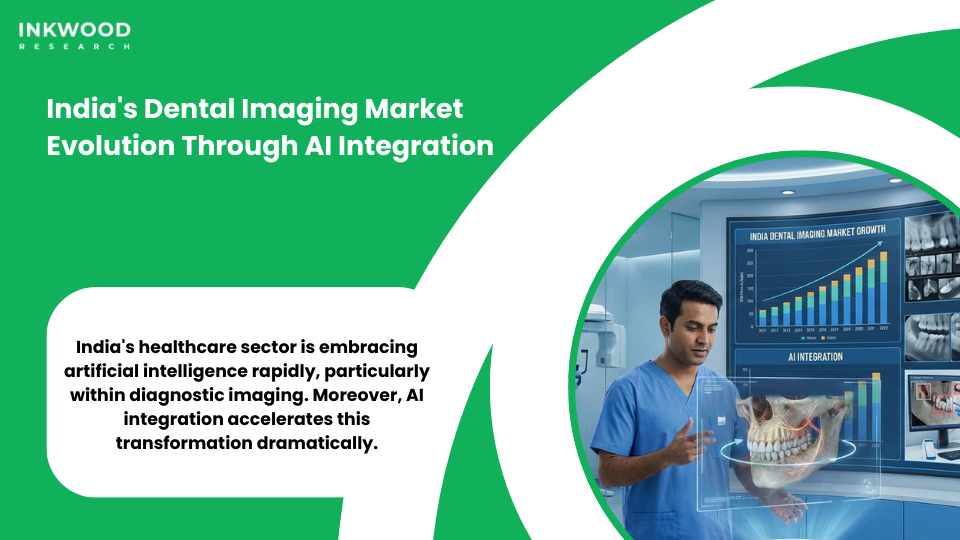
India’s healthcare sector is embracing artificial intelligence rapidly, particularly within diagnostic imaging. The India dental imaging market demonstrates exceptional growth potential, expanding from US$125.37 million in 2026 to US$298.24 million by 2034. This 11.44% compound annual growth rate surpasses many global benchmarks. Moreover, AI integration accelerates this transformation dramatically.
Market Scale and Growth Dynamics
India’s dental care needs intensify as oral health awareness increases nationwide. Urbanization drives demand for sophisticated diagnostic capabilities. However, practitioner shortages create significant challenges.
According to healthcare workforce studies, training new dentists requires extensive time investments. Therefore, AI-powered diagnostic support becomes increasingly valuable for existing practitioners.
The dental imaging sector encompasses various technologies serving diagnostic needs. Digital dental radiography devices replace traditional film-based systems across urban centers. Meanwhile, cone beam computed tomography (CBCT) devices provide three-dimensional visualization for complex cases. These technologies generate vast image datasets. Consequently, they create perfect environments for machine learning algorithm deployment.
AI as Catalyst for Diagnostic Democratization
Geographic healthcare disparities plague India’s medical system. Metropolitan areas concentrate experienced specialists, while rural regions struggle with basic services. AI-enabled dental imaging solutions help bridge these gaps.
Remote diagnostic support becomes feasible when algorithms provide preliminary analysis. Subsequently, general practitioners can consult specialists electronically about complex cases. Furthermore, AI addresses experience variability among practitioners.
Studies indicate 68% of dental specialists agree that AI evaluates minute radiographic details that practitioners might miss. Additionally, 64% believe AI assists budding dentists in radiological diagnoses. These perceptions reflect genuine clinical value. Therefore, technology adoption accelerates across India’s dental community.
How Machine Learning Enhances Diagnostic Precision
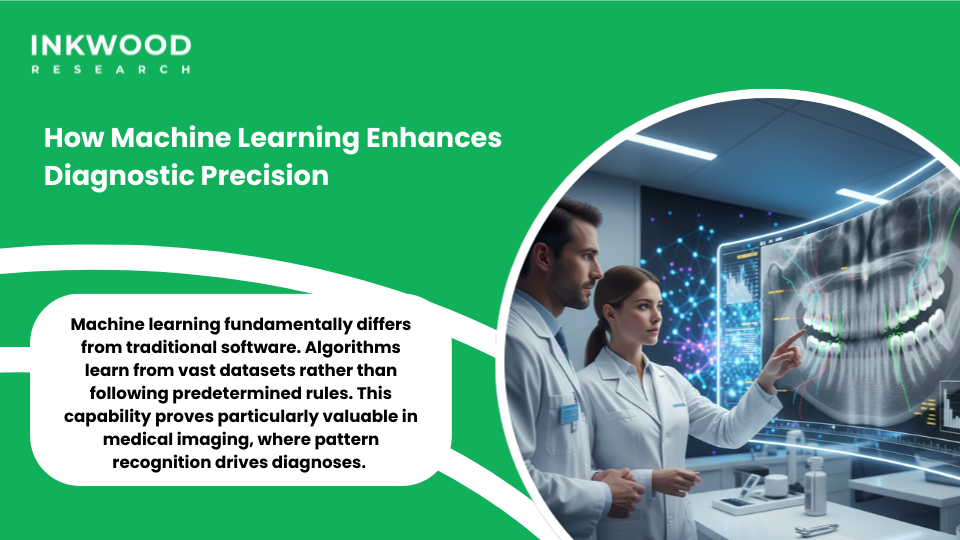
Machine learning fundamentally differs from traditional software. Algorithms learn from vast datasets rather than following predetermined rules. This capability proves particularly valuable in medical imaging, where pattern recognition drives diagnoses. Moreover, deep learning techniques enable computers to identify subtle anomalies that human observers miss.
Convolutional Neural Networks in Dental Analysis
Convolutional neural networks (CNNs) excel at image processing tasks. These algorithms analyze dental radiographs layer by layer, identifying features at multiple scales. Initially, networks detect basic edges and textures. Subsequently, deeper layers recognize complex structures like tooth boundaries and bone density patterns. Finally, output layers classify pathological conditions. Training CNNs requires thousands of labeled images.
Additionally, dental practices generate enormous image volumes. Researchers combine datasets from multiple institutions, creating comprehensive training libraries. According to studies on AI in dental radiology, these systems achieve diagnostic accuracy matching or exceeding human performance. Sensitivity for detecting tumors larger than 6mm reaches 98.6% in some implementations.
Moreover, CNNs provide quantitative measurements impossible through visual inspection alone. Bone level readings achieve sub-millimeter precision. Decay severity assessments become objective rather than subjective. Also, this standardization proves particularly valuable in multi-provider environments. As a result, diagnostic consistency improves significantly across practitioners using AI assistance.
Deep Learning Applications Across Imaging Modalities
Different dental imaging technologies benefit from specialized AI approaches. Digital dental radiography devices producing two-dimensional images utilize algorithms optimized for planar analysis. Conversely, AI-powered dental CBCT devices process three-dimensional datasets requiring volumetric processing techniques.
Each modality demands tailored algorithm architectures. Intraoral imaging systems capture high-resolution photographs revealing surface details. AI platforms analyze these images for early caries detection. Algorithms identify demineralization patterns preceding visible cavity formation. Similarly, periodontal assessment algorithms measure gum recession and attachment loss from photographic data. These capabilities enhance preventive care substantially.
On the other hand, 3D dental imaging systems generate complex datasets requiring sophisticated processing. AI segmentation algorithms automatically identify individual teeth, nerve canals, and anatomical landmarks. This automation saves hours compared to manual segmentation. Additionally, accuracy improves as algorithms leverage vast training databases. Treatment planning software integrates these AI-generated anatomical maps seamlessly.
Real-Time Analysis and Clinical Workflow Integration
Modern AI-enabled dental imaging solutions provide instantaneous feedback. Practitioners capture images and receive diagnostic suggestions within seconds. This real-time capability maintains natural clinical workflows.
Dentists review AI findings alongside traditional visual interpretation. Therefore, technology enhances rather than disrupts established practices. Cloud-based platforms enable continuous algorithm improvement. Hence, as systems analyze more images, diagnostic accuracy increases automatically.
Centralized databases aggregate learnings from thousands of practitioners. Subsequently, individual users benefit from collective experience. This network effect accelerates AI performance enhancement beyond individual practice capabilities.
Real-World AI Deployment Across Indian Dental Practices
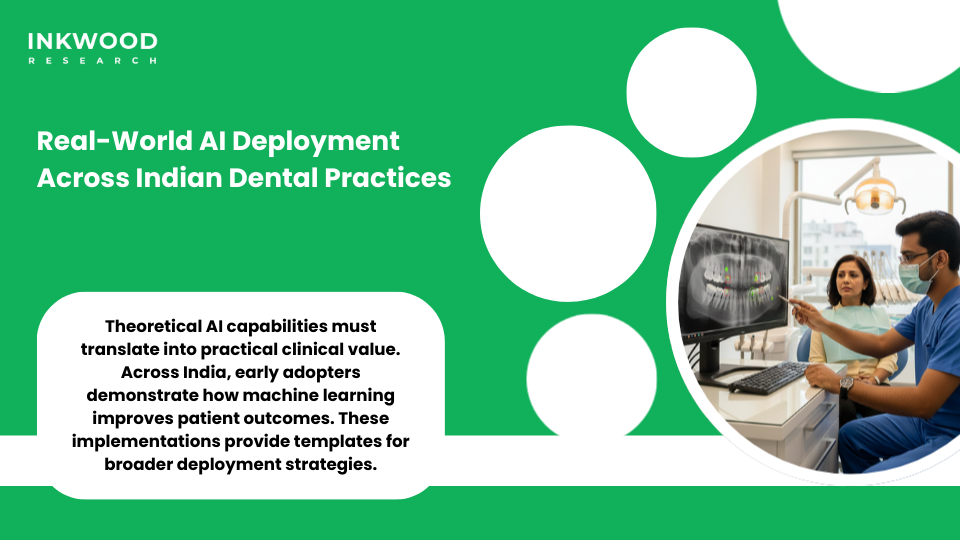
Theoretical AI capabilities must translate into practical clinical value. Across India, early adopters demonstrate how machine learning improves patient outcomes. These implementations provide templates for broader deployment strategies.
Caries Detection and Preventive Care
Dental caries affects vast portions of India’s population. Early detection enables conservative treatments that preserve tooth structure. However, incipient lesions often escape visual detection. AI algorithms trained on thousands of cavity progressions identify subtle demineralization patterns. Consequently, intervention occurs before extensive decay develops.
Research on AI in dental imaging indicates that automated caries detection achieves high sensitivity rates. Algorithms analyze bitewing radiographs systematically, flagging suspicious areas for practitioner review. This computer-aided detection supplements rather than replaces clinical judgment. Dentists make final treatment decisions informed by AI analysis.
Nevertheless, diagnostic accuracy improves measurably with AI assistance. Moreover, AI platforms track lesion progression over time. Longitudinal image analysis reveals whether caries advances, stabilizes, or remineralizes. This monitoring capability supports evidence-based decisions about intervention timing. Plus, conservative management becomes more defensible when AI quantifies disease stability. Therefore, unnecessary procedures decrease while genuine pathology receives prompt attention.
Periodontal Disease Assessment and Monitoring
Periodontal disease represents another major oral health challenge across India. Bone loss assessment traditionally requires careful radiographic measurement. However, this process proves time-consuming and subject to inter-observer variability. AI algorithms standardize bone level evaluation across all teeth automatically.
Clinical dental imaging devices market platforms incorporating AI analyze periodontal radiographs comprehensively. Algorithms measure alveolar bone height relative to the cemento-enamel junctions. These quantitative assessments detect subtle bone loss, indicating early disease. Additionally, AI flags areas requiring closer examination. Consequently, practitioners conduct more thorough periodontal evaluations efficiently.
Treatment response monitoring benefits tremendously from AI-powered analysis. After periodontal therapy, dentists track bone regeneration through successive radiographs. Manual measurements introduce variability that obscures subtle changes. Conversely, AI algorithms detect millimeter-scale improvements or deteriorations reliably. This precision enables evidence-based treatment adjustments, optimizing patient outcomes.
Implant Planning and Complex Surgical Cases
Cone beam computed tomography (CBCT) devices revolutionized implant dentistry through three-dimensional anatomical visualization. However, analyzing CBCT datasets requires significant expertise. AI platforms automate key planning steps, making advanced implantology more accessible. Aligning with this, algorithms identify optimal implant positions considering bone density, nerve proximity, and prosthetic requirements.
Automated nerve canal segmentation proves particularly valuable. Inferior alveolar nerve damage represents a serious surgical complication. AI algorithms trace nerve pathways through volumetric data automatically. This segmentation highlights safe zones for implant placement. Moreover, systems calculate minimum safe distances from critical structures. Therefore, surgical safety improves while planning time decreases.
Furthermore, AI-powered dental CBCT devices enable virtual surgical simulations. Practitioners test different implant configurations digitally before operating. AI platforms evaluate each scenario, predicting success probabilities. This comprehensive planning reduces intraoperative complications significantly. Additionally, patients receive more accurate treatment timelines and outcome expectations.
Navigating Infrastructure and Training Barriers
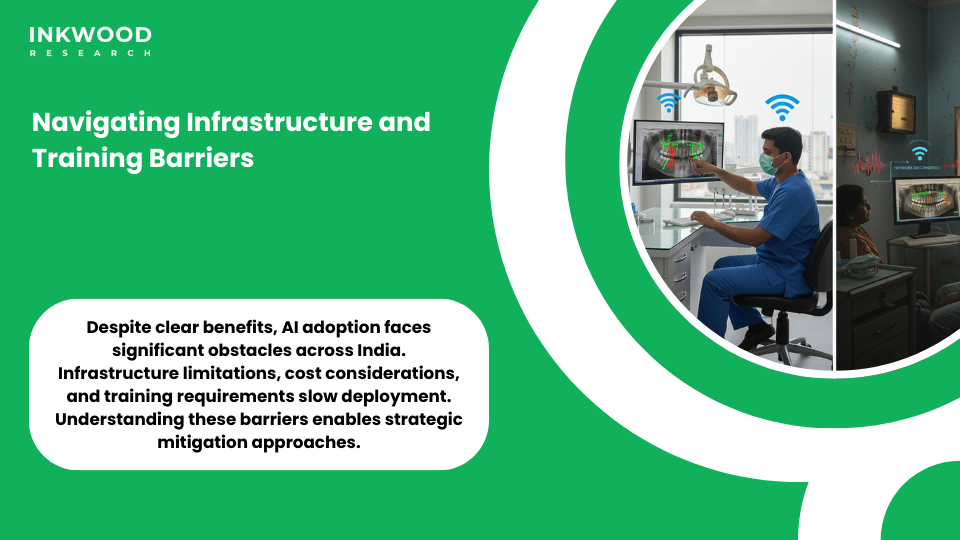
Despite clear benefits, AI adoption faces significant obstacles across India. Infrastructure limitations, cost considerations, and training requirements slow deployment. Understanding these barriers enables strategic mitigation approaches.
Technology Infrastructure and Connectivity Requirements
Many AI-enabled dental imaging solutions require reliable internet connectivity for cloud-based processing. However, rural India often lacks consistent high-speed internet. This infrastructure gap limits AI accessibility precisely where diagnostic support proves most valuable. Therefore, edge computing solutions that process data locally are becoming increasingly important.
Additionally, digital imaging equipment itself remains expensive for small practices. While costs decline gradually, initial capital requirements still challenge many practitioners. Financing options and equipment leasing programs help address affordability barriers. Nevertheless, economic constraints slow advanced technology penetration, particularly in tier-2 and tier-3 cities.
Power supply reliability also affects AI deployment feasibility. Plus, sophisticated imaging equipment requires stable electricity. Unfortunately, many regions experience frequent outages. Battery backup systems add expense while introducing maintenance requirements. These practical challenges complicate technology adoption beyond major metropolitan areas.
Training and Change Management Considerations
AI platforms require practitioners to modify established workflows. Learning new software interfaces demands time investments amid busy clinical schedules. Moreover, some dentists express skepticism about algorithm reliability. This resistance stems partly from unfamiliarity with machine learning fundamentals. Therefore, education becomes critical for successful adoption.
Dental schools increasingly incorporate AI training into curricula. Students learn to interpret algorithm outputs alongside traditional diagnostic methods. This integrated education prepares graduates for AI-augmented practice environments. However, established practitioners require continuing education programs. In this regard, professional organizations play vital roles in facilitating this knowledge transfer.
Furthermore, staff training extends beyond dentists themselves. Radiography technicians must understand proper image acquisition for AI analysis. Receptionists handle workflow software coordinating AI platforms with practice management systems. Comprehensive training programs addressing all team members maximize technology value. Consequently, successful implementations require organizational commitment beyond simple equipment purchases.
Data Privacy and Regulatory Compliance
Patient data protection concerns complicate AI deployment. Cloud-based platforms transmit medical images to remote servers for processing. This raises legitimate privacy questions. Compliance with data protection regulations requires robust security measures. Encryption, access controls, and audit trails all demand careful implementation.
Additionally, regulatory approval processes for AI medical devices remain evolving. India’s Central Drugs Standard Control Organization establishes guidelines for software-based medical devices.
However, specific AI validation requirements continue to develop. Manufacturers must navigate regulatory uncertainty while bringing products to market. This creates hesitation among some potential adopters awaiting clearer regulatory frameworks.
Leading Players Driving AI Innovation in India
Multiple companies compete within India’s emerging AI dental imaging market. Additionally, global technology leaders and domestic innovators both contribute to ecosystem development. Strategic partnerships between imaging manufacturers and AI developers accelerate innovation.
International Technology Providers
Carestream Dental brings comprehensive AI-integrated imaging solutions to the Indian markets. The company’s cloud-based platforms incorporate machine learning algorithms that analyze radiographs in real-time. For example, in October 2025, Carestream Dental launched the CS 3D Imaging Premium Package, an optional upgrade, which uses AI for automated implant planning, including merging CBCT and intraoral scans and mapping nerve canals in seconds. These innovations specifically address emerging market requirements for affordable, scalable diagnostic support.
Overjet, a leading AI diagnostic platform, expands globally, including Asia-Pacific markets. The system analyzes dental images automatically, detecting conditions like caries and bone loss. Studies indicate that practices implementing Overjet report a 25% case acceptance increases. This proven ROI accelerates adoption across cost-conscious markets. Indian dental practices increasingly explore such platforms, seeking competitive advantages.
Likewise, 3Shape provides comprehensive digital dentistry solutions, including AI-powered analysis tools. The company’s intraoral scanners and CAD/CAM systems integrate with diagnostic AI platforms. This ecosystem approach appeals to practices pursuing complete digital transformation. Partnerships with Indian distributors expand market access beyond major metropolitan centers.
Domestic Innovation and Localization
Indian technology companies develop AI solutions addressing specific local market needs. These platforms often incorporate regional language support and price points aligned with Indian economic realities. Additionally, domestic developers better understand infrastructure constraints affecting rural deployment feasibility.
Partnerships between Indian dental colleges and technology institutes drive research innovation. Academic institutions generate large patient datasets valuable for algorithm training. Collaborations between clinicians and data scientists produce AI systems optimized for local population characteristics. This research ultimately commercializes through startup ventures and technology licensing arrangements.
Moreover, government initiatives supporting digital health transformation create favorable environments. Policies encouraging AI healthcare applications reduce regulatory barriers. Financial incentives for technology adoption help offset initial investment costs. These supportive frameworks accelerate ecosystem development across India’s dental imaging market.
Equipment Manufacturers Integrating AI Capabilities
Traditional imaging equipment manufacturers increasingly embed AI directly into hardware. Cone beam computed tomography (CBCT) devices ship with integrated diagnostic algorithms. This bundled approach simplifies adoption—practitioners purchase comprehensive solutions rather than assembling disparate components.
KaVo Dental and similar manufacturers prioritize AI integration in product development roadmaps. Similarly, digital dental radiography devices increasingly feature built-in analysis capabilities. Sensors connect to practice management software incorporating AI diagnostic modules.
This seamless integration maintains familiar workflows while adding intelligent assistance. Equipment manufacturers partnering with leading AI developers create compelling value propositions for Indian dental practices.
Strategic Trajectory for AI-Powered Diagnostics
The Indian dental imaging market trajectory points toward accelerating AI integration. Technology costs decline while capabilities expand continuously. Accordingly, multiple factors suggest that AI becomes standard infrastructure rather than specialized tools. As a result, strategic positioning now determines future competitive advantages.
Expanding Clinical Applications and Capabilities
Current AI applications focus primarily on detection tasks. Future systems will incorporate treatment planning recommendations. Algorithms will suggest optimal therapeutic approaches based on comprehensive patient data analysis. This evolution transforms AI from a diagnostic assistant to a comprehensive clinical decision support system.
Predictive analytics represents another frontier. AI platforms analyzing longitudinal patient data will forecast disease progression probabilities. Moreover, risk stratification enables personalized preventive strategies. High-risk patients receive intensive monitoring while low-risk individuals follow standard protocols. In all, this precision medicine approach optimizes resource allocation across patient populations.
Furthermore, AI will increasingly integrate with other dental technologies. CAD/CAM integrated dental imaging systems combine diagnostic and therapeutic planning seamlessly. Automated workflows reduce manual data transfer between systems. Further, this integration improves efficiency while reducing errors. Therefore, comprehensive digital platforms incorporating AI throughout workflows will dominate future markets.
Infrastructure Development and Accessibility Improvements
Internet connectivity continues to improve across India through government initiatives and private investment. Expanded 4G and emerging 5G networks enable cloud-based AI services in previously underserved regions. This connectivity transformation removes major adoption barriers. Consequently, rural practices will access sophisticated diagnostic support matching urban capabilities.
Equipment costs decline steadily through manufacturing efficiency improvements and increased competition. Digital dental radiography devices, once considered luxury investments become economically accessible for small practices. Similarly, cone beam computed tomography (CBCT) devices pricing trends downward. Combined with AI capabilities enhancing value propositions, these technologies penetrate markets broadly.
Training infrastructure also expands significantly. Online education platforms deliver an AI curriculum to practitioners nationwide. Additionally, continuing education requirements increasingly incorporate technology competency standards. Dental associations facilitate knowledge sharing through webinars and conferences. This educational ecosystem ensures practitioners develop skills to maximize AI technology value.
Regulatory Maturation and Standardization
Regulatory frameworks governing AI medical devices will mature substantially. Clear approval pathways reduce uncertainty for manufacturers and practitioners alike. Plus, standardized validation requirements ensure quality while facilitating innovation.
This regulatory clarity accelerates market development by reducing adoption hesitation. Additionally, reimbursement policies will evolve, recognizing AI-enhanced diagnostic value. Also, insurance coverage for AI-assisted procedures incentivizes adoption.
Quantifiable outcome improvements justify premium reimbursement rates. These economic incentives align stakeholder interests around technology deployment. Therefore, policy environments increasingly support rather than hinder AI integration.
Key Takeaways
- Artificial intelligence revolutionizes India’s dental diagnostics through machine learning algorithms, enhancing accuracy and efficiency.
- The India dental imaging market grows from US$125.37 million (2026) to US$298.24 million (2034), with 11.44% CAGR. AI-enabled dental imaging solutions address practitioner shortages while improving diagnostic consistency.
- Deep learning platforms detect caries, periodontal disease, and surgical planning requirements with remarkable precision. Adoption challenges include infrastructure limitations, training requirements, and cost considerations. However, declining equipment prices, expanding connectivity, and supportive policies mitigate these barriers.
- Leading providers like Carestream Dental, Overjet, and 3Shape deploy AI platforms across Indian markets. Domestic innovation and academic research further accelerate ecosystem development.
- Future trajectory points toward AI becoming standard infrastructure within dental practices. Expanding clinical applications, improved accessibility, and regulatory maturation drive continued growth.
- Strategic investments in AI capabilities position practices competitively while improving patient outcomes. The dental diagnostic imaging market trends indicate sustained transformation throughout the coming decades.
Conclusion:
Machine learning fundamentally transforms how Indian dentists diagnose and treat oral diseases. AI-powered dental CBCT devices and sophisticated analysis platforms provide diagnostic capabilities previously requiring extensive specialist training. This democratization of expertise proves particularly valuable across India’s geographically diverse healthcare landscape.
Despite implementation challenges, clear trajectories toward broader adoption emerge. Technology costs decline while capabilities expand continuously. Infrastructure improvements enable sophisticated platforms in previously underserved regions. Educational initiatives prepare current and future practitioners for AI-augmented practice environments. These trends collectively accelerate the clinical dental imaging devices market transformation.
Based on our analysis, AI integration represents an inevitable evolution rather than an optional enhancement. Practices embracing these technologies early gain competitive advantages while improving patient care quality. Equipment manufacturers and software developers prioritizing the Indian market needs will capture substantial growth opportunities.
The convergence of technological capability, economic viability, and clinical necessity drives sustained AI adoption. For dental professionals, equipment suppliers, AI developers, and healthcare investors, understanding this transformation proves essential. The dental imaging sector exemplifies how artificial intelligence reshapes traditional medical practices. Organizations positioning strategically within this evolving ecosystem will thrive as India’s dental healthcare continues to modernize rapidly.
For companies seeking comprehensive intelligence on AI healthcare applications or dental technology markets in India, Inkwood Research delivers actionable insights and strategic guidance.
Contact our team to explore how these transformative trends align with your business objectives.
Frequently Asked Questions
How does AI improve dental diagnostic accuracy in India?
Machine learning algorithms analyze thousands of dental images, identifying patterns human observers might miss. Studies show AI detects early caries, periodontal disease, and oral pathologies with 95%+ accuracy. Real-time analysis provides immediate feedback to practitioners. This technology proves particularly valuable for less experienced dentists and in regions with specialist shortages.
What infrastructure requirements limit AI adoption in rural India?
Cloud-based AI-enabled dental imaging solutions require reliable internet connectivity, which remains inconsistent in rural areas. Additionally, digital imaging equipment itself requires stable power supplies. Training practitioners to use AI platforms effectively demands time investments and educational resources. However, expanding 4G networks, declining equipment costs, and online education platforms are gradually addressing these barriers.
Which dental imaging technologies benefit most from AI integration?
Cone beam computed tomography (CBCT) devices and digital dental radiography devices show the strongest AI integration benefits. CBCT’s complex three-dimensional datasets require sophisticated analysis algorithms to be provided efficiently. Similarly, routine radiographs analyzed by AI detect subtle pathologies, improving preventive care. 3D dental imaging systems integrated with treatment planning software demonstrate comprehensive AI capabilities, enhancing surgical safety and outcomes.