Table of Contents
This analysis is brought to you by Inkwood Research, a leading market intelligence firm specializing in Indian battery circular economy development, lithium-ion recycling technologies, electric vehicle supply chain analysis, and South Asian industrial policy frameworks. Our research team combines extensive experience analyzing India’s Battery Waste Management Rules implementation, hydrometallurgical processing innovations, second-life battery applications, and critical minerals recovery strategies across Indian states. Based on our proprietary research methodologies and strategic partnerships with Indian battery recyclers, EV manufacturers, government regulatory agencies, and technology providers, we deliver actionable insights that empower strategic decision-making for global enterprises navigating India’s rapidly evolving battery recycling landscape and sustainable mobility transformation.
TLDR
India’s battery recycling industry stands at a breakthrough point, driven by aggressive policy incentives and technological advancements. The India battery recycling market reached $531.84 million in 2026, projected to surge to $1,996.03 million by 2034 at an exceptional 17.98% CAGR. The Ministry of Mines launched a ₹1,500 crore incentive scheme supporting recyclers. Meanwhile, companies like Lohum, Attero, and Tata Chemicals pioneer hydrometallurgical processes, achieving over 95% material recovery rates.
Indian EV manufacturers developing closed-loop battery supply chains, recycling entrepreneurs evaluating market entry opportunities, investment analysts assessing high-growth circular economy sectors, government policymakers implementing Battery Waste Management Rules 2025, technology providers licensing advanced recycling processes, automotive OEMs planning end-of-life battery management, and sustainability officers meeting Extended Producer Responsibility targets will find actionable intelligence here. Additionally, academic researchers studying emerging market recycling ecosystems benefit from a comprehensive analysis.
India’s Battery Recycling Market Transformation
The India battery recycling market experiences an unprecedented transformation driven by explosive electric vehicle growth and progressive regulatory frameworks. The market was valued at $531.84 million in 2026. Projections indicate dramatic expansion to $1,996.03 million by 2034, representing an exceptional 17.98% CAGR. This growth rate outpaces global averages substantially, reflecting India’s commitment to building sustainable battery ecosystems.
India stands at a crucial juncture in building a circular battery economy. The country’s recommendations aim to streamline regulations, incentivize innovation, and foster collaboration between industry and policymakers. These measures address current challenges while unlocking sustainable growth potential. Moreover, they position India as an emerging leader in the Asia-Pacific battery circular economy development.
EV Adoption Driving Recycling Demand
India is rapidly expanding its electric vehicle market, with EV battery capacity expected to reach significant volumes by 2030. By 2030, 90% of India’s lithium-ion battery demand is expected to come from EVs. Plus, battery waste from EVs and stationary storage could exceed 10 million tonnes between 2025 and 2040.
The EV market is expanding at an unseen rate owing to changes in consumer preferences regarding sustainable mobility, government regulations, and technology breakthroughs. Further, electric two-wheelers accounted for around 60% of all EV sales in 2024, making them the leading force.
Battery Waste Management Rules 2025: Regulatory Revolution
India amended the Battery Waste Management Rules (BWMR) in 2025, establishing a comprehensive framework for battery lifecycle management. These rules mandate that manufacturers meet Extended Producer Responsibility (EPR) targets for battery collection and material recovery. However, implementation challenges persist across battery value chains.
Extended Producer Responsibility Framework
The Battery Waste Management Rules 2022 incorporate the Extended Producer Responsibility concept, requiring producers to ensure end-of-life collection, responsible handling, and recycling of battery wastes. EPR targets begin with progressive collection rates starting from 2027-28. Manufacturers must finance and manage the collection and recycling of batteries sold in India.
The growing interest in this industry is seen through the emergence of firms like Lohum, Attero, and Tata Chemicals. Establishing an effective EV battery recycling ecosystem will be essential to attaining sustainable mobility as India strives for net-zero emissions by 2070. Therefore, regulatory frameworks provide a foundation for industry development.
Implementation Challenges
Challenges persist across the battery value chain, including a lack of standard battery designs, the absence of tracking systems for reused batteries, inefficient segregation and transport logistics, and limited domestic processing of recovered materials. Economic constraints, such as low recycling returns for certain chemistries like LFP, further complicate business cases for recyclers.
The absence of immediate compliance requirements creates a waiting game where few players make significant moves toward building robust recycling infrastructure. This regulatory timeline gap, combined with technical hurdles, is further complicated by market uncertainties around standards for recycled materials and second-life applications.
Material Collection Requirements
In the Indian context, the problem of material collection is particularly acute as the unorganized sector handles the collection of electronic waste. The general public remains unaware of recycling advantages. Without implementing plans and policies for collecting old batteries, the disposal effects and ecosystem risks become apparent.
End-of-life battery collection and shipping involve several operators across large geographic areas. Workers need proper training and access to the right tools, ensuring batteries don’t get damaged during hazardous material handling. Therefore, comprehensive workforce development programs accompany regulatory implementation.
Leading Indian Companies Pioneering Recycling Innovation
Indian companies demonstrate remarkable innovation in lithium-ion battery recycling technologies and business models. These pioneers combine international best practices with local market understanding, creating solutions appropriate for Indian contexts. Their success attracts both domestic and foreign investment.
Attero Recycling: Advanced Material Recovery
Attero Recycling, India’s top e-waste recycler, has pioneered advanced material recovery processes specifically designed for diverse battery chemistries. The company handles both production scrap and end-of-life batteries through comprehensive collection networks. Moreover, Attero develops proprietary hydrometallurgical processes, achieving high recovery rates.
The company operates facilities across multiple Indian states, creating regional collection and processing hubs. This distributed network reduces transportation costs and environmental impacts. Additionally, Attero partners with EV manufacturers, establishing closed-loop supply chains that feed recovered materials back into production.
Lohum Cleantech: Integrated Circular Solutions
Lohum Cleantech develops integrated solutions for both recycling and second-life applications, maximizing value extraction from battery lifecycles. The company assesses battery health, determining optimal pathways between refurbishment, repurposing, and materials recovery. This comprehensive approach optimizes economic and environmental outcomes.
Lohum’s technologies separate and recover critical materials from end-of-life batteries, then purify these battery metals to the same or higher quality specifications compared to virgin materials. Their integrated battery recycling system follows “de-manufacturing” approaches, extracting metals and recovering materials systematically.
Tata Chemicals: Established Industrial Player
Tata Chemicals makes strategic investments in recycling infrastructure, leveraging group resources and market presence. As an established industrial leader, Tata brings operational excellence and financial strength to the battery recycling sector. Moreover, the company’s existing chemical processing expertise translates well to battery materials recovery.
Tata’s entry signals increasing mainstream acceptance of battery recycling as a legitimate industrial activity. Their involvement attracts additional capital and talent to the sector. Furthermore, it validates business models for other potential entrants evaluating market opportunities.
Emerging Startups and Innovators
ACE Green develops India’s largest lithium iron phosphate (LFP) battery recycling facility in Mundra, Gujarat. The facility aims for 10,000-tonne annual capacity using a zero-emissions hydrometallurgical process by 2026. This specialized LFP recycling addresses emerging market segments as battery chemistries diversify.
BatX Energies develops domestic black mass processing capabilities, keeping value within India rather than exporting to international processors. This vertical integration captures additional margin while building domestic expertise. Therefore, startups complement established players, creating a comprehensive ecosystem.
Hydrometallurgical Technologies Driving Efficiency
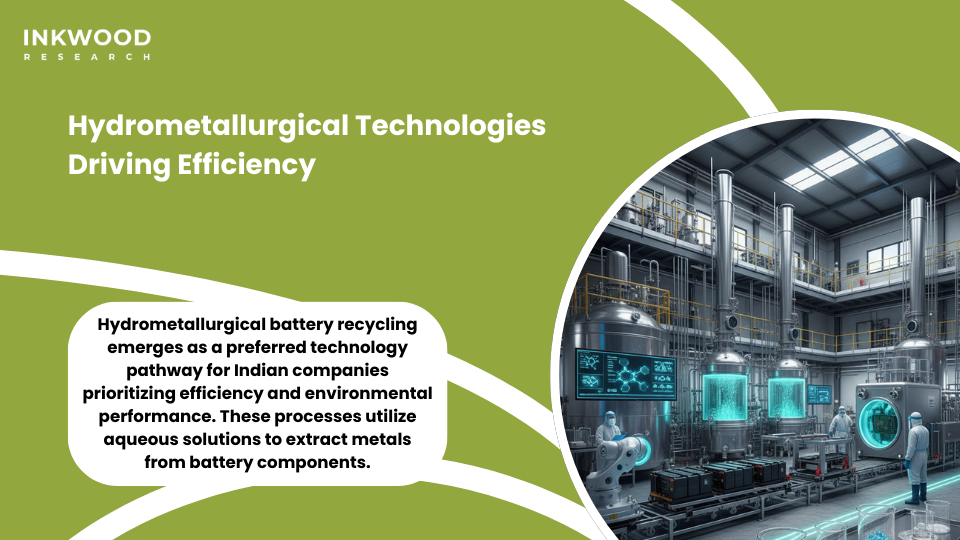
Hydrometallurgical battery recycling emerges as a preferred technology pathway for Indian companies prioritizing efficiency and environmental performance. These processes utilize aqueous solutions to extract metals from battery components. Seven major Indian companies employ hydrometallurgical methods, including Attero, Exigo, SungEEL HiMetal, Surbine Recycling, Tata Chemicals, Tes-Amm, and Ziptrax.
Process Fundamentals and Advantages
Hydrometallurgical processes utilize chemical solutions to extract metals, proving efficient and environmentally friendly when properly managed. Lower energy consumption compared to traditional approaches aligns well with India’s growing sustainability initiatives. Moreover, these methods enable the selective extraction of specific materials, improving recovery purity.
The technology has gained traction owing to its lower energy consumption compared to pyrometallurgical alternatives. Additionally, hydrometallurgy better handles diverse battery chemistries through adjustable processing parameters. Therefore, it provides the flexibility essential for managing mixed battery streams.
Recovery Rate Performance
Research from Vellore Institute of Technology shows at least 13 companies engaged in spent lithium battery recycling in India. These operations achieve recovery rates exceeding 95% for critical materials, including lithium, cobalt, nickel, and manganese, when properly optimized. Such performance matches international best practices.
By 2031, recovery rates are expected to reach 95% for cobalt, copper, lead, and nickel, with lithium at 85%. These targets drive continuous process improvements and technology investments. Furthermore, they ensure Indian recyclers remain competitive globally.
Second-Life Battery Applications in the Indian Context
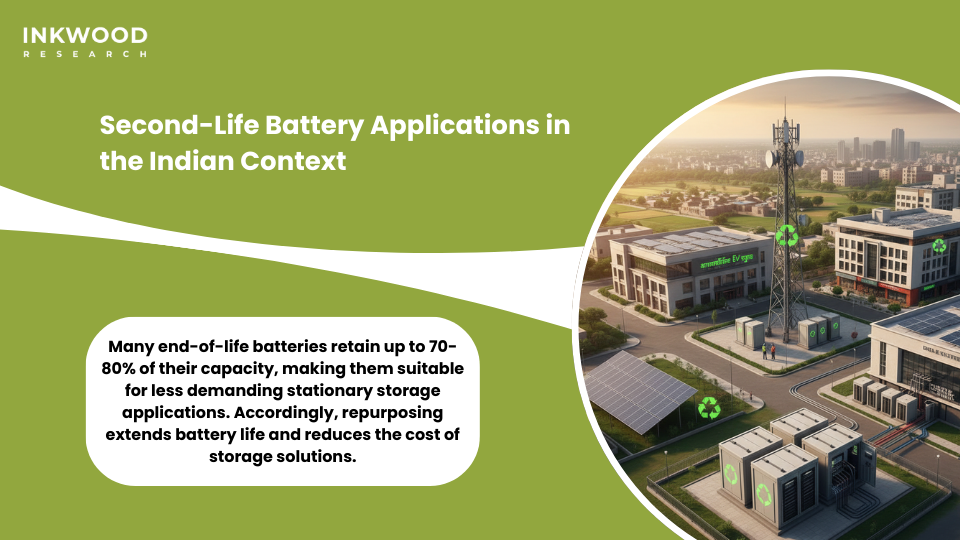
Many end-of-life batteries retain up to 70-80% of their capacity, making them suitable for less demanding stationary storage applications. Accordingly, repurposing extends battery life and reduces the cost of storage solutions.
Renewable Energy Integration
Second-life batteries paired with solar photovoltaic systems optimize renewable energy utilization across India. The country experiences rapid solar capacity expansion, requiring storage solutions to manage generation intermittency. Repurposed EV batteries provide cost-effective storage alternatives to new battery systems.
India’s renewable energy share in electricity production continues growing, creating opportunities for stationary storage deployment. Second-life batteries support grid integration of variable renewable sources. Moreover, they enable off-grid electrification in remote areas lacking grid connections.
Telecommunications Infrastructure
China’s biggest operator of telecommunication towers ended the purchase of lead-acid batteries in 2018, switching to repurposed lithium-ion batteries from EVs. Indian telecom operators similarly explore second-life battery applications for tower backup power systems. These applications require reliable but less demanding performance than automotive uses.
The transition from lead-acid to lithium-ion in telecom applications creates a massive market for repurposed batteries. Thousands of cell towers across India require backup power during grid outages. Therefore, second-life batteries address a substantial market opportunity.
Commercial and Industrial Applications
Data centers, commercial buildings, and industrial facilities implement second-life battery systems for backup power and demand management. These applications avoid expensive diesel generators while providing cleaner, quieter alternatives. Additionally, battery systems enable participation in demand response programs, generating additional revenue.
The economic case strengthens as second-life batteries cost significantly less than new systems. Installation and operational simplicities make them attractive for diverse applications. Furthermore, they support corporate sustainability objectives through circular economy participation.
Challenges: Feedstock Shortages and LFP Battery Economics
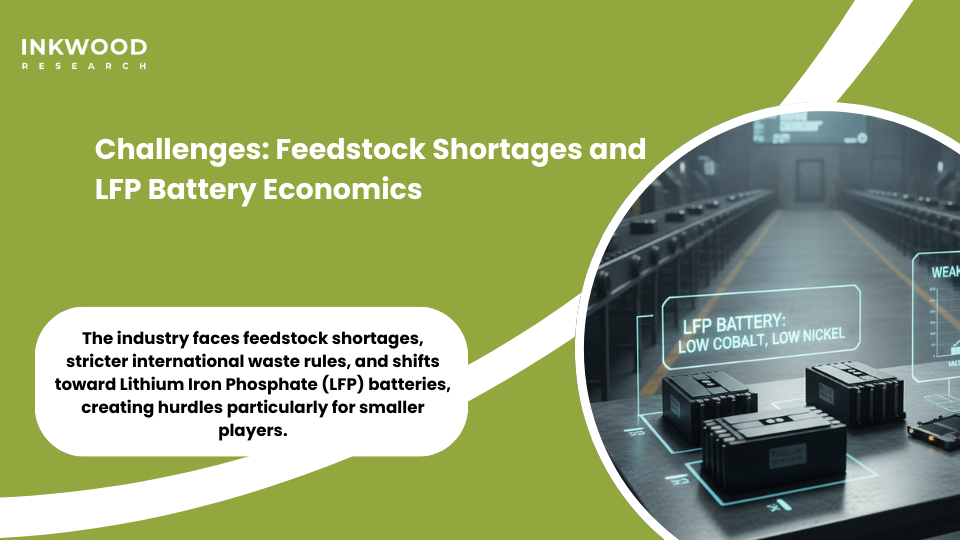
The industry faces feedstock shortages, stricter international waste rules, and shifts toward Lithium Iron Phosphate (LFP) batteries, creating hurdles particularly for smaller players. These challenges require strategic responses balancing short-term obstacles against long-term opportunities.
Feedstock Supply Uncertainties
The removal of customs duty on waste and scrap in 2024 aims to improve feedstock availability for recyclers by enabling imports. However, stricter international waste regulations limit the export of battery waste from other nations. China’s policy of not accepting waste exports affects potential feedstock sources for Indian recyclers.
Domestic EV adoption provides growing feedstock volumes, but the early-stage market generates limited end-of-life batteries currently. Production scrap from battery manufacturing provides interim feedstock, but quantities depend on domestic cell production capacity development. Therefore, recyclers face near-term supply uncertainties.
LFP Battery Recycling Economics
Economic constraints affect recycling returns for certain chemistries like LFP, complicating business cases for recyclers. Preliminary analysis of Lithium Iron Phosphate batteries, an emerging chemistry with growing adoption, highlights unique challenges underscoring the need for further research.
LFP batteries contain less valuable materials than NMC chemistries, reducing recovered material values. Lower cobalt and nickel content means recycling economics depend more heavily on lithium recovery efficiency. Therefore, specialized processes targeting LFP batteries require development and optimization.
International Waste Regulations
Stricter international waste rules complicate cross-border battery flows. Basel Convention amendments restrict hazardous waste movements between nations. These regulations aim to protect developing countries from waste dumping but also limit feedstock access for established recyclers.
India must develop a domestic collection infrastructure, reducing import dependence. Comprehensive EPR implementation ensures domestic battery waste flows to authorized recyclers. Meanwhile, regional cooperation frameworks could facilitate responsible cross-border movements supporting economies of scale.
Government Incentives Accelerating Industry Growth
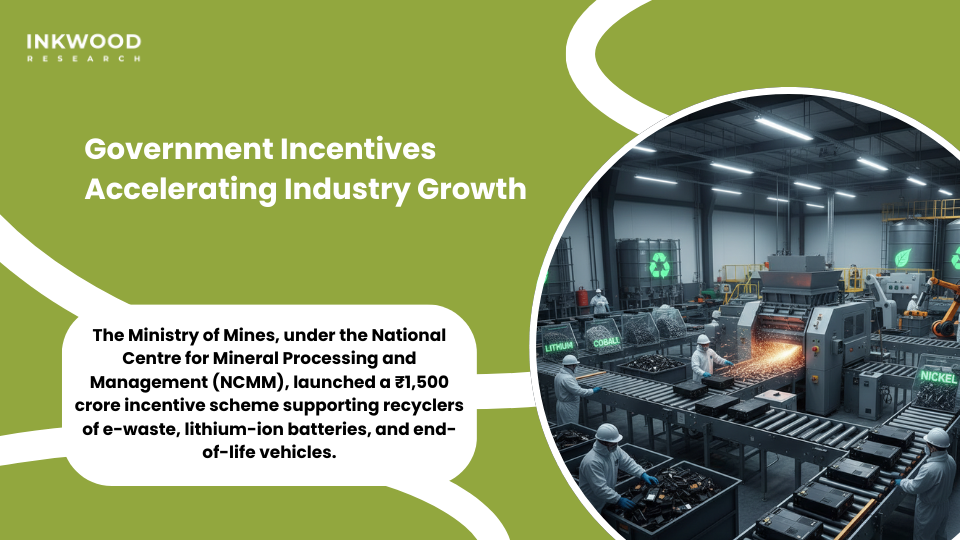
The Ministry of Mines, under the National Centre for Mineral Processing and Management (NCMM), launched a ₹1,500 crore incentive scheme supporting recyclers of e-waste, lithium-ion batteries, and end-of-life vehicles. This substantial funding demonstrates governmental commitment to circular economy development.
National Critical Mineral Mission
The government allocated Rs. 410 crore ($47.20 million) for the National Critical Mineral Mission in the budget estimate for 2025-26. This initiative emphasizes the production of EVs, their batteries, and the import and recycling of vital minerals from other nations. Moreover, it supports MSME participation in critical minerals manufacturing.
The exemption of basic customs duty (BCD) on cobalt powder and waste, lithium-ion battery trash, lead, zinc, and 12 other essential minerals was announced. This will help MSMEs manufacture these minerals domestically. Therefore, duty exemptions reduce raw material costs, improving recycling economics.
Production-Linked Incentive Schemes
The Production-Linked Incentive (PLI) scheme for Advanced Chemistry Cell (ACC) battery manufacturing indirectly supports recycling development. Domestic cell production generates manufacturing scrap requiring processing. Additionally, eventual end-of-life batteries from PLI-supported production create future feedstock.
The scheme encourages technology adoption and capacity expansion across battery value chains. Recycling infrastructure development complements manufacturing investments, creating integrated ecosystems. Furthermore, PLI support attracts international technology providers and investors.
FAME Program and EV Adoption
The Faster Adoption and Manufacturing of Hybrid and Electric Vehicles (FAME) II program accelerates EV deployment, creating downstream recycling opportunities. Higher EV sales today translate to increased end-of-life battery volumes in the coming years. Therefore, FAME indirectly supports recycling industry development.
State-level incentives complement central government programs, creating comprehensive support frameworks. Several states offer additional subsidies, tax benefits, and streamlined approvals for EV and battery-related projects. This multi-level government engagement demonstrates policy commitment.
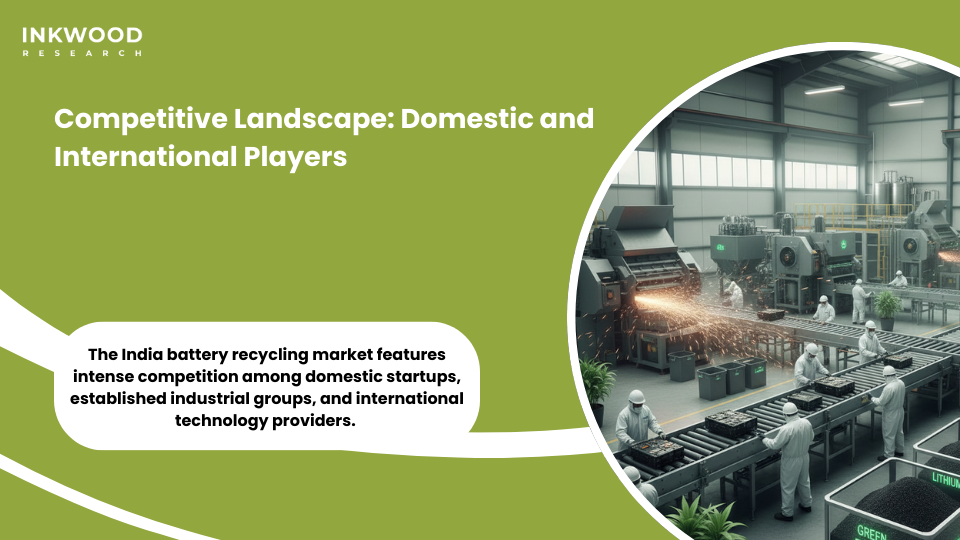
The India battery recycling market features intense competition among domestic startups, established industrial groups, and international technology providers. This diverse competitive landscape drives innovation while creating opportunities for partnerships and collaborations.
Domestic Market Leaders
GreenTek Remanufacturing, Satarem, and Umicore operate prominently within the Indian lithium-ion battery recycling market. These companies combine local market knowledge with proven technologies. Moreover, they establish collection networks and processing facilities across multiple states.
Exigo Recycling focuses on urban mining, recovering valuable materials from electronic waste, including batteries. Their integrated approach handles multiple waste streams, improving facility utilization. Additionally, diversification reduces dependence on single feedstock sources.
International Technology Providers
Companies such as Redwood Materials explore Indian market opportunities given its high growth potential. International players typically enter through partnerships, technology licensing, or minority investments rather than wholly owned operations. This approach mitigates regulatory and operational risks.
SungEEL HiMetal brings Korean recycling expertise to the Indian market through local partnerships. Their technologies achieve high recovery rates while meeting environmental standards. Furthermore, international collaborations facilitate knowledge transfer, accelerating domestic capability development.
Strategic Collaborations
Tes-Amm represents a joint venture between Indian and international partners combining complementary strengths. These partnerships leverage foreign technology and capital alongside local market access and operational capabilities. Moreover, they navigate regulatory requirements more effectively than standalone foreign entrants.
Research institutes and industry alliances play critical roles in advancing recycling methods and technologies. Continued R&D efforts result in the design of effective and affordable recycling systems customized to Indian settings. Therefore, collaborative innovation accelerates sector development.
Market Consolidation Trends
Despite India’s battery circularity ecosystem being in early stages, consolidation trends emerge as leading players acquire smaller competitors. Attero’s market leadership position attracts acquisition interest from international waste management and materials recovery companies. Such transactions provide growth capital while expanding global networks.
However, the market remains fragmented with numerous small-scale operators handling battery collection and preliminary processing. Formalization through EPR implementation will consolidate collection networks around authorized recyclers. Therefore, regulatory enforcement drives industry structuring.
Emerging Technologies Disrupting Traditional Recycling
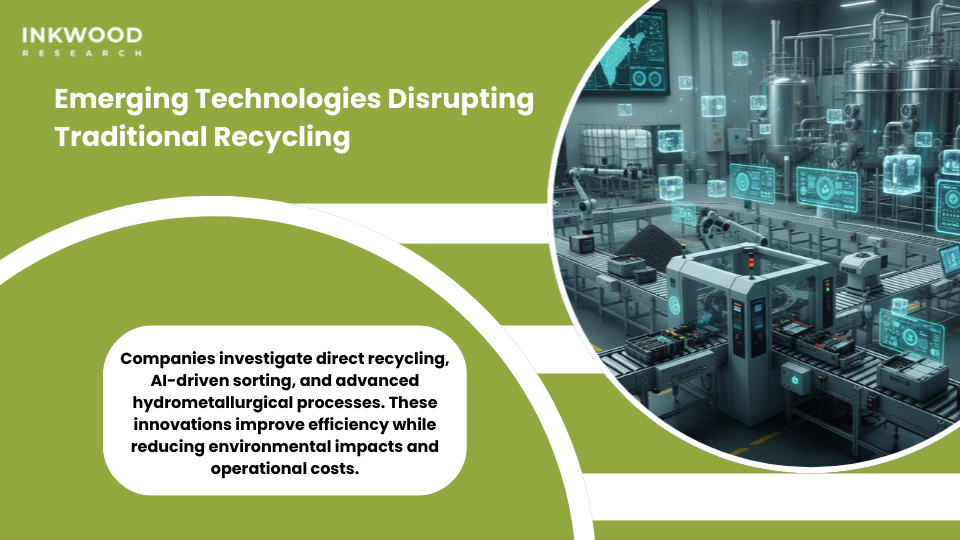
Technological innovation transforms Indian battery recycling industry growth prospects. Companies investigate direct recycling, AI-driven sorting, and advanced hydrometallurgical processes. These innovations improve efficiency while reducing environmental impacts and operational costs.
Direct Recycling and Reconditioning
Direct Recycling emerges as a revolutionary approach seeking to preserve battery structure while reconditioning components. This method makes it a cost-effective strategy for specific battery types and degradation patterns. Moreover, it avoids energy-intensive breakdown processes.
The process evaluates individual cells, determining which require replacement versus simple reconditioning. Subsequently, battery packs receive new cells and management systems, extending operational lives. This approach maximizes material retention while minimizing processing costs.
AI and Machine Learning Applications
AI-driven sorting systems automatically classify used batteries, improving recycling efficiency by 25% while reducing toxic waste. Machine learning algorithms optimize process parameters based on real-time data. Additionally, predictive maintenance reduces equipment downtime, improving facility utilization.
Digital tools, including digital twins and virtual twin experiences, optimize recycling workflows, enabling near-zero waste. These technologies simulate different processing scenarios, identifying optimal approaches before physical implementation. Therefore, AI accelerates process development and optimization.
Closed-Loop Manufacturing Integration
Companies develop closed-loop systems that collect non-reusable batteries and scraps generated during production, then reinject extracted materials into production stages. This vertical integration reduces supply chain risks while improving sustainability metrics.
Battery manufacturers increasingly partner with recyclers, establishing take-back programs and material supply agreements. These collaborations ensure steady feedstock for recyclers while providing manufacturers access to recovered materials. Furthermore, they support circular economy business models.
Blockchain for Supply Chain Traceability
Blockchain-based material tracking systems certify ethical sourcing throughout battery lifecycles. These digital platforms record material origins, processing steps, and quality certifications. Subsequently, downstream users verify material provenance supporting responsible sourcing commitments.
Traceability becomes increasingly important as international regulations require documentation of recycled content and ethical sourcing. Blockchain provides immutable records, reducing fraud risks. Moreover, it facilitates compliance with emerging digital product passport requirements.
Key Takeaways
- The India battery recycling market demonstrates exceptional growth potential, projected to reach US$1,996.03 million by 2034 at an outstanding 17.98% CAGR. This growth rate substantially exceeds global averages, reflecting India’s aggressive policy support and rapid EV adoption. Battery Waste Management Rules 2025 establish a comprehensive EPR framework requiring manufacturer responsibility for end-of-life collection and processing.
- Leading companies, including Attero Recycling, Lohum Cleantech, and Tata Chemicals, pioneer hydrometallurgical battery recycling technologies, achieving over 95% material recovery rates. Seven major Indian companies employ hydrometallurgical methods, proving efficiency and environmental benefits. Additionally, startups like ACE Green develop specialized LFP recycling facilities addressing emerging battery chemistries.
- The Ministry of Mines launched a ₹1,500 crore incentive scheme supporting recyclers while removing customs duties on critical mineral waste. National Critical Mineral Mission receives Rs. 410 crore allocation for 2025-26 budget, emphasizing domestic manufacturing and recycling capabilities. These governmental commitments provide substantial financial support for infrastructure development.
- Challenges persist, including feedstock shortages, LFP battery economics, stricter international waste regulations, and fragmented collection infrastructure. However, solutions emerge through international partnerships, technology development, and EPR implementation. Second-life battery applications in renewable energy storage, telecom towers, and commercial facilities create additional value before final recycling.
- Emerging technologies, including AI-driven sorting, direct recycling, closed-loop manufacturing integration, and blockchain traceability, transform traditional recycling approaches. These innovations improve efficiency while reducing costs and environmental impacts. Therefore, India positions itself as an emerging leader in the Asia-Pacific battery circular economy development.
Conclusion:
India’s battery recycling industry stands at an inflection point where regulatory frameworks, market demand, and technological capabilities align. The extraordinary 17.98% CAGR through 2034 reflects strong fundamentals and governmental commitment. Subsequently, India emerges as one of the most attractive markets globally for battery recycling investments.
Nevertheless, significant work remains. Standardization across battery designs, collection infrastructure development, workforce training, and regulatory enforcement requires continued attention. Success depends on sustained collaboration between government, industry, and research institutions.
International cooperation provides valuable opportunities. European and North American companies possess advanced technologies and operational expertise that Indian players can license or partner with, to access. Simultaneously, India offers massive market potential and cost-competitive operations, attracting foreign investment.
At Inkwood Research, we help organizations navigate India’s rapidly evolving battery recycling landscape through comprehensive market intelligence and strategic advisory services. Our experts analyze technology trends, regulatory developments, competitive dynamics, and investment opportunities shaping Indian battery circular economy markets.
Contact our team to explore how India’s battery recycling transformation can enhance your supply chain strategies, support sustainability objectives, and capture exceptional growth opportunities in the world’s fastest-growing major economy.
Frequently Asked Questions
What makes India's battery recycling market growth rate exceptional compared to global averages?
India’s battery recycling market grows at a 17.98% CAGR from 2026 to 2034, substantially exceeding the global average of 10.63%. This reflects rapid EV adoption (particularly two-wheelers), aggressive government policy support through ₹1,500 crore incentives, Battery Waste Management Rules implementation, and emerging domestic recycling infrastructure from companies like Attero and Lohum.
How do Battery Waste Management Rules 2025 impact manufacturers and recyclers?
The rules establish Extended Producer Responsibility, requiring manufacturers to finance battery collection, processing, and recycling. EPR targets begin from 2027-28 with progressive collection rate increases. Recyclers benefit from guaranteed feedstock flows, while manufacturers must develop take-back programs and partner with authorized processors.
What are the main challenges facing India's battery recycling industry development?
Key challenges include feedstock shortages due to the nascent EV market, unfavorable economics for LFP battery recycling, stricter international waste import regulations, lack of standardized battery designs, fragmented collection infrastructure, and limited public awareness. However, government incentives, technology improvements, and EPR implementation gradually address these obstacles.