Table of Contents

This analysis is brought to you by Inkwood Research, a leading market intelligence firm specializing in global cloud infrastructure, AI-driven cloud migration services, and intelligent cloud migration services ecosystems. Our research team combines extensive experience analyzing AI cloud migration solutions, data sovereignty regulations, and AI-powered cloud transformation patterns across North America, Europe, and Asia-Pacific. Based on our proprietary research methodologies and strategic partnerships with enterprise cloud providers and government technology advisors, we deliver actionable insights for enterprises navigating the global AI-driven cloud migration services market.
TLDR
Nations worldwide are moving beyond basic cloud adoption, prioritizing data sovereignty and AI-driven cloud migration services as strategic imperatives. The global AI-driven cloud migration services market is projected to grow from US$2.89 billion in 2026 to US$25.62 billion by 2034, at a CAGR of 31.33%. Governments in Europe, Asia-Pacific, and North America are mandating local data residency, driving enterprises to adopt intelligent cloud migration services that align technical capabilities with sovereign compliance requirements and national security frameworks.
This blog is essential reading for CIOs, cloud architects, and enterprise compliance leaders evaluating AI cloud migration solutions. Additionally, government technology advisors, policy strategists navigating data sovereignty frameworks, and investors tracking the global AI-driven cloud migration services market will find rigorous, fact-grounded intelligence here. Whether you operate in financial services, healthcare, or critical infrastructure, this analysis provides the strategic context needed to act confidently.
What Is Sovereign AI Cloud Migration?
The conversation around cloud migration has fundamentally shifted. Enterprises no longer simply ask whether they should move to the cloud; they now ask which cloud, governed by which laws, and protected by which AI-driven frameworks. This shift defines sovereign AI cloud migration, combining the operational power of automated cloud migration using AI with the legal imperatives of national data governance.
At its core, sovereign AI cloud migration describes the practice of moving workloads, data, and applications to cloud environments that comply with a nation’s specific data residency and governance requirements. Governments from the European Union to India and Australia are mandating that sensitive data, from citizen records to financial systems, remain within territorial borders. Consequently, enterprises seeking to adopt AI-powered cloud transformation must now integrate compliance architecture directly into their migration strategies.
According to our analysis, the global AI-driven cloud migration services market is set to reach US$25.62 billion by 2034, growing from US$2.89 billion in 2026 at a CAGR of 31.33%. Much of this growth is directly tied to sovereign cloud mandates that are accelerating AI cloud migration strategy across regulated industries worldwide.
How Are Data Sovereignty Regulations Reshaping the Global AI-Driven Cloud Migration Services Market?

Regulatory frameworks are rewriting the rules of cloud adoption in every major economy. The EU’s General Data Protection Regulation established the gold standard for data sovereignty, requiring that personal data of EU citizens be processed and stored in compliant environments. Since then, dozens of nations have followed with their own data localization laws, creating a fragmented but increasingly powerful global compliance architecture that enterprises must navigate.
The European Union’s GDPR also established a precedent that directly shapes how AI cloud migration solutions are designed, workload classification, access controls, and audit trails are now foundational requirements, not optional features.
For enterprises deploying intelligent cloud migration services, these regulations create three key compliance imperatives:
- Data residency: Ensuring data stays within legally defined territorial boundaries at every stage of the migration lifecycle
- Access controls: Restricting third-party government access from foreign jurisdictions, particularly for sensitive industrial and personal data
- Audit trails: Maintaining verifiable, machine-readable compliance records that regulatory bodies can inspect at any time
Moreover, the European Union’s AI Act, one of the world’s first comprehensive AI governance frameworks, introduces additional compliance layers for AI workloads running in cloud environments. These requirements directly influence how enterprises structure their cloud migration automation frameworks AI. Furthermore, businesses operating across multiple jurisdictions must build multi-cloud migration AI solutions that accommodate varying regulatory environments without sacrificing operational performance.
How Are North America and Europe Leading Compliance-Driven Cloud Strategies?
North America leads the global AI-driven cloud migration services market, reaching US$1,077.79 million in 2026 and projected to grow to US$8,878.62 million by 2034 at a 30.16% CAGR. Europe follows closely, expanding from US$749.90 million in 2026 to US$6,519.92 million by 2034 at a 31.04% CAGR, figures that underscore how sovereign cloud compliance is fueling substantial commercial opportunity across both regions.
In North America, federal agencies are driving AI cloud migration strategy through mandates like FedRAMP, which establishes standardized security requirements for cloud services used by US government entities. Enterprises serving public sector clients must therefore demonstrate alignment with these frameworks, accelerating investment in intelligent cloud migration services across BFSI and healthcare sectors.
Europe’s market, meanwhile, is shaped by GDPR and the forthcoming EU Data Act, which will further expand data sovereignty obligations to industrial and IoT data streams. European enterprises are making three strategic moves in response:
- Investing in hybrid cloud migration using AI to maintain operational flexibility while meeting strict residency requirements
- Deploying AI-based workload assessment tools to classify data sensitivity and map compliant migration pathways before any workload moves
- Partnering with certified sovereign cloud providers that can demonstrate verified compliance chains across the full migration lifecycle
The alignment of regulatory pressure with commercial cloud investment is particularly visible in the financial services sector. Banks and insurers must now demonstrate that cloud migration services with AI are delivering not just operational efficiency, but legally auditable data protection, a standard that is raising the bar for every player in the market.
Why Is Asia-Pacific the Fastest-Growing AI Cloud Migration Region?
Asia-Pacific is the fastest-growing region in the global AI-driven cloud migration services market, expanding from US$739.01 million in 2026 to US$7,881.55 million by 2034 at a remarkable 34.43% CAGR. This trajectory reflects a region simultaneously undergoing mass digital transformation and rapidly tightening its data governance frameworks, a combination that creates structural, sustained demand for AI cloud migration solutions.
Countries including India, Australia, Singapore, and Japan have each introduced data localization or digital sovereignty legislation in recent years. India’s Digital Personal Data Protection Act, for instance, introduces residency requirements for sensitive personal data, directly influencing enterprise AI-powered cloud transformation decisions across the region’s largest economy. What drives Asia-Pacific’s exceptional growth is a convergence of powerful structural factors:
- Government-led digital transformation programs that mandate cloud adoption across the public sector and critical infrastructure
- Rising enterprise demand for AI-based workload migration to cloud platforms, particularly in manufacturing, logistics, and financial services
- Rapid investment in domestic cloud infrastructure by both local hyperscalers and global providers seeking regional sovereign deployments
- Growing adoption of machine learning in cloud migration to optimize cost and performance in resource-constrained environments
Additionally, many Asia-Pacific enterprises are leapfrogging legacy infrastructure entirely, deploying AI cloud migration solutions from the outset rather than retrofitting existing systems. This gives the region a structural advantage in cloud modernization using artificial intelligence, particularly in markets where legacy debt is limited and regulatory mandates are driving greenfield cloud adoption.
Which Technologies Power Sovereign Intelligent Cloud Migration?
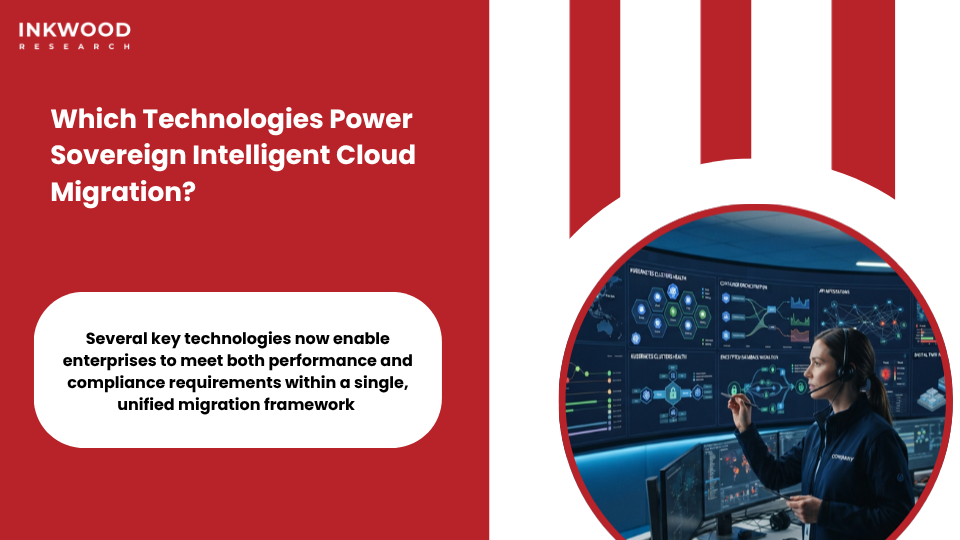
The technical architecture underpinning sovereign AI cloud migration has advanced considerably over the past two years. Several key technologies now enable enterprises to meet both performance and compliance requirements within a single, unified migration framework:
- AI-based workload assessment tools: These platforms analyze existing infrastructure, classify data sensitivity, and map optimal migration paths before a single workload moves, reducing both compliance risk and migration downtime.
- Predictive analytics for cloud migration: Machine learning models anticipate bottlenecks, downtime risks, and cost overruns, enabling cloud architects to intervene proactively rather than reactively.
- Robotic process automation cloud migration: RPA automates repetitive migration tasks, data validation, environment configuration, and testing, thereby reducing human error and significantly accelerating project timelines.
- AI-driven application dependency mapping: This technology visualizes how applications interconnect across on-premises and cloud environments, ensuring that migrations do not inadvertently break critical business workflows.
Together, these technologies form the foundation of cloud migration automation frameworks AI that enterprises are deploying at scale. Furthermore, the integration of generative AI in cloud transformation is enabling intelligent, real-time decision-making during migration, from automated compatibility checks to dynamic risk scoring as workloads move between environments. The emergence of autonomous cloud migration platforms represents the next frontier, combining these capabilities into self-orchestrating systems that minimize human intervention across the full migration lifecycle.
Key Players Driving AI Cloud Migration Solutions
The competitive landscape for AI-driven cloud migration services features a mix of global hyperscalers, enterprise IT giants, and specialized AI cloud migration consulting services firms. Several major players are shaping market direction:
- Microsoft Azure: Leads in hybrid cloud migration using AI, offering sovereign cloud deployments through Azure Government and Azure Sovereign offerings designed specifically for regulated industries and national government clients.
- AWS (Amazon Web Services): Deploys AI-based workload migration to cloud platforms through AWS Migration Hub, enabling automated cloud migration using AI at enterprise scale with integrated compliance documentation.
- Google Cloud: Advances intelligent cloud migration services through Vertex AI and migration factory frameworks, with particular strength in multi-cloud migration AI solutions for global enterprises.
- IBM: Focuses on AI-enabled DevOps and cloud migration, particularly for healthcare cloud migration AI solutions and cloud migration services for BFSI sector AI, where compliance and auditability are non-negotiable.
Accenture and Infosys: Lead in AI cloud transformation consulting companies practices, offering end-to-end intelligent workload migration using AI for enterprises navigating multi-jurisdictional sovereign cloud requirements.
Key Takeaways
- The global AI-driven cloud migration services market grows from US$2.89 billion (2026) to US$25.62 billion (2034) at a 31.33% CAGR, driven substantially by sovereign compliance mandates
- Sovereign cloud requirements, led by GDPR, national data localization laws, and the EU AI Act, are the primary structural catalysts reshaping AI cloud migration strategy globally
- North America and Europe lead compliance-driven adoption; Asia-Pacific grows fastest at 34.43% CAGR, fueled by government digital transformation programs and rising data governance frameworks
- Intelligent technologies, AI workload assessment, predictive analytics, RPA, and dependency mapping, form the backbone of compliant, sovereign migration architectures
- Multi-cloud and hybrid cloud migration using AI are the preferred deployment models for enterprises navigating multi-jurisdictional regulatory environments
Conclusion
The sovereign AI cloud migration imperative is reshaping enterprise IT strategy at a foundational level. As regulatory frameworks mature across North America, Europe, and Asia-Pacific, the demand for AI-powered cloud transformation that is simultaneously intelligent, compliant, and resilient will only intensify. For enterprises navigating this complex landscape, the ability to align AI cloud migration solutions with sovereignty requirements is not optional; it is a competitive differentiator that separates market leaders from laggards.
Inkwood Research provides the market intelligence and strategic frameworks needed to make those decisions with confidence.
Connect with our team to explore how our analysis can support your AI cloud migration strategy in this rapidly evolving global market.
Frequently Asked Questions (FAQs)
It combines AI-powered cloud transformation with data residency compliance, ensuring workloads meet national governance laws while maximizing migration efficiency and security.
They mandate data residency, restrict foreign access, and require audit trails, shaping how enterprises architect multi-cloud migration AI solutions across multiple jurisdictions.
BFSI, healthcare, and government sectors benefit most, as strict compliance requirements align directly with AI-based workload assessment and sovereignty-driven migration frameworks.
It maps how applications interconnect across environments, ensuring migrations do not break workflows or violate data residency requirements across jurisdictions.
It models compliance risk, cost overruns, and downtime scenarios before migration begins, enabling architects to address regulatory gaps proactively rather than reactively.
Hybrid combines on-premises and cloud environments; multi-cloud distributes workloads across multiple providers, both optimized by AI to meet sovereign compliance and performance requirements.