Table of Contents

This analysis is brought to you by Inkwood Research, a leading market intelligence firm specializing in Japanese renewable energy policy, advanced recycling technologies, and mature market waste management systems. Our research team combines extensive experience analyzing Japan’s regulatory evolution, public-private partnerships, and infrastructure development across the photovoltaic sectors. Based on our proprietary research methodologies and strategic partnerships with Japanese recycling companies, solar manufacturers, and government research institutions, we deliver actionable insights that empower strategic decision-making for global aenterprises navigating Japan’s solar panel recycling market maturation and regulatory transformation.
TLDR
Japan transforms solar panel recycling from a voluntary initiative into a mandatory framework as panels from the 2010s solar boom approach retirement. The market reached US$22.33 million in 2026 and projects growth to US$82.18 million by 2034. New legislation anticipated for 2025 mandates producer and importer funding for third-party recycling operations. Tokyo leads with comprehensive programs, including collection manuals and recycling promotion initiatives, supporting circular economy development.
Solar manufacturers planning Japanese market entry strategies, recycling companies evaluating infrastructure opportunities, policy makers benchmarking regulatory approaches, environmental consultants advising on compliance, and investment analysts assessing market potential will discover comprehensive insights into Japan’s regulatory evolution, public-private partnerships, technology innovation, and infrastructure development shaping Asia’s most mature photovoltaic recycling ecosystem.
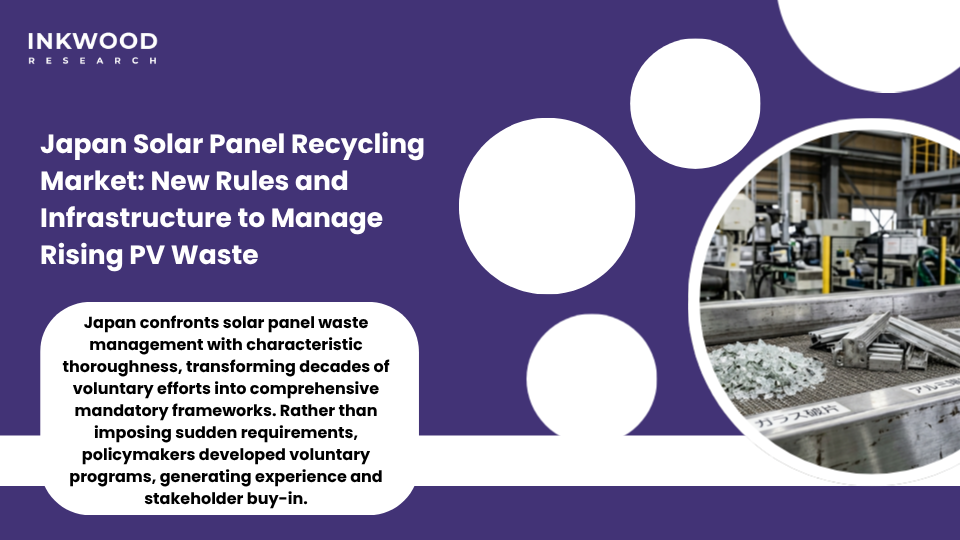
Japan confronts solar panel waste management with characteristic thoroughness, transforming decades of voluntary efforts into comprehensive mandatory frameworks. The nation’s early solar adoption during the 2010s feed-in tariff boom created significant installed capacity now approaching retirement age. Consequently, projected waste volumes reaching 500,000 tons annually by the mid-2030s necessitate systematic regulatory and infrastructure responses.
The Japanese approach reflects cultural preferences for consensus-building and incremental implementation. Rather than imposing sudden requirements, policymakers developed voluntary programs, generating experience and stakeholder buy-in. Subsequently, mandatory frameworks are built on proven foundations, reducing compliance friction. This measured progression enables smooth transitions from voluntary to required participation.
Tokyo’s leadership demonstrates how subnational governments pioneer innovations that national frameworks later adopt. The metropolitan area implemented residential solar panel mandates in April 2025 while simultaneously developing comprehensive recycling systems. These initiatives provide models for other jurisdictions facing similar challenges. Moreover, they position Japan as Asia’s most advanced photovoltaic recycling market.

Japan’s solar panel recycling market reached US$22.33 million in 2026, with projections indicating growth to US$82.18 million by 2034. This represents a compound annual growth rate of 17.69% during the forecast period. Market development reflects both increasing waste volumes from aging installations and strengthening regulatory requirements.
Despite lacking specific PV waste legislation until recently, Japan processed an estimated 2,079 tonnes of module waste in 2022. Of this volume, 1,638 tonnes underwent recycling while 441 tonnes entered reuse streams. Subsequently, these achievements demonstrate industry capabilities developed through voluntary programs before regulatory mandates emerged.
New legislation anticipated for 2025 will mandate recycling by requiring producers and importers to fund third-party operations. This extended producer responsibility framework ensures adequate financing while leveraging specialized recycling expertise. Furthermore, it creates predictable revenue streams supporting infrastructure investment decisions.
Early Solar Boom Creates Concentrated Retirement Volumes
Japan’s feed-in tariff implementation in 2012 triggered substantial solar deployment, concentrating installations within specific timeframes. These panels now approach their 20-25-year operational lifespans simultaneously. Consequently, retirement volumes will spike dramatically during the mid-2030s rather than accumulating gradually over decades.
Further, Projections indicate waste volumes could reach 350,000 tons by 2035, increasing to 470,000 tons by 2042. These concentrated volumes create both challenges and opportunities. Challenges include ensuring adequate processing capacity develops before peak waste arrives. Further, opportunities emerge from predictable volumes, enabling efficient facility planning and investment.
Regional distribution of installations influences recycling infrastructure deployment. Areas with high solar concentration require local processing capabilities, reducing transportation distances. Meanwhile, distributed residential systems need convenient collection networks ensuring proper disposal. As a result, these different requirements necessitate diversified infrastructure approaches.

Tokyo implemented groundbreaking solar panel regulations effective April 2025, mandating installation on new residential buildings by major developers. This requirement creates future recycling demand that concurrent programs address proactively. Rather than waiting for problems to emerge, Tokyo builds systems ahead of need.
The Tokyo Council for Advanced Recycling of Solar Power Equipment coordinates stakeholder efforts, including demolition contractors, transportation companies, and recycling operators. This collaborative body developed comprehensive manuals guiding proper panel removal and transportation. Additionally, the Residential Solar Panel Recycling Promotion Program launched in fiscal year 2023 supports industry development.
Moreover, these initiatives demonstrate how subnational governments can lead national policy development. Tokyo’s experience provides lessons for other jurisdictions while creating infrastructure serving broader regions. Furthermore, metropolitan programs establish standards that national frameworks may eventually adopt universally.
Public-Private Partnerships Accelerate Infrastructure Development
Japan leverages public-private collaboration, developing recycling capabilities through complementary strengths. Government agencies provide regulatory frameworks, coordination platforms, and financial support. Additionally, Private companies contribute operational expertise, technological innovation, and processing capacity.
Subsidy programs reduce initial investment barriers, encouraging private facility development. Government coverage of up to 60% of setup costs enabled 40% increase in licensed recycling facilities recently. These incentives accelerate capacity building while maintaining competitive private sector operations.
Industry associations facilitate knowledge sharing and best practice development. The Japan Photovoltaic Energy Association operates recycling programs streamlining end-of-life panel handling while ensuring environmental compliance. As a result, Such initiatives supplement regulatory requirements with industry-led standards exceeding minimum obligations.
Advanced Technologies Maximize Material Recovery Efficiency

Japanese companies develop sophisticated recycling technologies, achieving high recovery rates while maintaining profitability. Mechanical, thermal, and chemical processes work in combination to separate materials for reuse. Moreover, innovations focus on high-purity recovery enabling direct reintegration into manufacturing rather than downcycling into lower-value applications.
For example, the solaGlass project exemplifies innovative approaches transforming solar panel waste into valuable products. Ishizuka Glass and Kinjo Gakuin University collaborate to recycle panel glass into tableware prototypes. Moreover, this industry-academia partnership demonstrates circular economy principles while creating new markets for recovered materials.
Research continues to advance separation techniques addressing specific Japanese panel characteristics. Domestic manufacturers use particular materials and designs requiring adapted processing methods. Therefore, technology development emphasizes local material streams rather than solely importing international approaches.
Quality Standards Ensure Recovered Material Utility
Japanese recycling emphasizes quality over mere volume processed. Recovered materials must meet specifications enabling reuse in demanding applications. This requirement drives technology investments, achieving high-purity separation rather than accepting contaminated outputs.
Additionally, Glass recovery particularly demonstrates quality focus. Although glass constitutes 70-75% of panel weight, not all recovered glass achieves purity for photovoltaic reuse. Therefore, sorting and purification processes separate premium material from lower-grade outputs. Premium glass returns to solar manufacturing while other grades serve construction applications.
Silicon and silver recovery also requires precise processing, maintaining material purity. These valuable components justify sophisticated separation technologies despite higher costs. Furthermore, quality outputs command premium prices, offsetting processing expenses. As a result, this economic model supports sustainable recycling businesses rather than subsidized operations.
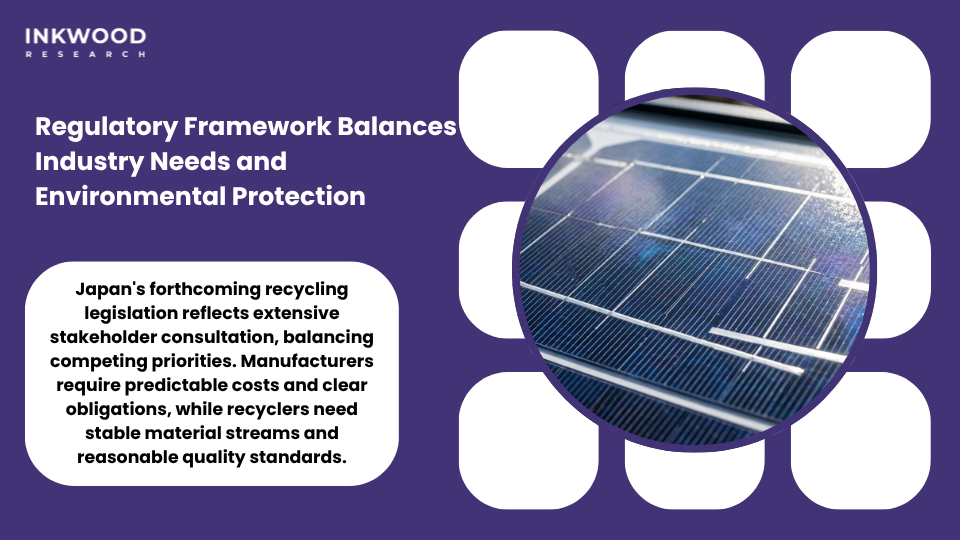
Japan’s forthcoming recycling legislation reflects extensive stakeholder consultation, balancing competing priorities. Manufacturers require predictable costs and clear obligations, while recyclers need stable material streams and reasonable quality standards. Environmental advocates demand comprehensive waste management to prevent improper disposal.
The proposed framework addresses these concerns through third-party fund management. Producers and importers contribute to centralized pools covering recycling costs. Also, Operators access funds according to established criteria, ensuring proper processing. This structure separates financial obligations from operational execution, enabling specialization.
Traceability requirements ensure accountability throughout material lifecycles. Panels receive identification enabling tracking from installation through retirement and recycling. This visibility prevents waste diversion while generating data informing policy refinement. Moreover, it supports circular economy development by connecting material flows across stakeholders.
Cost Allocation Mechanisms Ensure Fair Distribution
Fair cost allocation proves essential for regulatory acceptance and compliance. Manufacturers of panels reaching end-of-life may no longer exist or operate in Japan. Therefore, funding mechanisms must address orphaned products without penalizing current producers for historical installations.
Third-party fund management solves this challenge by pooling industry contributions. Current producers support the overall recycling infrastructure, benefiting the entire industry. Moreover, this collective approach distributes costs broadly while ensuring adequate funding regardless of specific manufacturer circumstances.
Differentiated contribution rates may reflect product characteristics affecting recycling difficulty. Panels using hazardous materials or complicated construction could incur higher fees for specialized processing. This incentivizes eco-design improvements, reducing future recycling costs.
Circular Economy Integration Strengthens Material Security

Japan views solar panel recycling as a critical component of its resource security strategy. The nation depends heavily on imported materials for manufacturing. Recycling provides domestic sources, reducing vulnerability to international supply disruptions. Furthermore, it aligns with broader circular economy objectives, minimizing waste while maximizing resource utilization.
Recovered materials supplement virgin inputs supporting sustained solar manufacturing growth. Silicon, silver, copper, and aluminum reclaimed from retired panels reduce procurement needs. This circular flow lessens import dependence while lowering environmental impacts associated with mining and refining.
On the other hand, industry coordination ensures recovered materials meet manufacturing specifications. Collaboration between recyclers and panel manufacturers establishes quality standards and delivery mechanisms. These connections transform recycling from waste management into supply chain integration.
Key Takeaways
- Japan’s solar panel recycling market demonstrates mature regulatory development, building on voluntary foundations.
- New legislation anticipated for 2025 mandates producer and importer funding for third-party recycling operations.
- The Tokyo metropolitan government pioneers comprehensive programs, including collection systems and recycling promotion initiatives.
- Projected waste volumes reaching 500,000 tons annually by mid-2030s drive infrastructure investment urgency.
- Public-private partnerships accelerate capacity development through government subsidies and private operational expertise.
- Advanced technologies focus on high-purity material recovery, enabling reuse in demanding applications.
- Regulatory framework balances industry needs with environmental protection through third-party fund management.
- Traceability requirements ensure accountability while supporting circular economy development. Cost allocation mechanisms distribute financial obligations fairly across current and historical producers.
- Circular economy integration strengthens resource security by providing domestic material sources. Recycling reduces import dependence while lowering environmental impacts.
- Industry coordination connects recovered materials with manufacturing specifications, completing circular loops.
Conclusion
Japan’s approach to solar panel recycling exemplifies methodical policy development, building consensus through incremental steps. Voluntary programs generated experience and stakeholder engagement. Subsequent mandatory frameworks leverage these foundations, ensuring smooth implementation.
The nation’s experience demonstrates how early solar adoption creates recycling obligations requiring proactive responses. Rather than waiting for a waste crisis, Japan builds infrastructure ahead of peak volumes. This foresight prevents environmental problems while capturing economic opportunities from material recovery.
Future developments will test whether current preparations prove adequate for projected volumes. However, Japan’s systematic approach combining regulation, infrastructure investment, and technological innovation creates robust foundations. Moreover, lessons from Japanese implementation inform other markets facing similar transitions.
Ready to engage with Japan’s solar panel recycling market? Inkwood Research delivers comprehensive intelligence on regulatory requirements and market opportunities. Contact our expert team for actionable insights supporting successful Japanese market operations.
Frequently Asked Questions
When will Japan’s mandatory solar panel recycling regulations take effect?
Japan is expected to introduce mandatory solar panel recycling regulations around 2025, requiring producers and importers to fund end-of-life photovoltaic panel recycling programs.
How does Tokyo’s solar panel recycling program differ from national initiatives?
Tokyo operates detailed residential solar panel collection and recycling programs, including guidance manuals and awareness initiatives that may serve as models for future national policies.
What materials can Japanese recyclers recover from solar panels?
Japanese recycling technologies can recover silicon, silver, copper, aluminum, and high-purity glass suitable for reuse in photovoltaic and manufacturing applications.
Why is solar panel recycling becoming important in Japan?
Japan’s early large-scale solar installations mean a growing volume of aging photovoltaic panels will soon reach end-of-life, increasing the need for organized recycling systems.
How does solar panel recycling support Japan’s circular economy goals?
Recycling enables recovery of valuable materials used in electronics and solar manufacturing, reducing raw material dependence and supporting resource efficiency.
What challenges does Japan face in solar panel recycling development?
Key challenges include high processing costs, limited recycling capacity, and the need to scale infrastructure as photovoltaic waste volumes increase.