Table of Contents
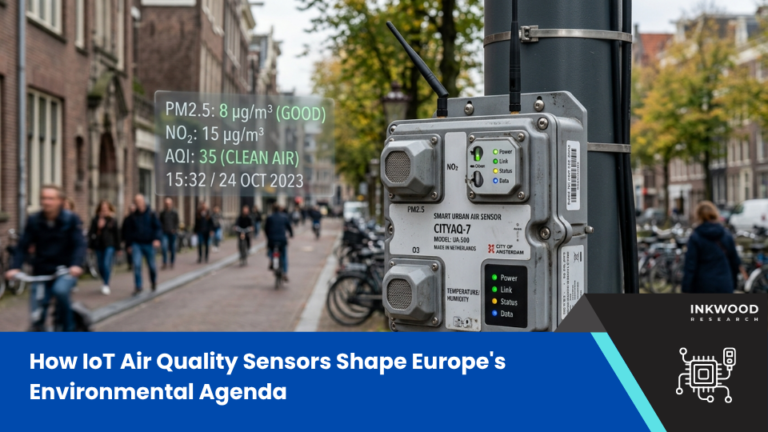
This analysis is brought to you by Inkwood Research, a leading market intelligence firm specializing in European environmental monitoring markets, IoT smart city infrastructure, and air quality technology ecosystems. Our research team combines deep expertise in Germany’s digital urban strategy, France’s national environmental health frameworks, and IoT sensor adoption patterns across EU regulatory environments. Through strategic partnerships with European city planners, environmental technology developers, and policy consultants, we deliver actionable intelligence for businesses navigating the rapidly evolving European air quality IoT sensors market.
TLDR
Germany and France are each building meaningful national frameworks around IoT air quality monitoring, but their approaches reflect distinct priorities. Germany is weaving smart air quality sensors into its smart city digitalization agenda, while France is embedding air quality IoT into its national health and environment plans. According to our analysis, the Germany air quality IoT sensors market is valued at US$147.97 million in 2026, growing to US$459.19 million by 2034. Meanwhile, the France air quality IoT sensors market is on a parallel growth path, expanding from US$98.65 million in 2026 to US$305.88 million by 2034. Both markets reflect a broader European commitment to real-time, data-driven environmental management.
This blog is essential reading for smart city planners, environmental technology investors, and IoT platform developers entering German or French markets. Additionally, European policymakers designing air quality frameworks, sustainability officers benchmarking against EU environmental standards, and health technology companies building IoT solutions aligned with national climate plans will find relevant, fact-grounded intelligence throughout.
How Are Germany and France Leading Europe’s Air Quality IoT Push?

Europe’s approach to environmental monitoring has shifted considerably over the past few years. Rather than relying solely on traditional reference monitoring stations, national governments are increasingly turning to IoT environmental sensors market solutions that provide real-time, distributed, and cost-effective air quality coverage. Germany and France, two of Europe’s largest economies, sit at the center of this shift, though their paths reflect different national priorities.
According to our analysis, the broader European air quality IoT sensors market is valued at US$638.11 million in 2026 and is projected to reach US$2,034.78 million by 2034, growing at a 15.60% CAGR. Within that regional picture, Germany and France together represent a substantial and strategically important share, with each country deploying IoT air quality monitoring investments through distinctly structured national programs.
Importantly, the European Union’s revised Ambient Air Quality Directive is setting tighter standards for member states, effectively creating a regulatory floor that accelerates the adoption of continuous, sensor-based monitoring across both countries. This directive, combined with each nation’s domestic policy agenda, is establishing a durable demand foundation for the Germany air quality IoT sensors market and the France air quality IoT sensors market well into the next decade.
How Is Germany Embedding IoT Air Quality Sensors into Its Smart City Roadmap?
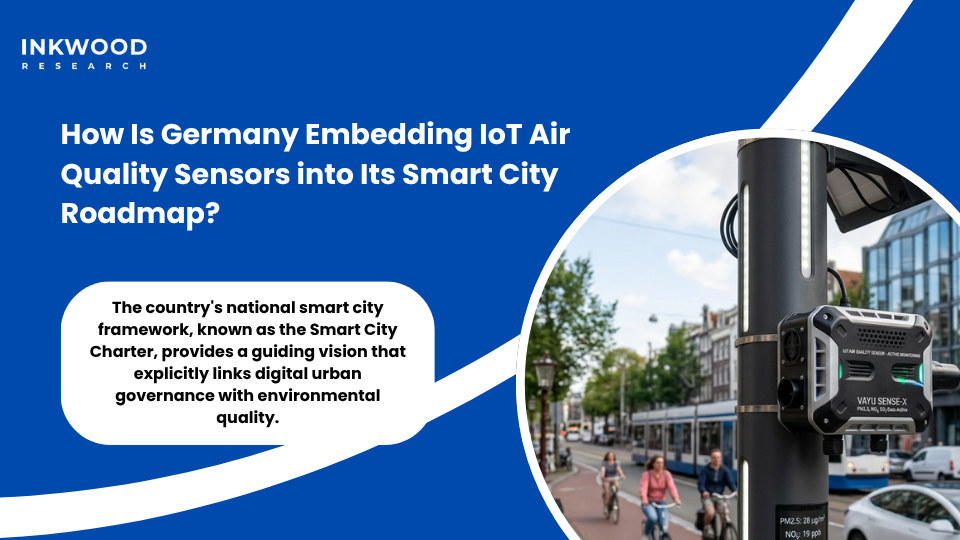
Germany’s approach to smart city air quality monitoring is systematic and infrastructure-led. The country’s national smart city framework, known as the Smart City Charter, provides a guiding vision that explicitly links digital urban governance with environmental quality. As a result, this places air pollution monitoring sensors market solutions at the intersection of city planning, public health, and climate policy.
German cities, particularly Berlin, Hamburg, Munich, and Frankfurt, are deploying dense networks of outdoor air quality monitoring sensors to complement traditional measurement stations. These IoT sensor networks capture localized, real-time data on particulate matter, nitrogen dioxide, ozone, and volatile organic compounds. The granularity they offer goes well beyond what fixed reference stations provide, enabling city planners to identify pollution hotspots at the street level rather than at the district level.
How Do German Smart Cities Use IoT Air Quality Data?
The real value of smart air quality sensors market solutions in German cities lies not just in data collection, but in how that data feeds into decision-making. Several practical applications are already in use:
- Traffic management systems use real-time pollution data to reroute vehicles away from high-emission corridors during peak hours, reducing localized nitrogen dioxide concentrations around schools and hospitals.
- Construction site monitoring deploys portable IoT environmental sensors to track dust and particulate emissions, helping municipalities enforce air quality conditions in building permits.
- Public transport planning integrates air quality data with passenger flow analytics, identifying routes where diesel bus exposure is highest and prioritizing electric vehicle transitions accordingly.
- Citizen-facing air quality dashboards translate raw sensor readings into accessible daily indices, improving public health communication and building community awareness around urban air pollution management.
Furthermore, Germany’s Federal Environment Agency (Umweltbundesamt) actively supports research into low-cost sensor validation, helping ensure that IoT-based air pollution monitoring systems deployed in smart city contexts meet acceptable accuracy standards. This institutional backing gives municipal procurement teams confidence to invest at scale in the Germany air quality IoT sensors market.
Which German Organizations Are Advancing Air Quality IoT?
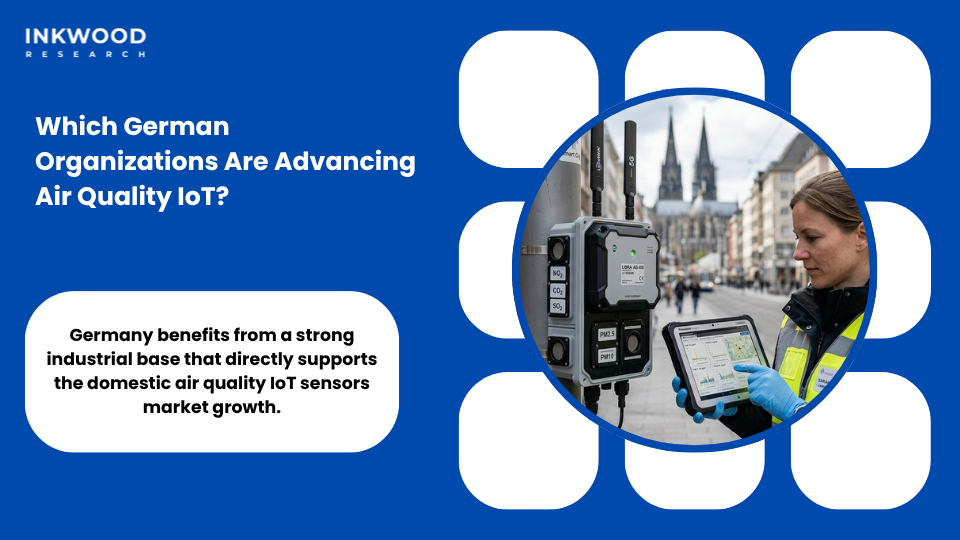
Germany benefits from a strong industrial base that directly supports the domestic air quality IoT sensors market growth. Several organizations are shaping both the technology and the deployment landscape:
- Bosch has developed a range of environmental IoT sensors for pollution control, including particulate matter and gas sensing solutions integrated into its connected mobility and smart building platforms. Its sensors are deployed in both automotive and urban monitoring contexts across Germany and broader Europe.
- Dräger, a long-established German manufacturer of gas detection and safety technology, has expanded its product line to include IoT air quality monitoring market solutions for industrial environments, supporting factory operators and municipal authorities in continuous emission tracking.
- Siemens integrates cloud-connected air quality monitoring systems into its building automation and smart infrastructure platforms. Its Desigo CC system, widely deployed in German commercial and public buildings, supports indoor air quality sensors market monitoring as part of broader building performance management.
- Fraunhofer Institute for Building Physics conducts applied research into sensor calibration, deployment methodologies, and data quality assurance for smart air quality sensors in urban and indoor environments, providing technical foundations that underpin commercial deployments across Germany.
How Is France Using IoT Sensors to Support Its National Health and Environment Plans?
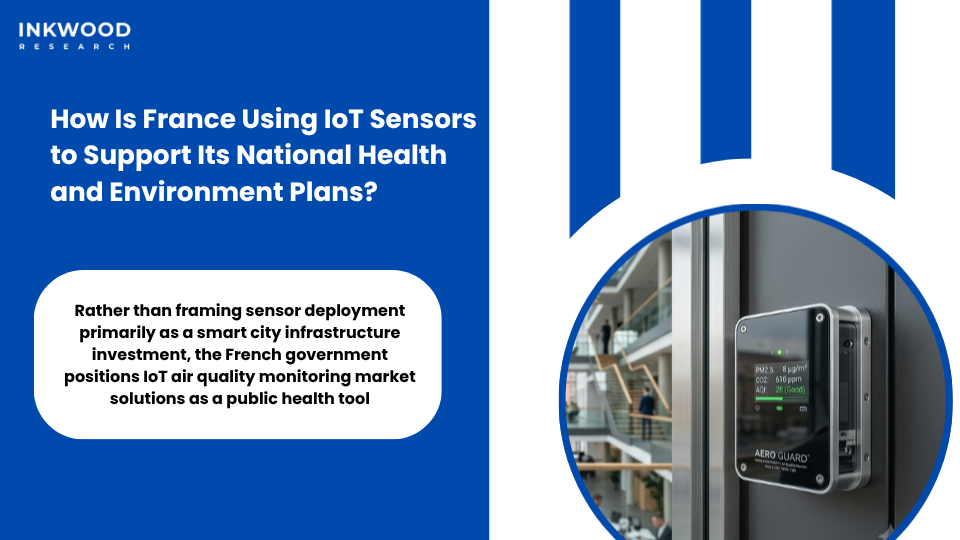
France takes a distinctly health-first approach to air quality IoT. Rather than framing sensor deployment primarily as a smart city infrastructure investment, the French government positions IoT air quality monitoring market solutions as a public health tool. This approach helps deliver on commitments under the National Health-Environment Plan (Plan National Sante-Environnement), which is now in its fourth iteration (PNSE 4).
This plan, administered jointly by the Ministry of Health and the Ministry of Ecological Transition, explicitly identifies air quality as one of the primary environmental determinants of public health. As a result, funding for air pollution monitoring sensors market infrastructure in France flows through a combination of national health programs, regional environmental agencies, and EU structural funds, creating a multi-channel investment pipeline that strengthens the France air quality IoT sensors market from multiple directions simultaneously.
Additionally, France’s ATMO networks, a national federation of accredited air quality monitoring associations, have begun integrating low-cost outdoor air quality monitoring sensors alongside traditional monitoring stations to increase spatial coverage, particularly in smaller cities and peri-urban areas where fixed station networks are sparse. This hybrid approach, blending regulatory-grade instruments with IoT sensor networks, reflects a pragmatic and health-oriented deployment philosophy that is fairly unique within Europe.
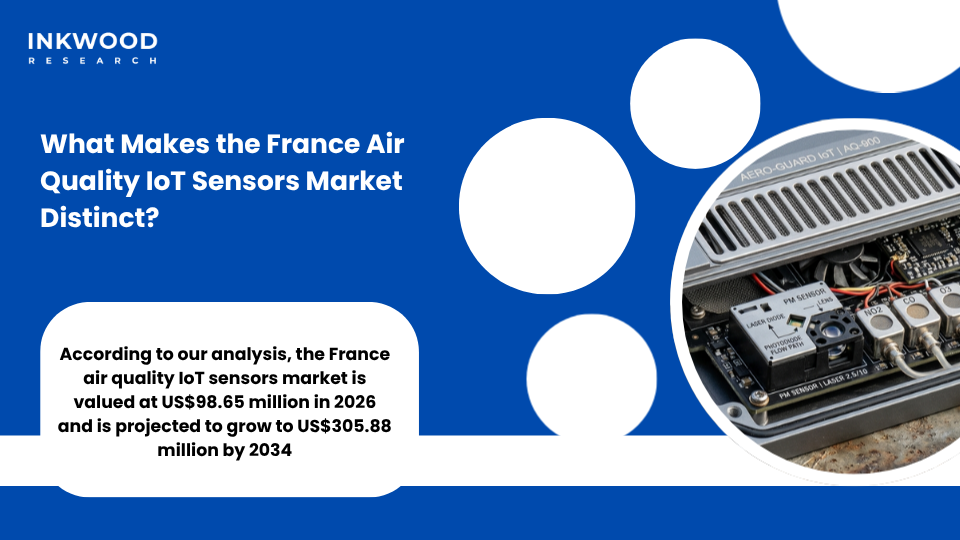
According to our analysis, the France air quality IoT sensors market is valued at US$98.65 million in 2026 and is projected to grow to US$305.88 million by 2034, reflecting a 15.19% CAGR. Several factors distinguish how this market is developing compared to its German counterpart:
- Health-environment integration: France’s PNSE 4 framework links IoT environmental sensors market investment to measurable public health targets, creating programmatic demand that is more predictable and longer-term than purely market-driven adoption.
- School and hospital prioritization: France’s government has prioritized deploying indoor air quality monitoring systems in schools and healthcare facilities first, where vulnerable populations are most exposed. Several regional councils have funded sensor programs in primary schools, generating real-world deployment data that is informing national standards.
- Agricultural and peri-urban monitoring: Unlike Germany’s primarily urban focus, France is also deploying real-time IoT monitoring platforms in agricultural zones where pesticide drift and ammonia from livestock operations contribute meaningfully to regional air quality degradation.
- Schneider Electric’s role: Paris-based Schneider Electric is integrating air quality detection sensors market capabilities into its EcoStruxure building management platform, supporting both commercial office and public sector deployments across France and beyond.
How Do These Two Markets Reflect the Broader European Trend?
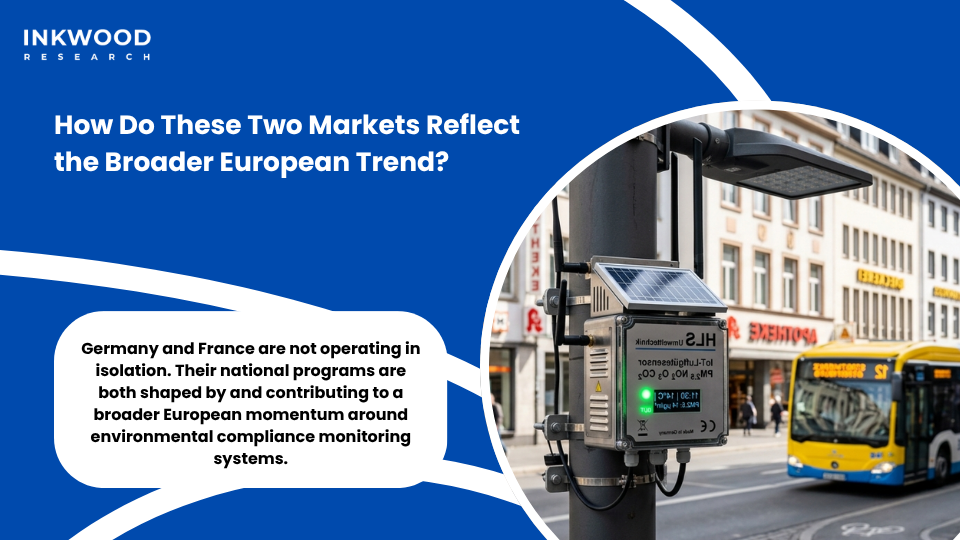
Germany and France are not operating in isolation. Their national programs are both shaped by and contributing to a broader European momentum around environmental compliance monitoring systems. The EU Green Deal, the revised Air Quality Directive, and the European Climate Law together create a policy environment where continuous, real-time smart city air quality monitoring is increasingly expected rather than optional.
What is particularly interesting is how the two countries complement each other. Germany provides the industrial and engineering depth, sensor manufacturing, platform integration, and municipal digitalization, while France contributes the health-policy framework and the institutional network, through ATMO and PNSE, that channels investment systematically toward vulnerable populations and priority environments. Together, they demonstrate that there is no single template for successful IoT air quality monitoring market development, and that national context shapes deployment patterns as much as technology availability.
For technology developers, investors, and policy strategists looking at the European air quality IoT sensors market, understanding these distinctions is as important as understanding the aggregate growth numbers. The pathways to market in Germany and France are meaningfully different, and the companies and platforms that succeed in each will likely reflect those differences.
Key Takeaways
- The Germany air quality IoT sensors market grows from US$147.97 million in 2026 to US$459.19 million by 2034 at a 15.21% CAGR, driven by smart city digitalization and Federal Environment Agency validation programs.
- The France air quality IoT sensors market expands from US$98.65 million in 2026 to US$305.88 million by 2034, anchored in national health-environment plans and ATMO network expansion.
- The broader European air quality IoT sensors market is valued at US$638.11 million in 2026 and is on track to reach US$2,034.78 million by 2034, reflecting consistent regulatory tailwinds across EU member states.
- Germany’s deployment model is infrastructure-led and urban-focused, with Bosch, Dräger, Siemens, and Fraunhofer shaping the competitive and technical landscape.
- France’s approach is health-policy-driven, with school and hospital prioritization, agricultural monitoring, and Schneider Electric’s platform integration defining the market’s character.
- The EU’s revised Ambient Air Quality Directive is creating a shared regulatory foundation that accelerates IoT sensor adoption across both markets simultaneously.
Conclusion:
Germany and France are building two of Europe’s most instructive examples of how national priorities shape IoT air quality monitoring market development. Whether through Germany’s smart city engineering approach or France’s health-environment policy framework, both countries are demonstrating that air pollution monitoring sensors market investment works best when it is anchored in a clear national purpose. For businesses navigating the Germany air quality IoT sensors market or the France air quality IoT sensors market, that context is not just background information; it is the strategic entry point.
Inkwood Research provides the market intelligence and strategic analysis needed to navigate European environmental monitoring markets with confidence.
Connect with our team to explore how our insights can support your positioning across Europe’s air quality IoT sensors landscape.
Frequently Asked Questions
How large is the Germany air quality IoT sensors market?
Our analysis values the market at US$147.97 million in 2026, projected to reach US$459.19 million by 2034 at a 15.21% CAGR.
How is Germany using IoT sensors in its smart city roadmap?
German cities deploy IoT air quality networks for real-time traffic management, construction monitoring, and public health communication through accessible pollution dashboards.
What is driving the France air quality IoT sensors market?
France’s National Health-Environment Plan (PNSE 4) channels investment into IoT monitoring for schools, hospitals, and agricultural zones as a public health priority.
How large is the France air quality IoT sensors market?
The market stands at US$98.65 million in 2026, growing to US$305.88 million by 2034 at a 15.19% CAGR, backed by health-environment policy frameworks.
Which German companies are active in the air quality IoT sensors market?
Bosch, Dräger, Siemens, and the Fraunhofer Institute are among the key organizations advancing Germany’s air quality IoT sensors market across urban and industrial applications.
How does the EU Air Quality Directive affect Germany and France?
The revised EU Ambient Air Quality Directive sets tighter standards that both countries must meet, accelerating continuous IoT-based air quality monitoring adoption nationally.