
Table of Contents
This analysis is brought to you by Inkwood Research, a leading market intelligence firm specializing in Middle East digital infrastructure, government cloud transformation programs, and enterprise AI adoption ecosystems. Our research team combines deep expertise in Saudi Arabia’s Vision 2030 digital initiatives, UAE cloud sovereignty frameworks, and hyperscale data center investment dynamics across the Gulf region. Through strategic partnerships with regional technology providers and government digital agencies, we deliver actionable intelligence for organizations navigating the Saudi Arabia and UAE AI-driven cloud migration services markets.
TLDR
The Middle East is undergoing a hyperscale infrastructure transformation that is fundamentally reshaping AI-driven cloud migration across the Gulf. The Saudi Arabia AI-driven cloud migration services market is projected to grow from US$42.99 million in 2026 to US$325.91 million by 2034, at a 28.81% CAGR. The UAE AI-driven cloud migration services market mirrors this momentum, expanding from US$39.28 million to US$297.94 million at a 28.82% CAGR, driven by Vision 2030, ambitious data center programs, and a strategic race to become the region’s dominant AI hub.
Enterprise technology strategists, government digital transformation officers, cloud infrastructure investors, and technology vendors targeting the Middle East will find this analysis directly relevant. Additionally, data center developers, AI infrastructure consultants, and organizations evaluating Saudi Arabia or the UAE as platforms for regional cloud operations will gain targeted, fact-grounded intelligence here.
Why Are Saudi Arabia and the UAE Becoming Global AI Infrastructure Hubs?
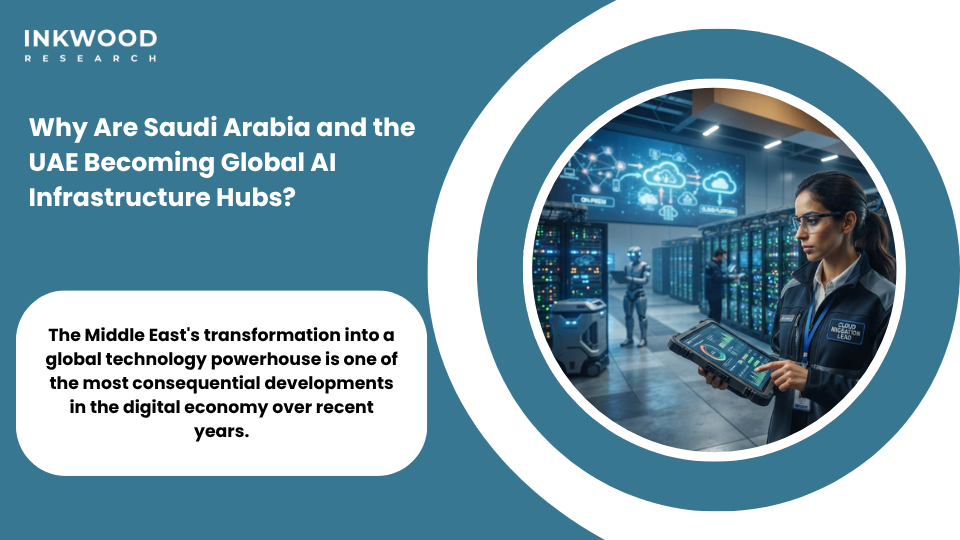
The Middle East’s transformation into a global technology powerhouse is one of the most consequential developments in the digital economy over recent years. While this evolution spans multiple sectors, the scale and ambition of AI infrastructure investment in Saudi Arabia and the UAE stand out as particularly significant, and it is directly reshaping demand for AI-driven cloud migration services across the Gulf.
Both markets share a common and powerful driver: national mandates for economic diversification that place digital transformation at the center of long-term strategy. Saudi Arabia’s Vision 2030 has established digital economy development as a core national priority, with cloud adoption and AI integration identified as essential capabilities for public and private sector modernization alike.
The UAE’s equivalent framework, the UAE Digital Economy Strategy, targets doubling the digital economy’s contribution to GDP, creating a structural, sustained pull for intelligent cloud migration solutions that will persist well beyond 2034.
Several converging forces are accelerating both markets simultaneously:
- Government-led digital transformation programs generating large-scale enterprise migration demand
- Rapid expansion of hyperscale data center capacity attracting the world’s largest cloud providers
- Growing private sector AI workloads requiring cloud-native, scalable infrastructure
- Regulatory environments specifically designed to attract and retain technology investment
- Significant financial sector digitization driving cloud migration services for the BFSI sector AI
The result: the Saudi Arabia AI-driven cloud migration services market is on track to grow from US$42.99 million in 2026 to US$325.91 million by 2034, at a 28.81% CAGR.
The UAE AI-driven cloud migration services market follows a near-identical trajectory, expanding from US$39.28 million in 2026 to US$297.94 million by 2034 at a 28.82% CAGR.
The Stargate Blueprint: What a 5GW AI Data Center Means for Global Migration
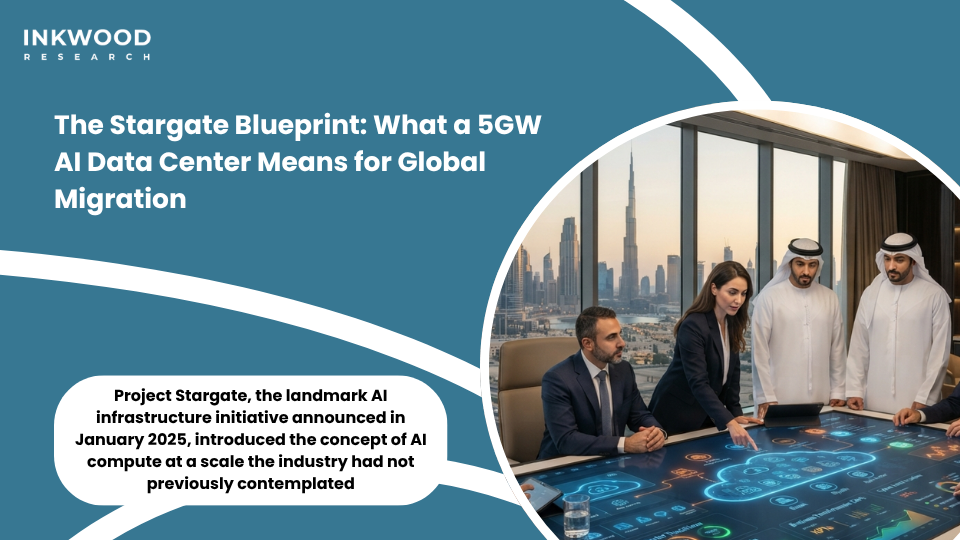
Project Stargate, the landmark AI infrastructure initiative announced in January 2025, introduced the concept of AI compute at a scale the industry had not previously contemplated within a single coordinated program.
The initiative, backed by OpenAI, SoftBank, and Oracle, is committed to deploying up to US$500 billion in AI infrastructure across the United States over four years, with an immediate first-phase commitment of US$100 billion. Its architecture established a new blueprint for what AI-scale data centers must look like, and that blueprint is now influencing infrastructure planning across the Gulf region.
What Is Project Stargate and Why Does It Matter?
The Stargate blueprint matters well beyond its US footprint because it has established a new architectural and economic template for AI-scale infrastructure globally. Data centers designed for AI workloads at this scale require fundamentally different engineering compared to traditional enterprise cloud facilities.
Understanding this distinction matters for organizations planning migrations in the Gulf because it defines the destination environment they are migrating toward.
Key structural characteristics that distinguish Stargate-class facilities from conventional data centers include:
- Power configurations optimized for high-density GPU cluster deployment and continuous AI model training workloads
- Advanced liquid cooling and thermal management systems at unprecedented facility scale
- High-bandwidth internal networking fabrics specifically designed for distributed AI workload patterns
- Modular construction approaches that allow rapid, staged capacity expansion to match demand growth
- Purpose-built connectivity to renewable energy sources to address sustainability requirements at scale
How Does Hyperscale AI Infrastructure Change Migration Strategy?
The availability of Stargate-class compute fundamentally changes how enterprise architects think about cloud migration. Traditionally, AI cloud migration strategy for enterprises centered on lift-and-shift approaches or incremental application modernization.
However, when the destination environment is capable of running advanced generative AI in cloud transformation natively, migration becomes an opportunity to transform how applications operate, not merely where they run.
This shift is particularly relevant for Middle Eastern organizations planning migrations as part of Vision 2030 or the UAE digital economy programs. Organizations that plan their migrations with this infrastructure trajectory in mind can build future-ready architectures from the outset:
- Enterprises can incorporate generative AI in cloud transformation capabilities into migration planning from day one
- Hybrid cloud migration using AI becomes viable at much larger scales, enabling phased transitions without service disruption
- Cloud migration cost optimization using AI is enabled by smarter resource allocation within AI-capable environments
Legacy workloads can be transformed during migration rather than simply replicated in new environments
Hexagon: Inside the World’s Largest Government Data Center Ambition
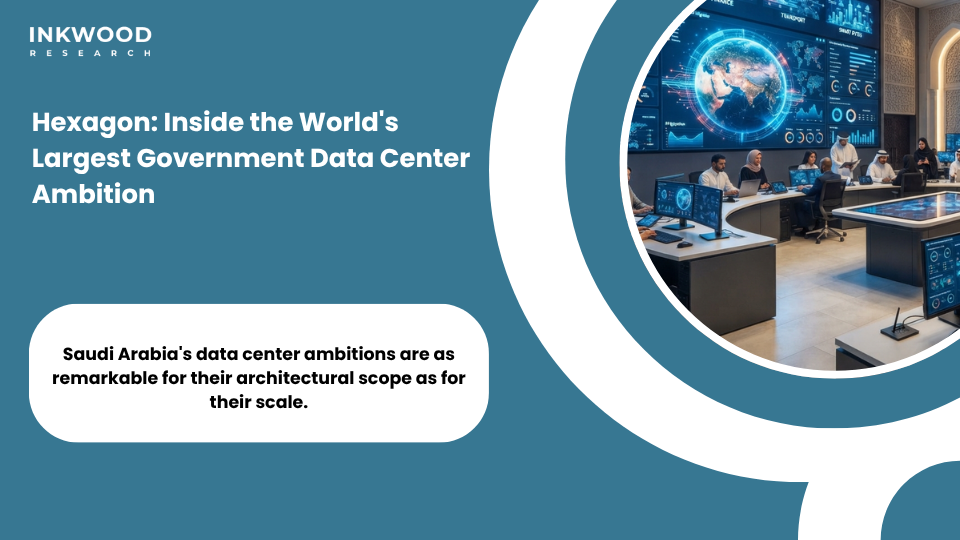
Saudi Arabia’s data center ambitions are as remarkable for their architectural scope as for their scale. The Hexagon government data center initiative, positioned as a landmark sovereign cloud infrastructure project, reflects the Kingdom’s determination to build domestically controlled digital infrastructure capable of supporting the full breadth of Vision 2030’s digital economy ambitions.
This approach represents a clear and deliberate strategy: ensure that Saudi Arabia’s most sensitive government and national security workloads remain within sovereign infrastructure, even as the Kingdom simultaneously attracts hyperscaler investment for commercial cloud services.
What Is the Hexagon Data Center Initiative?
The Hexagon initiative exemplifies the dual-track model that digitally ambitious nations are adopting: sovereign cloud for critical government data alongside global hyperscaler infrastructure for commercial workloads. This architecture is increasingly recognized as best practice for governments seeking both digital security and economic competitiveness, and it has direct and significant implications for the Saudi Arabia AI-driven cloud migration services market.
Government-scale data center projects of this nature create specific, large-volume demand for AI-driven cloud migration services across several distinct dimensions:
- Migrating existing government agency systems from legacy infrastructure to modern cloud-native environments at scale
- Establishing consistent security and compliance baselines across potentially hundreds of government entities simultaneously
- Enabling AI capabilities within government operations through modern, API-accessible cloud infrastructure
- Supporting cross-agency data sharing on a secure, standardized platform that preserves data sovereignty
How Does Sovereign Infrastructure Accelerate Migration Adoption?
The existence of large-scale sovereign infrastructure directly addresses one of the most significant barriers to cloud adoption in government: data sovereignty concerns. When agencies can migrate to cloud environments that are physically and legally within the Kingdom, the risk profile of that migration changes fundamentally, and approvals that previously took months can proceed considerably faster.
Moreover, infrastructure investments of this scale create strong incentives for domestic technology ecosystem development. This, in turn, drives demand for specialized AI cloud migration consulting services and cloud migration managed services with AI from providers with proven Saudi market expertise. The combination of government mandate and world-class infrastructure creates a powerful adoption flywheel that will sustain market growth well through 2034.
Saudi Arabia: Vision 2030 and the Cloud Migration Imperative
Saudi Arabia’s cloud migration market is growing rapidly, and the underlying drivers extend well beyond infrastructure investment alone. Vision 2030 has established a comprehensive framework for economic diversification that fundamentally requires digital transformation across every sector of the economy, from oil and gas to healthcare, financial services, education, and tourism.
The Saudi Cloud Computing Policy, administered by the Ministry of Communications and Information Technology (MCIT), establishes clear guidance that actively encourages all government entities to prioritize cloud services in new IT deployments. This policy direction, combined with Vision 2030’s sectoral transformation goals, creates demand that spans the entire cloud stack, from infrastructure to application modernization to AI workload migration.
Which Industries Are Leading Cloud Migration Adoption in Saudi Arabia?
Migration demand is not uniformly distributed across sectors, and understanding where adoption is highest helps technology providers and investors prioritize effectively. Four sectors stand out as particularly active:
- Financial services: Saudi Arabia’s banking sector is among the most digitally advanced in the region, driving strong demand for cloud migration services for BFSI sector AI that meet Saudi Central Bank (SAMA) regulatory requirements. Cloud-native core banking and AI-powered risk analytics are leading migration use cases.
- Healthcare: The Kingdom’s healthcare digitization initiatives, a core element of Vision 2030, are creating significant demand for AI cloud migration solutions capable of handling sensitive patient data within sovereign cloud frameworks compliant with national health data regulations.
- Manufacturing and industrial: Vision 2030’s industrial diversification goals require factories and industrial operators to adopt modern cloud and AI capabilities, supporting demand for AI cloud migration for manufacturing industry environments with complex operational technology dependencies.
- Government and public services: The broadest migration demand originates from government entity digitization, where thousands of legacy systems are being replaced at scale as part of nationwide e-government programs.
The UAE’s approach to AI-powered cloud transformation differs meaningfully from Saudi Arabia’s model. While both markets share national mandates for digital transformation, the UAE has built its cloud strategy around a fundamentally open, internationally integrated economy, which creates distinct patterns of demand for intelligent cloud migration services that reward global connectivity as much as sovereignty.
Why Is the UAE a Leading Regional AI Cloud Hub?
Dubai and Abu Dhabi have both invested significantly in positioning the UAE as a regional headquarters destination for multinational technology companies. The Abu Dhabi Digital Authority (ADDA) and Dubai’s Smart Dubai initiative actively facilitate cloud adoption across public and private sectors.
Together, they have attracted multiple hyperscaler infrastructure investments into the UAE, improving the local availability and performance of enterprise AI cloud migration solutions for the entire region.
The UAE’s status as a global business hub means its cloud migration market is driven by an unusually diverse sectoral mix, each with its own specific migration requirements and timelines:
- Financial services and fintech: Dubai International Financial Centre (DIFC) hosts hundreds of financial institutions requiring intelligent cloud migration services compliant with DIFC’s own data protection framework, driving sophisticated, compliance-aware migration demand
- Logistics and supply chain: The UAE’s position as a global logistics hub creates demand for AI-based workload migration to cloud platforms that support real-time operational systems without disruption
- Retail and e-commerce: Rapid digital commerce growth is generating demand for scalable cloud infrastructure and smart cloud transition services capable of handling significant seasonal load variation
- Media and entertainment: Abu Dhabi and Dubai’s growing media sectors are creating demand for cloud-native content management and AI cloud migration solutions tailored to high-bandwidth workloads
How Are UAE Regulatory Frameworks Supporting Migration?
The UAE has developed one of the more sophisticated cloud governance frameworks in the region. The UAE Cloud First Policy encourages government entities to prioritize cloud solutions in all new IT deployments. Additionally, Federal Decree-Law No. 45 of 2021 on personal data protection provides the structured governance framework that organizations need to plan compliant migrations with confidence, removing one of the most common sources of delay in enterprise migration programs.
This regulatory clarity is a genuine competitive advantage for the UAE AI-driven cloud migration services market. When the legal framework governing data transfer, storage, and processing is clear and stable, organizations can accelerate their AI cloud migration strategy for enterprises without the months-long legal review cycles that regulatory uncertainty otherwise necessitates.
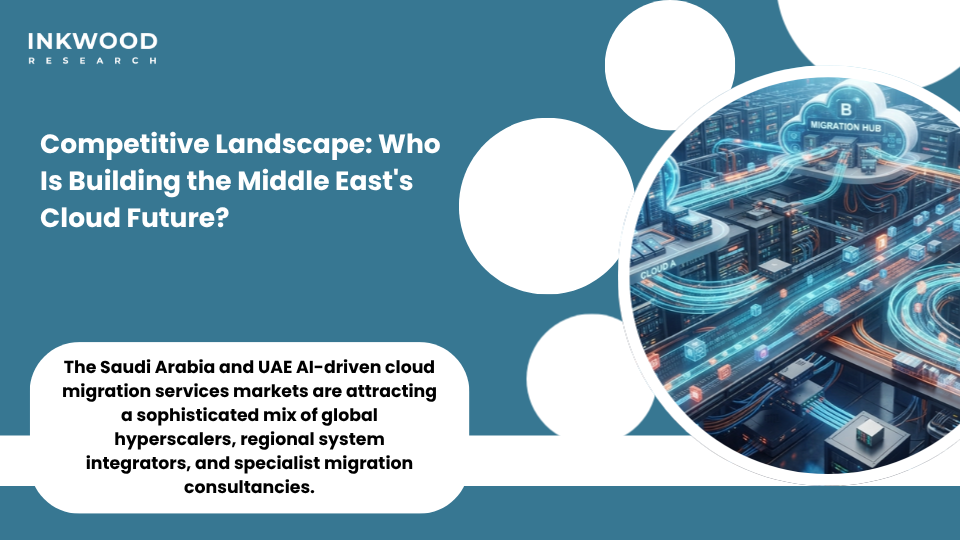
The Saudi Arabia and UAE AI-driven cloud migration services markets are attracting a sophisticated mix of global hyperscalers, regional system integrators, and specialist migration consultancies. Competition is intensifying across three dimensions simultaneously: technology platform, advisory services, and managed migration operations.
- Microsoft Azure: Has made significant investments in both markets, with data center regions in the UAE and growing Saudi Arabia infrastructure commitments. Azure Migrate and Azure AI Services deliver integrated automated cloud migration tools using AI, while strong government relationships support public sector pipeline development.
- Amazon Web Services (AWS): Launched its AWS Middle East UAE Region in 2022, providing critical local infrastructure. AWS migration acceleration programs and its extensive partner ecosystem support cloud migration automation frameworks AI at scale across both markets, with particular strength in enterprise and financial services.
- Google Cloud: Expanding its Middle East presence with notable strength in data analytics, AI/ML capabilities, and autonomous cloud migration platforms relevant to data-intensive government and enterprise use cases in both Saudi Arabia and the UAE.
- Oracle: Has established a notably strong position in the government sector across both markets, with sovereign cloud offerings specifically designed for regulated data environments. Oracle’s AI-based server migration tools and database cloud migration capabilities are particularly relevant for Saudi government modernization programs.
- Accenture, Deloitte, and PwC: The major consulting firms operate substantial Middle East practices functioning as primary AI cloud transformation consulting companies for government and enterprise clients navigating complex migration programs, often as the first point of contact ahead of technology platform selection.
- Regional operators, STC (Saudi Arabia) and e& formerly Etisalat (UAE): These telecoms-anchored technology firms are investing in cloud managed services capabilities, combining cloud migration managed services with AI and deep local market knowledge that global vendors struggle to replicate alone.
Key Takeaways
- Saudi Arabia’s AI-driven cloud migration services market grows from US$42.99 million to US$325.91 million by 2034 at a 28.81% CAGR, driven by Vision 2030 mandates, sovereign infrastructure investment, and BFSI and healthcare sector digitization
- The UAE market expands from US$39.28 million to US$297.94 million at a matching 28.82% CAGR, reflecting the strength of its open, diversified digital economy and internationally integrated business environment
- Project Stargate has established a new AI infrastructure template influencing data center design across the Gulf, creating AI-capable compute environments that fundamentally change the economics of enterprise cloud migration
- Saudi Arabia’s sovereign cloud strategy, exemplified by the Hexagon initiative, is reducing data sovereignty barriers and accelerating government migration programs that will sustain demand throughout the forecast period
- UAE regulatory clarity, including the Cloud First Policy and Federal data protection law, enables organizations to plan migrations with confidence, removing a significant source of adoption delay
- Financial services, healthcare, and government sectors are leading adoption across both markets, with cloud migration services for BFSI sector AI representing a particularly high-growth segment in both countries
Conclusion:
The Middle East’s emergence as a global AI infrastructure hub is not a distant forecast; it is unfolding now, and the market trajectory makes the direction unmistakably clear. Saudi Arabia and the UAE are each pursuing distinct but complementary strategies: one rooted in national sovereignty and the transformational ambition of Vision 2030, the other in open economic integration and global strategic positioning.
Both approaches are generating sustained, structural demand for AI-driven cloud migration services that will only intensify as infrastructure capacity expands and the economic imperative for digital modernization deepens across every sector.
For organizations entering or expanding within these markets, understanding the nuances of regulatory frameworks, government procurement dynamics, and hyperscaler positioning is not optional, but foundational.
Inkwood Research delivers the market intelligence, competitive analysis, and regional expertise needed to act decisively in this rapidly evolving landscape.
Connect with our team to explore how our research can support your strategy across the Saudi Arabia and UAE AI-driven cloud migration services markets.
Frequently Asked Questions
What is driving growth in the Saudi Arabia AI-driven cloud migration services market?
Vision 2030 digital mandates, sovereign infrastructure expansion, and strong BFSI and healthcare sector cloud adoption are the primary growth drivers through 2034.
How is the UAE's regulatory framework supporting cloud migration adoption?
The UAE Cloud First Policy and Federal data protection law provide regulatory clarity, enabling enterprises to design and execute compliant migrations with confidence and reduced approval timelines.
What role does Project Stargate play in the Gulf region cloud migration strategy?
Stargate establishes an AI-scale infrastructure template, improving migration economics and enabling generative AI workloads for organizations across Saudi Arabia and the UAE.
How is Saudi Arabia's SAMA regulating cloud adoption in the financial services sector?
SAMA’s cloud computing framework requires banks to conduct risk assessments, maintain data within approved boundaries, and ensure vendor compliance before migrating regulated workloads.
What makes the UAE an attractive base for regional AI cloud migration operations?
Its open economy, mature data protection law, Cloud First Policy, and concentration of hyperscaler infrastructure make it the Gulf’s most internationally integrated cloud hub.
How does generative AI in cloud transformation differ from traditional migration approaches?
Rather than simply relocating workloads, generative AI enables application redesign during migration itself, building AI-native capabilities directly into the destination architecture from day one.