Table of Contents
TLDR
The global material handling vehicles market is experiencing a remarkable transformation through automation, electrification, and smart technologies. Valued at $45.27 billion in 2025, the industry projects growth to $65.20 billion by 2032. E-commerce expansion, labor shortages, and sustainability initiatives drive unprecedented demand for automated guided vehicles (AGVs), electric forklifts, and intelligent warehouse solutions. Emerging markets across Asia-Pacific lead adoption as manufacturers innovate with lithium-ion batteries, AI-powered fleet management, and autonomous systems reshaping global logistics operations.
Supply chain executives, warehouse managers, logistics directors, and procurement specialists will discover actionable insights here. Investment analysts evaluating industrial automation opportunities benefit from comprehensive market intelligence. Equipment manufacturers, distributors, and technology providers gain competitive perspectives. Additionally, business strategists planning facility upgrades or exploring automation solutions find valuable data-driven guidance throughout this analysis.
Understanding the Global Material Handling Vehicles Market
The global material handling vehicles market represents specialized industrial equipment transforming how businesses move, store, and manage materials worldwide. According to our analysis, the global material handling vehicles market encompasses forklifts, pallet jacks, tow tractors, and increasingly sophisticated autonomous systems. These material handling vehicles serve critical functions across manufacturing, warehousing, distribution, and logistics operations globally.
Modern material handling equipment industry has evolved dramatically from basic mechanical tools to intelligent, connected systems. Furthermore, the machinery & equipment market integration of IoT sensors, artificial intelligence, and advanced powertrains revolutionizes operational efficiency. Businesses across continents recognize that strategic equipment investments directly impact competitiveness and profitability.
Market Size and Growth Trajectory
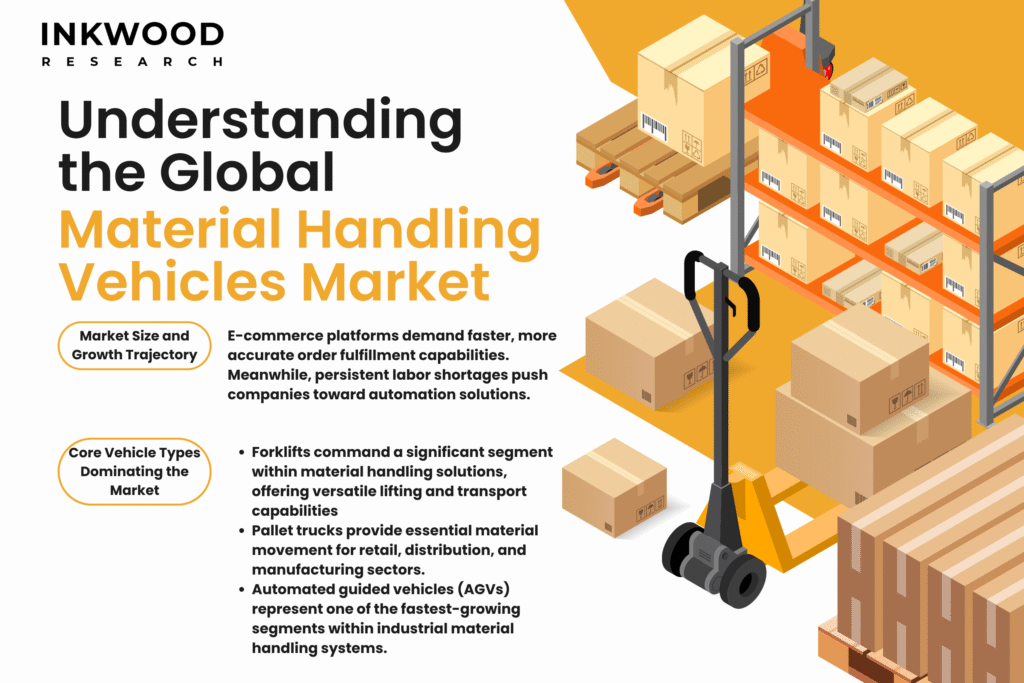
Our research indicates the material handling vehicles market size reached $45.27 billion in 2025. Projections show expansion to $65.20 billion by 2032, advancing at a 5.35% CAGR. This growth stems from multiple converging factors transforming global logistics networks.
E-commerce platforms demand faster, more accurate order fulfillment capabilities. Meanwhile, persistent labor shortages push companies toward automation solutions. Additionally, sustainability mandates accelerate transitions to electric and hybrid powertrains across industrial fleets.
Core Vehicle Types Dominating the Market
- Forklifts command a significant segment within material handling solutions, offering versatile lifting and transport capabilities. Electric models increasingly replace internal combustion variants, particularly in indoor warehouse environments. Load capacities range from compact units handling under five tons to heavy-duty equipment exceeding 36 tons.
- Pallet trucks provide essential material movement for retail, distribution, and manufacturing sectors. These compact vehicles excel in confined spaces where larger equipment cannot operate efficiently. Moreover, electric pallet jacks reduce operator fatigue while maintaining consistent productivity throughout shifts.
- Automated guided vehicles (AGVs) represent one of the fastest-growing segments within industrial material handling systems. These autonomous platforms navigate facilities using various technologies, including laser guidance, vision systems, and magnetic tracks. Consequently, businesses achieve 24/7 operations without human intervention.
E-Commerce Revolution Reshaping Material Transport Vehicles
The explosive growth of online retail fundamentally transforms warehouse automation solutions requirements globally. Amazon, Alibaba, and countless regional e-commerce platforms operate massive fulfillment networks requiring sophisticated e-commerce warehouse automation systems. Consumer expectations for same-day or next-day delivery create unprecedented operational pressures.
According to U.S. Census Bureau data, e-commerce sales continue strong growth trajectories despite economic uncertainties. This expansion directly correlates with surging demand for automated warehouse vehicles capable of processing thousands of orders daily. Peak shopping seasons like Black Friday and Singles’ Day intensify these requirements exponentially.
Fulfillment Speed Demands Advanced Equipment
Traditional manual picking methods cannot match modern consumer expectations. Instead, companies deploy warehouse robots market solutions that seamlessly integrate with material handling fleets. These coordinated systems reduce order processing times from hours to minutes.
Furthermore, accuracy becomes paramount as return rates impact profitability significantly. Advanced smart warehouse technologies minimize picking errors through barcode scanning, weight verification, and real-time inventory tracking. Therefore, businesses invest heavily in equipment offering both speed and precision.
Scaling Operations Through Automation
Seasonal demand fluctuations challenge traditional staffing models across retail sectors. However, distribution center automation systems provide consistent capacity regardless of external labor market conditions. Companies scale throughput by adding autonomous vehicles rather than recruiting temporary workers.
Battery swapping technology enables continuous operations for electric warehouse vehicles during peak periods. Quick battery exchanges eliminate lengthy charging downtime, maintaining productivity during critical demand surges. Consequently, retailers maximize revenue opportunities without operational bottlenecks.
Electric Material Handling Equipment Takes Center Stage
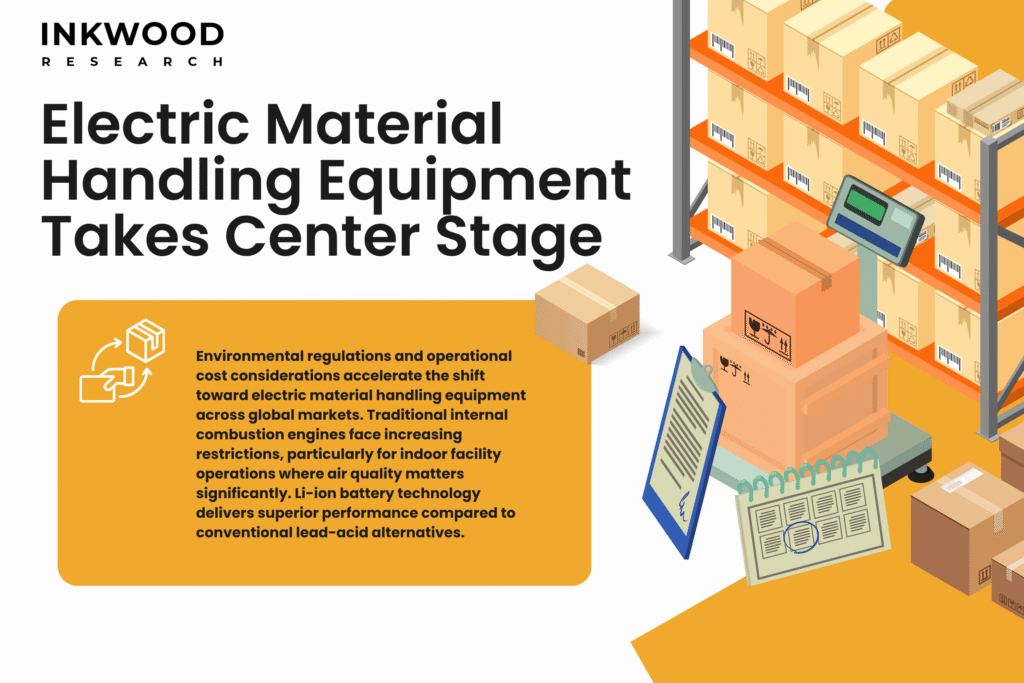
Environmental regulations and operational cost considerations accelerate the shift toward electric material handling equipment across global markets. Traditional internal combustion engines face increasing restrictions, particularly for indoor facility operations where air quality matters significantly. Li-ion battery technology delivers superior performance compared to conventional lead-acid alternatives.
Electric powertrains offer compelling total cost of ownership advantages. Maintenance requirements decrease dramatically without oil changes, filter replacements, or emissions system servicing. Energy costs remain more predictable than volatile diesel or propane pricing.
Lithium-Ion Technology Transforms Operations
Modern lithium-ion batteries charge faster, last longer, and require minimal maintenance compared to previous generations. Opportunity charging during breaks or shift changes keeps equipment operational without dedicated charging periods. Additionally, battery management systems optimize performance and extend lifespan through intelligent charging protocols.
Cold storage environments particularly benefit from electric solutions. Internal combustion engines struggle in freezing temperatures while producing harmful emissions. Conversely, electric systems operate reliably across temperature ranges without contaminating food-safe environments.
Sustainability Drives Corporate Commitments
Major corporations increasingly commit to carbon neutrality targets requiring fleet electrification. Toyota Industries Corporation reduced energy use by 40% through electric vehicle adoption. Similarly, Nissan achieved 51% CO2 emissions reductions by transitioning to electric lift trucks.
These sustainability achievements resonate with environmentally conscious consumers and investors. Consequently, companies prioritize electric equipment procurement to demonstrate environmental stewardship. Regulatory incentives and tax credits further improve electric vehicle adoption economics across regions.
Hydrogen Fuel Cells Emerge for Heavy Applications
While lithium-ion dominates lighter-duty segments, hydrogen fuel cells show promise for heavy-duty applications requiring extended runtime. Fuel cell systems refuel in minutes compared to battery charging times. Moreover, they provide consistent power output regardless of charge state.
Nevertheless, hydrogen infrastructure development remains limited in most markets. Initial equipment costs exceed traditional alternatives significantly. However, pilot programs demonstrate viability for specific high-intensity use cases where battery limitations prove problematic.
Automated Warehouse Vehicles Transform Operations
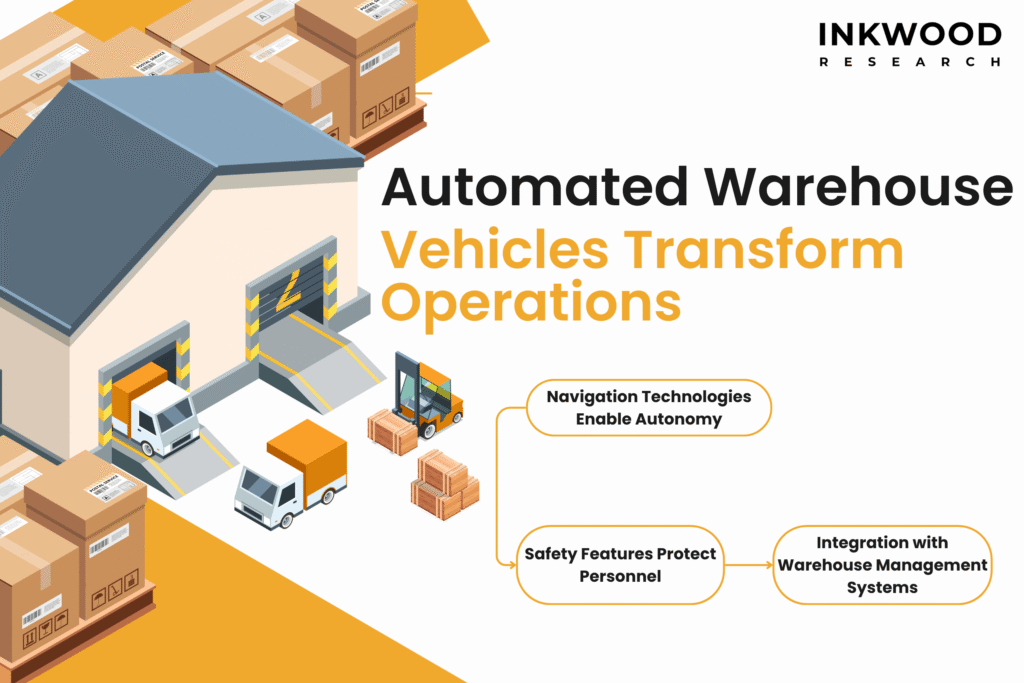
Autonomous forklifts and self-guided systems revolutionize material handling operations by eliminating human operator requirements. These intelligent machines navigate complex warehouse environments using sophisticated sensor arrays, cameras, and artificial intelligence algorithms. Consequently, businesses achieve unprecedented operational consistency and efficiency.
Labor shortages in developed economies make autonomous systems increasingly attractive. Warehouse worker turnover exceeds 40% annually in many markets, creating constant training burdens. Automated solutions eliminate these staffing challenges while maintaining productivity 24/7.
Navigation Technologies Enable Autonomy
Laser-guided systems provide precise positioning within facilities through triangulation from fixed reference points. Vision-based platforms utilize cameras and machine learning to interpret environments dynamically. Magnetic tape offers cost-effective guidance for defined routes between workstations.
SLAM (Simultaneous Localization and Mapping) technology represents the latest advancement. These systems create and update facility maps continuously while navigating obstacles. Therefore, businesses gain flexibility as layouts evolve without infrastructure modifications.
Safety Features Protect Personnel
Collision avoidance systems detect humans, other vehicles, and obstacles through multiple sensor types. LiDAR technology creates detailed 3D environmental maps, enabling safe navigation in crowded spaces. Additionally, emergency stop mechanisms activate instantly when unexpected situations arise.
Regulatory bodies like OSHA establish strict safety standards for autonomous equipment operations. Compliance requires comprehensive testing, validation, and ongoing monitoring. Nevertheless, autonomous systems consistently demonstrate superior safety records compared to manually operated equipment.
Integration with Warehouse Management Systems
Modern industrial trucks and lifts communicate seamlessly with warehouse management software through wireless connectivity. Task assignments, priority adjustments, and route optimization occur automatically based on real-time demand. This integration maximizes fleet utilization while minimizing idle time.
Predictive maintenance capabilities monitor equipment health continuously. Sensors track component wear, battery status, and performance metrics. Consequently, maintenance teams address potential issues before failures disrupt operations.
Regional Powerhouses Drive Global Supply Chain Automation
Emerging markets across Asia-Pacific, Latin America, and Africa experience accelerated industrial growth, driving material handling trucks demand. Countries like India, Vietnam, Indonesia, and Thailand expand manufacturing sectors rapidly as companies diversify global supply chains. These regions offer compelling growth opportunities for material handling equipment manufacturers seeking long-term expansion.
Asia-Pacific Leads Global Adoption
China dominates the regional market share through massive manufacturing infrastructure and e-commerce penetration. According to industry analysis, China represents approximately 46.25% of the Asia-Pacific material handling vehicles market, as of 2025. Domestic companies like Hangcha and Anhui Heli compete vigorously with international brands.
India’s market expands as government initiatives promote manufacturing through “Make in India” campaigns. Foreign investment flows into automotive, consumer goods, and electronics sectors, requiring sophisticated logistics automation market solutions. Infrastructure development projects create additional demand for heavy-duty material handling equipment across construction and industrial applications.
European Markets Emphasize Sustainability
European Union regulations drive aggressive emissions reduction targets across industrial sectors. Consequently, electric and hydrogen-powered equipment gain market share faster than global averages. Germany, France, and the United Kingdom lead the adoption of advanced warehouse automation solutions technologies.
Jungheinrich AG expanded manufacturing capacity in Czechia during 2023, positioning for regional growth. European companies increasingly specify electric equipment for new facilities regardless of cost premiums. Sustainability reporting requirements compel equipment electrification across corporate fleets.
Latin America and the Middle East Show Promise
Brazil and Mexico represent Latin America’s largest markets through manufacturing concentrations and growing e-commerce sectors. However, economic volatility and infrastructure limitations temper growth rates. Nevertheless, long-term demographics favor increasing consumption and logistics demand.
Middle Eastern nations invest heavily in logistics infrastructure supporting trade corridors between Asia and Europe. Saudi Arabia and the UAE develop massive distribution hubs requiring state-of-the-art material transport vehicles and automation systems. Government-funded projects accelerate technology adoption despite smaller market sizes.
Competitive Landscape: Industry Giants Lead Innovation
Toyota Industries Corporation maintains global market leadership through comprehensive product portfolios and extensive distribution networks. The company’s 2024 lift truck revenue reached $16.32 billion despite challenging market conditions. Toyota emphasizes innovation with investments in autonomous systems, electric powertrains, and IoT-enabled fleet management.
In May 2024, Toyota broke ground on a new $100 million manufacturing facility dedicated to electric lift truck production in Columbus, Indiana. This 295,000-square-foot plant demonstrates a commitment to electric vehicle leadership in North America. Additionally, Toyota and Raymond jointly opened an Energy Solutions Manufacturing Center, producing lithium-ion batteries for equipment fleets.
- KION Group AG Advances Automation Solutions
KION Group AG operates internationally through brands including Linde, STILL, and Baoli. The company’s 2024 Industrial Trucks & Services revenue reached $8.96 billion globally. KION emphasizes electrification and automation across product lines, positioning for sustainable growth.
In January 2025, KION partnered with NVIDIA and Accenture to develop “Physical AI” warehouse solutions. This collaboration creates digital twins of warehouse operations, enabling advanced simulations and real-time optimizations. Furthermore, the initiative enhances automation efficiency and supply chain flexibility through cutting-edge technology integration.
KION introduced the X35-X50 electric forklift series in April 2023, handling loads up to 3.5 tons. The Baoli brand launched 48-volt battery-powered reach trucks in 2024, expanding electric equipment accessibility. Moreover, KION develops hydrogen fuel cell systems for industrial trucks, pioneering alternative energy solutions.
- Jungheinrich AG Expands Through Strategic Partnerships
Jungheinrich AG reported $6.12 billion in lift truck revenue for 2023, selling 121,800 units globally. The German manufacturer emphasizes warehouse technology leadership through comprehensive automation solutions. Products range from electric forklifts to sophisticated AGV systems serving diverse applications.
Jungheinrich partnered with Mitsubishi Logisnext Americas to form Rocrich AGV Solutions in 2023. This joint venture delivers autonomous lift trucks and automation solutions across North American markets. Additionally, Jungheinrich acquired Magazino to elevate automation expertise through advanced robotics capabilities.
The company commenced operations at its Chomutov production plant in Czechia during June 2023. This facility manufactures electric reach trucks, expanding European capacity significantly. Furthermore, Jungheinrich invests in R&D to maintain technological leadership in autonomous vehicle development.
- Crown Equipment Corporation Strengthens American Manufacturing
Crown Equipment Corporation, based in New Bremen, Ohio, generated $5.29 billion in 2024 revenue. The privately held company maintains a strong North American presence through direct sales models and factory-trained service networks. Crown specializes in electric forklifts, reach trucks, and order pickers for warehouse operations.
In January 2024, Crown acquired a leading AGV technology company, strengthening its autonomous vehicle portfolio. This acquisition accelerates next-generation smart warehouse technology development. Crown’s Proximity Assist System uses LiDAR sensing to provide operators with corrective action opportunities, enhancing workplace safety.
- Hyster-Yale Materials Handling Innovates Electric Solutions
Hyster-Yale Materials Handling Inc serves global markets through Hyster and Yale brands. The company focuses on diverse power source options, including electric, internal combustion, and hydrogen fuel cells. Product lines address applications from compact warehouses to heavy industrial environments.
In February 2024, Yale Lift Truck Technologies launched lithium-ion forklifts targeting retail and warehouse applications. The ERP32-40UXTL three-wheeled and ERP30-70UXL four-wheeled models offer enhanced maneuverability and efficiency. These innovations demonstrate Hyster-Yale’s commitment to electric technology advancement.
- Mitsubishi Logisnext Co Ltd Leverages Global Reach
Mitsubishi Logisnext manufactures equipment marketed under multiple brands, including Mitsubishi Forklift Trucks, Unicarriers, and Cat Lift Trucks. This multi-brand strategy addresses diverse market segments and regional preferences effectively. The company maintains a strong presence across the Americas, Asia, and Europe.
In June 2024, Mitsubishi Logisnext launched the ESSENTiAL electric forklift for light-duty applications. This entry-level model features 3-tonne and 6-tonne load capacities, expanding accessibility for smaller operations. Additionally, the company develops the ΣSynX platform, integrating unmanned forklifts, AGVs, and palletizers through advanced logistics systems.
Latest Product Developments and Technological Breakthroughs
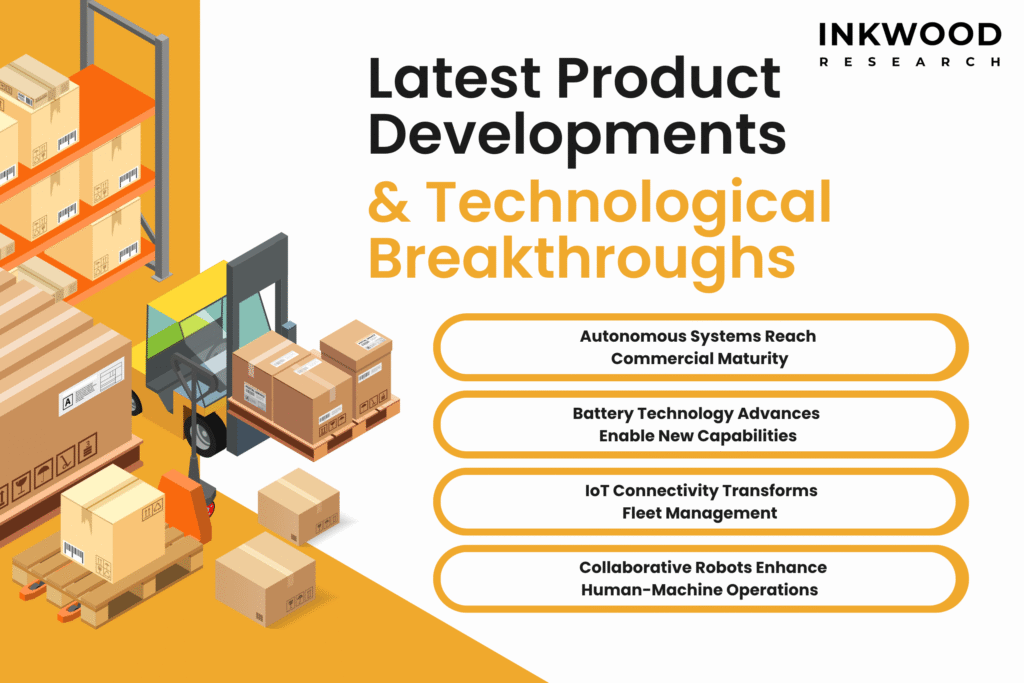
The forklift market witnessed significant innovation throughout 2024 and early 2025. Manufacturers prioritize operator comfort, safety enhancements, and technological integration across product lines. These developments address evolving customer requirements for efficiency, sustainability, and productivity.
- Autonomous Systems Reach Commercial Maturity
Fully autonomous forklift deployment accelerated significantly during 2024. Companies like Amazon, DHL, and major retailers expanded autonomous fleet sizes beyond pilot programs. These systems demonstrate consistent performance in high-volume distribution centers processing tens of thousands of orders daily.
Seegrid Corporation, specializing in vision-guided autonomous vehicles, continues expanding installations across North American facilities. The company’s systems navigate without infrastructure modifications, reducing deployment complexity and costs. Consequently, mid-sized operations adopt autonomous technology previously limited to industrial giants.
- Battery Technology Advances Enable New Capabilities
Fast-charging lithium-ion systems reduce charging times to under one hour for many applications. This capability enables single-shift charging during breaks rather than overnight charging cycles. Opportunity charging strategies maximize equipment availability without battery swapping infrastructure investments.
Battery energy density improvements extend the runtime between charges significantly. Modern systems operate full shifts on single charges for most applications. Furthermore, battery management software optimizes charging patterns, extending cell lifespan while maintaining performance.
- IoT Connectivity Transforms Fleet Management
Telematics systems provide unprecedented visibility into fleet operations through real-time data collection. Managers monitor equipment utilization, operator behavior, maintenance requirements, and productivity metrics continuously. This data-driven approach identifies optimization opportunities invisible through traditional management methods.
Predictive maintenance algorithms analyze sensor data to forecast component failures before breakdowns occur. Maintenance teams schedule repairs during planned downtime rather than responding to emergency failures. Consequently, equipment reliability improves while maintenance costs decrease through optimized parts management.
- Collaborative Robots Enhance Human-Machine Operations
Cobot integration within material handling operations balances automation benefits with human expertise. These systems handle repetitive tasks while human operators manage complex decision-making and problem-solving activities. Safety features enable cobots to operate alongside personnel without protective barriers.
Intuitive programming interfaces allow rapid deployment and reconfiguration as operational requirements evolve. Unlike traditional industrial robots requiring specialist programming, cobots adapt quickly to changing workflows. Therefore, businesses achieve automation flexibility previously unavailable through fixed automation systems.
Market Challenges and Strategic Solutions
Despite robust growth prospects, the material handling equipment industry confronts several significant challenges impacting adoption rates and operational success. Understanding these obstacles enables businesses to develop effective mitigation strategies while maximizing investment returns.
- High Initial Investment Requirements
Advanced automation systems require substantial capital expenditures beyond traditional equipment costs. Autonomous vehicles, warehouse management software, and supporting infrastructure create multi-million dollar project budgets. Small and medium-sized businesses particularly struggle justifying these investments despite long-term benefits.
Leasing and rental programs address capital constraints by converting capital expenditures into operational expenses. Equipment manufacturers increasingly offer flexible financing options enabling technology access without prohibitive upfront costs. Additionally, phased implementation approaches allow incremental investments matching cash flow capabilities.
- Skilled Operator and Technician Shortages
Modern equipment requires sophisticated technical knowledge for operation, maintenance, and troubleshooting. Traditional forklift operators need retraining for advanced autonomous system supervision. Maintenance technicians must understand complex electrical systems, software platforms, and diagnostic procedures.
Manufacturers respond through comprehensive training programs and certification courses. Remote diagnostics capabilities enable expert support without on-site technician availability. Furthermore, equipment design increasingly emphasizes user-friendly interfaces, reducing operator skill requirements.
- Infrastructure Limitations in Developing Markets
Emerging economies often lack electrical grid capacity supporting large electric vehicle fleets. Charging infrastructure investments add project costs and complexity. Additionally, service networks remain sparse in many regions, creating maintenance and parts availability concerns.
Local manufacturing facilities and service center investments address these infrastructure gaps gradually. International manufacturers partner with regional distributors, expanding service coverage. Moreover, hybrid powertrains offer transitional solutions where electrical infrastructure proves inadequate.
- Safety and Regulatory Compliance Complexity
Workplace safety regulations vary significantly across countries and regions. Compliance requires a comprehensive understanding of local requirements, ongoing training programs, and rigorous documentation. Liability concerns prompt substantial safety feature investments beyond minimum regulatory standards.
Advanced collision avoidance systems, operator monitoring, and automated safety protocols address these concerns. Regular equipment inspections and maintenance ensure ongoing compliance. Furthermore, industry associations provide guidance on navigating complex regulatory environments across markets.
Key Takeaways
- Market Growth: The global material handling vehicles market expands from $45.27 billion (2025) to $65.20 billion (2032), driven by e-commerce growth, labor shortages, and sustainability initiatives worldwide.
- Electric Revolution: Electric material handling equipment dominates new purchases, offering lower operating costs, reduced maintenance, and environmental compliance advantages compared to internal combustion alternatives.
- Automation Acceleration: Autonomous forklifts and AGVs transition from experimental to mainstream adoption, addressing persistent labor challenges while enabling 24/7 operations without human intervention.
- Regional Dynamics: Asia-Pacific markets lead growth through industrialization and e-commerce expansion, while developed markets emphasize electrification, automation, and sustainability compliance.
- Competitive Innovation: Industry leaders like Toyota Industries, KION Group, Jungheinrich, Crown Equipment, and Hyster-Yale invest billions in electric technology, autonomous systems, and smart warehouse solutions.
- Technology Integration: IoT connectivity, AI-powered fleet management, and predictive maintenance transform equipment from simple tools to intelligent, interconnected business systems, optimizing warehouse operations.
- Emerging Solutions: Hydrogen fuel cells, collaborative robots, and battery swapping technologies address specific operational challenges, expanding application possibilities beyond traditional equipment capabilities.
Conclusion
The global material handling vehicles market stands at a transformational inflection point. Automation, electrification, and intelligent technologies converge to redefine logistics operations worldwide. E-commerce expansion, labor market dynamics, and sustainability imperatives create unprecedented demand for sophisticated equipment solutions.
Businesses embracing these technologies gain competitive advantages through enhanced productivity, reduced costs, and improved operational flexibility. However, successful implementation requires strategic planning, appropriate technology selection, and ongoing adaptation to evolving market conditions.
Inkwood Research provides comprehensive market intelligence supporting informed decision-making across the material handling industry. Our analysts track competitive dynamics, technology trends, and regional developments impacting your business strategy.
Ready to optimize your material handling operations?
Contact our team for customized market analysis and strategic recommendations aligned with your specific requirements.
Frequently Asked Questions (FAQs)
E-commerce expansion creates massive warehouse automation demand as retailers scale fulfillment operations. Labor shortages in developed economies accelerate autonomous vehicle adoption. Additionally, sustainability regulations push companies toward electric equipment, while emerging market industrialization generates substantial new demand across Asia-Pacific, Latin America, and Africa.
Autonomous systems eliminate dependency on human operators, enabling consistent 24/7 operations without staffing concerns. These vehicles reduce labor costs by 30-40% while improving safety through collision avoidance technologies. Furthermore, integration with warehouse management systems optimizes workflows, reducing order processing times and increasing throughput significantly.
Electric equipment offers 40-50% lower operating costs through reduced maintenance and predictable energy expenses. Lithium-ion batteries enable opportunity charging during breaks, maximizing equipment availability. Moreover, electric vehicles eliminate indoor air quality concerns, comply with emissions regulations, and support corporate sustainability commitments while delivering superior performance characteristics.