Table of Contents
This analysis is brought to you by Inkwood Research, a leading market intelligence firm specializing in European pharmaceutical manufacturing, Germany’s Industry 4.0 ecosystem, and pharmaceutical additive manufacturing innovations. Our research team draws on deep expertise in German pharma regulation, chemical engineering, and digital manufacturing integration across Europe’s leading pharmaceutical and chemical companies. Through strategic partnerships with German pharmaceutical manufacturers, chemical technology providers, and regulatory consultants, we deliver actionable intelligence for enterprises navigating the Germany pharmaceutical 3D printing manufacturing market.
TLDR
Germany occupies a unique position at the intersection of industrial manufacturing precision and pharmaceutical innovation. The Germany pharmaceutical 3D printing manufacturing market is projected to grow from US$41.42 million in 2026 to US$123.03 million by 2034, at a 14.58% CAGR. Industry 4.0 infrastructure, BASF’s industrial-scale 3D printing leadership, and Germany’s deep pharmaceutical heritage are converging to define a production model that the rest of Europe is already watching closely, and beginning to follow.
This blog is directly relevant for pharmaceutical manufacturing executives, chemical engineers, and European market entry strategists evaluating Germany’s pharmaceutical additive manufacturing landscape. Additionally, investors tracking the Germany pharmaceutical 3D printing manufacturing market, regulatory affairs professionals working within EMA and BfArM frameworks, and supply chain leaders planning for decentralized drug manufacturing will find targeted strategic intelligence here.
Why Is Germany Central to Europe’s Pharmaceutical 3D Printing Market?
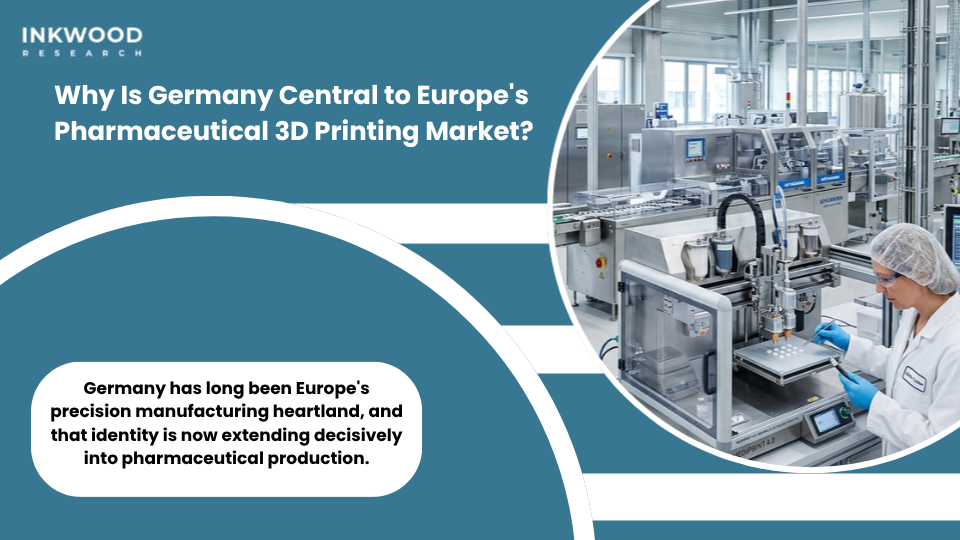
Germany has long been Europe’s precision manufacturing heartland, and that identity is now extending decisively into pharmaceutical production. The Germany pharmaceutical 3D printing manufacturing market, valued at US$41.42 million in 2026 and projected to reach US$123.03 million by 2034 at a 14.58% CAGR, reflects a broader industrial transformation, one where Industry 4.0 principles and pharmaceutical additive manufacturing are merging into a genuinely new production model.
What makes Germany’s trajectory distinctive is not simply its market size. Rather, it is the convergence of world-class chemical engineering, deep pharmaceutical heritage, and a manufacturing culture built on precision and reliability. When those foundations meet 3D printing drug manufacturing, the resulting capabilities have implications well beyond Germany’s borders.
Furthermore, Germany sits at the core of the broader European pharmaceutical 3D printing manufacturing market, itself growing from US$171.95 million in 2026 to US$518.09 million by 2034 at a 14.78% CAGR, anchoring European competitiveness in pharmaceutical additive manufacturing.
How Does Germany’s Regulatory Environment Enable Pharmaceutical 3D Printing?
The European Medicines Agency (EMA) has been progressively developing frameworks for advanced pharmaceutical manufacturing, including additive manufacturing. Germany’s Federal Institute for Drugs and Medical Devices (BfArM) aligns closely with these EMA guidelines, providing German manufacturers with a clear, if still evolving, regulatory pathway for 3D printed drug development and commercialization.
Moreover, Germany’s Industry 4.0 national strategy, the government’s framework for digitizing manufacturing across all sectors, provides the exact infrastructure that pharmaceutical additive manufacturing requires: digital-physical integration, real-time process monitoring, and automated quality control systems operating within rigorous engineering standards.
How Is BASF’s 3D Printing Strategy Reshaping Industrial Pharma?
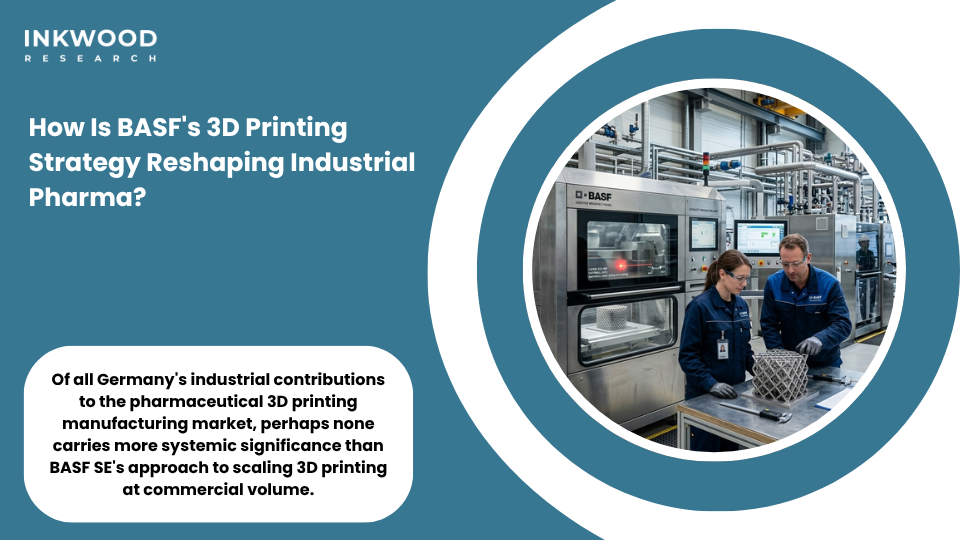
Of all Germany’s industrial contributions to the pharmaceutical 3D printing manufacturing market, perhaps none carries more systemic significance than BASF SE’s approach to scaling 3D printing at commercial volume. Headquartered in Ludwigshafen, BASF has been advancing additive manufacturing for catalyst production, engineering geometric complexity in catalyst structures that conventional manufacturing cannot achieve at equivalent precision.
This matters directly for pharmaceutical manufacturing because catalysts are fundamental to API synthesis. More efficient catalyst geometries mean cleaner chemical reactions, reduced by-products, and lower energy consumption across the pharmaceutical-chemical supply chain. Consequently, BASF’s industrial-scale 3D printing program is not peripheral to the pharma 3D printing manufacturing market; it is actively improving the upstream supply chain that feeds it.
What Does BASF’s Scale-Up Signal for Pharmaceutical Drug Manufacturing?
BASF’s industrial scaling of 3D printing is a proof of concept with broad implications for digital pharma manufacturing. If additive manufacturing can operate reliably at commercial chemical production volumes, maintaining quality, consistency, and regulatory compliance, then the pathway for pharmaceutical-grade 3D printing at equivalent scale becomes demonstrably clearer.
Furthermore, BASF’s materials division has developed pharmaceutical-grade polymer filaments and binders specifically designed for 3D printing drug manufacturing applications in drug delivery systems. This materials infrastructure, polymer grades optimized for FDM and SLS pharmaceutical 3D printing, is a foundational resource that German drug manufacturers can access through an established supply relationship rather than building from scratch.
What 3D Printing Technologies Are German Pharma Companies Using?
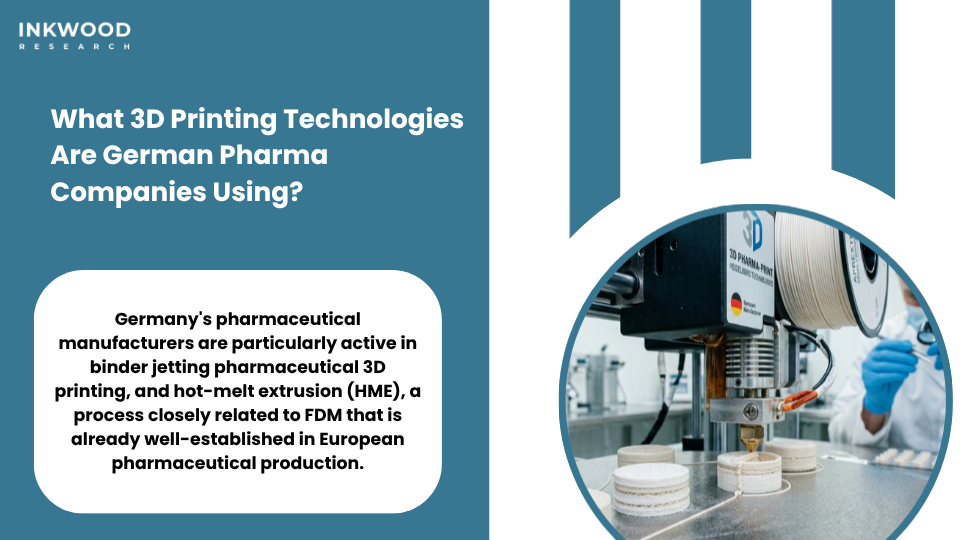
Germany’s pharmaceutical manufacturers are particularly active in binder jetting pharmaceutical 3D printing, and hot-melt extrusion (HME), a process closely related to FDM that is already well-established in European pharmaceutical production. HME enables continuous processing of APIs with polymeric carriers, producing solid dispersions that improve the bioavailability of poorly soluble drugs. When combined with 3D printing deposition systems, this creates a powerful platform for advanced drug formulation with programmable release architecture.
Additionally, selective laser sintering (SLS) is gaining traction among German pharmaceutical manufacturers for producing porous, fast-disintegrating tablets without binding agents or solvents, a cleaner manufacturing route that aligns well with sustainability goals embedded in Germany’s broader industrial policy. EOS GmbH, based in Munich, has introduced SLS systems specifically designed for pharmaceutical-grade applications with enhanced cleanroom integration features.
How Does Industry 4.0 Enable Digital Pharma Manufacturing at Scale?
Germany’s approach to pharmaceutical 3D printing is fundamentally data-driven. Industry 4.0 infrastructure means that 3D drug manufacturing equipment operates within connected, continuously monitored production networks, generating quality data in real time rather than through periodic batch testing. This approach aligns directly with the FDA’s Process Analytical Technology (PAT) framework and the EMA’s push for real-time release testing.
The result is a digital pharma manufacturing model where process control is not a periodic checkpoint but a continuous operational reality. Merck KGaA, through its healthcare and performance materials divisions, is investing precisely in this integration, developing pharmaceutical additive manufacturing systems that connect seamlessly into Industry 4.0 production environments at its Darmstadt headquarters. That kind of system-level integration is what separates Germany’s approach from markets simply adopting 3D printing as a standalone tool.
How Are German Companies Approaching Decentralized Drug Manufacturing?
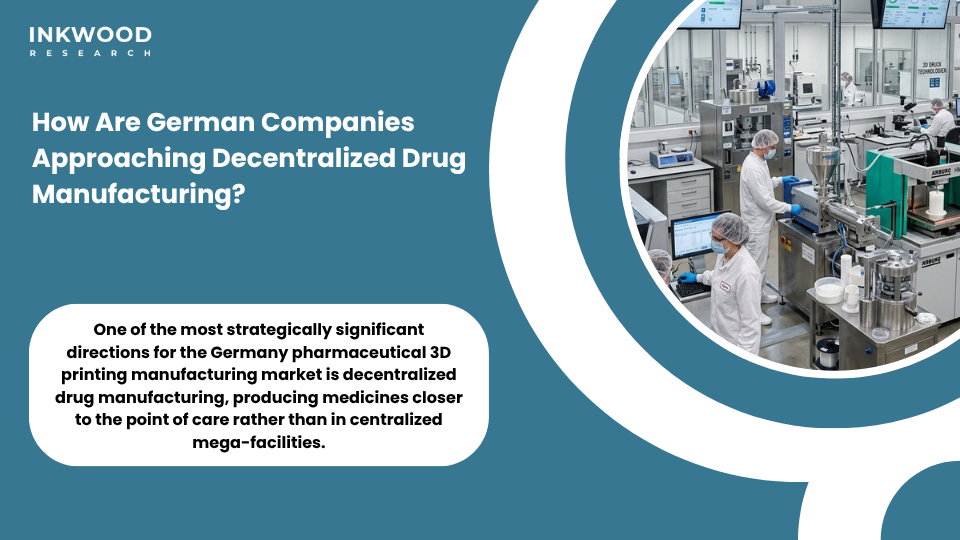
One of the most strategically significant directions for the Germany pharmaceutical 3D printing manufacturing market is decentralized drug manufacturing, producing medicines closer to the point of care rather than in centralized mega-facilities. Hospital pharmacies equipped with pharmaceutical-grade 3D printers could manufacture personalized doses for patients with rare diseases or complex therapy regimens, eliminating supply chain delays and reducing waste from overstocked fixed-dose inventory.
Small-batch drug manufacturing is particularly relevant for:
- Rare disease drugs: Patient populations too small to justify conventional production economics can be served economically and profitably through 3D printing’s zero-tooling-change flexibility.
- Pediatric formulations: Doses calibrated precisely to individual weight and metabolic profiles, a persistent clinical gap in conventional pharmaceutical manufacturing.
- Geriatric polypills: Multi-drug combination tablets reducing daily tablet burden for elderly patients on complex therapeutic regimens, improving adherence and quality of life.
Boehringer Ingelheim, one of Germany’s largest pharmaceutical manufacturers, has been exploring 3D printing integration within its manufacturing innovation programs, focusing specifically on clinical trial supply and personalized drug delivery systems for specialized patient populations. This positions the company at the leading edge of hospital-linked decentralized production models that are beginning to emerge across European healthcare systems.
Who Are the Key Players in Germany’s Pharmaceutical 3D Printing Space?
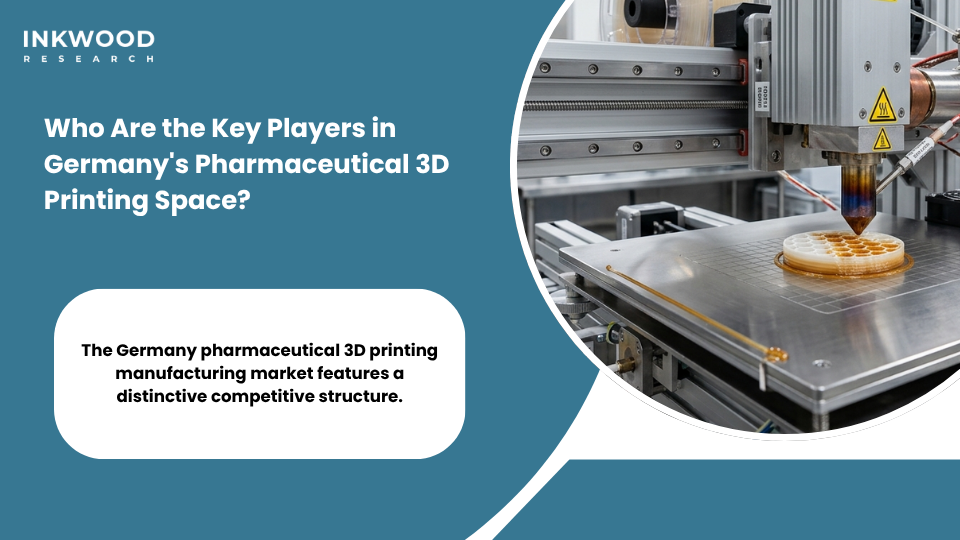
The Germany pharmaceutical 3D printing manufacturing market features a distinctive competitive structure. It is one where major pharmaceutical companies, chemical giants, specialty materials manufacturers, and industrial equipment providers all contribute to a vertically integrated ecosystem that few other markets can replicate.
- Merck KGaA is investing in 3D printing for drug development, with a focus on pharmaceutical excipients, advanced drug delivery architectures, and continuous manufacturing pipelines. Their Darmstadt headquarters serves as the primary hub for pharmaceutical additive manufacturing R&D within the company’s European operations.
- Bayer AG is exploring additive manufacturing for drug delivery innovation and small-molecule API production efficiency, with particular interest in applying 3D printing to complex drug formulation challenges in its pharmaceutical pipeline.
- Boehringer Ingelheim is advancing 3D printing within its clinical manufacturing and personalized medicine programs, focusing on building point-of-care production capabilities that can serve specialized patient populations without requiring centralized pharmaceutical manufacturing infrastructure.
- BASF SE leads industrial-scale 3D printing for chemical and catalyst production, with direct implications for pharmaceutical API supply chains. Its pharmaceutical-grade materials division additionally provides polymer filaments and binders optimized for pharmaceutical additive manufacturing applications.
- Evonik Industries develops pharmaceutical-grade polymer materials specifically engineered for additive manufacturing in drug delivery systems, including new grades optimized for SLS pharmaceutical 3D printing introduced in 2024. Their materials expertise positions them as a critical enabler across the German pharma 3D printing ecosystem.
On the equipment side, EOS GmbH (Munich) introduced pharmaceutical-compatible SLS systems in 2024, designed for clinical and small-batch drug manufacturing with enhanced containment and cleanroom integration. Siemens additionally provides industrial automation infrastructure for digital pharma manufacturing systems, connecting 3D printing equipment into broader Industry 4.0 production networks.
Key Takeaways
- The Germany pharmaceutical 3D printing manufacturing market is projected to grow from US$41.42 million in 2026 to US$123.03 million by 2034, at a 14.58% CAGR.
- Germany’s Industry 4.0 infrastructure, digital-physical integration, real-time process monitoring, and automated quality control, provide the ideal production environment for scaling pharmaceutical additive manufacturing commercially.
- BASF’s industrial-scale 3D printing for catalyst production demonstrates that additive manufacturing can meet the volume and quality demands of the chemical-pharmaceutical supply chain, clearing a critical proof-of-concept barrier.
- Binder jetting, hot-melt extrusion, and SLS are the dominant 3D printing drug manufacturing technologies deployed by German pharmaceutical manufacturers, each aligned to different formulation and production requirements.
- Decentralized drug manufacturing, for rare diseases, pediatric formulations, and polypills, represents Germany’s highest-impact near-term opportunity within the pharma 3D printing manufacturing market.
- Merck KGaA, Bayer, Boehringer Ingelheim, BASF, Evonik, and EOS GmbH are the primary corporate drivers of pharmaceutical additive manufacturing investment across Germany’s integrated pharma-industrial ecosystem.
Conclusion: India's Renewable Energy Leadership Journey
Germany’s pharmaceutical 3D printing manufacturing market is not simply following global trends; it is actively shaping them. The combination of Industry 4.0 infrastructure, pharmaceutical heritage, chemical engineering leadership, and a regulatory environment that supports manufacturing innovation creates uniquely enabling conditions for pharmaceutical additive manufacturing to scale at speed.
For pharmaceutical companies, investors, and supply chain strategists evaluating Europe’s advanced manufacturing landscape, Germany represents both the clearest benchmark and the most consequential opportunity in 3D printing drug manufacturing.
Inkwood Research delivers the market intelligence and strategic analysis needed to navigate the Germany pharmaceutical 3D printing manufacturing market with confidence.
Connect with our team to explore how our insights can support your strategy.
Frequently Asked Questions
What is the size of the Germany pharmaceutical 3D printing manufacturing market?
The market stands at US$41.42 million in 2026, projected to reach US$123.03 million by 2034 at a 14.58% CAGR, anchored by Germany’s industrial and pharmaceutical manufacturing strength.
How does Industry 4.0 support pharmaceutical 3D printing in Germany?
Industry 4.0 provides digital-physical integration, real-time process monitoring, and automated quality control, exactly the infrastructure pharmaceutical additive manufacturing needs to scale reliably at commercial volumes.
What is BASF's role in Germany's pharmaceutical 3D printing ecosystem?
BASF leads industrial-scale 3D printing for catalyst production and supplies pharmaceutical-grade polymer materials, demonstrating additive manufacturing reliability at volumes and quality standards applicable to the pharma supply chain.
What 3D printing technologies do German pharma companies use?
Binder jetting, hot-melt extrusion (HME), and selective laser sintering (SLS) are the most widely deployed pharmaceutical 3D printing technologies across Germany’s pharmaceutical manufacturers.
What is decentralized drug manufacturing and why does it matter for Germany?
Decentralized manufacturing produces personalized medicines at or near the point of care. In Germany, it addresses rare disease drug access, pediatric dosing flexibility, and geriatric polypharmacy, areas conventional centralized production cannot serve cost-effectively.
Which German companies are leading pharmaceutical 3D printing investment?
Merck KGaA, Bayer, Boehringer Ingelheim, BASF, Evonik Industries, and EOS GmbH are the primary corporate investors driving pharmaceutical additive manufacturing across Germany’s integrated pharma-industrial ecosystem.