Table of Contents

This analysis is brought to you by Inkwood Research, a leading market intelligence firm specializing in European industrial energy technologies and automation systems. Our research team combines extensive experience analyzing biomass energy markets, digital manufacturing solutions, and Germany’s Energiewende initiatives. Based on our proprietary research methodologies and strategic partnerships with equipment manufacturers, industrial facilities, and technology providers, we deliver actionable insights that empower organizations navigating advanced industrial heating strategies.
TLDR
German factories adopt smart biomass boilers integrating digital monitoring technologies. These advanced systems optimize combustion efficiency through real-time data analysis. Furthermore, automated controls reduce fuel consumption while maintaining output quality. Predictive maintenance capabilities minimize unexpected downtime significantly. IoT connectivity enables remote operational oversight and performance benchmarking. Consequently, industrial facilities achieve substantial cost reductions compared to conventional systems. Market growth reflects technological sophistication and environmental performance requirements.
Manufacturing executives optimizing energy costs, facility managers implementing Industry 4.0 strategies, sustainability officers pursuing emissions reductions, procurement specialists evaluating boiler technologies, automation system integrators, biomass equipment manufacturers developing smart solutions, and energy consultants advising industrial clients will gain valuable perspectives on Germany’s advanced industrial biomass heating technologies.
Digital Transformation Revolutionizing Germany Industrial Biomass Boiler Operations
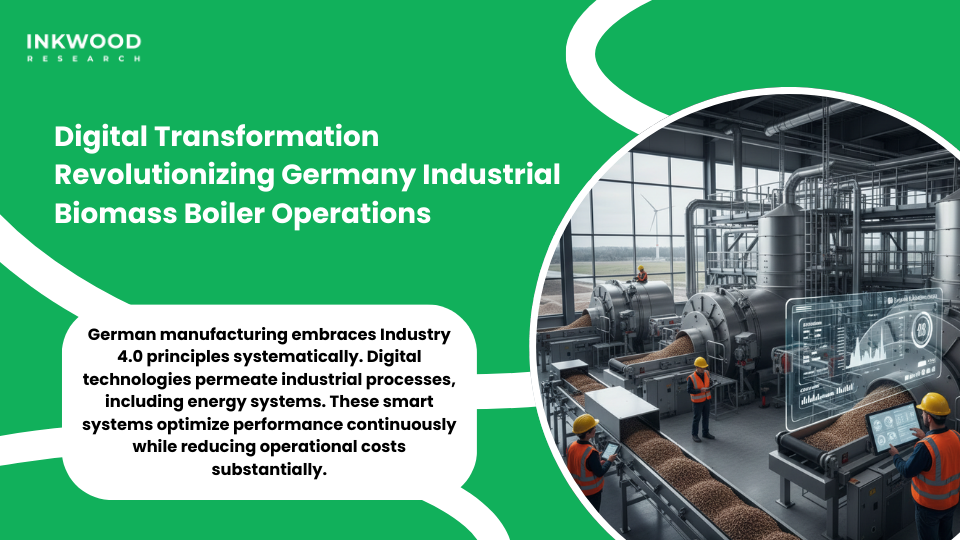
German manufacturing embraces Industry 4.0 principles systematically. Digital technologies permeate industrial processes, including energy systems. Consequently, modern biomass boilers incorporate sophisticated monitoring and control capabilities. These smart systems optimize performance continuously while reducing operational costs substantially.
The Germany industrial biomass boiler market demonstrates strong technological advancement. Projections indicate growth from US$1,237.56 million in 2026 to US$2,374.11 million by 2034. This represents an 8.48% compound annual growth rate, reflecting equipment sophistication and industrial demand. Moreover, automation integration distinguishes German installations from conventional biomass systems deployed elsewhere.
According to bioenergy research, biomass represents a significant percentage of fuel and heat consumption in German industry. Wood pellets and chips provide standardized fuels suitable for automated handling systems. Furthermore, quality specifications ensure consistent combustion characteristics essential for digital control optimization.
Real-Time Monitoring Capabilities in Modern Systems
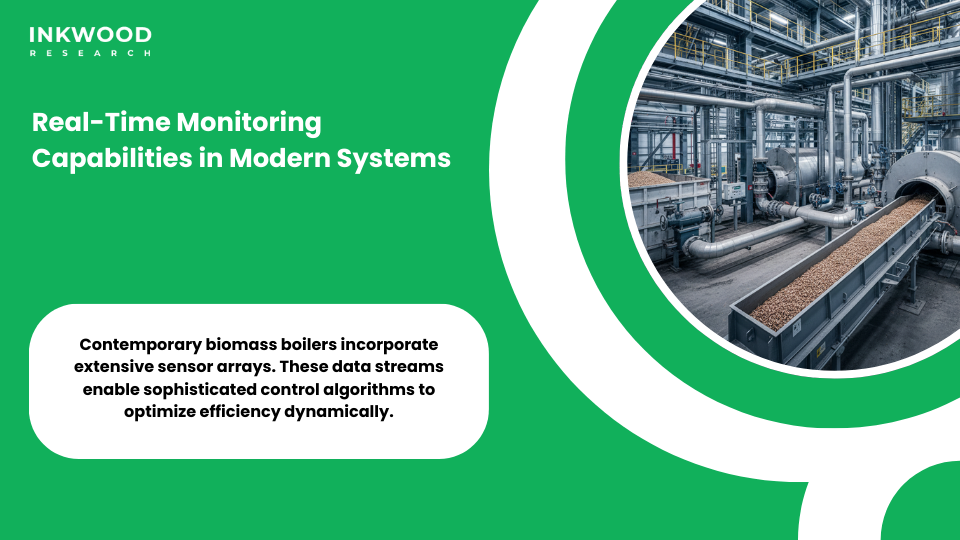
- Contemporary biomass boilers incorporate extensive sensor arrays. Temperature, pressure, oxygen concentration, and emissions parameters receive continuous measurement. Additionally, fuel feed rates and combustion air flows undergo precise monitoring. These data streams enable sophisticated control algorithms to optimize efficiency dynamically.
- Cloud connectivity facilitates remote system oversight. Operators access real-time performance dashboards from any location. Moreover, historical data analysis reveals optimization opportunities and performance trends. Consequently, facility managers make informed decisions based on comprehensive operational intelligence rather than periodic manual inspections.
- Predictive maintenance algorithms anticipate equipment issues proactively. Machine learning models analyze operational patterns, identifying degradation signatures. Furthermore, automated alerts notify maintenance teams before failures occur. This approach reduces unplanned downtime significantly while extending equipment service life through timely interventions.
Fuel Cost Reduction Through Advanced Combustion Control

Automated combustion optimization delivers measurable fuel savings. Traditional biomass boilers rely on operator experience for tuning adjustments. Conversely, smart systems continuously optimize air-fuel ratios based on real-time combustion analysis. Consequently, fuel consumption decreases while maintaining consistent thermal output.
Adaptive control responds to biomass quality variations automatically. Wood pellet moisture content and density fluctuate between batches. However, smart boilers detect these variations and adjust operating parameters accordingly. Therefore, combustion efficiency remains optimized despite feedstock inconsistencies that would degrade conventional system performance.
Load modulation capabilities match energy production to instantaneous demands. Manufacturing processes exhibit varying thermal requirements throughout production cycles. Moreover, weather conditions influence heating loads seasonally and daily. Smart biomass boilers scale output precisely, avoiding excess fuel consumption from oversized capacity operation.
Economic Benefits from Efficiency Improvements
Efficiency gains translate directly into cost reductions. Even modest 5-10% fuel savings generate substantial annual financial benefits for energy-intensive facilities. Furthermore, improved combustion reduces ash generation, decreasing disposal costs. Consequently, total operating expenses decline across multiple categories simultaneously.
Payback periods for digital upgrades prove attractive. Retrofitting existing biomass boilers with smart controls requires moderate capital investments. However, fuel savings typically recover costs within 2-3 years. Additionally, enhanced reliability reduces maintenance expenses, further improving return on investment.
Competitive advantages emerge from operational excellence. Manufacturers reducing energy costs per unit output improve profit margins directly. Moreover, environmental performance enhancements support corporate sustainability reporting and stakeholder communications. Therefore, smart biomass systems deliver both financial and reputational benefits.
Emissions Control and Environmental Compliance

Stringent environmental regulations drive technology advancement. German air quality standards impose strict particulate matter and nitrogen oxide limits. Consequently, biomass boiler manufacturers develop sophisticated emissions control systems integrated with digital monitoring platforms. These solutions ensure regulatory compliance while optimizing fuel efficiency.
Continuous emissions monitoring provides compliance documentation automatically. Smart systems record pollutant concentrations continuously throughout operations. Furthermore, automated reporting generates regulatory submissions, reducing administrative burdens. Consequently, facilities demonstrate environmental compliance efficiently while maintaining operational focus.
Emissions reduction through combustion optimization improves air quality. Precise control minimizes incomplete combustion, producing particulates and carbon monoxide. Additionally, staged combustion and flue gas recirculation technologies reduce nitrogen oxide formation. Therefore, modern Germany industrial biomass boiler systems achieve environmental performance exceeding conventional technologies significantly.
Integration with Enterprise Energy Management Systems

Smart biomass boilers connect seamlessly with facility-wide energy management platforms. Standardized communication protocols enable data exchange with building automation systems. Moreover, integration with manufacturing execution systems optimizes thermal energy production, matching production schedules precisely.
Holistic energy optimization considers entire facility operations. Combined heat and power configurations balance electricity generation with thermal production based on instantaneous needs. Furthermore, thermal storage integration enables load shifting, capitalizing on time-of-use electricity pricing. These sophisticated strategies maximize economic value from biomass resources.
Data analytics unlock continuous improvement opportunities. Performance benchmarking against similar facilities identifies optimization potential. Additionally, weather data integration enables predictive load management. Consequently, industrial energy managers achieve operational excellence through data-driven decision-making.
Interoperability Standards Facilitating Technology Adoption
Industry standards ensure equipment compatibility across manufacturers. Communication protocols like Modbus and OPC UA enable multi-vendor integration. Moreover, common data models facilitate analytics platform development. These standardization efforts reduce deployment complexity while enhancing system flexibility.
Cybersecurity considerations protect industrial control systems. Smart boilers implement network segmentation and authentication protocols. Furthermore, regular security updates address emerging vulnerabilities. Consequently, connectivity benefits materialize without compromising operational security or reliability.
Vendor ecosystems develop specialized applications. Third-party software providers create analytics tools and optimization algorithms. Additionally, cloud platform operators offer scalable infrastructure for data processing. This collaborative environment accelerates innovation, benefiting end users through expanding capabilities.
Wood Pellet Supply Chain Supporting Technology Deployment
Germany maintains a robust wood pellet production infrastructure. Approximately 60-63 pellet plants operate nationwide, though capacity has declined from historical peaks. Nevertheless, annual production exceeds 2 million tonnes, supporting substantial industrial consumption. Moreover, standardized fuel quality enables automated boiler systems to function optimally.
Supply chain reliability proves essential for automated operations. Just-in-time fuel delivery systems require dependable logistics. Furthermore, quality consistency ensures combustion control algorithms function properly. Therefore, reputable pellet suppliers become strategic partners for facilities deploying smart biomass boilers.
Price stability relative to fossil fuels influences adoption decisions. Wood pellet costs demonstrate lower volatility compared to natural gas or heating oil. Additionally, local sourcing reduces exposure to international commodity markets. Consequently, biomass energy provides budgeting certainty valuable for long-term planning.
Policy Framework Supporting Market Development

Germany’s Energiewende policies create favorable conditions for biomass adoption. The Renewable Energy Act provides feed-in tariffs for biomass electricity. Additionally, the Renewable Heat Act requires renewable heating systems in new construction. These frameworks encourage industrial biomass boiler investments systematically.
The Market Incentive Programme offers financial support for efficient biomass heating. Subsidies reduce capital barriers for technology adoption. Moreover, combined heat and power installations receive preferential treatment, recognizing efficiency benefits. Consequently, governmental support accelerates market development beyond purely economic motivations.
Future policy directions emphasize flexibility and grid integration. Biogas plants increasingly provide dispatchable renewable electricity, complementing variable solar and wind generation. Similarly, biomass boilers with thermal storage contribute to the energy system balance. Therefore, policy evolution positions biomass as a strategic technology within comprehensive renewable energy strategies.
Industry Collaboration Advancing Technology Development
Research institutions support biomass technology innovation. The German Biomass Research Centre coordinates applied research across energy conversion pathways. Additionally, universities develop advanced control algorithms and combustion modeling capabilities. This collaborative research environment accelerates commercial technology deployment.
Demonstration projects validate technologies under industrial conditions. Public-private partnerships test emerging innovations at scale. Furthermore, performance data sharing benefits the entire industry through collective learning. Consequently, successful concepts achieve widespread adoption more rapidly than isolated development efforts would enable.
International knowledge exchange enhances capabilities. Germany participates actively in IEA Bioenergy collaborative programs. Moreover, technology exports spread German innovations globally. This international engagement strengthens the domestic industry while contributing to worldwide renewable energy advancement.
Key Takeaways
- Digital monitoring transforms biomass boiler economics fundamentally. Smart systems optimize combustion efficiency continuously, reducing fuel consumption substantially.
- Furthermore, predictive maintenance capabilities minimize unexpected downtime. Consequently, total operating costs decline significantly compared to conventional technologies.
- Market growth reflects technological sophistication and environmental imperatives. The Germany industrial biomass boiler sector demonstrates steady expansion through 2034. This development builds on robust pellet supply infrastructure and supportive policy frameworks. Additionally, Industry 4.0 integration enables unprecedented operational excellence.
- Successful deployment requires comprehensive system thinking. Technology selection must consider fuel availability, operational requirements, and integration capabilities. Moreover, vendor selection emphasizes service support and continuous improvement partnerships. Therefore, strategic planning determines long-term value realization.
- Environmental performance improvements align economic and sustainability objectives. Emissions reductions meet regulatory requirements while supporting corporate responsibility goals.
- Meanwhile, renewable energy utilization contributes to national climate commitments. Consequently, smart biomass boilers deliver triple bottom line benefits.
Conclusion:
German industry demonstrates how digital technologies enhance biomass energy systems. Smart monitoring and control capabilities transform conventional boilers into sophisticated energy management platforms. Moreover, these innovations deliver measurable cost reductions while improving environmental performance.
Technology maturation continues through collaborative research and industrial experience. Equipment manufacturers incorporate increasingly sophisticated capabilities in standard offerings. Meanwhile, operational data accumulation enables continuous algorithm improvement. Consequently, performance advantages compound over time as systems learn and adapt.
Manufacturing executives pursuing operational excellence should evaluate smart biomass solutions carefully. Based on our analysis, digital monitoring capabilities fundamentally change biomass boiler economics and operational characteristics. The Germany industrial biomass boiler market exemplifies how technology integration creates competitive advantages.
For comprehensive insights into smart biomass technologies or industrial energy management strategies, Inkwood Research provides detailed market intelligence and consulting services. Contact our team to explore how digital biomass solutions align with your facility optimization objectives.
Frequently Asked Questions
How do smart biomass boilers reduce fuel costs compared to conventional systems?
Digital monitoring enables continuous combustion optimization based on real-time data analysis. Automated controls adjust air-fuel ratios precisely, minimizing waste. Additionally, adaptive algorithms compensate for biomass quality variations, maintaining peak efficiency. Consequently, fuel consumption decreases 5-10% typically while maintaining consistent output.
What digital technologies are integrated into modern Germany industrial biomass boilers?
Systems incorporate extensive sensor networks monitoring temperature, pressure, oxygen, and emissions continuously. Cloud connectivity enables remote oversight and data analytics. Furthermore, predictive maintenance algorithms anticipate equipment issues proactively. IoT protocols facilitate integration with enterprise energy management platforms.
What payback periods can facilities expect from smart biomass boiler investments?
Digital control retrofits typically achieve payback within 2-3 years through fuel savings. New smart boiler installations demonstrate longer payback periods depending on facility-specific factors. However, comprehensive benefits, including maintenance cost reductions and reliability improvements enhance overall value propositions significantly beyond simple fuel economics.